-
-
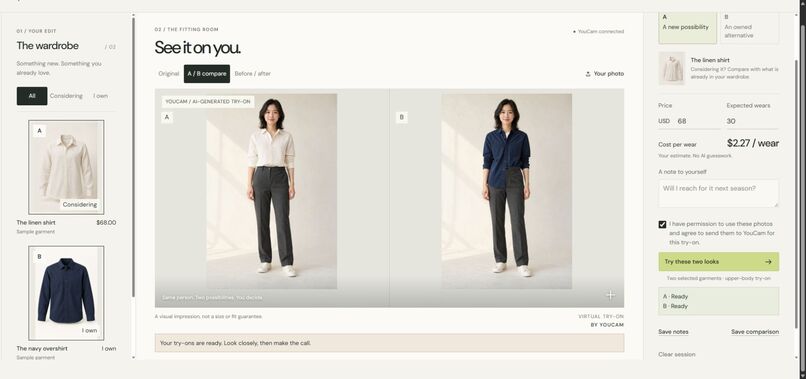
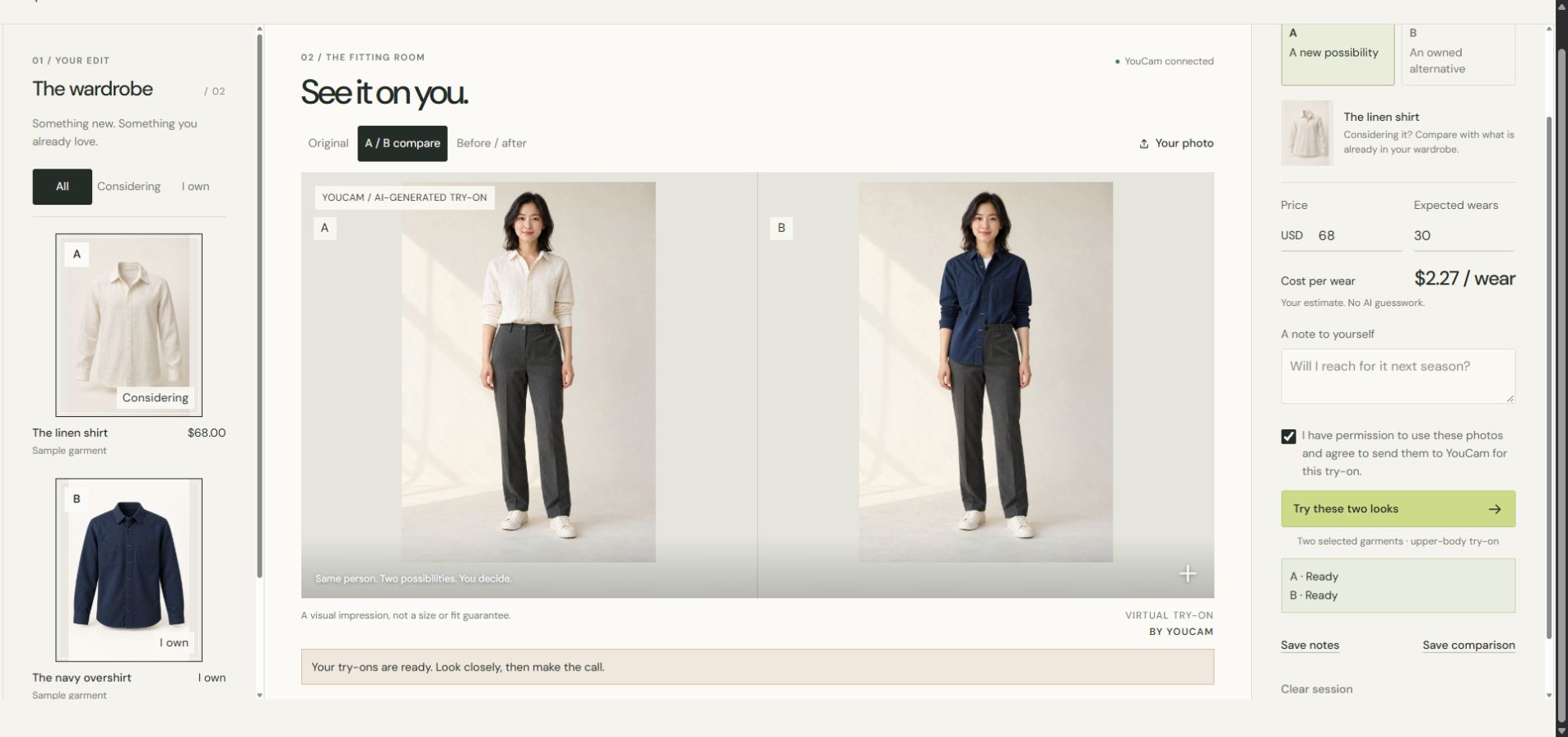
Fictional wardrobe scenario: genuine YouCam results for linen A and navy B, using the same synthetic sample person.
-
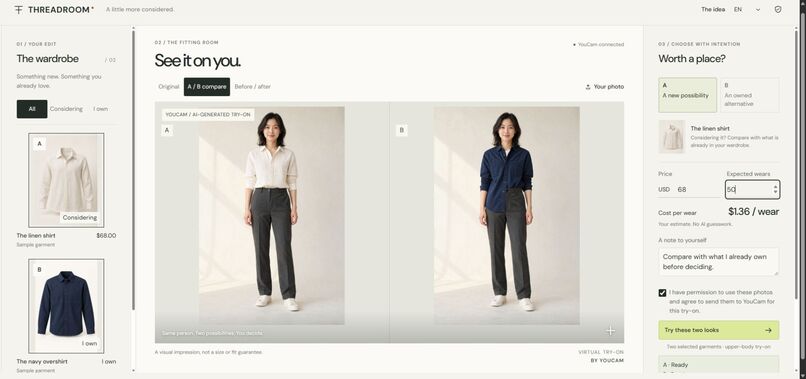
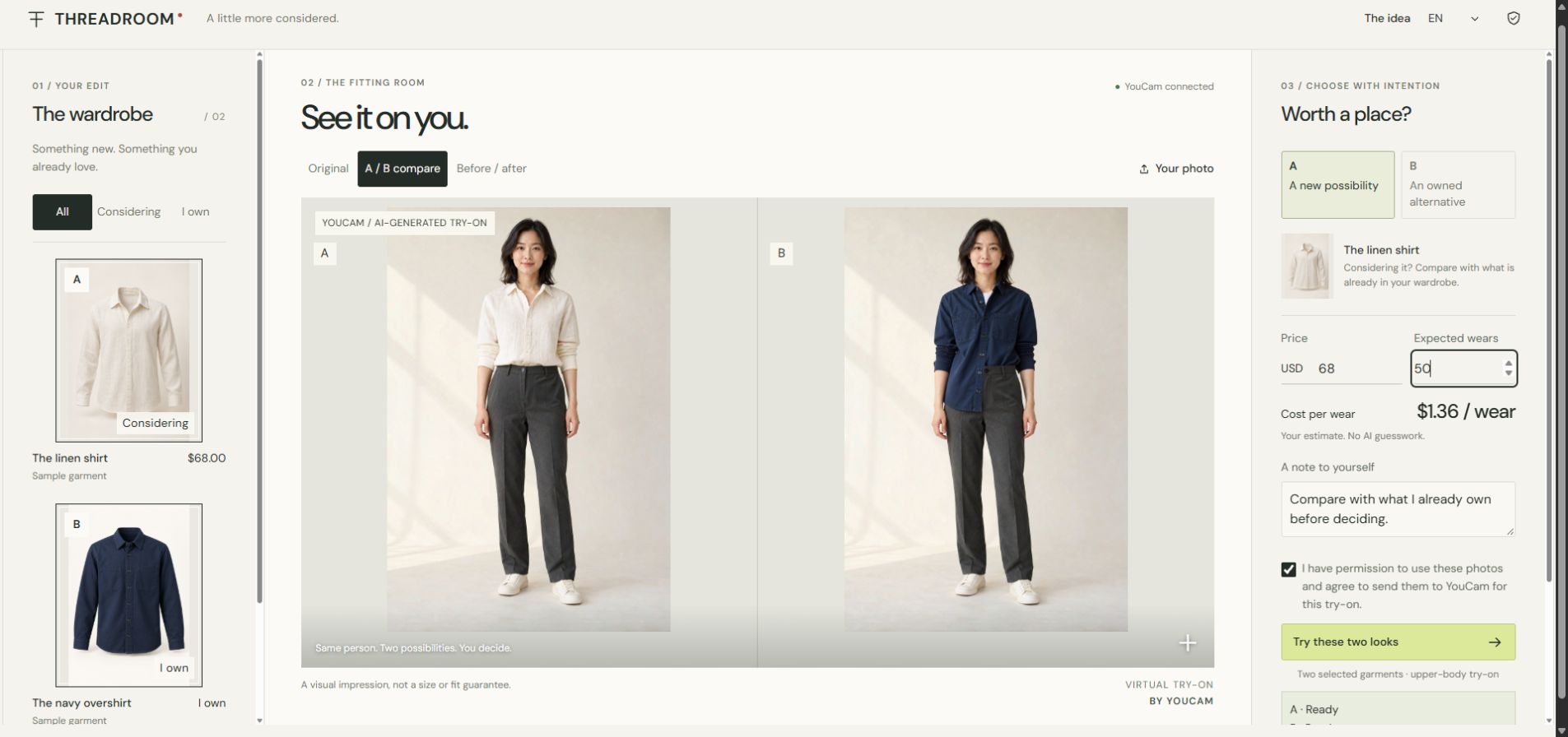
A later decision note: $68 / 50 estimated wears = $1.36 per wear. User assumptions, not measured savings.
-
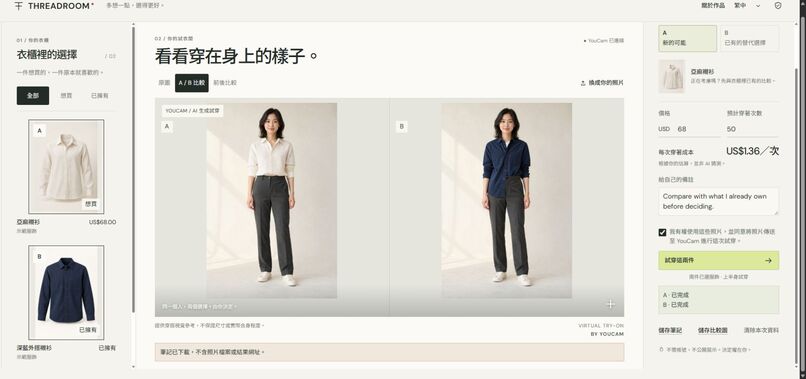
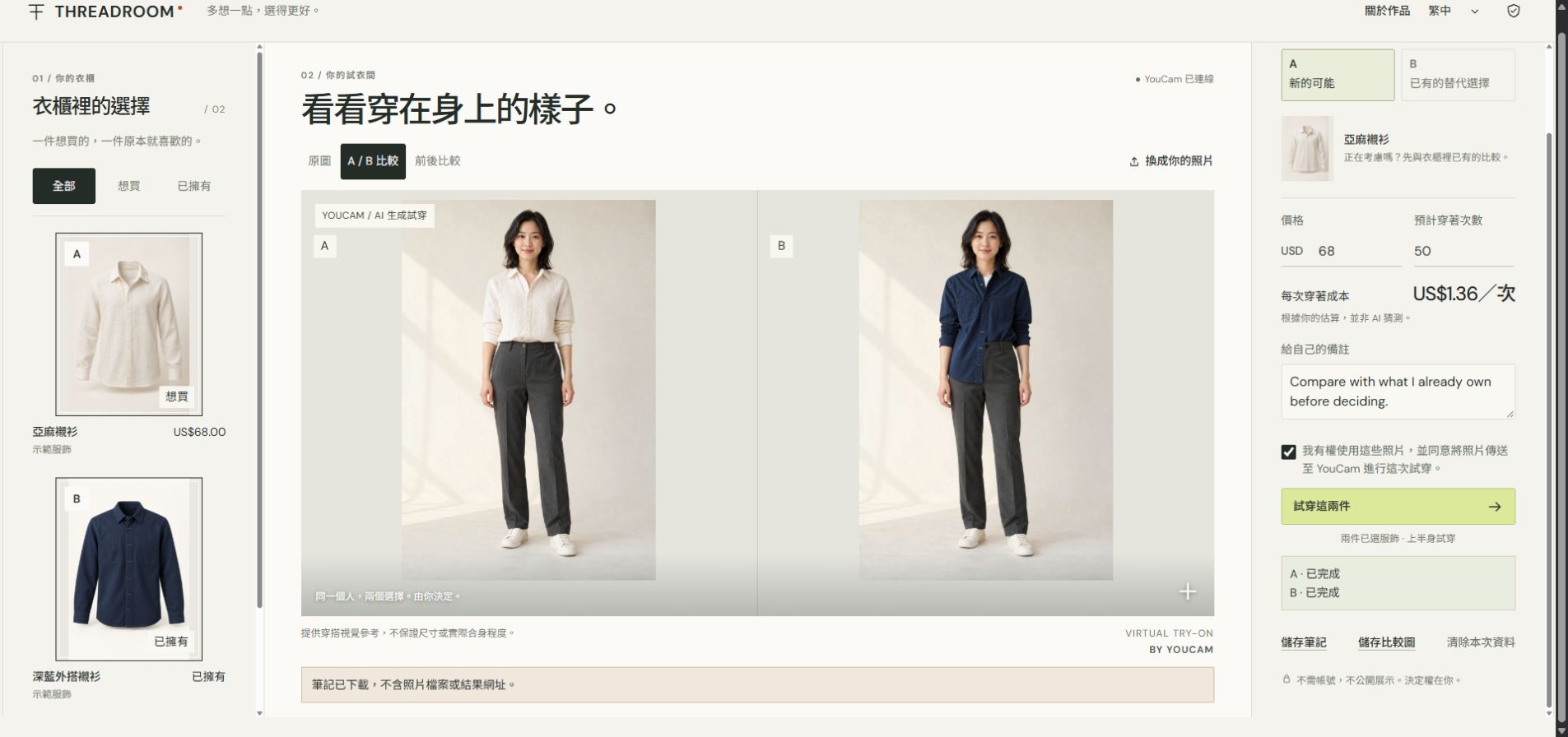
The same completed YouCam A/B results in the Traditional Chinese interface.
-
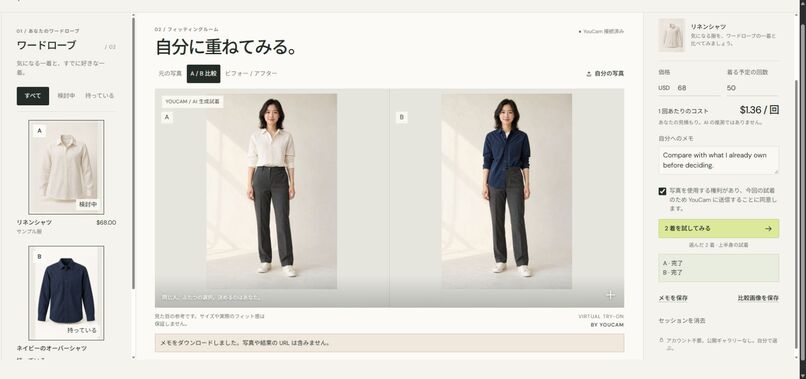
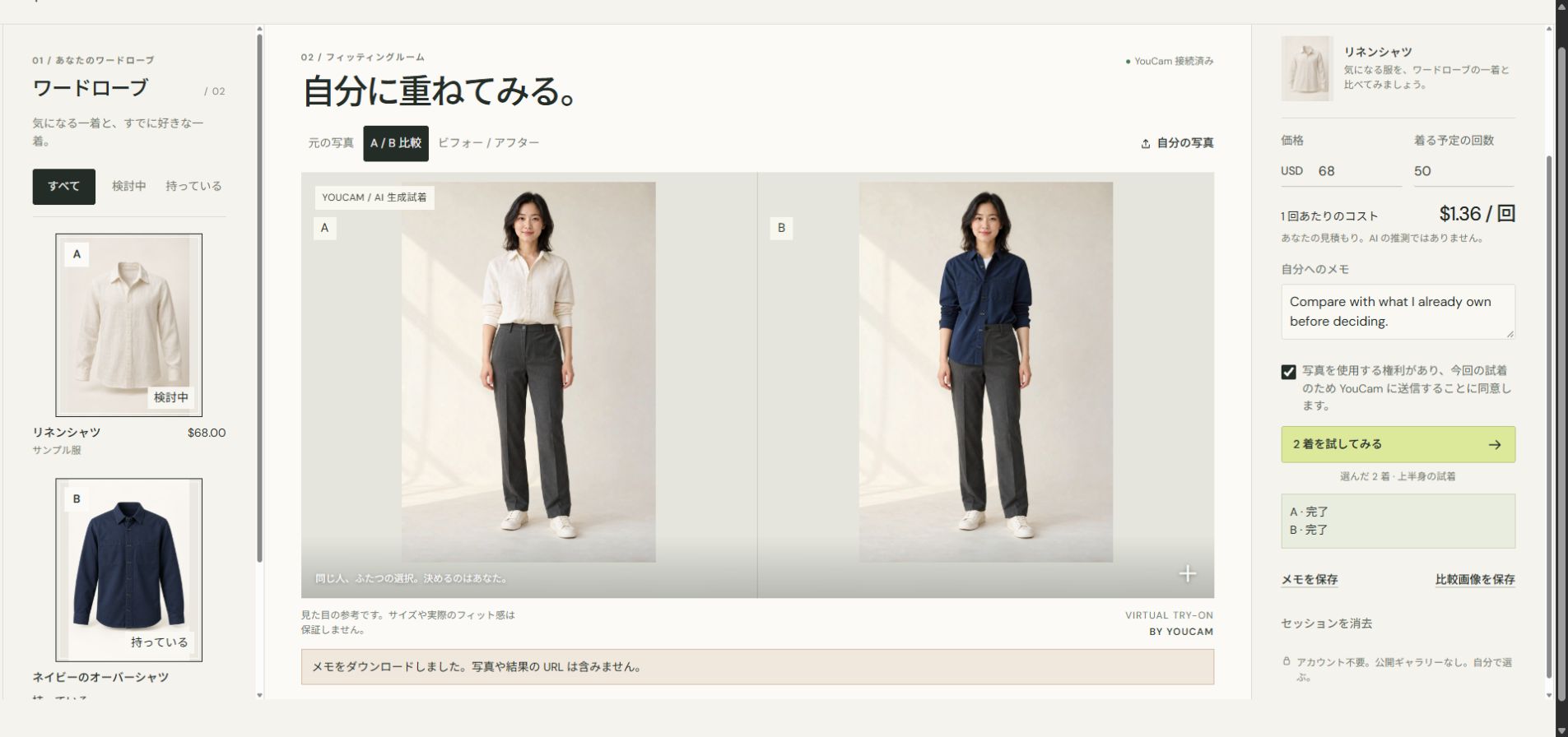
The same completed YouCam A/B results in the Japanese interface.
-
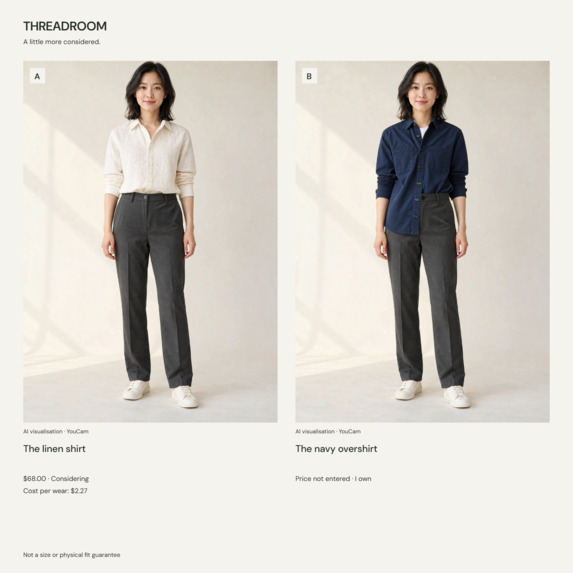
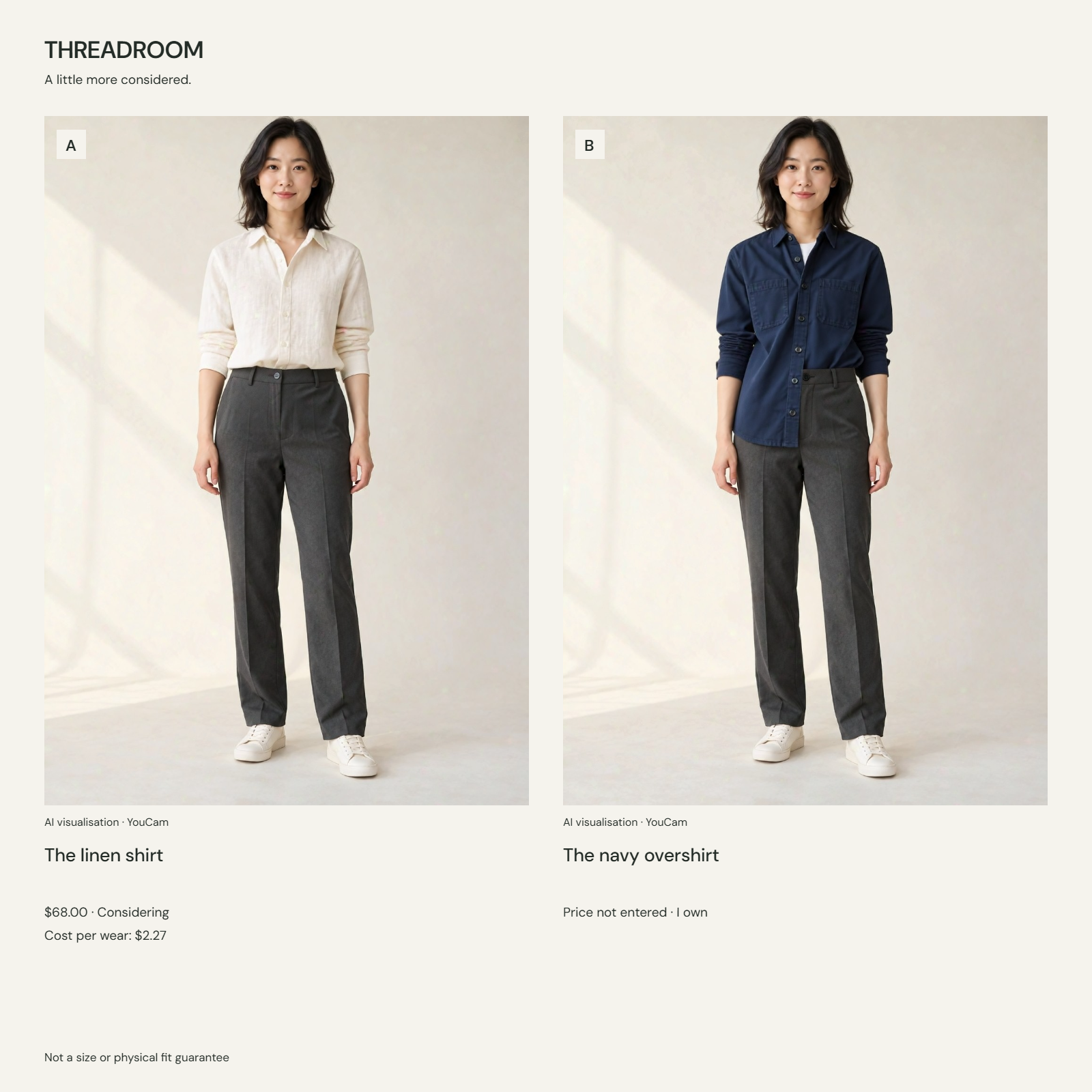
Actual downloaded card: $68 / 30 estimated wears is about $2.27 per wear. User estimates, not measured savings.
Inspiration
A possible purchase competes with something already in a wardrobe. Most shopping tools give the new item all the attention. THREADROOM gives the alternative an equal place: the same person, two garments, and a moment to consider how often either one will actually be worn.
This is a small decision workspace for an individual shopper. It does not sell clothing or post a user's photos to a public gallery. The sample adult and garments are original synthetic demonstration assets; the ownership labels and price describe a fictional shopping scenario.
What it does
The root page is the fitting room. Choose two garments, provide an authorized person image, and explicitly consent to processing. YouCam generates two upper-body try-on previews. Compare them side by side or switch to before/after while keeping the original input clearly labelled.
Then add a price, estimated wears and a note to yourself. In the demonstrated example, 68 divided by 50 gives 1.36 per wear. Those are user assumptions and ordinary arithmetic, not an AI prediction or measured savings. Save an optional comparison image or an image-free notes file. English, Traditional Chinese and Japanese are available in the same workspace.
Generated previews are visual impressions. They do not establish physical fit, sizing, comfort or fabric accuracy.
How we built it
A buildless HTML, CSS and JavaScript client talks to a small PHP service. The server integrates YouCam AI Clothes Try-On, using the cloth-v3 upper-body workflow. It validates and re-encodes images, uploads sanitized inputs, creates asynchronous tasks, checks their actual status and downloads validated outputs into private storage. Results are served only to the owning session; API credentials stay on the server.
The integration checks feature cost and available units before reserving a bounded budget in a locked ledger. An uncertain chargeable request is never automatically repeated. Same-origin mutation checks, CSRF protection, private no-store responses and image metadata removal are part of the implementation.
The hosted demo runs on existing infrastructure with free activity units. No judge account, personal provider key or payment is required. It limits each session to two tasks and has a finite shared demonstration budget. Start with the supplied synthetic samples.
Codex assisted implementation, and OpenAI image generation supplied the three original sample inputs. Sample inputs are distinct from the later genuine YouCam outputs. Public source code and documentation use MIT; fonts, sample assets and provider outputs retain their separately documented conditions.
What we verified
Five genuine YouCam tasks completed: three in controlled local validation and two through the public site's actual Chrome interface. The public A/B results both reached Ready and loaded at 1024 by 1536. Local desktop checks also exercised before/after, all three interface languages, the decision arithmetic, a real comparison PNG download and a notes JSON containing no images or URLs.
The application has 21 offline fake-provider regression cases. Those tests are separate from real provider outcomes. The deployed application matched 23 source files during activation. The public demo and repository are linked below.
The 2-minute-20-second English video is edited from actual application screenshots and a real comparison download, with genuine YouCam results and English captions. It is not a continuous screen recording. Its person images and narration are synthetic.
Challenges and learning
The difficult parts were preserving image provenance, handling asynchronous results without inventing progress, and protecting a finite API budget when a request outcome is uncertain. Strict TLS verification stayed enabled while configuring the local PHP trust bundle.
Privacy also needs precise language: session isolation does not prove deletion. Browser Clear completion and comprehensive mobile/accessibility coverage are not claimed by this submission. The privacy documentation explains private result storage, persistent budget metadata, provider retention and cleanup limits. Use the cleared samples for evaluation.
What's next
Test whether this comparison helps people make decisions they still endorse later, improve accessible/mobile operation, and verify stronger retention and cleanup procedures before broader personal-photo use. Wardrobe history and retailer integrations are future work. We do not claim measured effects on returns, spending or the environment.
Built With
- html5
- javascript
- php
- youcam-api

Log in or sign up for Devpost to join the conversation.