-
-
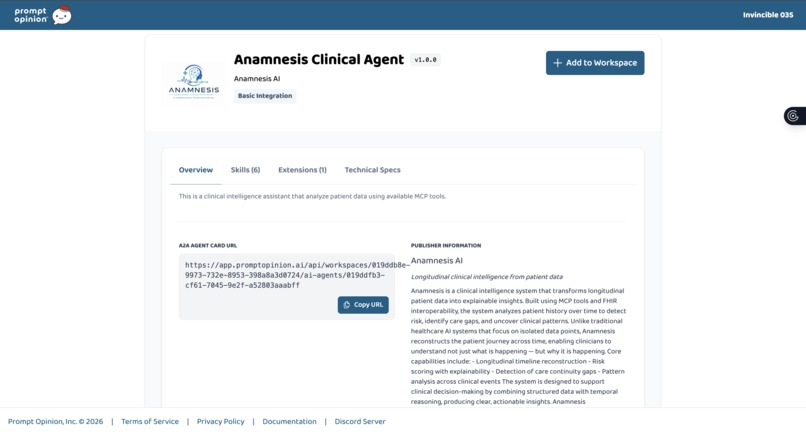
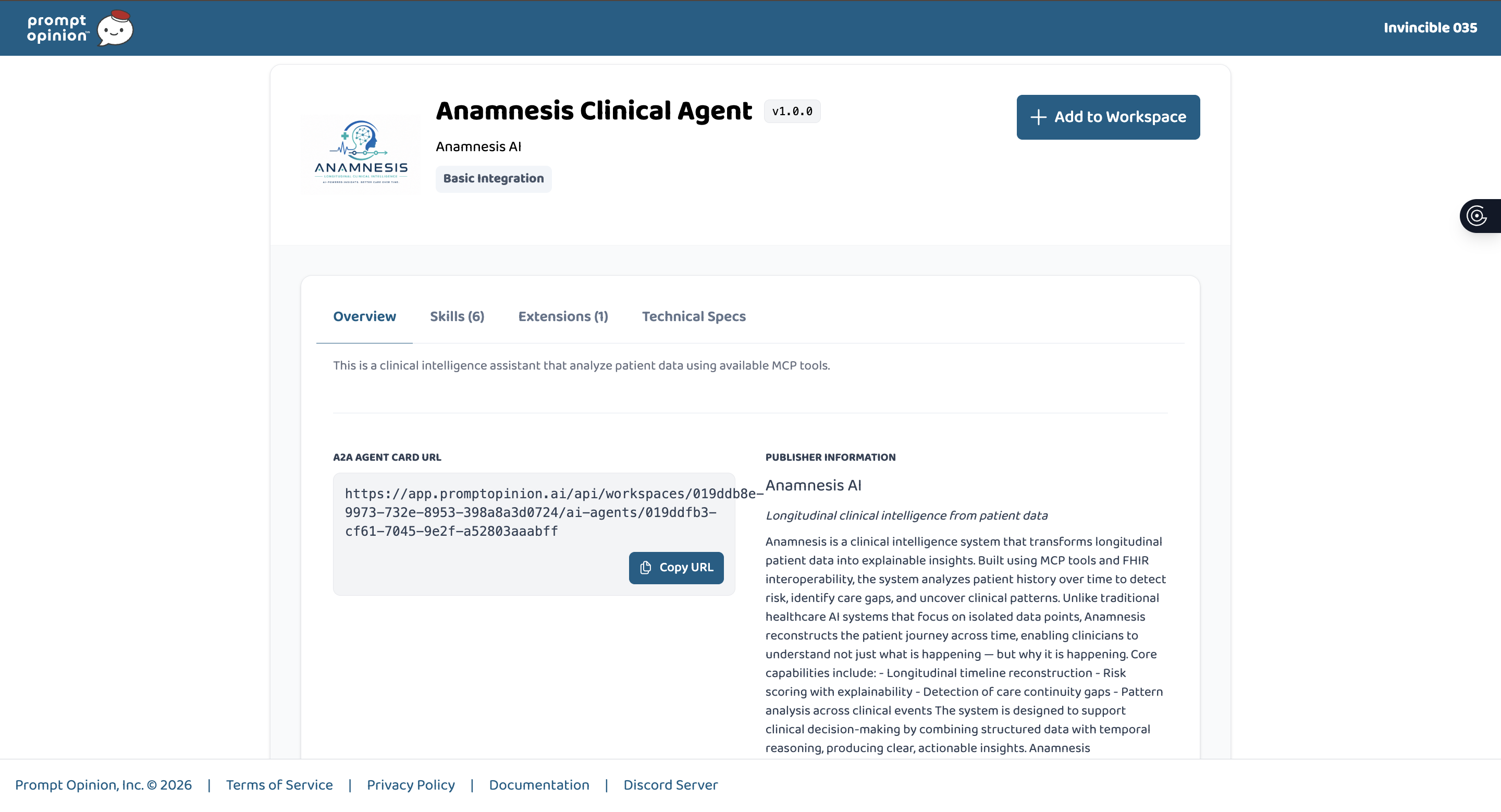
Marketplace Listing of Clinical Agent
-
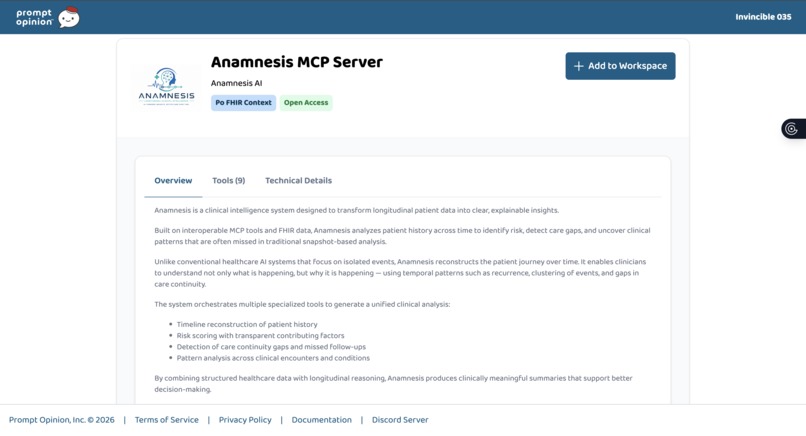
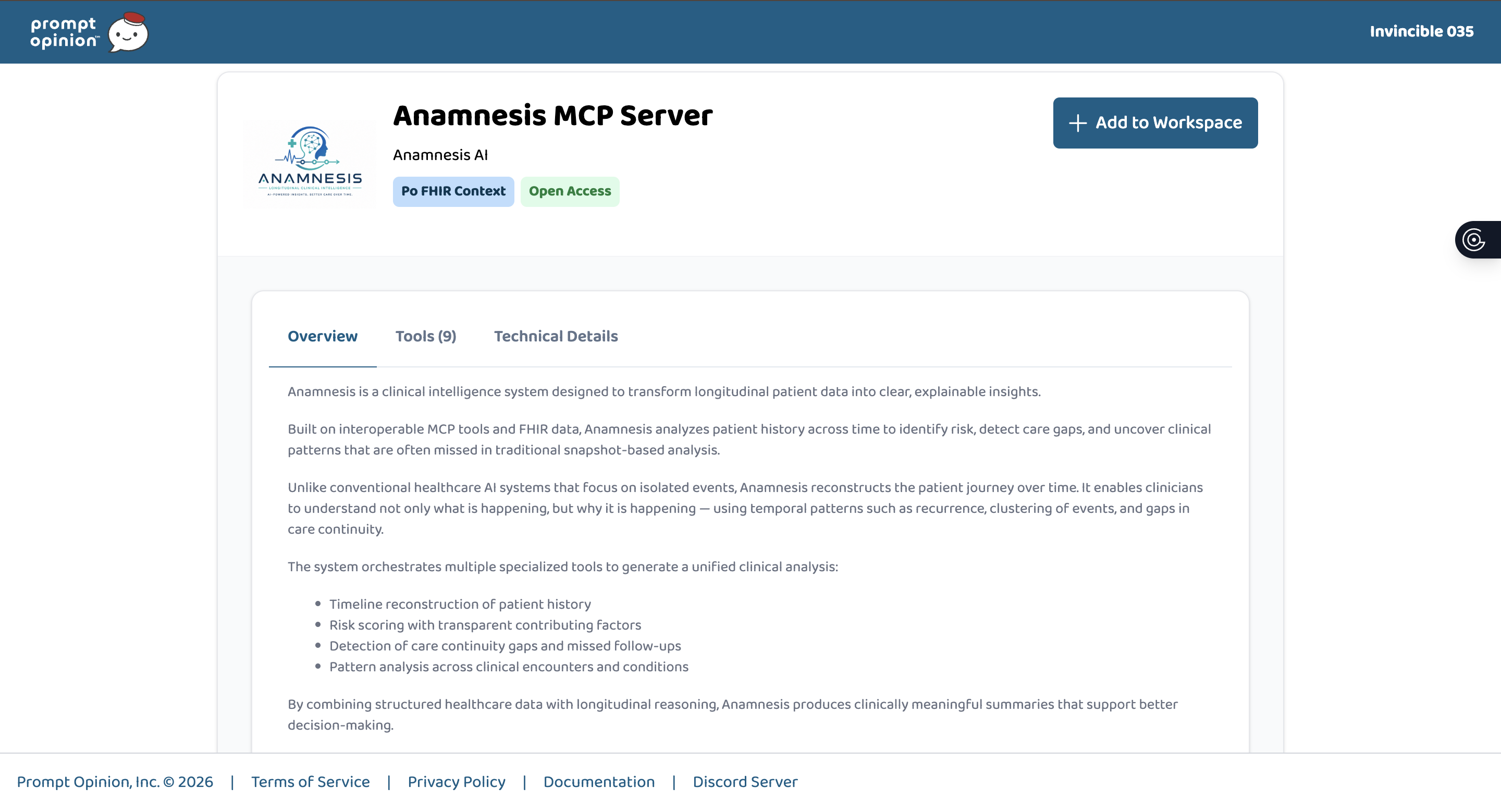
Marketplace Listing of MCP Server
-
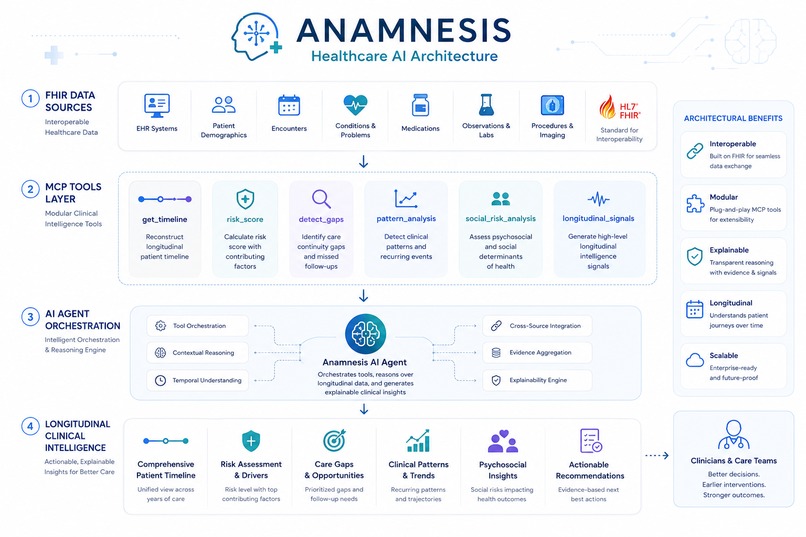
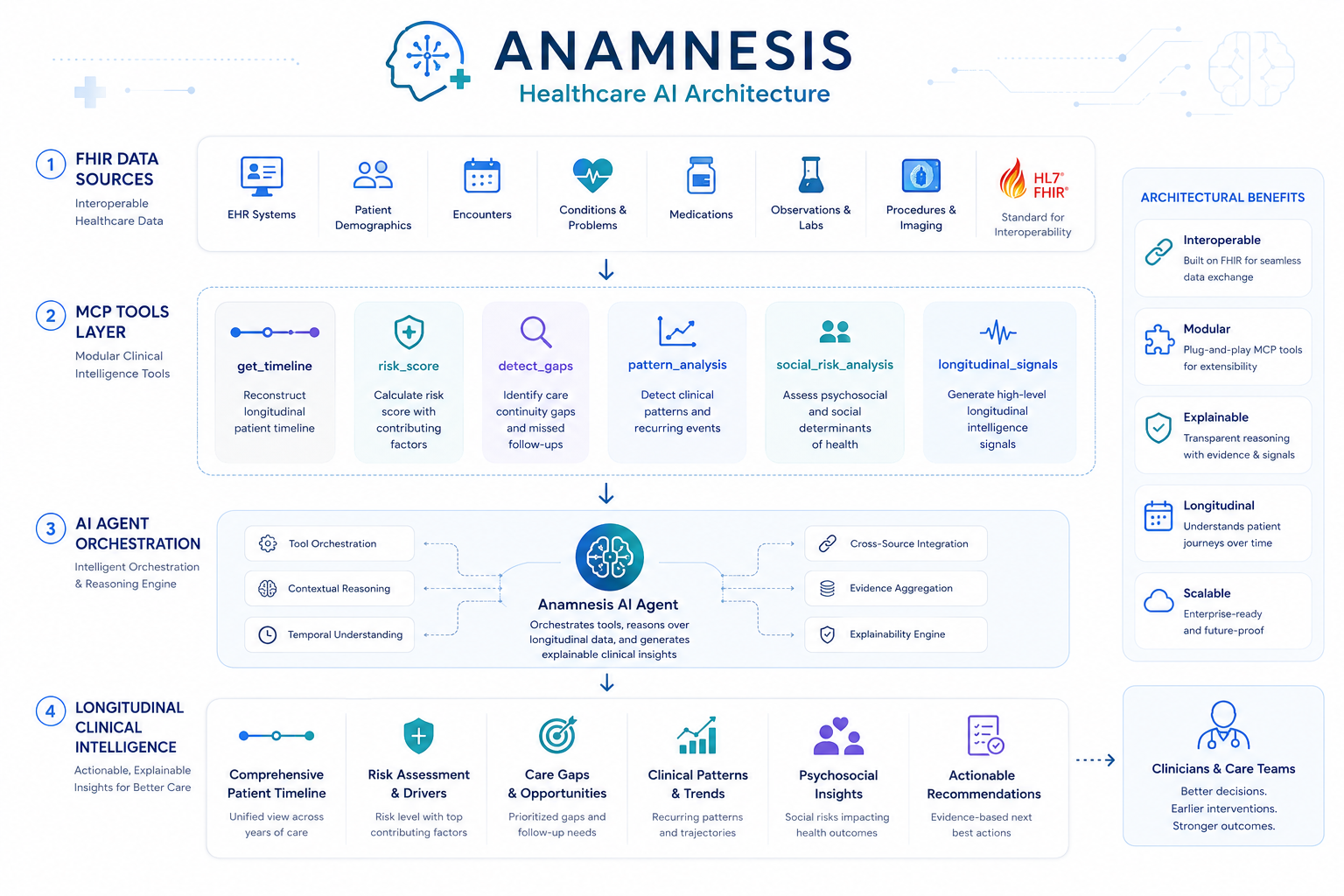
Anamnesis Architectural Design
-
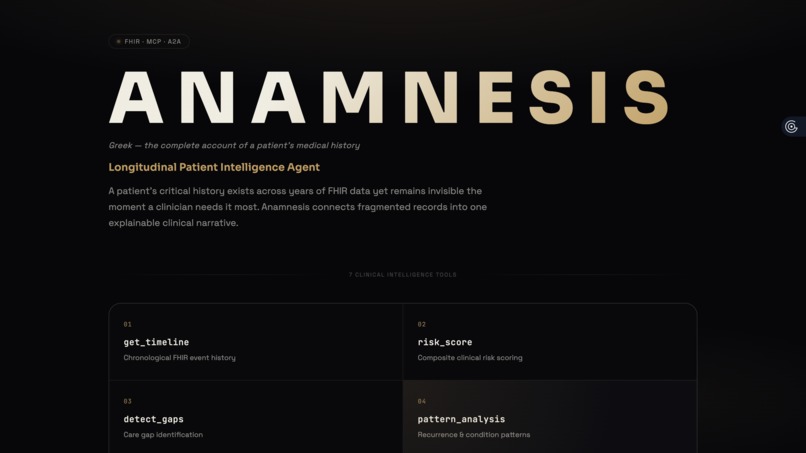
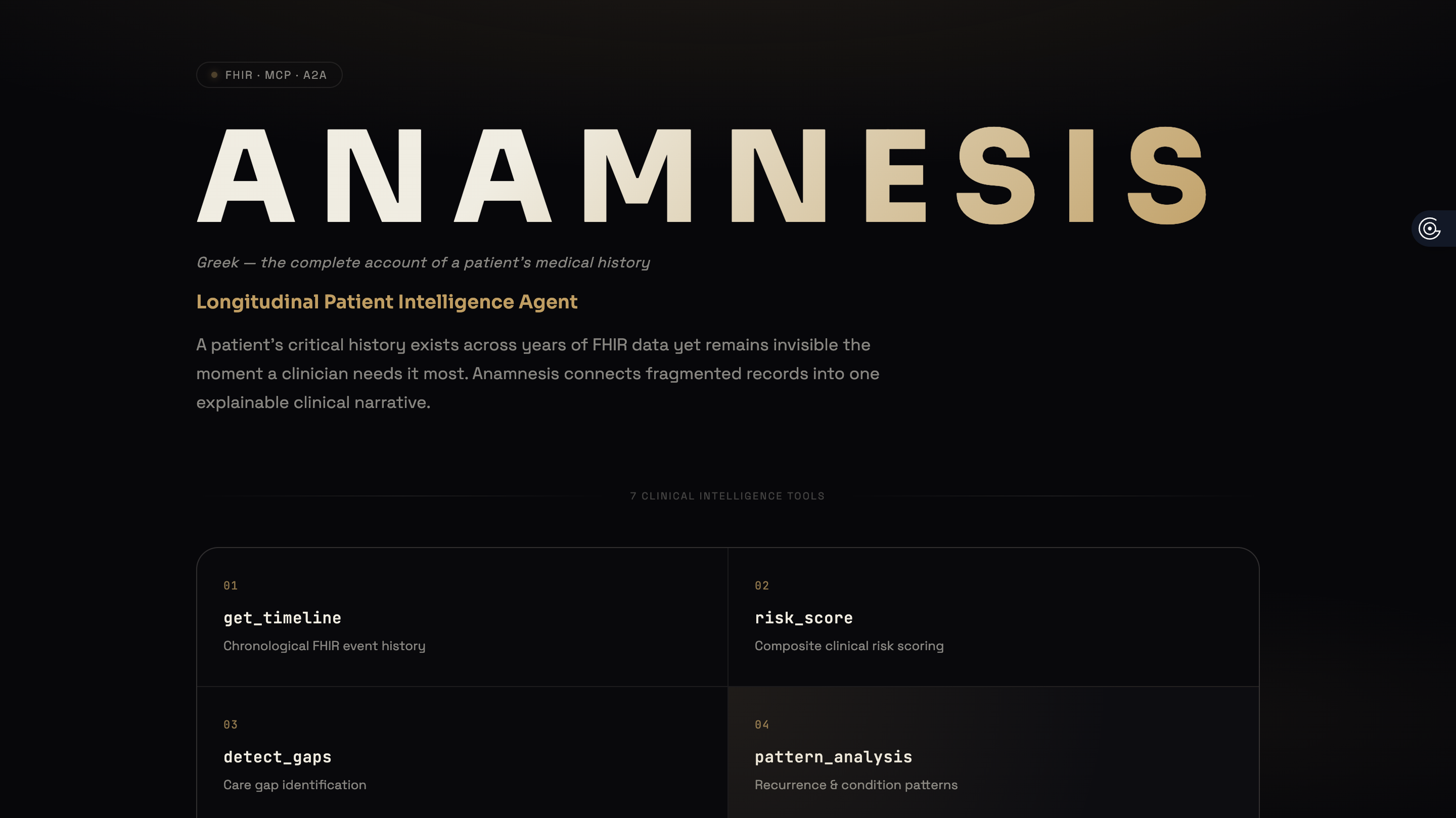
Anamnesis live website
Inspiration
Modern healthcare systems are exceptionally good at storing data - but far less effective at understanding it over time.
Most clinical AI solutions evaluate healthcare events in isolation: a diagnosis, a lab result, a single encounter. In reality, patient health unfolds longitudinally through recurring conditions, fragmented care, behavioral factors, and evolving risk patterns across years.
We built Anamnesis to shift healthcare analysis from static snapshots to continuous clinical intelligence.
Our goal was to create a system capable of reconstructing the patient journey over time and transforming fragmented healthcare records into explainable longitudinal insight.
What it does
Anamnesis is a longitudinal clinical intelligence platform powered by interoperable MCP tools and FHIR healthcare data.
The system analyzes patient history across years of clinical activity to identify:
- Longitudinal risk trajectories
- Care continuity gaps
- Recurring utilization patterns
- Psychosocial and behavioral risk signals
- Explainable clinical intelligence insights
Rather than simply summarizing medical records, Anamnesis detects temporal patterns across the patient journey and synthesizes them into structured, clinician-friendly intelligence briefs.
The platform focuses not only on what is happening clinically - but how patterns evolve over time and why they matter.
How we built it
We designed Anamnesis as an orchestrated healthcare AI architecture built on MCP (Model Context Protocol) and FHIR interoperability standards.
System Architecture
FHIR Data Sources → MCP Tool Layer → AI Agent Orchestration → Longitudinal Clinical Intelligence
The platform consists of multiple specialized MCP tools:
get_timeline- reconstructs longitudinal patient timelinesrisk_score- generates explainable risk stratificationdetect_gaps- identifies fragmented continuity and missed follow-upspattern_analysis- detects recurrence, clustering, and utilization trendssocial_risk_analysis- analyzes psychosocial and behavioral determinantslongitudinal_signals- synthesizes high-level temporal intelligence signalstimeline_visualization- build a visualization-ready timeline with clinical phases and chart data.
The AI orchestration layer invokes these tools sequentially, aggregates the outputs, and synthesizes them into a unified Clinical Intelligence Brief.
FHIR interoperability enables the system to work with real-world healthcare data structures and clinical workflows.
Challenges we ran into
One of the biggest challenges was designing a system that felt clinically intelligent rather than simply AI-generated.
We had to solve several problems simultaneously:
- Coordinating multiple MCP tools reliably across a longitudinal workflow
- Maintaining consistent patient context across all tool invocations
- Transforming fragmented FHIR records into coherent temporal narratives
- Handling incomplete or sparse patient histories while preserving explainability
- Designing output structures that resembled clinician-facing intelligence rather than generic AI summaries
Another major challenge was balancing technical orchestration with clinical readability. We wanted the final output to feel interpretable, explainable, and operationally useful in healthcare settings.
Accomplishments that we’re proud of
- Built a working multi-tool MCP healthcare intelligence system
- Successfully implemented longitudinal reasoning over multi-year patient histories
- Developed explainable risk stratification using clinical and psychosocial signals
- Integrated interoperable FHIR healthcare data into MCP orchestration workflows
- Designed a clinician-oriented “Clinical Intelligence Brief” rather than generic AI summaries
- Created a modular architecture that can scale with additional healthcare intelligence tools
Most importantly, we transformed fragmented healthcare data into explainable temporal insight.
What we learned
This project fundamentally changed how we think about healthcare AI.
We learned that:
- Longitudinal patterns are often more clinically meaningful than isolated events
- Explainability is essential for trust in healthcare intelligence systems
- Tool orchestration is critical for building reliable AI workflows
- Temporal reasoning dramatically improves clinical context generation
- Presentation and interpretability matter just as much as technical capability
We also learned that healthcare AI becomes significantly more valuable when it helps clinicians understand trajectories, recurrence, and continuity over time.
What’s next for Anamnesis AI
We see Anamnesis evolving into a continuous longitudinal intelligence layer for healthcare systems.
Future directions include:
- Real-time clinical event ingestion
- Predictive risk trajectory modeling
- Expanded FHIR resource coverage
- Interactive clinician-facing timeline visualization
- Multi-agent collaboration for coordinated care planning
- Longitudinal population health analytics
- Early intervention and preventative care intelligence
Our long-term vision is to build infrastructure that helps healthcare systems move from reactive care toward proactive, explainable, and time-aware clinical decision support.


Log in or sign up for Devpost to join the conversation.