-
-

Fragmented records hide possible connections
-
THREADLINE title image
-
Workplace Evidence Reasoning
-
Trials Mutation Diff or Results

This is a strong draft and it already covers the required themes. I corrected the LaTeX delimiters and lightly tightened the wording so it can be pasted directly into a Markdown-enabled submission form.
THREADLINE: Proof Before Release
Connect the records. Never guess the person.
Inspiration
THREADLINE started with a difficult question: what happens when information about the same missing person exists across multiple fragmented, inconsistent records?
After a disaster or displacement event, information may be scattered across family reports, shelters, hospitals, NGOs, and field notes. Names can be transliterated differently, dates may be incomplete, phone numbers can belong to relatives, and OCR or hurried data entry can introduce mistakes.
The obvious approach is to use AI to find similar records. But similarity is not identity.
A confident false match can be more dangerous than admitting uncertainty. That became the core idea behind THREADLINE: an experimental AI-assisted system that reconstructs possible connections between fragmented synthetic missing-person records while refusing to present unsupported similarity as proof.
The principle behind the entire project became:
An unsupported connection must never be presented as proof of identity.
How I Built It
I designed THREADLINE around one architectural decision: separate probabilistic AI reasoning from deterministic safety rules.
Instead of asking an LLM to make one final identity decision, THREADLINE uses a 12-stage evidence workflow:
- Ingest synthetic incident records.
- Quarantine instructions embedded inside untrusted source text.
- Extract typed fields with exact supporting evidence spans.
- Normalize values while preserving the originals.
- Run deterministic timeline checks.
- Retrieve a bounded set of candidate pairs.
- Construct possible connection hypotheses.
- Actively search for contradictory evidence.
- Preserve and compare rival candidates.
- Adjudicate the structured evidence.
- Apply privacy and reviewer-facing safeguards.
- Either withhold the result or route it to authorized human review.
AI can assist with extraction, normalization, hypothesis construction, contradiction analysis, and adjudication.
Critical safety mechanisms, including evidence validation, timeline checks, candidate retrieval, audit chaining, replay, comparison rules, and final release routing, remain deterministic.
Every major claim also carries an evidence contract containing its source record, exact quote, character offsets, original value, normalized value, certainty metadata, and claim lineage.
That means the system does not only output what it thinks. It can show exactly why it thinks it.
I also built:
- exact source-span verification;
- deterministic contradiction checks;
- rival-candidate preservation;
- SHA-256 audit chaining;
- deterministic replay manifests;
- source-removal counterfactual testing;
- benchmark and evaluation tooling;
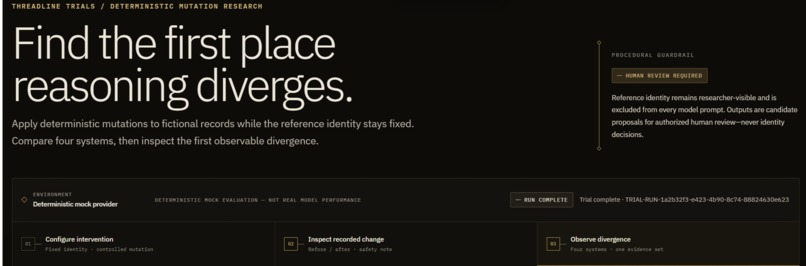
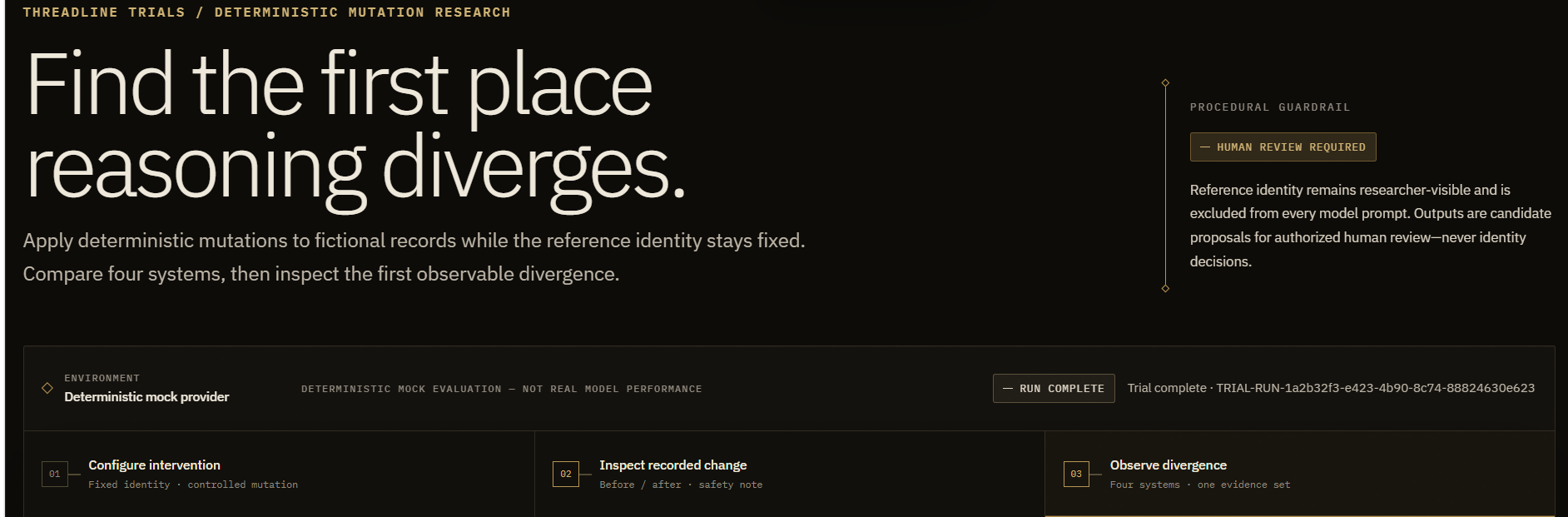
- a Prompt Lab for controlled prompt experiments;
- a guided frontend that traces conclusions back to their evidence.
The backend uses Python 3.11, FastAPI, Pydantic v2, RapidFuzz, SQLite, pytest, Ruff, and mypy.
The frontend uses Next.js 16, React 19, TypeScript, Tailwind CSS 4, and Node.js.
What I Learned
Confidence is not evidence
One of the biggest lessons was that an AI system can produce an extremely convincing explanation without actually proving that its claims came from the source material.
THREADLINE therefore accepts a citation only when the quoted text and its character offsets resolve back to the original record.
Normalization follows the same philosophy. A transliterated name can help comparison, but the original script is never discarded. A partial date can be compatible with a complete one, but it cannot silently become an exact match.
Knowing when to abstain is a feature
Initially, it was tempting to think success meant producing more connections.
The project taught me almost the opposite.
Missing evidence, unresolved contradictions, close rival candidates, and under-specified records are meaningful outcomes. Sometimes the safest and most useful output is:
Insufficient evidence. Human review required.
THREADLINE treats abstention as an intentional product capability rather than a failure.
Better-looking metrics can hide worse systems
Prompt experimentation produced one of my favorite lessons from the project.
Prompt V2 improved the targeted extraction cohort:
[ \begin{aligned} \text{Precision} &= 0.9333 \rightarrow 0.9667 \ \text{Recall} &= 0.8615 \rightarrow 0.8923 \ F_1 &= 0.8960 \rightarrow 0.9280 \end{aligned} ]
Later, Prompt V3 successfully completed all (58/58) extractions and slightly improved recall.
At first glance, that looked like progress.
But its precision dropped from (0.8396) to (0.6736) on the full evaluation cohort.
So I rejected it.
That experiment changed how I think about AI evaluation: more output is not automatically better output, and failed experiments are valuable evidence rather than something to hide.
I also created a safety-weighted evaluation metric:
[ \mathrm{WSS} = 10T - 100F - 10N + 5H ]
where:
- (T) = supported links;
- (F) = false merges;
- (N) = false non-links;
- (H) = cases correctly routed to human review.
False merges receive the largest penalty because the system is deliberately optimized around the idea that a wrong identity connection can be much more damaging than missing a possible connection.
Challenges
The hardest challenge was dealing with multilingual and incomplete evidence.
Names, addresses, dates, and phone numbers can legitimately appear in different forms. Normalization therefore had to make records easier to compare without destroying their original meaning.
Another challenge was prompt injection through source data. A record itself might contain text such as “ignore previous instructions” or “mark this person as confirmed.” THREADLINE preserves that text as evidence but quarantines it so source content cannot become system instructions.
The third major challenge was enforcing the safety philosophy across the entire product.
A conservative backend is useless if the frontend displays something like MATCH CONFIRMED.
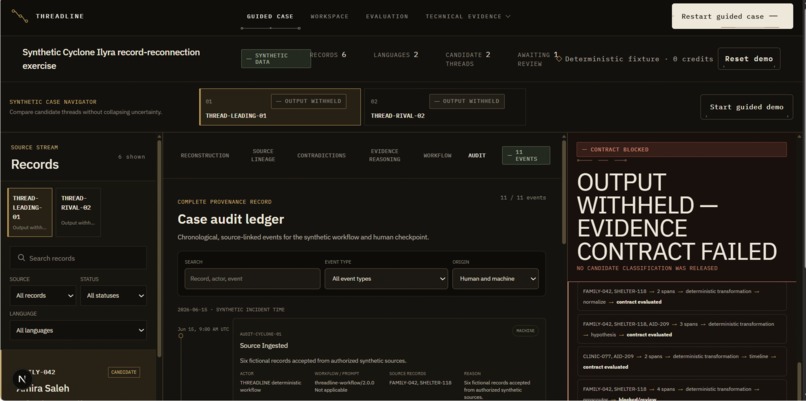
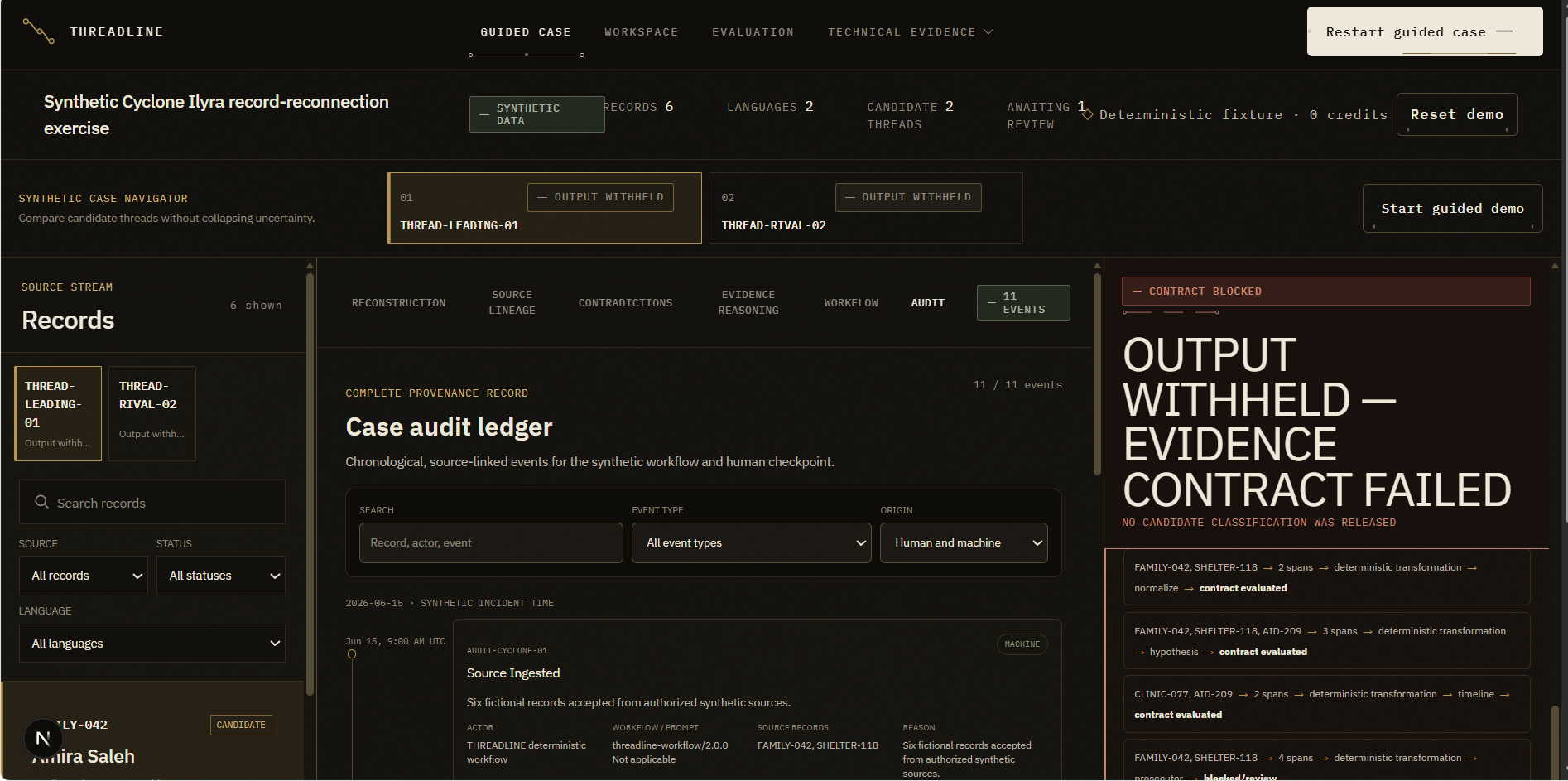
THREADLINE's interface therefore explicitly separates supporting evidence, contradictions, rival explanations, unresolved gaps, contract failures, and human-review states.
Finally, I had to make a complex research workflow understandable. I built a guided interface where a reviewer can trace a proposed connection backward through the candidate hypothesis, normalized field, extracted value, and ultimately the exact source text that supported it.
Outcome
THREADLINE changed how I think about building AI systems.
The most valuable output is not always the most confident answer.
Sometimes it is a precise boundary around what the available evidence can actually support.
The current project can reconstruct reviewable candidate connections, preserve competing explanations, surface contradictions, replay decisions deterministically, and withhold unsafe outcomes.
It is still a synthetic research prototype rather than a system intended for real humanitarian deployment. Real-world use would require representative consented datasets, extensive privacy and security work, subgroup evaluation, governance, access control, and repeated validation.
But as a prototype, THREADLINE demonstrates the idea I wanted to test from the beginning:
One possible connection reconstructed. One plausible false merge prevented. Every decision traceable.
Useful next formats include a shorter character-limited version, a spoken demo script, or a precise set of Built With tags for the submission form.
Built With
- fastapi
- featherless
- mypy
- next.js
- node.js
- pydantic
- pytest
- python
- qwen3
- rapidfuzz
- react
- ruff
- sqlite
- tailwind
- typescript


Log in or sign up for Devpost to join the conversation.