Inspiration
Clothing personalization often involves a disconnect between creative ideas and the ability to evaluate them visually. A customer might imagine a shirt with a particular color, pattern, or aesthetic, but communicating that idea, revising it, and understanding how it might look when worn can be difficult.
Many existing solutions focus on either generating fashion imagery or virtually trying on finished garments. THREADFORM was inspired by the opportunity to connect these experiences through a more structured, editable design workflow.
The central question was simple: What if clothing personalization could become an iterative design process rather than a sequence of disconnected images?
THREADFORM explores this idea by combining controlled garment editing, design history, and AI-powered virtual try-on.
What it does
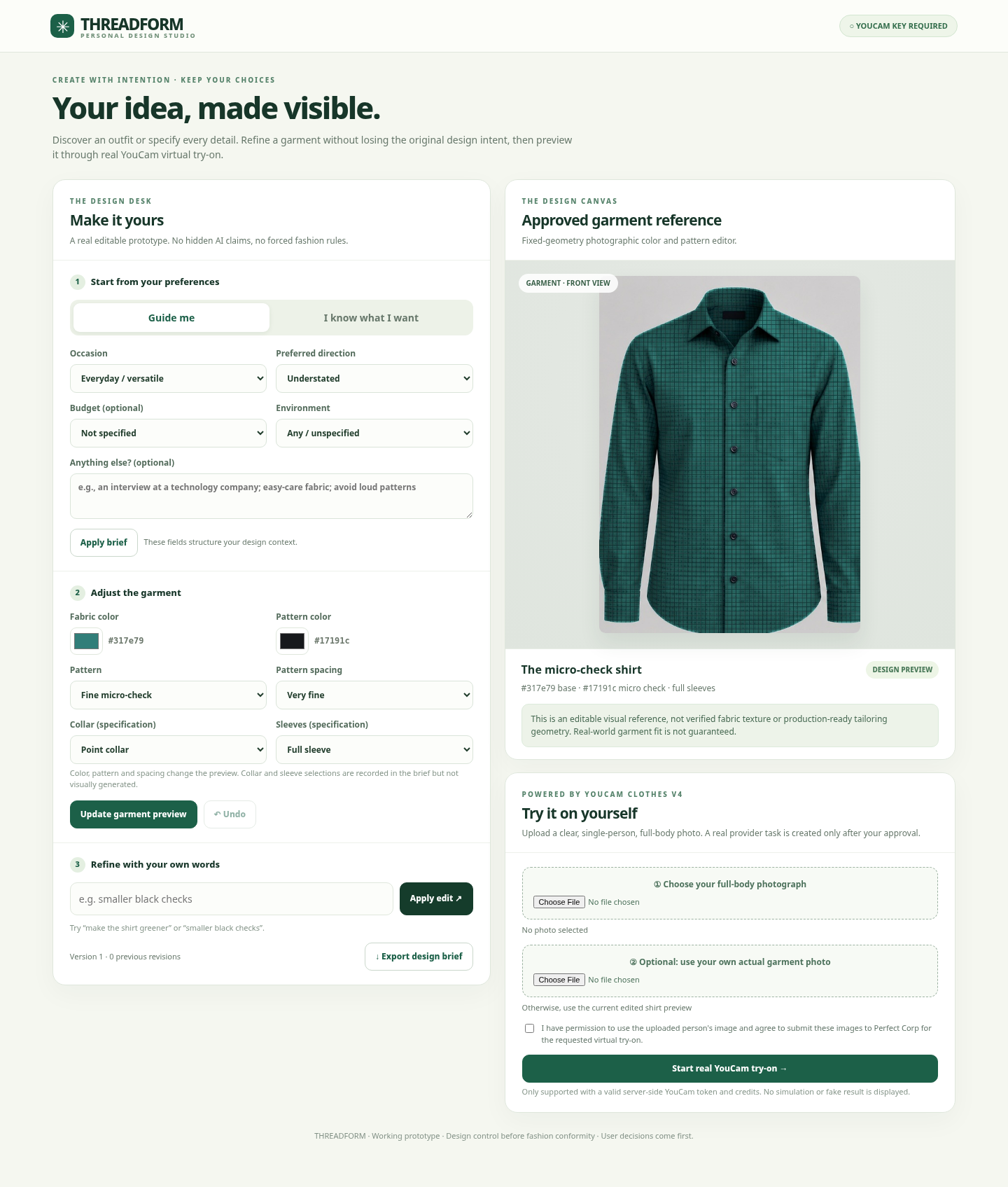
THREADFORM — Design Integrity × YouCam Clothes V4 is an interactive garment personalization studio that allows users to explore, revise, and visualize clothing designs.
The prototype focuses on a customizable shirt and provides several capabilities:
- Interactive garment editing: Adjust shirt colors and patterns through structured controls.
- Design preferences: Record occasion, style, and budget considerations.
- Text-based editing commands: Make supported design adjustments using natural-language-style instructions.
- Version history and undo: Revisit earlier design decisions without restarting the process.
- Design brief export: Produce a structured summary of selected garment preferences and specifications.
- AI-powered virtual try-on: Submit a garment preview and a person photograph to Perfect Corp's YouCam Clothes V4 API to generate a visual try-on result.
The application separates deterministic design-preview editing from AI-generated virtual try-on. This distinction helps users understand which operations are controlled by the application and which depend on the external AI service.
THREADFORM is intended as a visual design-exploration tool, not a guarantee of physical fit, exact textile reproduction, or manufacturing feasibility.
How we built it
THREADFORM was developed as a web application using Python, FastAPI, JavaScript, HTML, and CSS.
The frontend provides the interactive garment-design experience, including editable controls, a visual preview, design history, and virtual try-on interactions.
The backend, implemented with FastAPI, manages the application's API endpoints and the integration with Perfect Corp's YouCam Clothes V4 API.
The YouCam integration follows a server-side workflow:
- Prepare the person and garment images for submission.
- Register and upload the required image assets through the provider's API workflow.
- Create a Clothes V4 virtual try-on task.
- Poll the task status until processing completes or an error is returned.
- Display the resulting try-on image within the application.
API credentials are maintained server-side through environment variables rather than exposed in frontend source code.
The application was first tested locally using Uvicorn. The source code was then published to GitHub and deployed to Vercel.
Technology stack: FastAPI, Python, JavaScript, HTML/CSS, Perfect Corp YouCam Clothes V4 API, GitHub, and Vercel.
Challenges we ran into
- Connecting garment editing with virtual try-on
A garment preview that looks correct in a controlled design interface does not automatically translate into an equally precise AI-generated try-on image. Maintaining the relationship between the user's design choices and the final visualization is a significant challenge.
- Integrating an asynchronous external API
The YouCam Clothes V4 workflow requires more than a single image-generation request. Image registration, uploading, task creation, status polling, and result retrieval all need to work together reliably.
- Preserving meaningful user control
The design interface needed to support revisions without forcing users to restart their work. This motivated the implementation of structured controls, undo functionality, and version history.
- Distinguishing visualization from physical accuracy
An attractive try-on image should not be confused with verified measurements, fabric behavior, garment construction, or actual fit. Keeping these limitations clear was an important design consideration.
- Moving from local development to public deployment
The application required dependency setup, API credential configuration, GitHub integration, and deployment of the FastAPI backend alongside its frontend.
Accomplishments that we're proud of
- Built an interactive garment personalization prototype with structured design controls.
- Implemented editable design history, undo, and design brief export.
- Integrated the real Perfect Corp YouCam Clothes V4 API, rather than relying on simulated virtual try-on responses.
- Successfully completed a local end-to-end virtual try-on request and displayed the generated result.
- Published the application source code to a public GitHub repository.
- Deployed THREADFORM to Vercel and verified that its production backend responds successfully with YouCam credentials configured.
A particularly meaningful milestone was seeing a customized shirt preview progress through the actual YouCam Clothes V4 workflow and return a completed virtual try-on visualization.
What we learned
The development process highlighted several lessons.
Design control and AI visualization serve different purposes. Deterministic editing provides predictable interactions, while AI-powered virtual try-on helps users visualize a design in a more realistic context.
A successful API integration requires careful orchestration. Image preparation, task lifecycle management, response handling, and credential security are all essential parts of the experience.
Visual realism does not automatically mean design fidelity. An AI-generated garment image may not preserve every fine pattern or material detail. This creates an important opportunity for future evaluation and improvement.
Transparency improves product usefulness. Users should understand what a system can demonstrate and what still requires physical sampling, professional measurements, or manufacturing validation.
Most importantly, garment personalization becomes more useful when design decisions remain editable and understandable.
What's next for THREADFORM
The next development priorities are:
- Greater design fidelity: Improve preservation and evaluation of fine patterns, colors, and garment details between the design preview and virtual try-on result.
- Expanded garment support: Move beyond the initial shirt prototype to additional apparel categories and design variations.
- More advanced design intelligence: Introduce context-aware recommendations for materials, styling, and compatible design choices.
- Better comparison tools: Allow users to compare multiple design versions and virtual try-on outputs side by side.
- Improved usability and reliability: Strengthen error handling, responsiveness, accessibility, and deployment-level testing.
- Craftsmanship-oriented workflows: Explore how structured design briefs could eventually support communication between customers, tailors, and garment makers.
The longer-term vision is to make THREADFORM a bridge between personalized fashion design, visual experimentation, and practical garment communication.
THREADFORM's guiding principle: Design with control. Visualize with AI. Refine with confidence.
Built With
- api
- clothes
- corp
- css3
- fastapi
- html5
- javascript
- perfect
- python
- v4
- vercel
- vscode
- youcam
