-
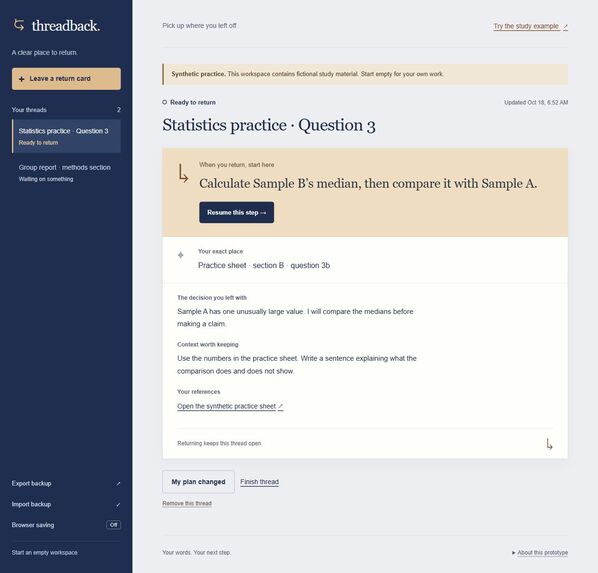
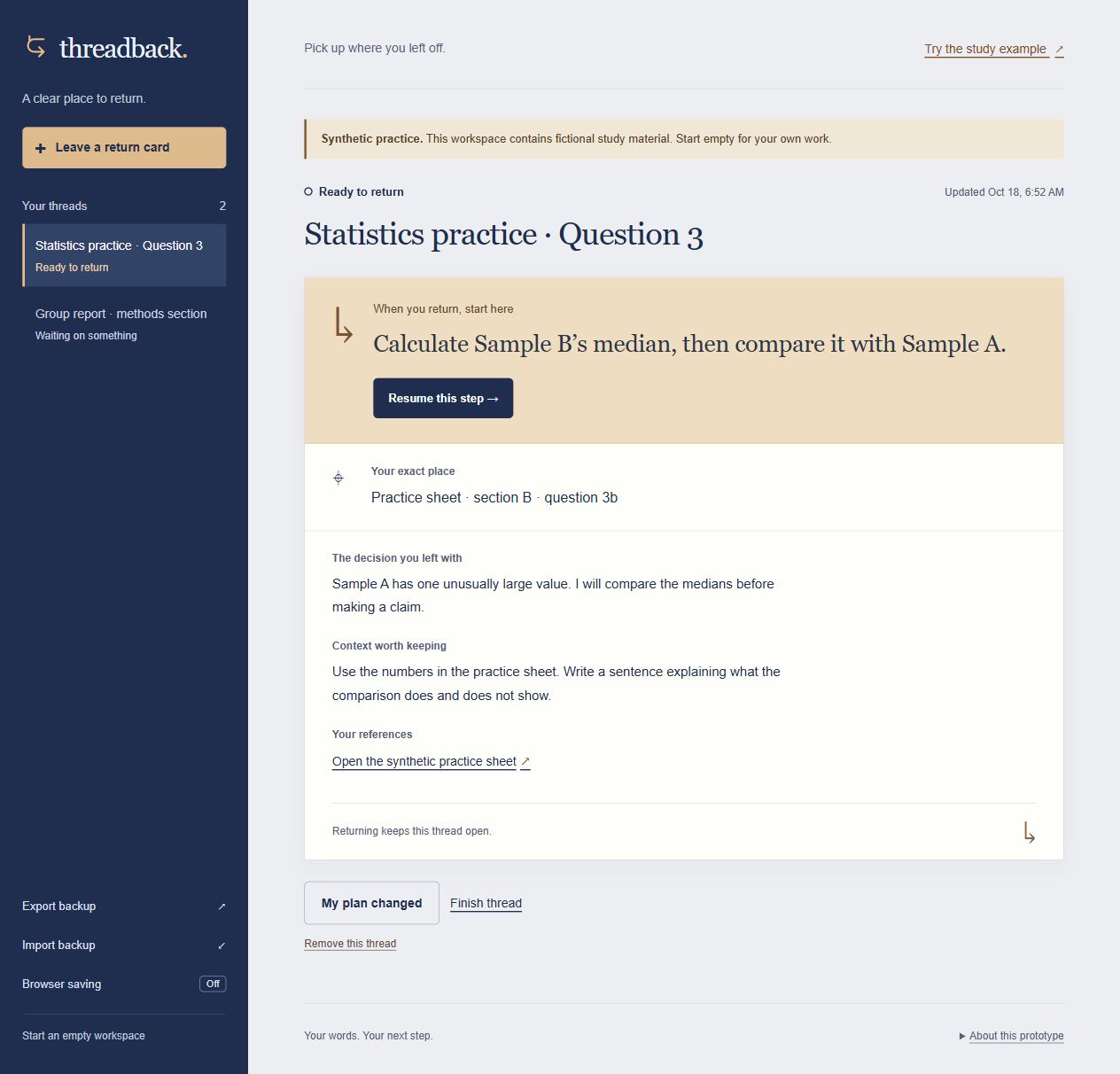
A return card keeps the next action beside its exact place and previous decision. Actual app; synthetic practice material.
-
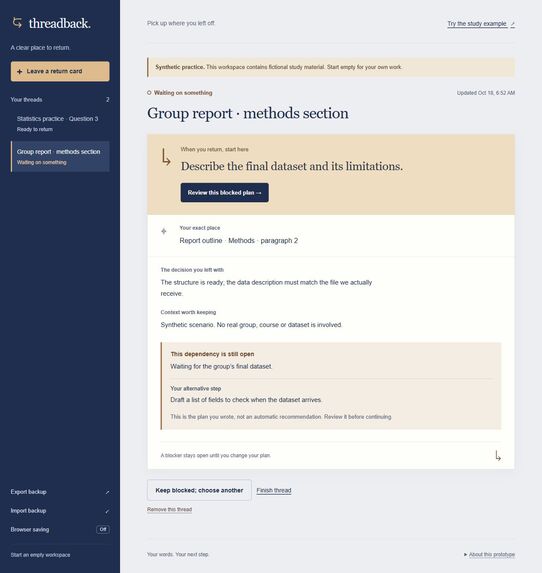
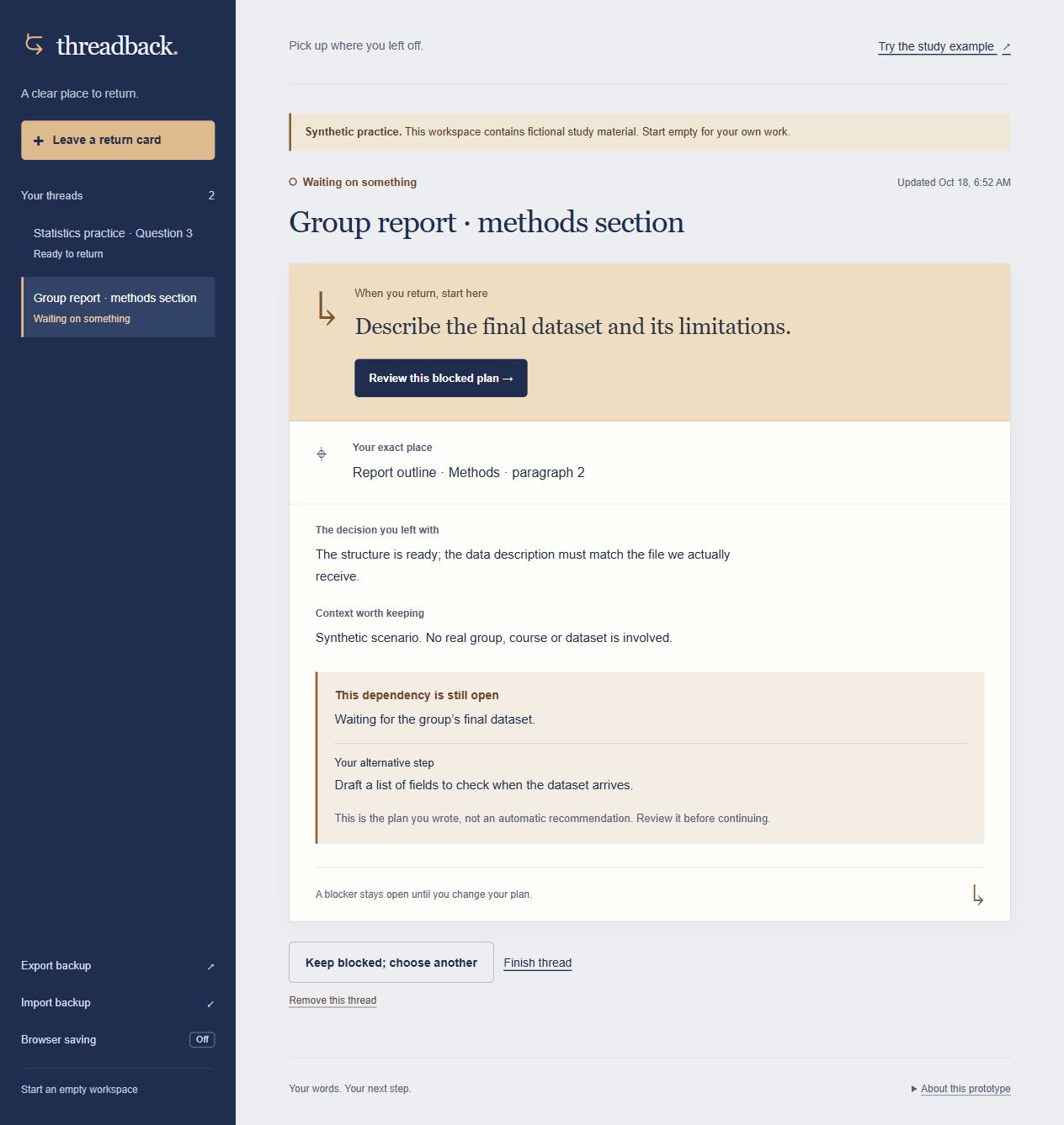
An unresolved dependency stays visible with a user-written alternative. Actual app; fictional group-report scenario.
Inspiration
A task title tells you what to work on, but it may not tell you where to continue. Threadback preserves an exact study anchor, the decision made before leaving, and one concrete next action.
This is a design hypothesis, not a user-interview story. Notes and task descriptions can hold the same information. Our earlier Benchkeep project explored returning to unfinished craft work; that conceptual relationship is disclosed. Threadback is a new academic workflow, with explicit behavior when the plan changes or a dependency is still missing.
What it does
Leave a return card with a title and a next action. Add a question, page or section, the previous decision, references, and a blocker with your own alternative when useful. On return, the next action leads the page.
Resume keeps the thread open. Replan preserves the previous card, retaining the five most recent checkpoints. A missing dependency stays blocked until the user changes the plan. Finish and reopen are separate actions.
Browser saving is optional. Two-tab revision checks pause stale writes and preserve the current tab's work. JSON backups include unfinished drafts, even an incomplete reference that is not yet a valid link. Import validates the file before offering to replace existing work. A workspace supports 20 threads, three references per card and a shared 4 MiB UTF-8 backup limit.
Try the working demo
Open the live link and select Try the study example. The clearly labeled synthetic cards include an actual practice sheet at question 3b. Resume the statistics card, leave a revised next step, then inspect the missing-dataset card. Its blocker and user-written alternative remain visible.
The repository's WALKTHROUGH.md guides the full return, replan, persistence and backup flow. No account or runtime AI service is required. The gallery shows the actual application with fictional practice material.
How it was built
HTML, CSS and vanilla JavaScript modules, with Node.js built-ins for the local server and tests. There are no third-party packages, application backend or analytics service. Web Locks coordinate optional browser saves. Native controls, responsive layout, visible state labels and a reduced-motion rule support the interface.
OpenAI Codex provided substantial assistance with research, design, implementation, testing, software review and documentation. Jhona is the entrant; no unaided human coding or user research is claimed. No Benchkeep code, interface assets, screenshots or video were reused.
Challenges and learning
The independent review found that a valid large workspace could export a backup that the old importer rejected. Aligning model and file-picker limits, measuring UTF-8 bytes, and testing maximum workspaces fixed that mismatch. The review also caught impossible calendar dates and unclear history retention.
The corrected suite passed 28 automated tests. Real browser checks covered draft recovery, a downloaded-and-restored JSON file, rejection of an incompatible file without losing work, stale tabs, and finish/reopen behavior. Card and editor views were exercised at 390 and 320 pixels. VALIDATION.md records the scope and limits.
Limits and next steps
The examples are synthetic; no student interviews, classroom adoption, time savings or grade improvements are claimed. Narrow-screen checks are not a full accessibility audit. Browser-local data is readable and can be lost; it is not cloud sync, encryption or a guarantee the app loads offline.
The next product step is voluntary student feedback on whether capturing a useful return card is worth the effort. That research has not been performed. The working demo, source, walkthrough, validation record and credits are available now.

Log in or sign up for Devpost to join the conversation.