-
-
THREAD TRIAGE
Inspiration
Moderating fast-moving communities often turns into a triage problem. In news, tech, education, and discussion subreddits, moderators repeatedly face the same questions: Is this a duplicate? Is this too vague? Is this better for a megathread? Is this likely to start a hostile argument?
We built Thread Triage to reduce that repetitive moderation load without trying to replace moderator judgment. The goal was to make the first pass through the queue faster, more consistent, and more explainable. Instead of forcing moderators to manually re-evaluate the same patterns over and over, Thread Triage highlights likely outcomes early and gives mods a clean, actionable recommendation.
What it does
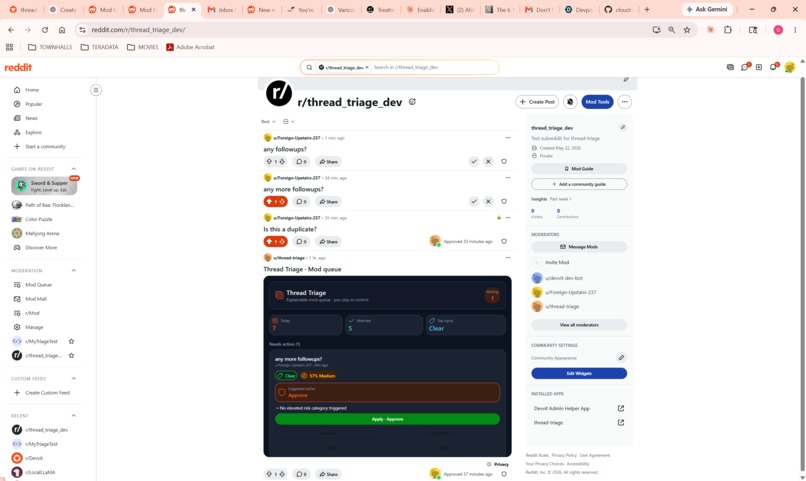
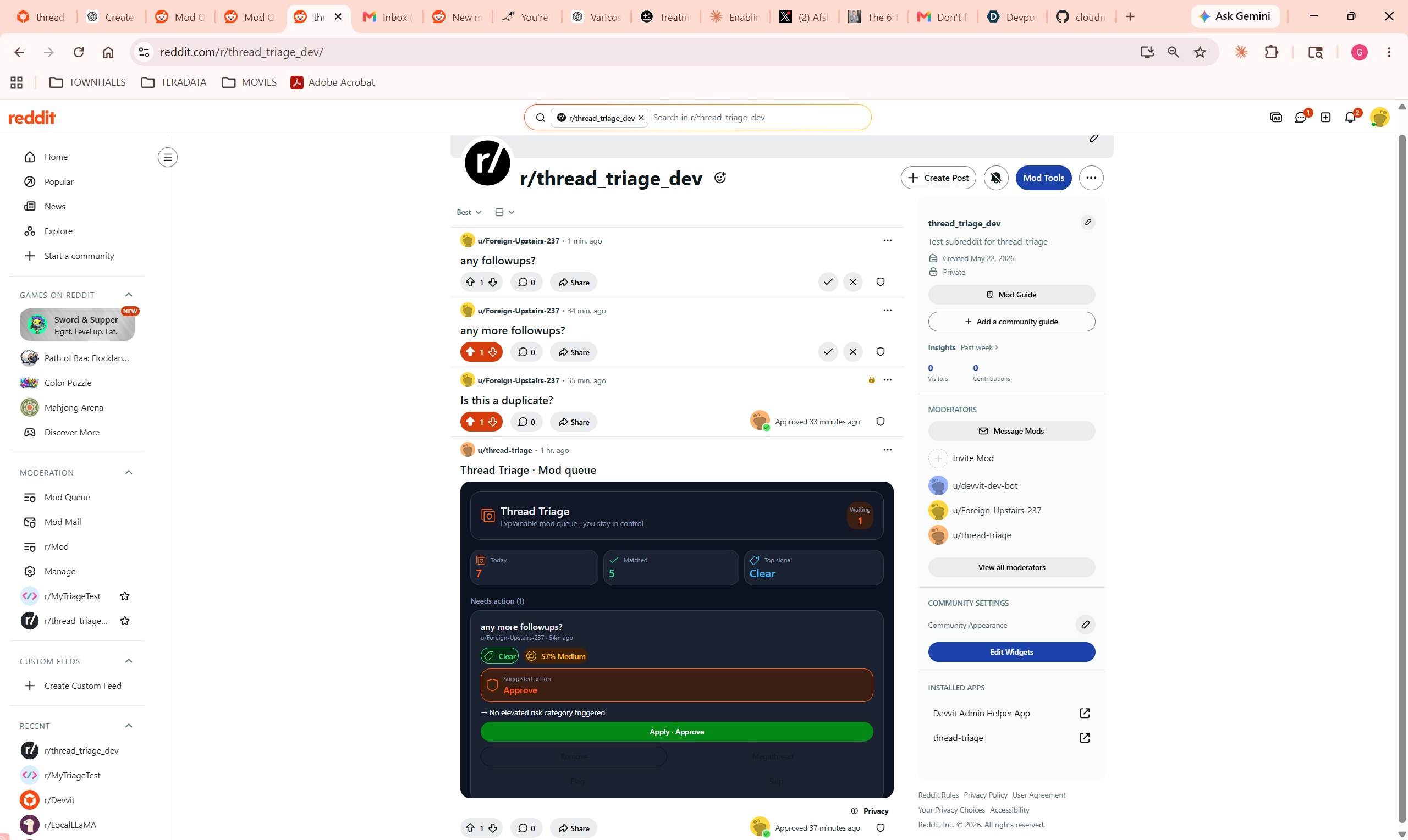
Thread Triage is a Devvit moderation app that analyzes new posts and classifies them into moderation-relevant buckets such as:
- probable duplicate
- likely FAQ or beginner support question
- likely low-effort or vague post
- possible flamewar risk
- needs human review
- safe / no action
For each flagged item, moderators see a compact triage card with:
- a recommended action
- a confidence level
- short reasons explaining the recommendation
Moderators can quickly choose to:
- approve
- remove with reason
- send to a megathread
- flag for discussion
- ignore the recommendation
The app is designed to save moderator time while keeping humans fully in control of the final decision.
How we built it
We built Thread Triage directly on Reddit’s Developer Platform using Devvit, using the mod tool workflow and architecture recommended for moderation apps. The app uses a lightweight triage engine, subreddit-specific presets, configurable thresholds, and a moderator-facing dashboard so the experience feels native to Reddit moderation instead of like an external bot bolted on later.
Our implementation focused on:
- real-time post triage
- configurable presets for different community types
- explainable recommendations instead of black-box decisions
- a clean moderator UI with fast actions
- action logging so moderators can review what happened and override suggestions when needed
For the first release, we prioritized a reliable, launch-ready moderation workflow over a broad but unfinished feature set.
Challenges we ran into
The biggest challenge was balancing intelligence with trust.
It is easy to build something that sounds powerful, but much harder to build something moderators will actually trust in a real queue. We had to make careful tradeoffs between automation and transparency. Rather than over-automating, we focused on explainable recommendations that moderators can understand at a glance.
Another challenge was designing for multiple subreddit styles. A duplicate story in a news community, a beginner question in a programming subreddit, and a repetitive help post in a study community may all require different handling. That pushed us to build configurable presets and threshold-based logic so the app could be useful across multiple moderation contexts.
We also wanted the UI to feel polished and fast, because a moderation tool only saves time if moderators can understand and act on it immediately.
Accomplishments that we're proud of
We are proud that Thread Triage feels like a real moderation product rather than just a hackathon demo.
Some of the accomplishments we’re most excited about are:
- turning messy moderation patterns into clear, explainable recommendations
- building a Reddit-native Devvit app instead of relying on an external workflow
- keeping moderators in control while still meaningfully reducing repetitive work
- designing a UI that is fast to scan, simple to configure, and easy to demo
- making the app broadly useful for news, tech, education, and discussion communities
Most importantly, we built something that directly targets queue fatigue and repetitive decision-making, which are real pain points for moderators.
What we learned
One of the biggest lessons from this project is that good moderation tooling is not just about detection accuracy. It is also about trust, usability, and speed.
Moderators are much more likely to use a recommendation system if it is:
- explainable
- easy to configure
- fast to scan
- safe by default
We also learned that Reddit-native tools create a much better moderation experience than off-platform workflows. Building in Devvit made it easier to think in terms of moderator actions, configuration, and installability from the start.
Another major takeaway was that a focused, polished tool is often more valuable than a broad but unfinished one. Narrowing the scope helped us build a more coherent product.
What's next for Thread Triage
The next step for Thread Triage is deeper customization and broader moderation coverage.
Planned improvements include:
- stronger duplicate detection across longer time windows
- better subreddit-specific rule tuning
- optional comment triage for heated reply chains
- richer dashboard analytics for moderator teams
- more detailed recommendation explanations and review history
- better support for community-specific workflows and megathread routing
Our long-term vision is for Thread Triage to become a trusted moderation copilot that helps communities process repetitive queue decisions faster, more consistently, and with less fatigue.
Built With
- devvit
- redis
- typescript

Log in or sign up for Devpost to join the conversation.