Inspiration
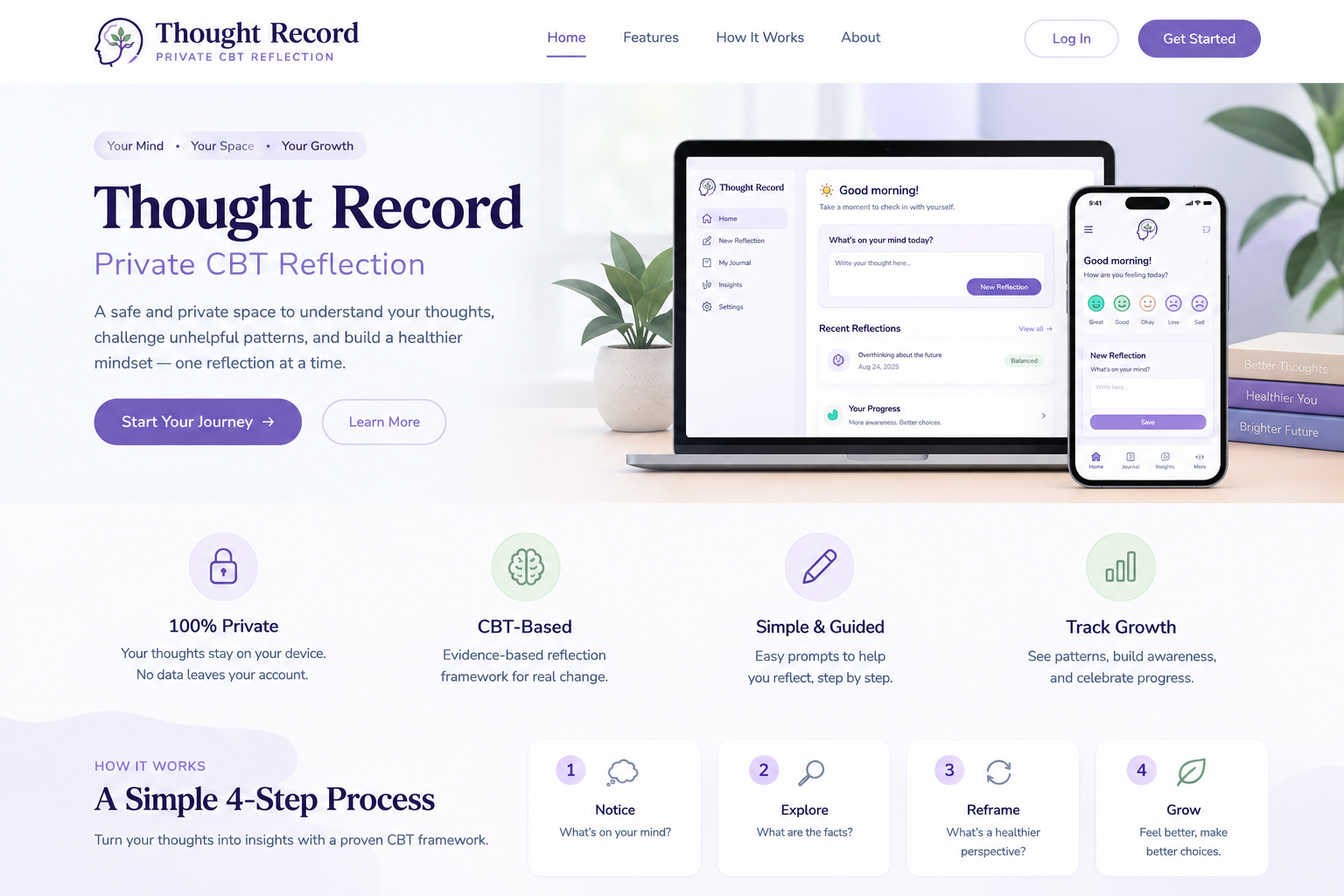
When a difficult thought keeps looping, people often need a private place to slow down and separate facts from assumptions. Thought Record is a calm, lightweight reflection tool for moments when writing things down can make the next step feel more manageable.
What it does
Thought Record guides a person through a short CBT-inspired reflection: what happened, what went through their mind, what they felt, how intense it was, and what a more balanced alternative might sound like. It can show recurring patterns and lets people export or delete their own records.
The app includes a safety-first crisis signal screen. If a message suggests immediate danger, the normal analysis flow stops and the app presents support-oriented guidance instead. It does not diagnose, provide emergency care, or replace a qualified professional.
Privacy and responsible design
The app is local-first. Records are stored in the user’s browser, with no account, cloud journal, or profile required. Safety checks run before any optional analysis request. The interface includes clear boundaries, accessible labels, keyboard-friendly controls, and a visible self-help disclaimer.
How I built it
I built the app with Next.js and React using the Pages Router. Browser localStorage and IndexedDB handle private entries and attachments. The analysis route is provider-agnostic and can use a language model when configured, while the safety gate remains deterministic and testable. The project includes dependency-free safety regression checks and is deployed on Vercel.
Challenges I ran into
The main challenge was balancing useful reflection with responsible limits. A mental-health tool should not overclaim, diagnose, or continue a normal journaling flow when a crisis signal appears. I also focused on keeping the privacy model understandable and making the interface calm enough to use during an emotionally difficult moment.
Accomplishments I’m proud of
I’m proud that the result is a working, accessible prototype with a real privacy boundary, a support-first safety path, a clear product scope, and a live demo that anyone can try without creating an account.
What I learned
I learned that responsible AI product design is as much about what the system refuses to do as what it can do. Clear boundaries, deterministic safety behavior, local data ownership, and an honest user experience are essential when building for mental health.
What’s next
Next, I would add optional clinician-reviewed content packs, multilingual support, stronger on-device screening, and independent usability and safety evaluation—without weakening the local-first privacy model.
Built With
- indexeddb
- javascript
- next.js
- react


Log in or sign up for Devpost to join the conversation.