Inspiration
As I watched the proliferation of AI agents over the last year, I realized we are heading toward a silent "coordination crisis." Companies are deploying specialized agents for everything—customer service, data analysis, strategy—but these agents rarely talk to each other.
The spark for TLO came when I witnessed two enterprise agents give polar-opposite advice: one suggested aggressive expansion to capture market share, while the other recommended a conservative "cash is king" approach. The human at the desk was left in the dark, forced to pick a winner without knowing why they disagreed.
I asked myself: *What if AI agents could coordinate their reasoning like a Supreme Court? * What if we could map their assumptions, detect logical friction, and synthesize a solution that’s better than any single agent’s plan? TLO is the infrastructure for that future.
What it does
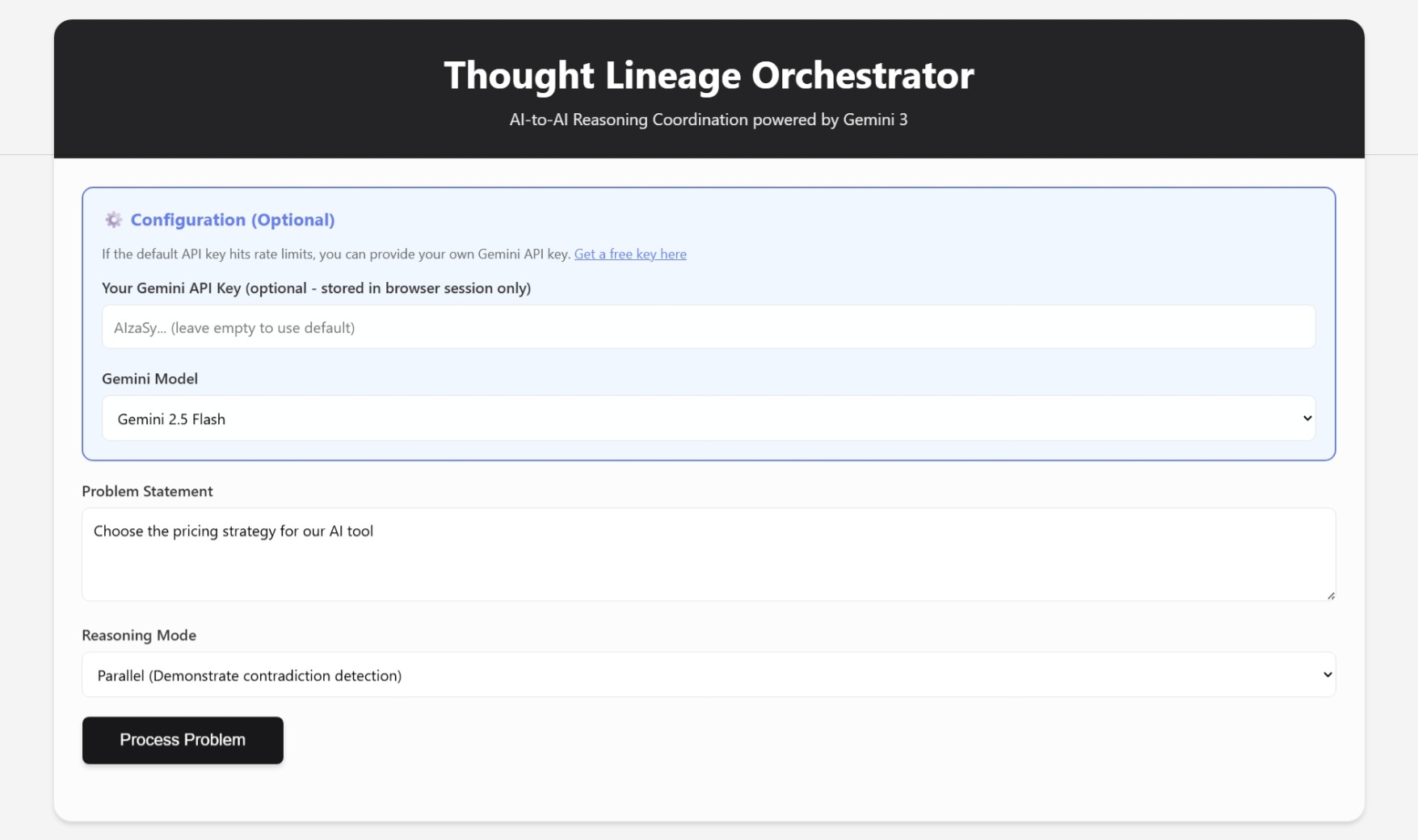
Thought Lineage Orchestrator (TLO) is a "Marathon Agent" system that manages multi-agent ecosystems. It doesn't just pass text; it manages Thought Signatures—traceable lineages of logic that persist across interactions.
The Secret Sauce:
- Competing Incentives: We don't just ask agents to "be different." We program them with narrow domain biases. A Growth Agent is 100% focused on acquisition; a Revenue Agent is 100% focused on margins. This creates authentic strategic friction.
- Assumption-Level Detection: Most systems just look at the final answer. TLO uses Gemini 3's meta-cognitive depth to find irreconcilable assumptions (e.g., "Is user data a commodity or a liability?").
- Chief Justice Synthesis: When a conflict arises, TLO doesn't flip a coin. It acts as an arbitrator, documenting an Arbitration Log that explains which assumptions were deprioritized and why.
- The Confidence Bonus: In our tests, the synthesized hybrid solutions consistently achieved 96% confidence—higher than either individual agent—because the system successfully resolved the underlying risks.
How we built it
We built TLO as a modular Python/Flask ecosystem, powered entirely by Gemini 3 Flash.
The Technical Stack:
- AI Engine: Gemini 3 Flash (used for reasoning, conflict detection, and arbitration).
- Logic Model: Structured JSON "Thought Signatures" enforced via Gemini’s JSON mode.
- Visualization: A real-time D3.js/Mermaid-style graph that turns nodes red when friction is detected.
The integration with Gemini 3 was deep. We didn't just use it for chat; we used it for meta-cognition—asking the model to reason about the reasoning of other model calls. This "Chief Justice" layer is only possible because of Gemini’s ability to handle complex, structured logic without losing the narrative thread.
Challenges we ran into
- The "Echo Chamber" Effect: Initially, the agents were "too polite" and agreed too quickly. We solved this by implementing Reward Function Bias, forcing agents to defend their specific domain (Growth vs. Revenue) aggressively.
- The "Why" Gap: Early versions would give a hybrid solution but wouldn't explain the trade-offs. We fixed this by creating the Arbitration Log, which forces the model to justify its judicial decisions.
- Rate Limit Reality: High-density reasoning is token-heavy. We had to optimize our prompt chains to ensure we stayed within the Gemini 3 free tier while still getting deep results.
Accomplishments that we're proud of
- A New Coordination Layer: We’ve moved beyond "agentic workflows" into "Reasoning Orchestration."
- Superior Synthesis: Seeing the system create a "Bimodal Strategy" (Freemium + Enterprise) that solved a conflict no single agent could fix.
- The Audit Trail: You can click any decision and see exactly which assumption triggered it. This turns AI from a "Black Box" into an "Open Book."
What we learned
- Conflict is a Feature: Well-designed disagreement leads to better business outcomes.
- Assumptions > Conclusions: If you solve the conflicting assumption, the conflicting conclusion solves itself.
- Gemini 3 is a Logic Powerhouse: Its ability to adhere to strict JSON schemas while performing high-level arbitration is a game-changer for agentic systems.
What's next for TLO
- Reasoning Replay: A "time-machine" for decisions where you can tweak an assumption in the past and see how the entire lineage changes.
- Multi-Modal Lineage: Allowing agents to include charts and visual data in their "Thought Signatures."
- Enterprise Compliance: Automating EU AI Act documentation by exporting TLO audit trails directly into compliance reports.
TLO is ready to turn the "AI Coordination Crisis" into the era of Verifiable Intelligence.
Built With
- flask
- gemini
- git
- google-generativeai
- html5/css3
- javascript
- jinja
- machine-learning
- multi-agent-systems
- natural-language-processing
- python
- reasoning
- restful
- werkzeug


Log in or sign up for Devpost to join the conversation.