Inspiration
I built ThisThat because I noticed something broken about AI tools: they're designed for individuals in a world built on collaboration.
Think about it—we use Google Docs to write together, Figma to design together, GitHub to code together. But when it comes to AI? Everyone retreats to their own ChatGPT tab. Everyone needs their own expensive API keys. Everyone works alone.
That felt wrong. So I built ThisThat to make AI truly collaborative.
What is ThisThat?
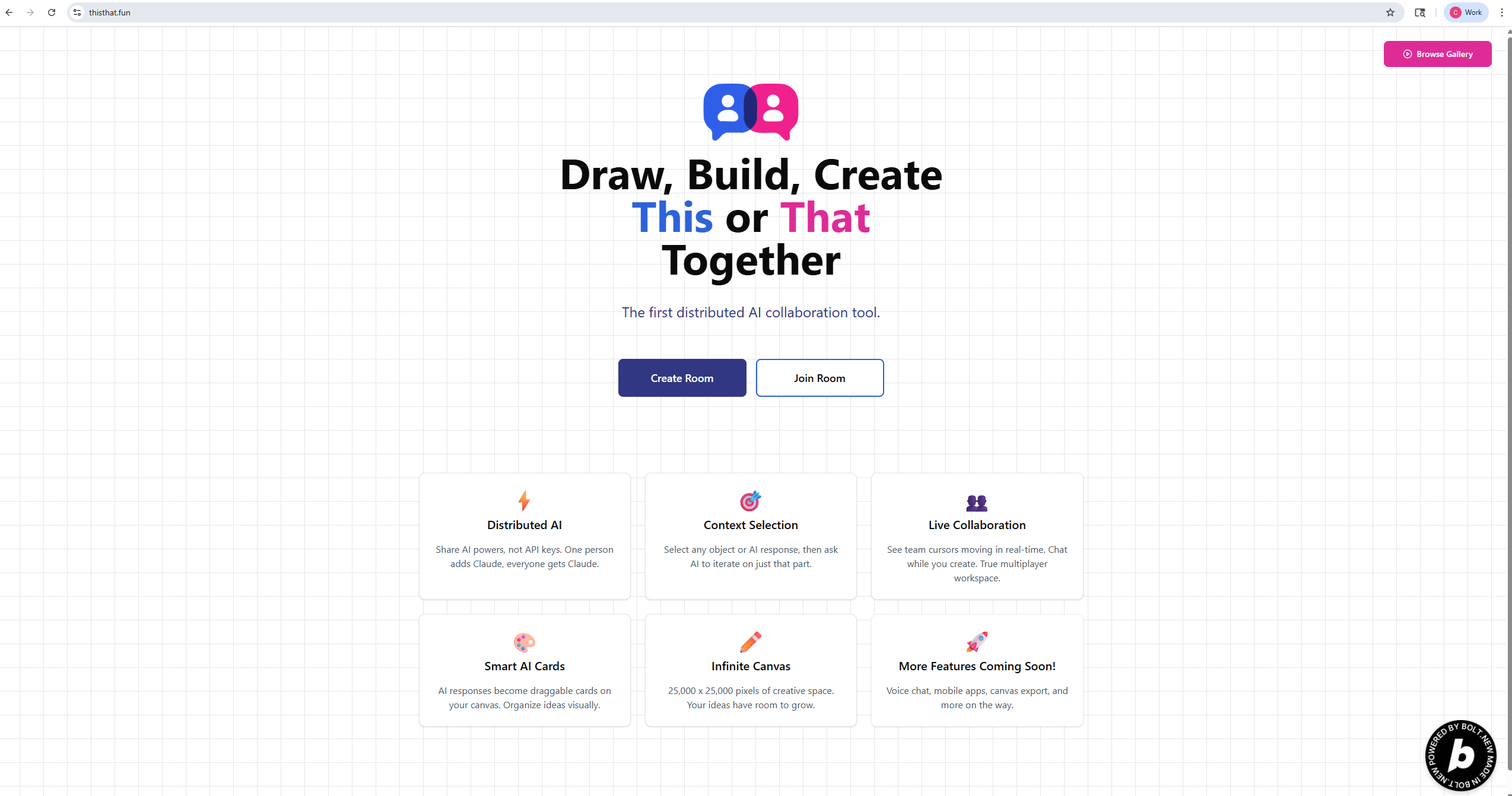
ThisThat is a real-time collaborative canvas where teams can draw, chat, and use AI together—all in the same space. But here's the magic: when one person adds their AI API key, everyone in the room can use it instantly.
Imagine a infinite canvas where:
- You sketch an idea with your team
- Someone types
@claude explain this concept - Claude responds with a draggable card on the canvas
- Another person asks
@gpt-4 turn this into code - Everyone sees both responses, compares them, iterates together
No screen sharing. No "let me paste this in Slack." Just pure collaborative flow.
What it does
ThisThat's distributed AI system changes everything:
One person adds their API key → Everyone in the room can use that AI Any one can iterate and build off of the responses. Select the AI output and ask the AI to help you dig deeper into a subject, make changes to code and watch it iterate in real time with you.
Real scenarios where this shines:
- A teacher with Claude can help 30 students explore complex topics together
- A design team can ask GPT-4 and Gemini the same question, see responses side-by-side
- A startup can pool their AI subscriptions—one has Claude, another has GPT-4, everyone benefits
- Knowledge flows naturally—see someone's great prompt, iterate on it immediately on the canvas
How I built it
This project represents a marathon of AI-assisted development. I spent countless hours with Bolt.new rapidly prototyping the core concepts—testing WebRTC approaches, experimenting with canvas implementations, and iterating on the distributed AI architecture. Bolt was incredible for going from zero to working prototype at lightning speed.
But as the codebase grew complex, I transitioned to Cursor for the heavy lifting. Cursor's codebase-aware AI helped me:
- Refactor the entire WebRTC implementation to a hybrid Supabase architecture
- Debug intricate race conditions in the peer-to-peer messaging
- Optimize the 25,000x25,000px canvas for smooth multi-user performance
- Build the sophisticated API key routing system that makes distributed AI possible
Challenges I ran into
The hardest part wasn't the AI integration—it was making collaboration feel effortless:
- Routing AI requests to the right person with the right API key
- Syncing canvas drawings, chat, and AI responses in real-time
- Handling failures gracefully when someone with an API key leaves ## Accomplishments that we're proud of
- The Distributed AI System Actually Works: Routing API requests through peer connections while maintaining security seemed impossible at first. But it works beautifully—API keys stay private, costs stay fair, and everyone benefits.
The User Experience Feels Magical: From the "Color + Animal" avatars to draggable AI cards to live cursors—every interaction feels delightful and intuitive.
Having the guts to actually build something for myself for the first time ever! As a PM/PMM I have also spent time building for others. It was nice to get out of my comfort zone.
What I learned
Building ThisThat taught me that the best collaboration happens when tools get out of the way. The journey from pure WebRTC (which crashed constantly) to a hybrid Supabase architecture showed me that idealism must bend to user experience.
What's next for ThisThat
The current version is just the beginning. Here's the roadmap:
Immediate Future (Next Month)
- Canvas Drawing Sync: Full real-time synchronization of drawings between all users
- : Select any canvas element and ask AI to iterate on it
- Voice Commands: Speak your ideas, see them transformed instantly
- Mobile Support: Collaborate from anywhere, on any device
Medium Term (Next Quarter)
- Persistent Rooms: Save your collaborative sessions and return to them later
- AI Provider Marketplace: Trade AI credits in real-time ("I'll give you 10 Claude queries for 15 GPT-4 queries")
- Team Workspaces: Organizations can pool their AI resources company-wide
- Plugin System: Add custom AI providers and tools
Long Term Vision
ThisThat will become the default way teams work with AI—a space where human creativity and artificial intelligence blend seamlessly. Imagine:
- Design teams iterating on concepts with Midjourney + Claude + human sketches
- Students learning together with AI tutors that everyone can access
- Startups building their entire product with shared AI resources
The goal is simple: make AI collaboration as natural as any other form of teamwork.
Final Thoughts
Building ThisThat reinforced my belief that the best tools bring people together. In a world where AI is becoming essential, we shouldn't be working in isolation. We should be pooling our resources, sharing our discoveries, and building on each other's ideas.
Because in the end, the best vibes happen when we build together.
Built With
- bolt.new
- cursor
- javascript
- nextjs
- react
- shadcn
- supabase
- typescript
- vercel


Log in or sign up for Devpost to join the conversation.