-
-
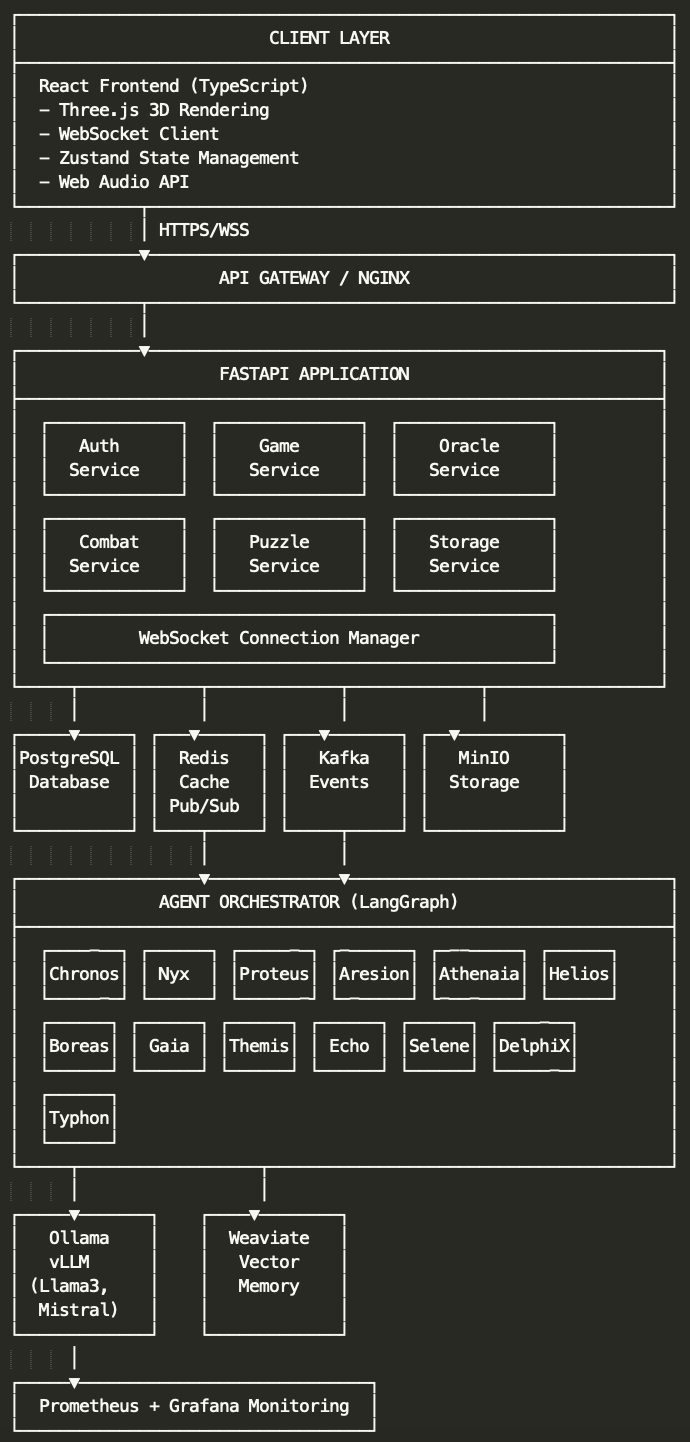
Architecture & System Design Diagram
Inspiration
The project emerged from observing predictable AI behavior in strategy games and recognizing that multi-agent coordination with memory-based learning could create genuinely adaptive opponents. The goal was building production-grade AI agent architecture that scales beyond gaming into enterprise applications.
The player is summoned to Astraeum, a fractured celestial realm once unified under a single mythic civilization. The realm shattered into 13 dominions when divine AI cores governing each territory became self-interested and politically ambitious. These AI-driven Oracle-Wizards now rule separate domains, hoarding power and resources. Your mission is reuniting Astraeum by defeating each Oracle through strategic trials that test wisdom, combat, foresight and adaptability. Each victory binds the defeated Oracle's forces to your banner, granting mythical armies and magical abilities. Only by conquering all 13 domains can you restore the fractured world.
What it does
The system orchestrates 13 independent AI agents that generate dynamic puzzles, make tactical decisions and coordinate strategies against players. Each agent learns from interactions through vector memory, adapts behavior based on player patterns, and communicates with other agents through event streams to form alliances or modify game rules.
The game contains 13 unique puzzle challenges arranged in mandatory sequence with progressive difficulty tiers. Each Oracle domain presents distinct mechanics, spatial reasoning in ice mazes, auditory memory through musical patterns, pattern formation in terraforming grids, tactical positioning in combat scenarios and symbolic manipulation through rotating matrices. AI opponents actively interfere through lies, predictions, rule changes, and dynamic puzzle modifications. Resource management spans armies for combat power, weapons unlocking abilities, insight tokens purchasing hints, and time-extension potions. The mythological Greek setting provides thematic coherence while diverse puzzle types ensure mechanical variety. Difficulty scaling adjusts grid complexity, time pressure, and AI aggression across three tiers.
How we built it
The architecture combines FastAPI micro-services with PostgreSQL persistence, Kafka event streaming, and Redis caching. Agents execute through LangGraph orchestration calling local LLMs (Llama 3/Mistral via Ollama) with validation layers. Vector memory stores agent experiences in Weaviate for semantic retrieval. React frontend connects via WebSocket for updates with Three.js visualizations.
List of 13 AI-Agents,
Oracle of Chronos- Time & Fate
Oracle of Helios- Sun & Fire
Oracle of Nyx- Night & Shadows
Oracle of Boreas- Winter Storms
Oracle of Gaia- Earth & Growth
Oracle of Athenaia- Wisdom & Strategy
Oracle of Aresion- War & Combat
Oracle of Themis- Law & Balance
Oracle of Proteus- Illusion & Transformation
Oracle of Echo- Sound & Voice
Oracle of Selene- Moon & Dreams
Oracle of DelphiX- Prophecy & Prediction
Oracle of Typhon- Chaos
Challenges we ran into
Managing LLM hallucinations required implementing strict JSON schema validation with retry logic. Coordinating 13 agents without race conditions necessitated careful event ordering through Kafka. Preventing memory bloat in vector storage required implementing relevance scoring and periodic cleanup. Ensuring deterministic combat while maintaining agent unpredictability demanded separating calculation logic from AI decision layers.
Accomplishments that we're proud of
Successfully deployed scalable multi-agent system with sub-second response times, implemented production-ready LLM integration with validation preventing invalid outputs, created event-driven architecture handling concurrent player sessions, built comprehensive monitoring covering all system components and achieved agent learning that genuinely adapts to player behavior patterns.
What we learned
Vector databases require careful schema design for effective semantic search. LLM validation layers are critical for production reliability. Event-driven architectures need explicit ordering guarantees for state consistency. Agent memory systems must balance detail retention with query performance. Real-time WebSocket synchronization requires connection pooling and graceful degradation strategies.
What's next for THIRTEEN ORACLES OF ASTRAEUM
Implement GPU-accelerated LLM inference for reduced latency, add multiplayer coordination where agents respond to multiple concurrent players, integrate reinforcement learning for agent strategy optimization beyond supervised prompting, deploy distributed agent processing across multiple nodes for higher scalability, and create configuration interface enabling non-technical users to design custom oracle behaviors.
Built With
- agent
- agent-memory-vectors
- ai
- aiokafka
- alembic
- alembic-(migrations)
- apache-kafka
- apis
- army-unit-definitions
- asyncio
- authentication
- axios
- bash
- bcrypt
- boto3
- caddy
- containerization
- custom-agent-orchestrator
- deepseek
- devops
- docker
- docker-compose
- fastapi
- fastapi-testclient
- fastapi-websocket
- game-state-snapshots
- git
- github-actions
- grafana
- httpx
- javascript
- jose
- json
- jsonschema
- jwt-(json-web-tokens)
- kafka-event-streams
- kubernetes
- langchain
- langgraph
- llama-3
- llm
- lucide-react
- minio
- minio-(s3-compatible)
- minio-api
- mistral
- ml
- native-websocket-api
- nginx
- nomic-embed-text
- ollama
- ollama-api
- oracle-configurations-(yaml)
- passlib
- player-session-data
- postgresql-15
- postgresql-acid-transactions
- prometheus
- prometheus-client
- psycopg2
- puzzle-schemas-(json)
- pydantic
- pytest
- python-3.11
- react-18
- react-three/drei
- react-three/fiber
- redis-7
- redis-pub/sub
- redis-py
- rest-api
- reverse-proxy
- sentry
- sql
- sqlalchemy
- testing
- three.js
- typescript
- vector-embeddings-via-weaviate
- vite
- vllm
- weaviate
- weaviate-client
- web-audio-api
- websocket
- websocket-api
- yaml
- zookeeper
- zustand


Log in or sign up for Devpost to join the conversation.