-
-
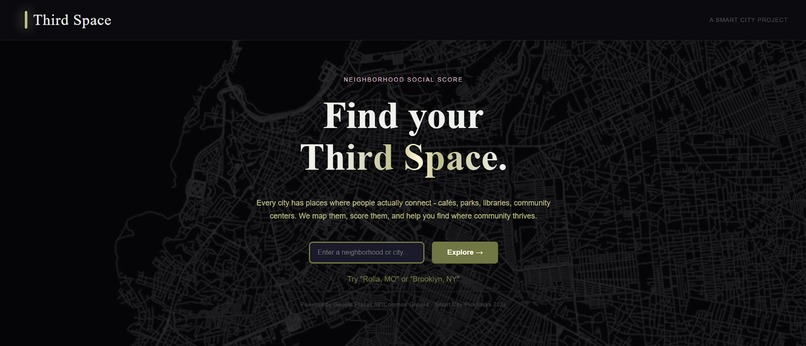
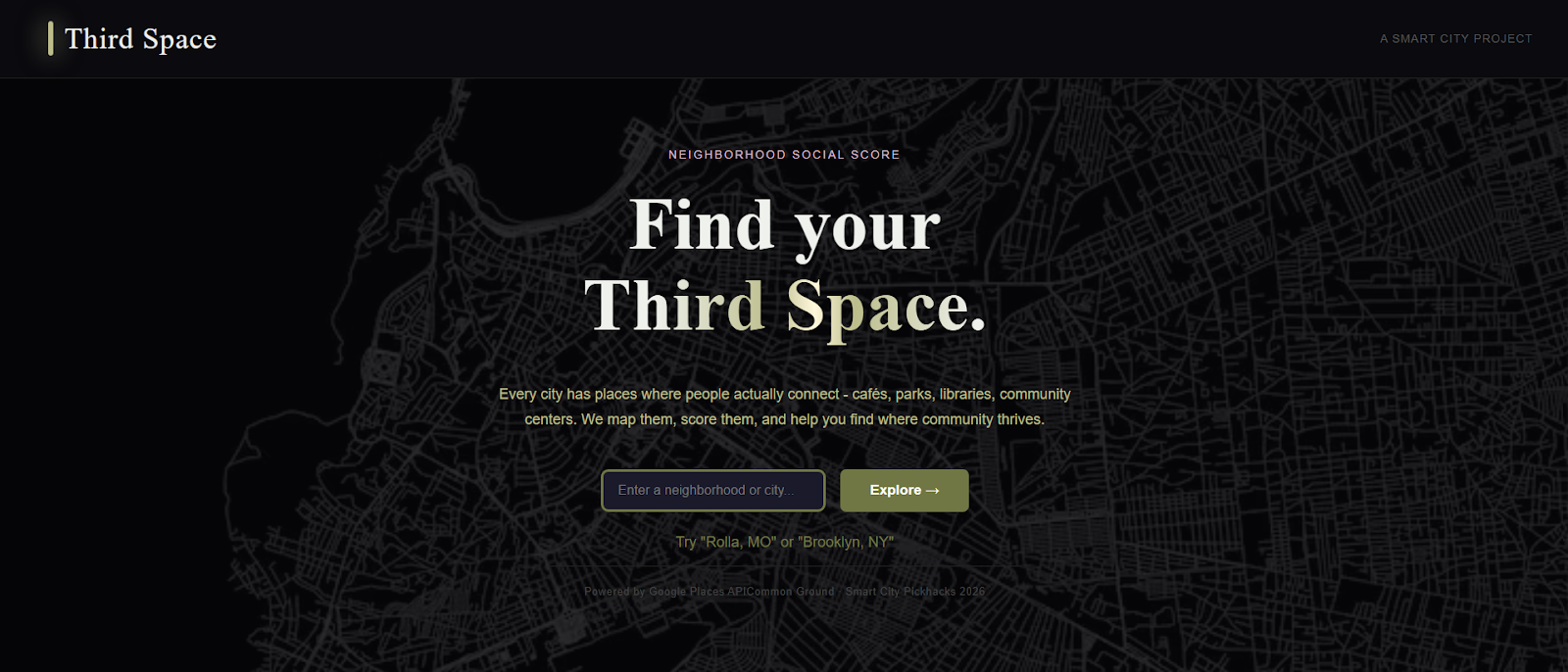
Landing Page
-
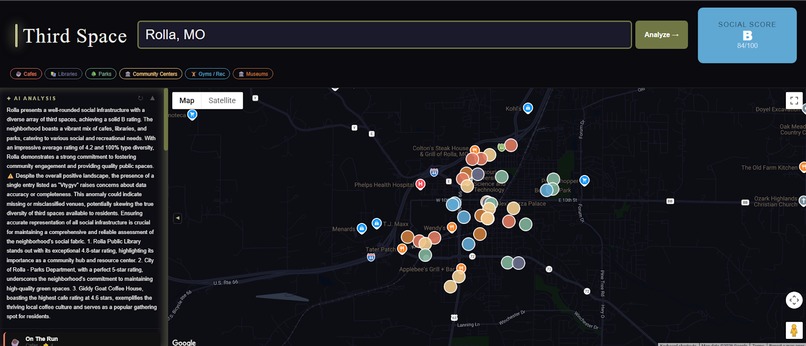
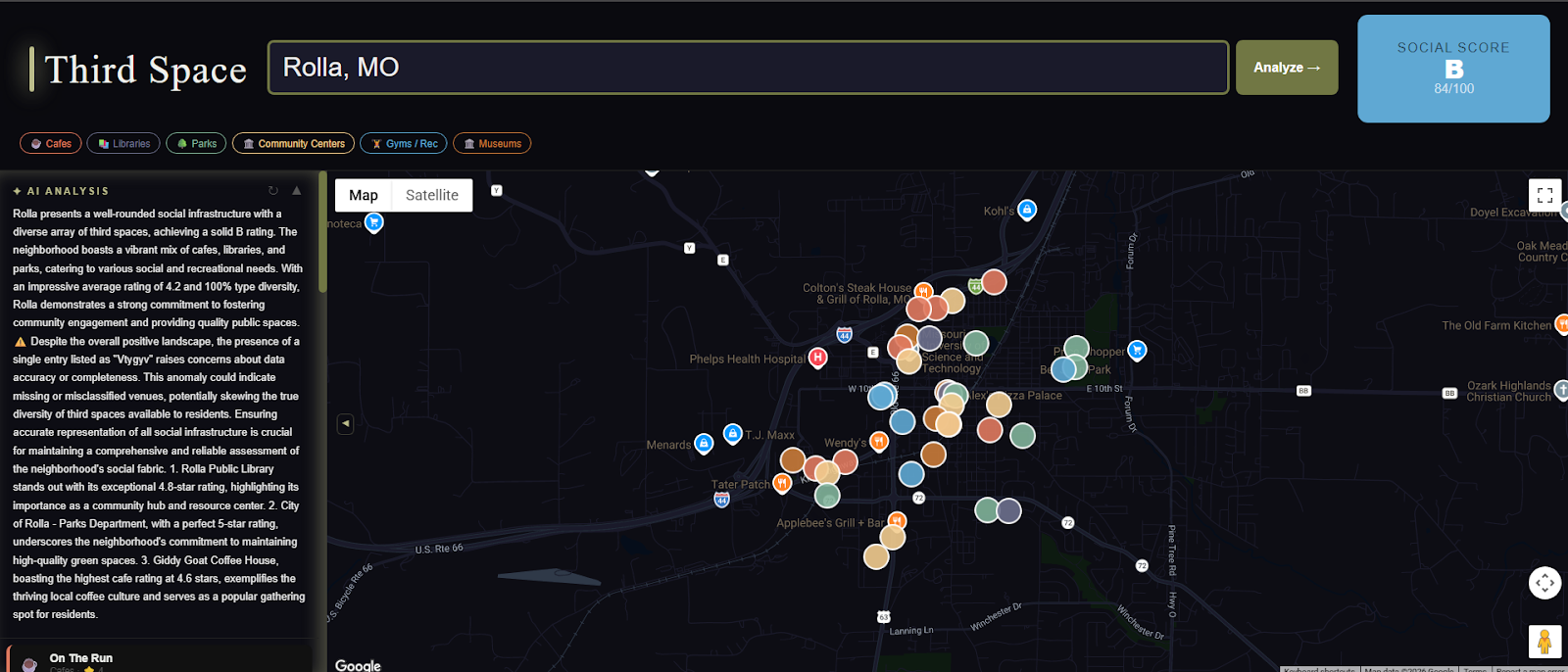
Search Results, with AI overview
-
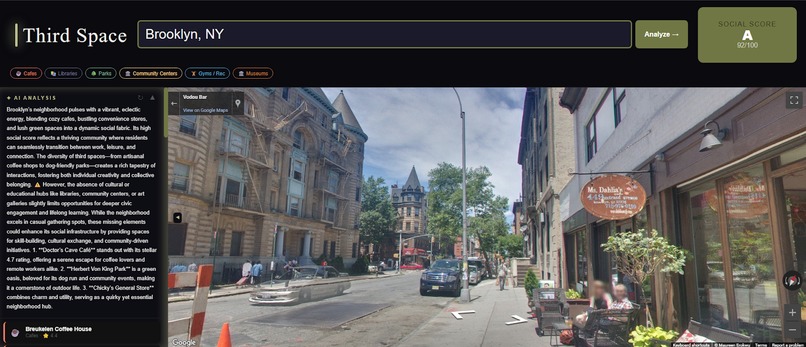
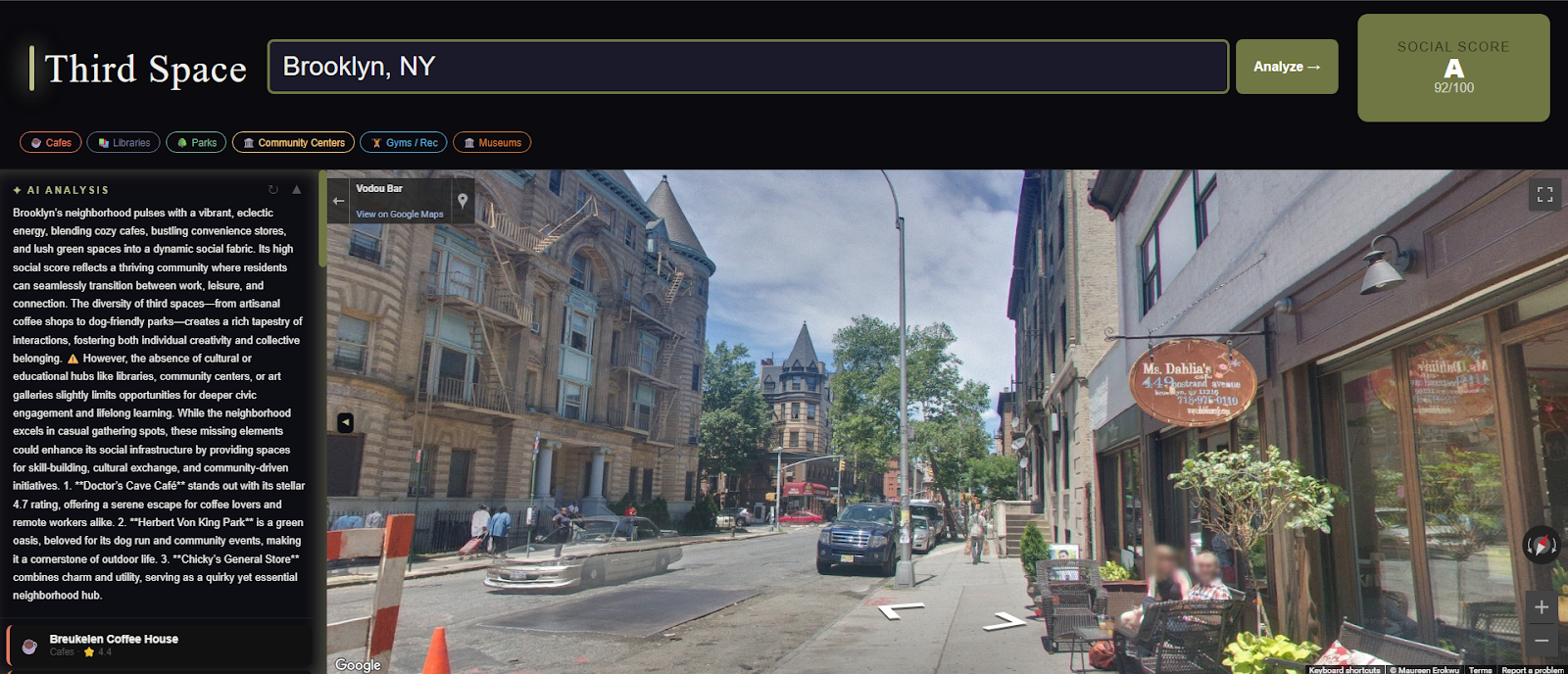
Street View
-
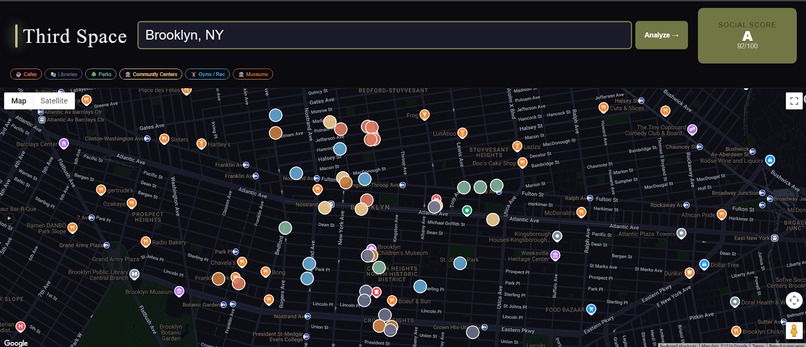
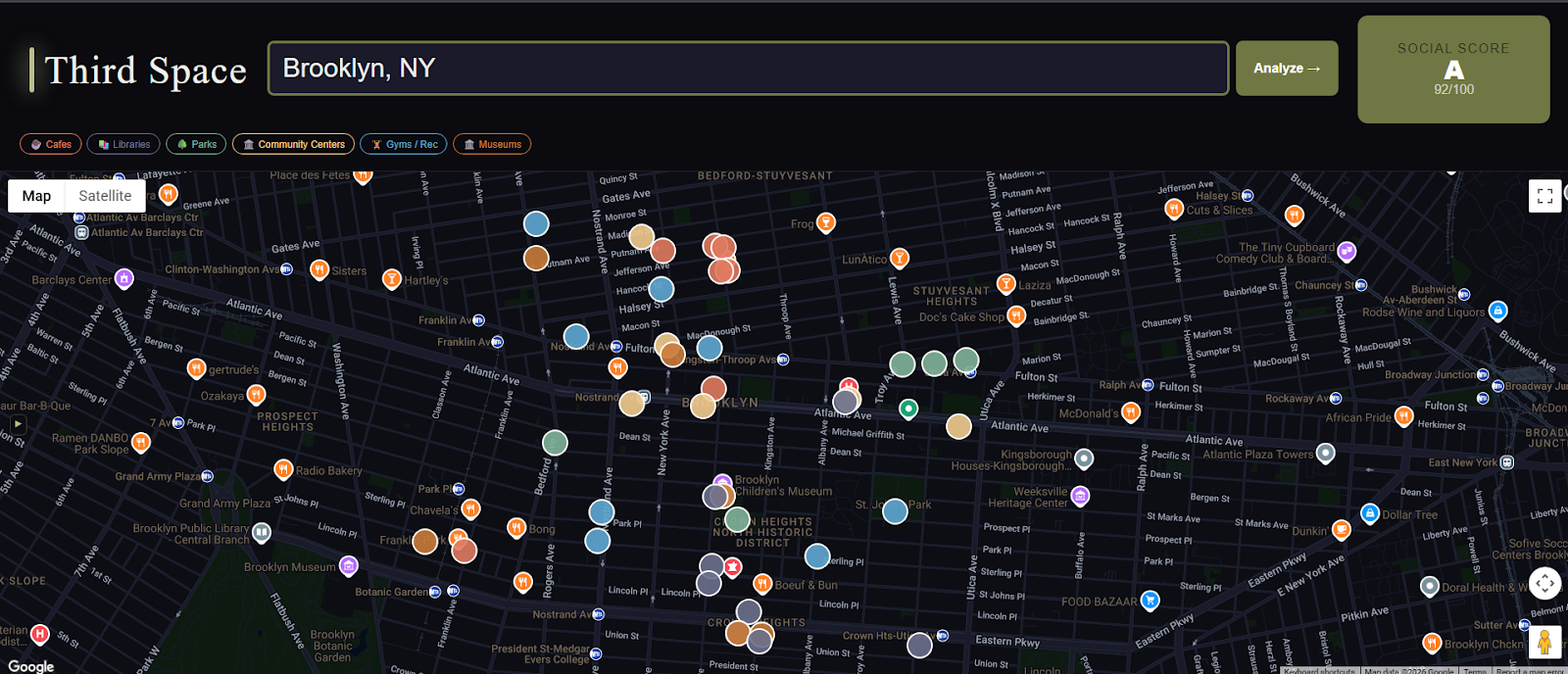
Full Map View
Inspiration
Being a college student, I found that going from work/school to home can be exhausting, repetitive, and unproductive. This made me remember the term "Third Space". You have your home, your work/school but what about that third place where you can not only be comfortable but also build community? Third spaces are the places between home and work where real community happens: cafés, libraries, parks, community centers. This project was about analyzing different neighborhoods/cities for their number of quality third spaces and giving them a social score.
What it does
Third Space is a tool that scores any neighborhood's social infrastructure in seconds. You type in any city or neighborhood, and Third Space pulls live data from Google Places, runs it through a weighted scoring algorithm inspired by urban planning research and gives you a letter grade with a full breakdown: what the neighborhood excels at, the number of these third spaces, what's missing, and an AI-generated personality profile on the community. I built this because cities aren't about just transit or groceries, and more about finding some place you belong.
How we built it
Third space is built with react for the frontend, pulling live location data from Places API to find and categorize third spaces within a certain radius. A custom scoring algorithm weighs quantity, type diversity, and average ratings to generate a letter grade. An Express.js backend sends requests to Open Router's AI API, which generates a natural language response profile for each neighborhood with a custom prompt. The app is deployed on Vercel with the backend hosted on railway
Challenges we ran into
The hardest challenge I ran in to was getting the AI analysis to work reliably. Free models on Gemini and anthropic wouldn't work for me, and the free models for OpenRouter would route to models what would exhaust their token budget. I also had issues with balancing soring algorithms to accurately reflect the social score of the neighborhood since Google Places tends to return highly rated venues and city sizes are often diverse.
Accomplishments that we're proud of
I was proud to fully deploy a web app working end to end in a hackathon time frame. This was my first time working with the Google Places API and full AI response integration, and seeing the work pay off into a polished product was very satisfying. Being able to see all different types of cities and their strengths/weaknesses, including Rolla, was really interesting.
What we learned
I learned a great deal about react and the required languages that support it. Being able to connect the Google Places API and the AI API backend with API keys to the react front-end was pretty new for me still.
What's next for Third Space
The biggest things I would want to focus on next would be full deployment with more consistent frameworks, polished/increased features for neighborhood comparison, and better algorithm calculation to take different cities and preferences in mind (Some prefer more cafes over libraries.)
Built With
- css
- express.js
- github
- google-places
- html
- javascript
- node.js
- openrouter
- railway
- react
- vercel


Log in or sign up for Devpost to join the conversation.