Project Story
The Inspiration
We are currently living through a loneliness epidemic, largely driven by digital isolation. Big tech recommendation algorithms have optimized for endless scrolling, trapping us in algorithmic echo chambers. We realized that standard chatbots usually act as blind enablers (or "CooperateBots") that just keep users glued to their screens.
We wanted to build a "PrudentBot"—an AI inspired by Löb's Theorem that cooperates with the user's authentic cultural tastes, but gently "defects" against their screen addiction by nudging them out into the real world. Our goal was to create a *"Discord for real-life connection". Just as Discord helps you find digital servers for niche interests, our project helps you find your physical community. In a life of isolation, #StatelessThirdSpace is simply about creating a place for you to go.
What is Stateless ThirdSpace?
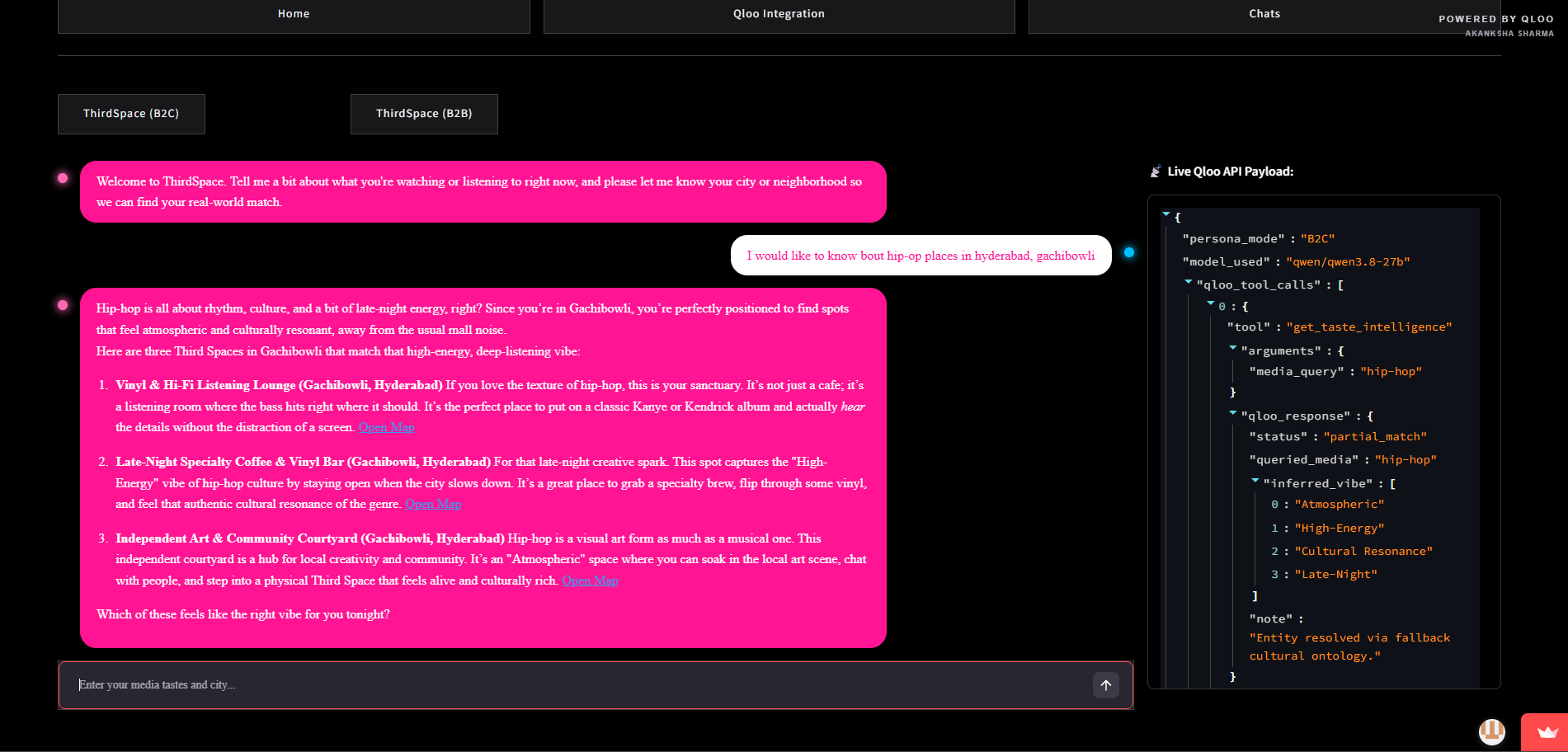
Stateless ThirdSpace is a dual-persona AI application built to bridge the gap between digital culture and physical communities[cite: 1, 4]. It operates in two distinct modes:
- B2C (The Digital Off-Ramp): This is not a flashy algorithmic tool; it is a warm, empathetic companion. It asks about the media you are currently consuming, evaluates your vibe, and suggests highly correlated, real-world "Third Spaces" (like an indie bookstore or an underground jazz cafe) where you can log off and belong.
- B2B (The Third-Space Architect): On the enterprise side, we created a formal real estate consultant tool. It takes target demographic data and cross-references it with local cultural affinities to advise commercial developers on exactly what physical amenities to build to fill "cultural gaps" in a neighborhood.
How We Built It & The Qloo Integration
We built the frontend using #Streamlit and the backend using #Python, #LangChain, and Groq's Llama 3 8B model.
At the core of the engine is the QLOO API. We utilized Qloo's Taste Intelligence and Locality Intelligence via transient JSON payloads. Because we rely on Qloo's "Stateless Inference," the app maps culture without tracking individual identities, meaning zero Personally Identifiable Information (PII) is ever retained.
Mathematically, our LangChain router executes a translation of digital inputs into geospatial outputs, which can be expressed simply as: $$ \mathcal{F}(T_{digital}, L_{geo}) \rightarrow S_{physical} $$ Where the user's digital taste ($T_{digital}$) and their city's Locality Intelligence ($L_{geo}$) converge to output the optimal physical Third Space ($S_{physical}$)[cite: 1, 10].
The Human Touch in the JSON: Instead of just parsing raw data and spitting out a robotic list of locations, we injected a psychological "Agent Constitution" into the backend. When the agent receives the structured Qloo JSON payload, this underlying prompt forces the LLM to process the data empathetically[cite: 10]. It translates cold API data into a highly human, natural conversation—explaining why a physical space matches the user's emotional frequency, rather than just telling them to go there.
Challenges We Faced
Our biggest hurdle was the frontend User Experience. Streamlit is notoriously rigid, but we wanted a highly immersive, dual-theme design. We had to aggressively override the default DOM using CSS injections to achieve our specific vision. This included creating a custom 3D axis logo animation that resolves into a doorway with a light beam, building custom iOS-style chat bubbles for the B2C tab, and ensuring absolutely no emojis were rendered in the professional interface. Furthermore, managing a complex ReAct tool-calling loop on a free-tier LLM without overflowing the context window required us to efficiently pass only bite-sized, temporary Qloo JSON payloads per turn.
What We Learned
We learned the profound difference between "Popularity Intelligence" and "Locality Intelligence". Recommending a physical location based purely on high ratings creates generic experiences. By leaning into Qloo's cultural taste graphs, we learned how to treat physical spaces as nuanced cultural entities, proving that #AI can be used to safely enrich physical human connection rather than just maximizing digital engagement.
