-
-
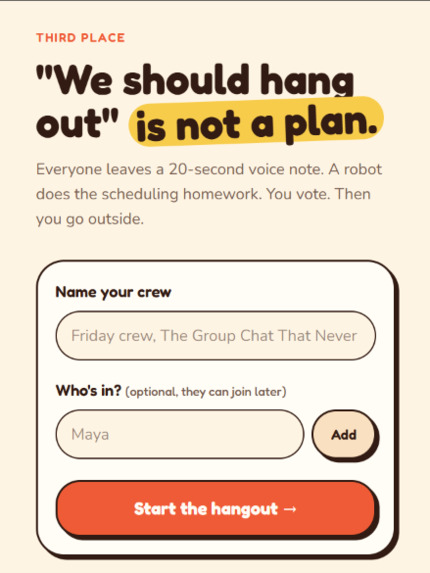
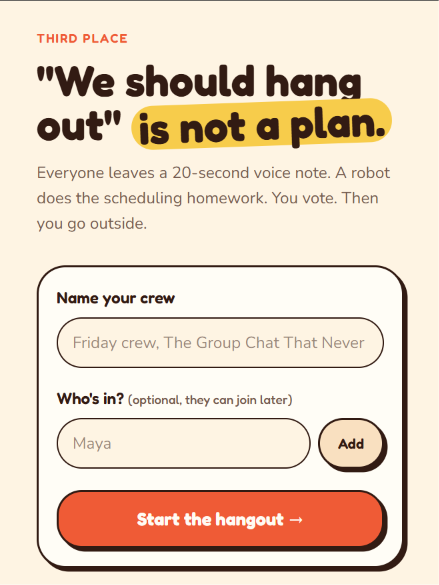
Home Page
-
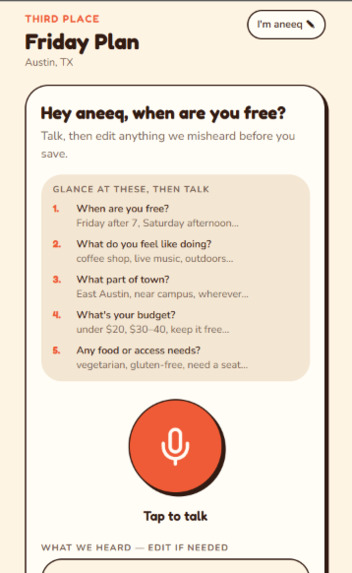
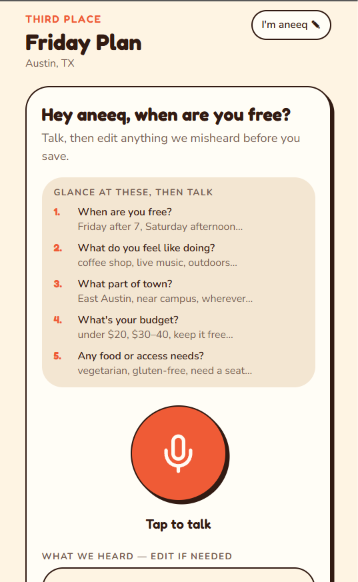
Capture Page
-
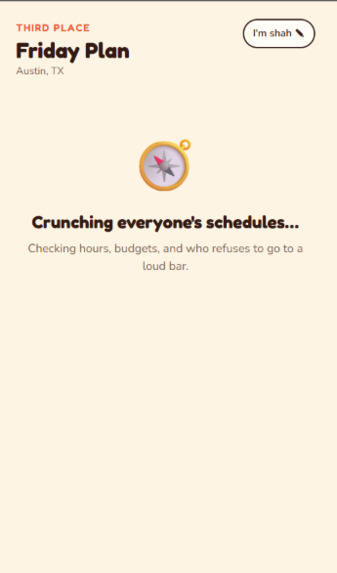
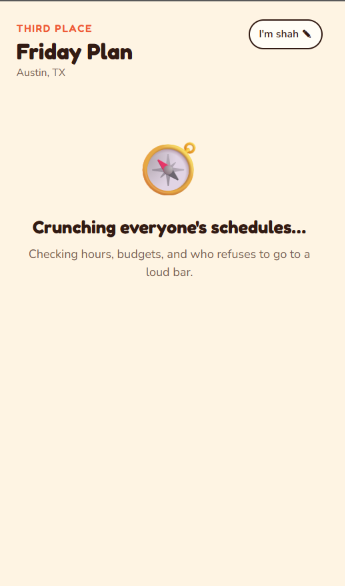
Loading page
-
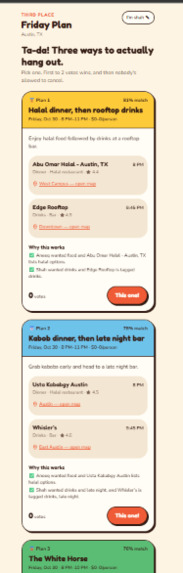
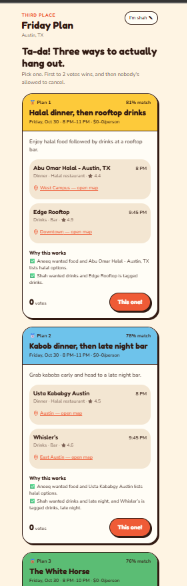
Voting Page
-
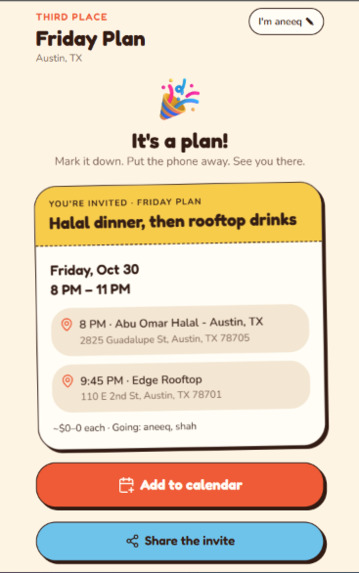
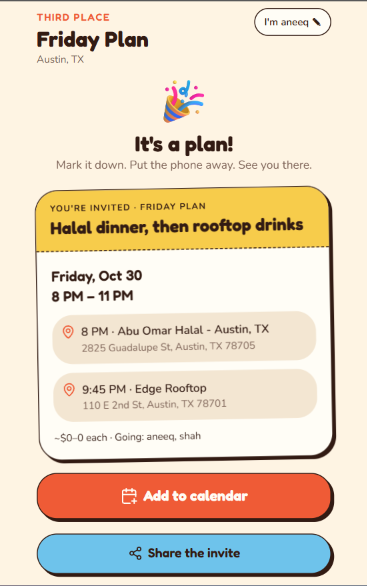
Final Plan Page
Inspiration
Everyone has a group chat that is all vibes and no calendar. "We should hang out" gets a dozen thumbs-up, then dies in a thread about whose Friday is free, who is vegetarian, and whether East Austin is too far. Nobody wants to be the friend who does the scheduling homework, so the hangout never happens.
We named the project Third Place after sociologist Ray Oldenburg's idea: home is the first place, work is the second, and the third is where you actually see people — a patio, a cheap dinner, a show. The app exists to get friends out of the chat and into one of those rooms. The product succeeds when everyone puts their phone down.
Austin made that concrete. It is a city of real third places, and we had 24 hours.
What it does
Turns your "Let's hang out together" into actual plans that suit everyone.
One person names the crew and shares a link. No accounts. Each friend leaves a 10–20 second voice note (or types) about when they are free, what they feel like, where in town, budget, and any food or access needs. The backend transcribes it, extracts structured constraints, finds real Austin venues and events, and returns exactly three ranked plans with plain-language reasons that name real people and real venue facts — plus honest tradeoffs when someone has to give something up.
The group votes. Majority wins. A confirmed plan becomes a shareable invite card and an .ics file you can drop on a calendar. Then you go outside.
How we built it
We split the work the way a small product team would, and locked a contract first so we could build in parallel:
- Frontend — React, TypeScript, TanStack Start/Router, Vite, built with Lovable. Voice recording in the browser, live group state, voting, invite card, calendar download.
- Backend — Node + TypeScript on Hono. In-memory groups, a plan pipeline, SerpApi search, and an RFC 5545
.icsexporter. - Shared contract —
shared/types.ts, a JSON Schema for constraints, anddocs/api-contract.md. Frontend and backend only talk through that shape.
The pipeline is:
- Transcribe voice with Muse Voice.
- Extract constraints with Muse Spark against a strict schema: free windows, budget, vibe, diet, accessibility, neighborhood, transport. Relative language like "Friday after 7" is resolved in
America/Chicago. - Merge overlapping free time (everyone first; otherwise the largest subset free for at least an hour). Dietary, accessibility, and budget caps are hard. Vibe and area are soft.
- Search Google Maps and Google Events via SerpApi, then drop places that are closed in the window.
- Score venues against each person's stated needs, then ask the model to assemble 3 different 1–2 stop plans. Reasons may only cite facts in the data.
- Vote until more than half the group agrees; then export the invite.
We built against mock payloads until the live path existed, and cache SerpApi responses so the demo still works if the key or the network flakes.
Challenges we ran into
"Friday after 7" is not a datetime. People talk like people. We had to resolve weekdays, "afternoon," "under $30," and empty time (treat them as flexible) into ISO windows without inventing a night nobody offered.
The model wants to be helpful, which is dangerous. Early extractions invented vegetarian or wheelchair needs nobody said. We added a schema, a retry loop, and a text-stem backstop: dietary and accessibility tags only survive if the transcript actually mentioned them.
Venues lie if you let the LLM write the brochure. Ranking prompts are grounded in precomputed matches and violations. A reason that claims a patio or a gluten-free menu we do not have in the data is a bug, not copy.
Opening hours are a mess. SerpApi returns strings like "11 AM–2 PM, 5–10 PM" and "Open 24 hours." We wrote a parser and drop anything closed during the planned window.
Friends do not all overlap. If Maya is free Friday and Jordan is free Saturday, failing the whole group is worse than planning for the largest subset and saying so.
24 hours, three surfaces, one API. The only way that worked was treating the contract as source of truth and refusing to drift.
Accomplishments that we're proud of
- A full loop in a day: share a link → talk for 20 seconds → three real Austin plans → vote → calendar file.
- Plans that explain themselves. "Maya wanted cheap and Dev wanted outdoors" only if both the person and the venue support it.
- Hard needs are actually hard. Vegetarian, quiet, seating, and a budget cap can knock a place out instead of becoming flavor text.
- No accounts, no group-chat archaeology. Identity is just a name on a link.
- A cache-first venue layer so judges can demo without burning API quota or waiting on a live Maps call.
- An invite that looks like a ticket and an
.icsthat actually opens in a calendar.
What we learned
Structured output beats a clever prompt. A shared JSON Schema, retries, and server-side normalization did more for reliability than asking the model to "please be careful."
Ground the language model in facts, then let it write. We score venues in code (hours, overlap, diet, budget) and only then ask for titles, "why," and tradeoffs. The model is a copywriter with a short leash, not a travel agent with a search bar.
Voice UX is product work. A 20-second cap, on-screen prompts ("when / what / where / budget / needs"), a mic level, and a typed fallback mattered as much as the model behind them.
And the social lesson: the hard part of hanging out is not finding a bar. It is turning four messy preferences into one time and place without someone feeling ignored.
What's next for Third Place
- Persist groups so a refresh does not wipe the crew (state is in memory for the hackathon).
- More cities, not just Austin.
- Calendar import so "when are you free" is not only a voice note.
- Richer invite cards (generated images, not only the in-app ticket).
- Recurring friend groups and a history of places that already worked.
- Live presence on the vote screen so you can see who still needs to pick.
The north star does not change: fewer threads, more third places.
Built With
- caddy
- claude
- cursor
- docker
- google-gemini
- google-maps
- hono
- lovable
- meta
- muse
- muse-image
- muse-spark
- muse-voice-transcribe
- node.js
- openai
- react
- serpapi
- shadcn-ui
- tailwind-css
- tanstack-start
- typescript
- vercel
- vite
- vultr
