-
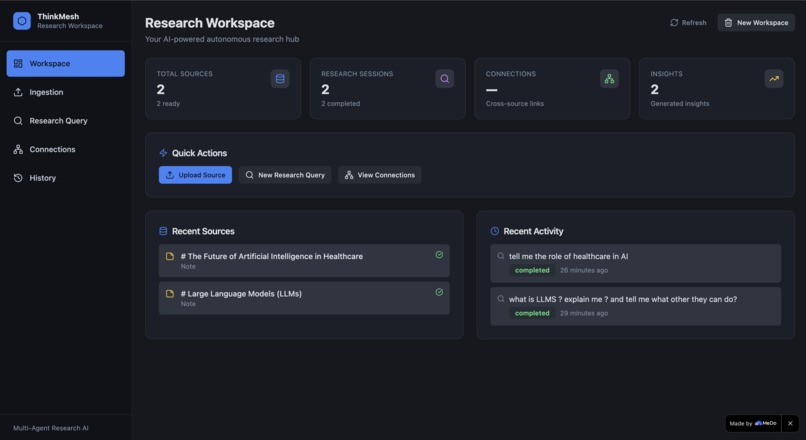
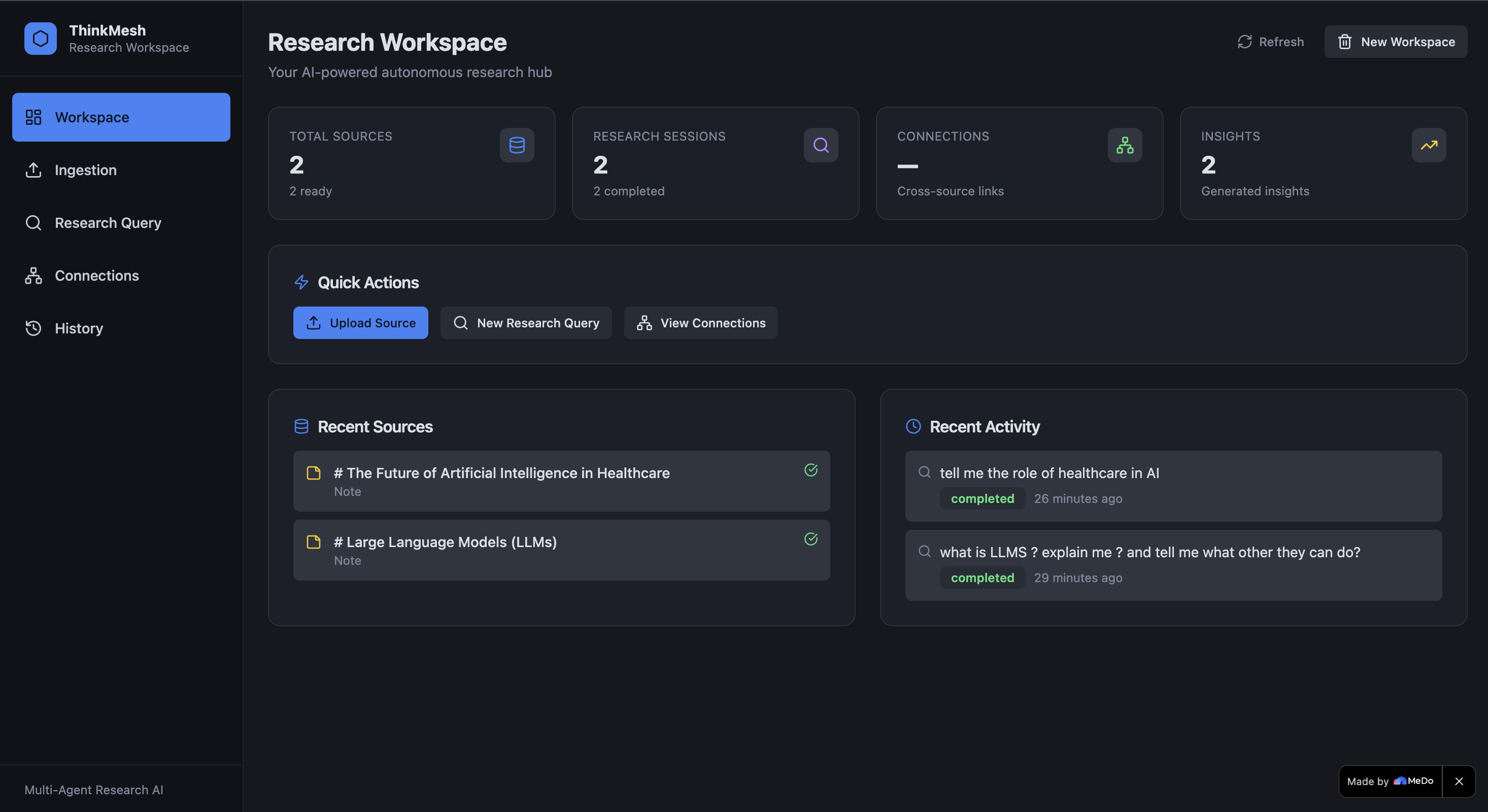
Dashboard
-
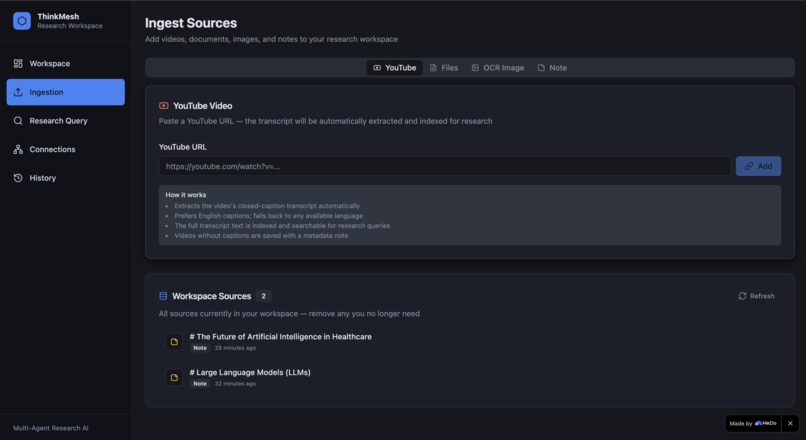
source control
-
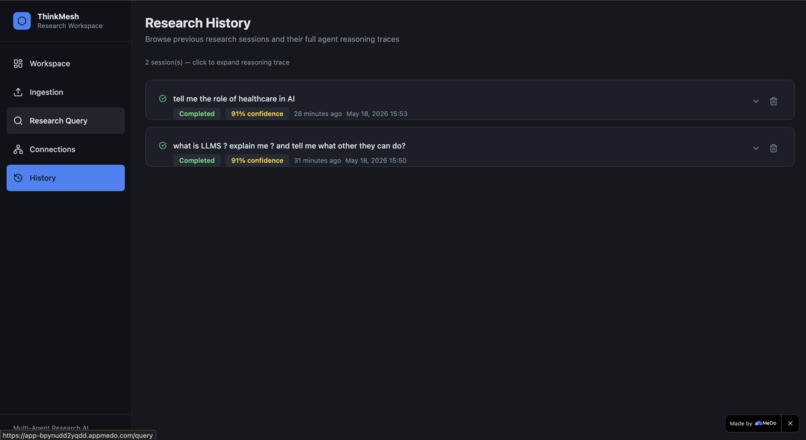
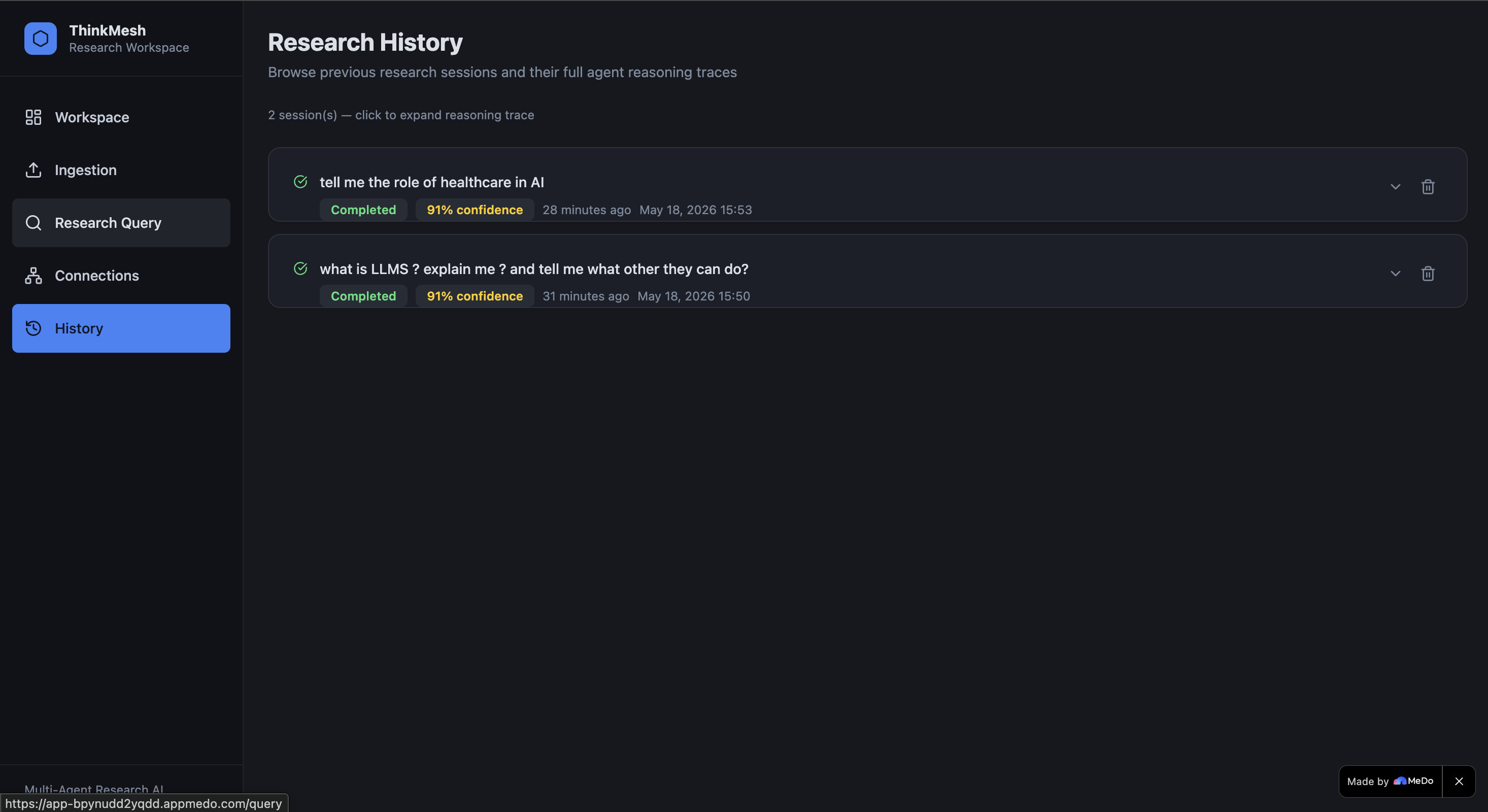
Research History
Inspiration
Modern knowledge work is fragmented across YouTube videos, PDFs, research papers, notes, screenshots, and scattered documents. Most AI tools today only provide a single chatbot response, hiding how conclusions are actually formed.
I wanted to explore a different idea: What if AI systems could reason more like collaborative research teams instead of simple assistants?
ThinkMesh was inspired by emerging autonomous research systems and multi-agent reasoning architectures. The goal was to build an AI-native workspace where multiple reasoning agents could analyze the same information from different perspectives, critique each other, and synthesize grounded insights transparently.
Instead of producing one opaque answer, ThinkMesh exposes the reasoning process itself.
What it does
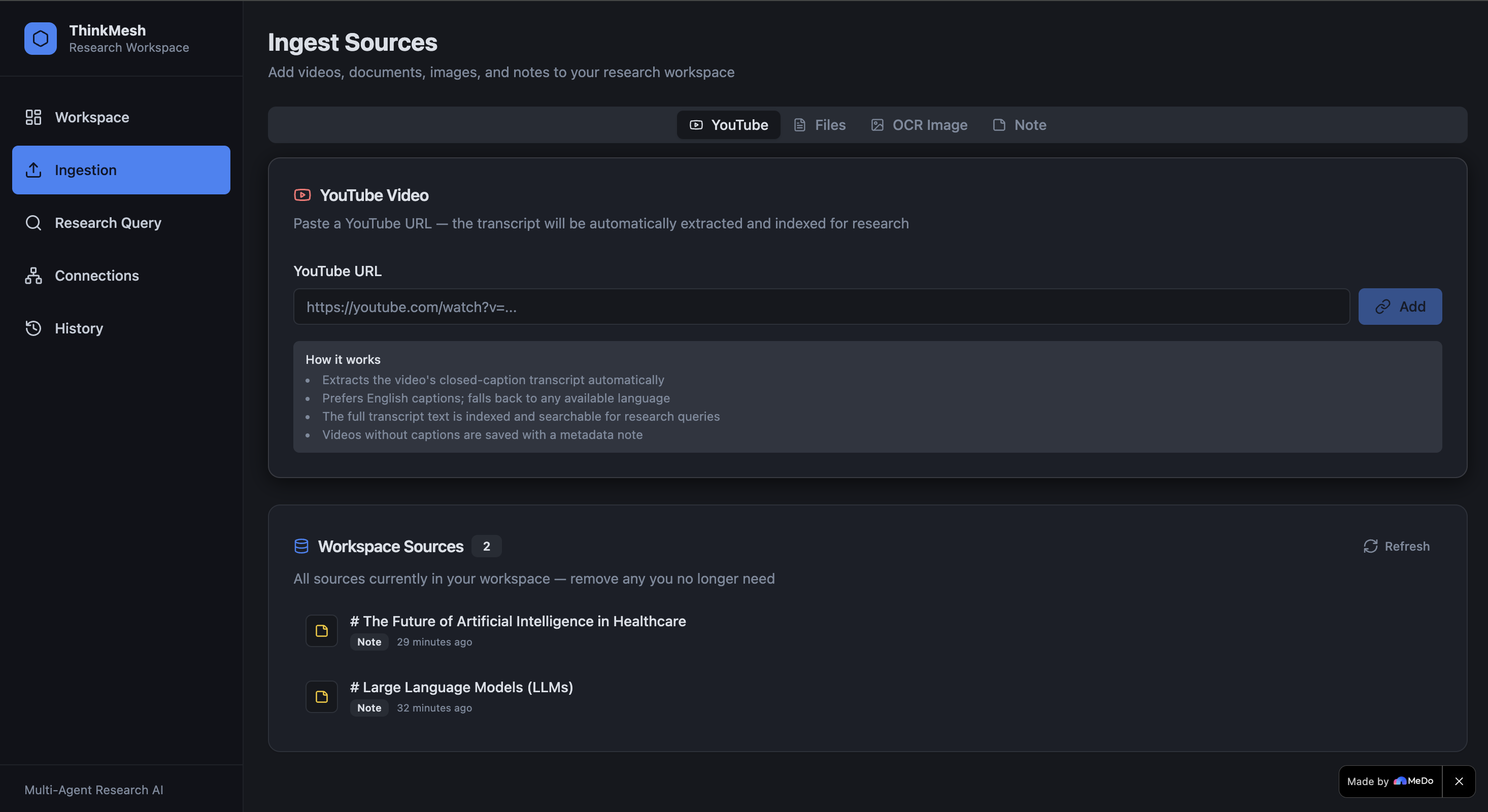
ThinkMesh is an autonomous research workspace that ingests:
- YouTube videos
- PDFs
- text/markdown documents
- notes
- scanned documents and screenshots via OCR
The system retrieves relevant information and runs a sequential multi-agent reasoning pipeline:
- Summarizer — extracts factual information
- Skeptic — questions assumptions and gaps
- Contrarian — generates opposing viewpoints
- Connector — identifies hidden patterns and relationships
- Judge — synthesizes all perspectives into a grounded final answer
Users can see every reasoning step, citations, supporting evidence, and the final synthesis.
ThinkMesh also identifies cross-source relationships such as:
- contradictions
- recurring concepts
- thematic overlaps
- hidden insight clusters
across all uploaded materials.
How we built it
The original ThinkMesh architecture combines:
- Next.js
- TypeScript
- FastAPI
- LangGraph
- PostgreSQL + pgvector
- Ollama local models
- Groq-hosted judge models
For the MeDo version, the project was adapted into an AI-native workflow application using:
- MeDo backend services
- sequential LLM orchestration
- retrieval-augmented generation (RAG)
- OCR processing via PaddleOCR / Baidu AI Studio integrations
- multi-source ingestion workflows
- visible reasoning interfaces
The application is structured into five major sections:
- Workspace
- Ingestion
- Research Query
- Connections
- History
The Research Query page acts as the core experience where users watch multiple reasoning agents collaborate in real time.
Challenges we ran into
One of the biggest challenges was designing reasoning flows that felt meaningful instead of repetitive. Each agent needed a distinct purpose and reasoning style while still contributing toward a coherent final synthesis.
Another challenge was handling heterogeneous data sources consistently. Videos, PDFs, OCR-extracted screenshots, and notes all needed to become part of the same searchable research workspace.
Designing the UI was also important. Since ThinkMesh focuses heavily on transparent reasoning, the interface needed to clearly visualize the progression between agents without overwhelming the user.
Balancing retrieval quality, reasoning depth, and response speed was another key engineering challenge.
What we learned
This project taught us a lot about:
- multi-agent reasoning systems
- retrieval-augmented generation pipelines
- sequential orchestration
- grounded synthesis
- transparent AI workflows
- cross-source knowledge retrieval
- OCR-powered document understanding
We also learned that exposing intermediate reasoning steps creates a much more engaging and trustworthy AI experience compared to traditional single-response chat systems.
What's next for ThinkMesh
Future directions for ThinkMesh include:
- deeper research graph visualizations
- dynamic agent generation
- collaborative multi-user workspaces
- advanced citation tracing
- multimodal retrieval pipelines
- autonomous hypothesis generation
- interactive knowledge maps
The long-term vision is to build a next-generation AI research environment where autonomous reasoning systems help humans explore, critique, and synthesize knowledge transparently.
Built With
- baidu-ai-studio
- fastapi
- groq
- langgraph
- multi-agent-ai-systems
- next.js
- node.js
- ocr-processing
- ollama
- paddleocr
- pgvector
- postgresql
- react
- retrieval-augmented-generation-(rag)
- semantic-search
- typescript
- vector-embeddings


Log in or sign up for Devpost to join the conversation.