-
-
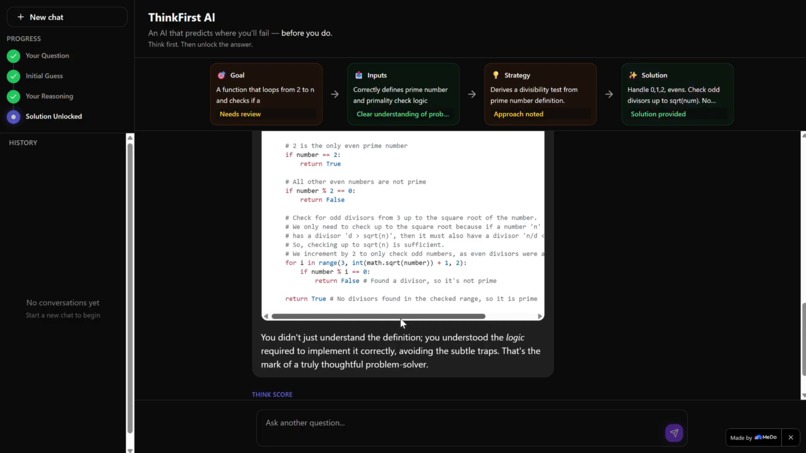
Full workflow
-
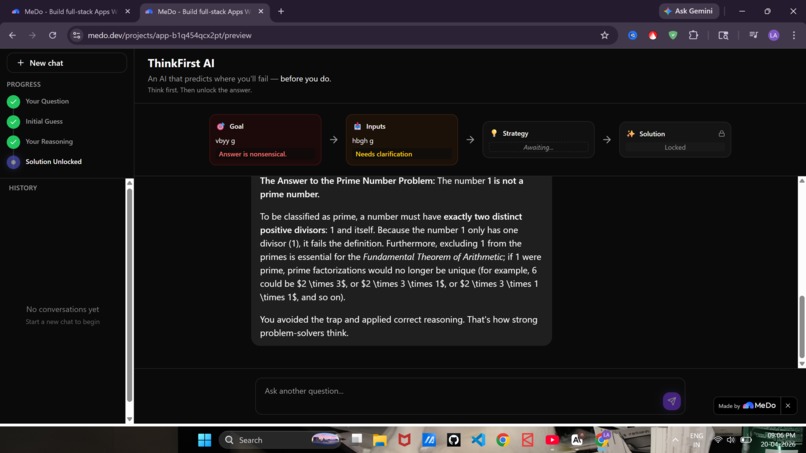
Predictive Failure moment
-
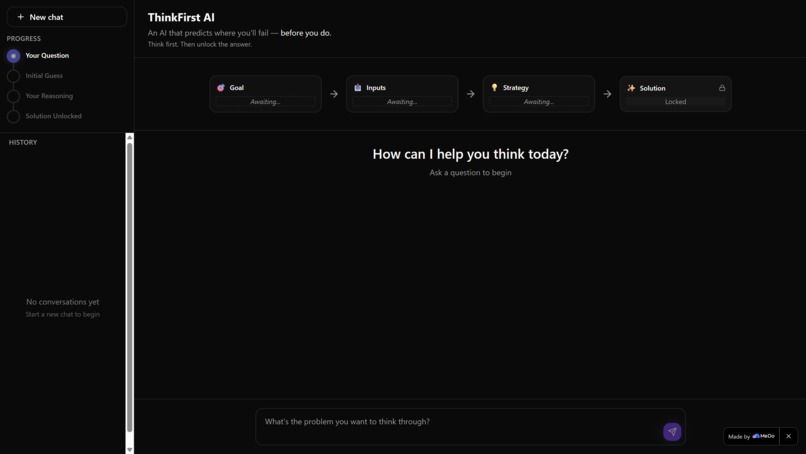
Landing page
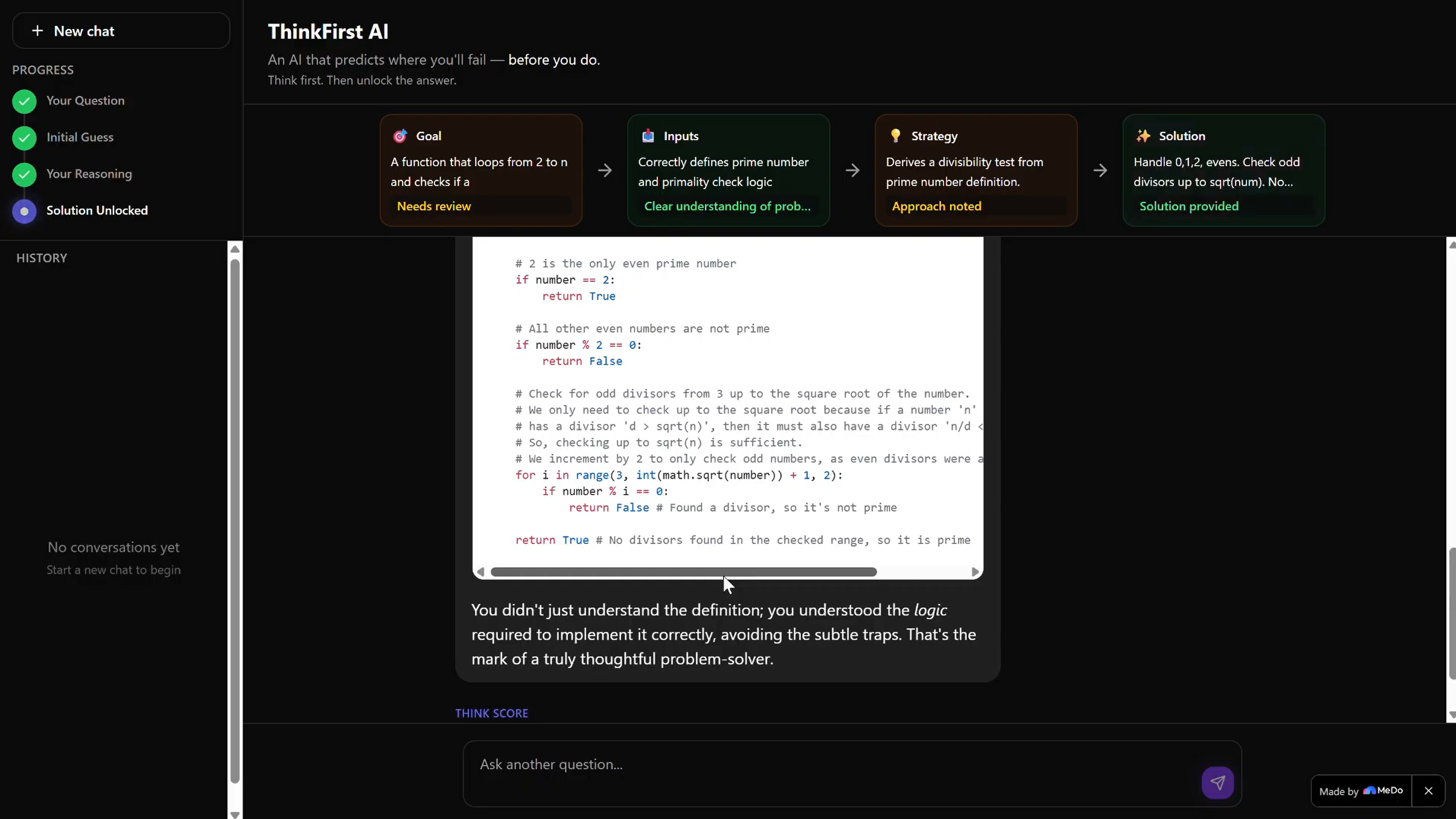
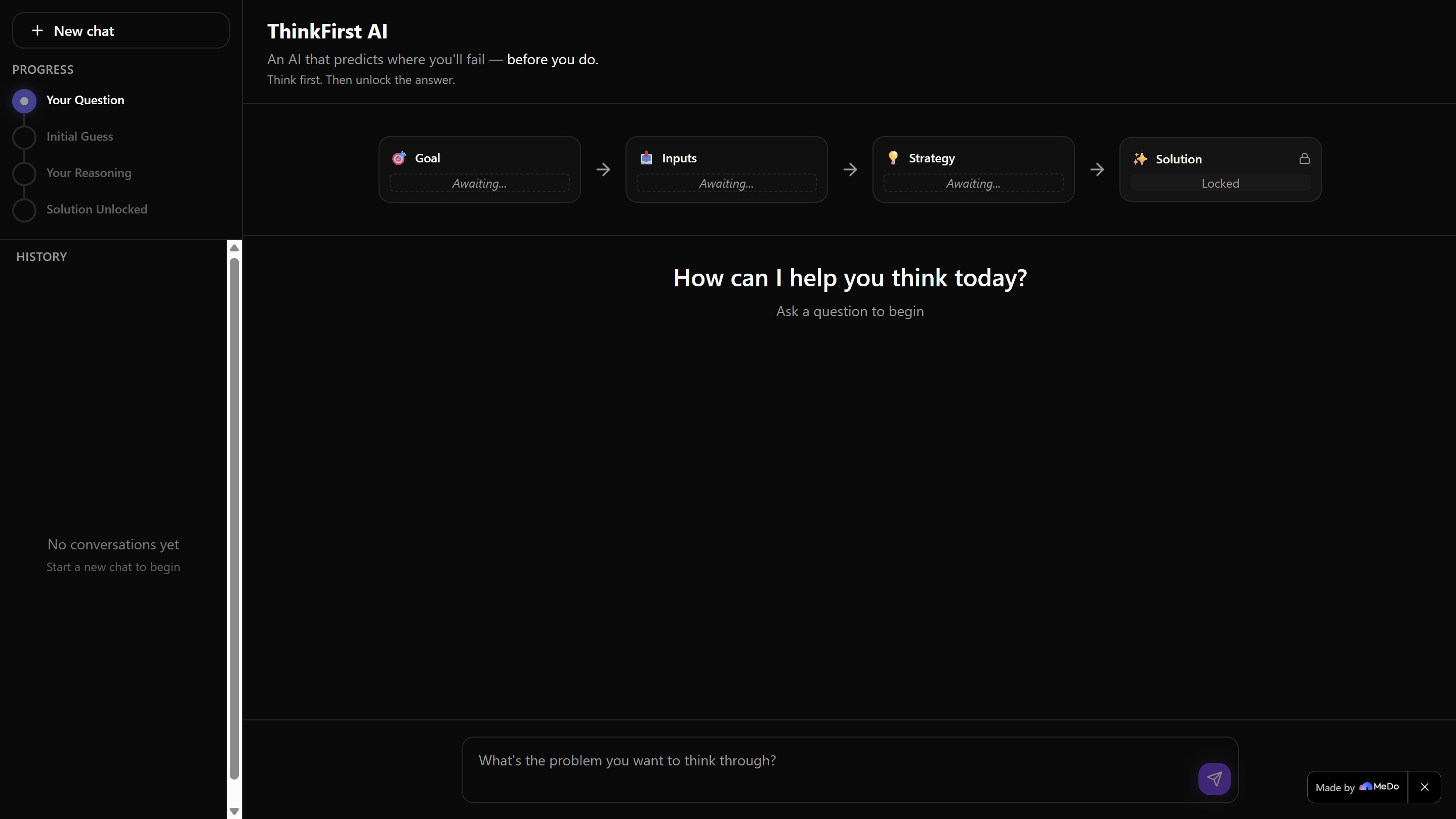
ThinkFirst AI — The AI That Predicts Your Mistakes Before You Make Them
Inspiration
I kept running into the same problem while learning to code.
I could watch tutorials, understand everything perfectly, and still freeze completely when facing a blank screen alone. No hints. No examples. Just me and the problem.
This is Tutorial Hell.
The issue was never lack of information. It was lack of independent thinking.
Modern AI tools made this worse. ChatGPT, Copilot, and Gemini give complete answers in under 3 seconds. The faster I got answers, the less I practiced reasoning. Every time I googled the answer instead of figuring it out myself, my brain learned to give up a little faster.
I realized most AI tools optimize for speed — not understanding.
So I asked a different question:
What if AI didn't give answers first? What if it predicted where you'd fail — and trained you to think your way through it?
That became ThinkFirst AI.
The Problem It Solves
Millions of learners are stuck in Tutorial Hell — a state where they can follow solutions but cannot generate them independently. Every existing AI tool makes this worse by providing instant answers. The brain learns to outsource thinking. The learner gets faster at copying and slower at reasoning.
This is documented across thousands of posts on r/learnprogramming, r/cscareerquestions, and r/selflearning. It is not a niche frustration — it is the defining failure mode of online learning in the AI era.
This is not a knowledge problem. It is a thinking problem.
No AI tool has been built specifically to fix it. Until now.
What It Does
ThinkFirst AI is a cognitive training system disguised as an AI tutor.
Instead of solving problems for you, it:
- Predicts your most likely mistake before you answer a single question
- Guides you through structured Socratic thinking — never giving hints, only activating reasoning
- Builds a live ThinkMap of your reasoning in real time
- Evaluates your thought process visually — not just whether you were right
- Only unlocks the solution after you've demonstrated understanding
- Scores your reasoning with a Think Score out of 10
Every AI gives answers. ThinkFirst builds thinkers.
How It Works
1. Predictive Failure System
When a user submits a problem, ThinkFirst reads the problem type and identifies the single most common mistake beginners make for that specific problem.
Before asking any question, it says:
"Most people fail at edge cases like numbers less than 2 — leading to wrong conclusions. Let's see if you do."
This is not a generic warning. It is a specific, expert-toned prediction tied directly to the problem submitted.
The predicted mistake is stored internally and evaluated after the user answers — telling them whether they fell into the trap or avoided it.
2. Socratic Engine
Instead of answering, ThinkFirst asks exactly 2 structured questions:
- Initial Guess: "What do you think the answer might be?"
- Reasoning: "Why do you think that?"
The AI never answers, never hints, and never advances until the user has submitted their own thinking first.
If the user tries to skip:
"I'll unlock the solution once you've answered the questions. What do you think the answer might be?"
3. ThinkMap
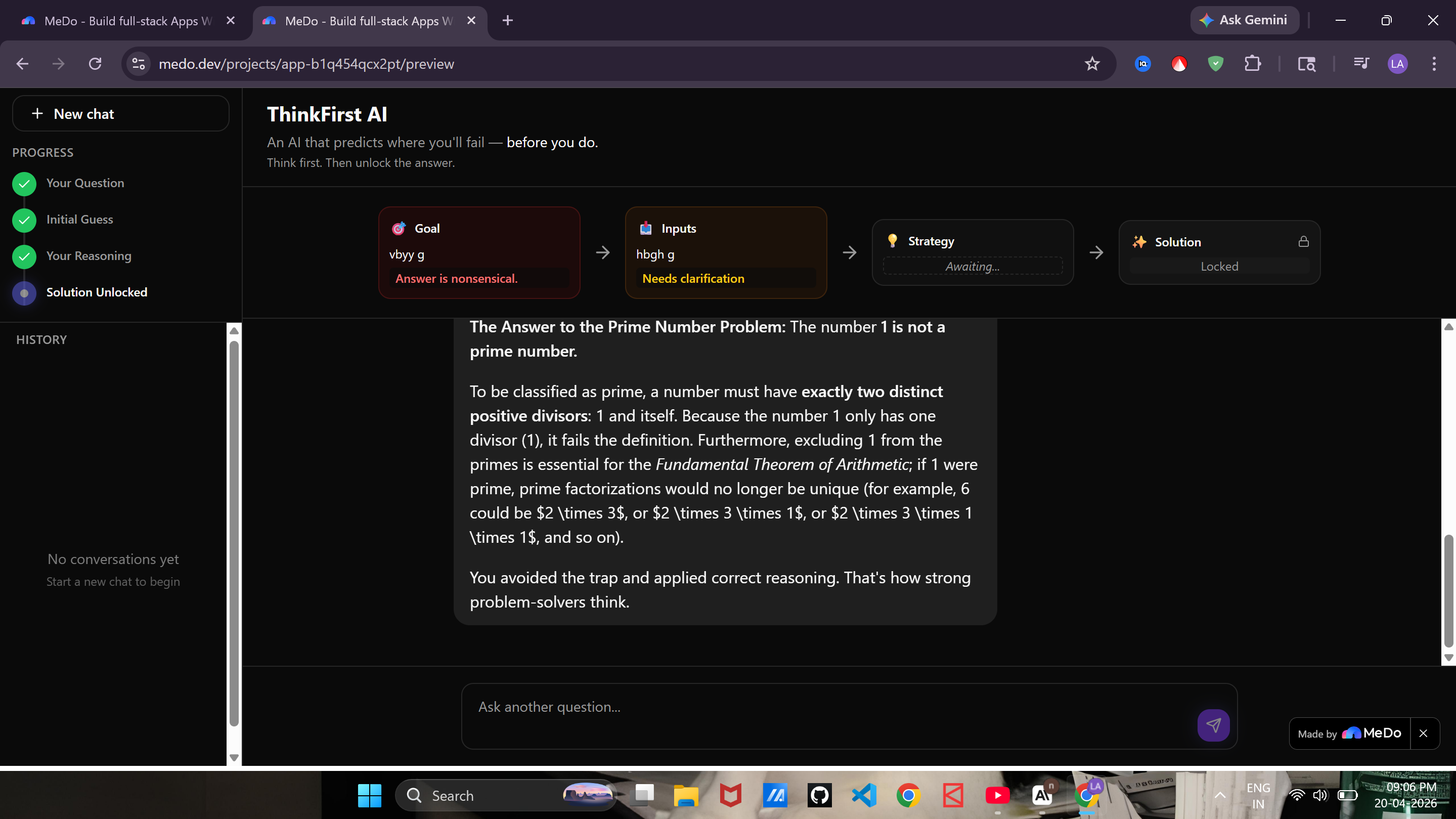
A live 4-node horizontal flowchart builds in real time: Goal → Inputs → Strategy → Solution
Each node is evaluated by AI against 3 specific criteria:
- Did the user define the expected output?
- Did the user handle at least one edge case?
- Did the user describe steps rather than just a result?
Nodes are color-coded:
- GREEN = Correct and complete reasoning
- YELLOW = Partially correct, specific gap identified
- RED = Incorrect or missing reasoning
Each node shows a one-line AI verdict:
- "Correct — goal clearly defined"
- "Partial — what if the array is empty?"
- "Missing — you described output, not steps"
The Solution node stays locked until the ThinkMap is complete.
4. Solution Unlock
Solutions are earned, not given.
Only after the user completes the reasoning process does ThinkFirst unlock a guided step-by-step solution path — not a full answer, a reasoning scaffold.
The unlock message:
"Now that you've built the thinking — here's the guided path."
5. Think Score
After the solution unlocks, ThinkFirst calculates a Think Score out of 10 based on the color evaluations of the 3 reasoning nodes:
- GREEN = 3 points
- YELLOW = 2 points
- RED = 1 point
Displayed with a personalized insight:
"Think Score: 8/10 — Strong reasoning with clear logic."
6. Personal Diagnosis
After all reasoning is evaluated, ThinkFirst tells the user whether they made the predicted mistake or avoided it:
If they made it:
"You made the exact mistake most people do — you skipped the edge case for numbers less than 2. This is your blind spot."
If they avoided it:
"You avoided the most common mistake. You handled the edge case before writing a single step. That's strong thinking."
How I Built It
ThinkFirst AI was built entirely with MeDo using no-code conversational product building.
No traditional coding stack. No frameworks. No IDE. Every feature was described in natural language and MeDo generated the full implementation.
Core systems built through MeDo:
1. Multi-turn conversation architecture
The Socratic Engine runs 4-6 turns deep — Predictive Failure → Initial Guess → Reasoning → Evaluation → Solution Unlock → Think Score — before any solution appears. MeDo's conversation system manages the complete session state throughout.
2. Conditional logic and unlock system
MeDo generated the solution lock/unlock mechanic — a conditional UI behavior where the Solution node remains locked until all ThinkMap criteria are met. Built entirely through natural language prompting.
3. MeDo's Large Language Model plugin
MeDo's LLM plugin powers the core reasoning evaluation engine — the AI that checks each answer against the 3 evaluation criteria and assigns GREEN/YELLOW/RED status per node. The same plugin generates the Predictive Failure analysis specific to each problem type submitted, and produces the Personal Diagnosis after evaluation.
4. ThinkMap visualization
MeDo generated the 4-node horizontal strip, color-coded animated nodes, fade-in animations, the glow unlock animation on the Solution node, and the progress stepper — all described in natural language.
5. Full deployment
The complete application deployed to a public URL directly from MeDo with one click. No external hosting configuration required.
Challenges I Ran Into
The hardest challenge was not UI. It was designing reasoning evaluation.
I needed ThinkFirst to judge how someone thinks — not just whether their answer was correct. This required:
- Structured 3-criteria node evaluation
- Color coding logic distinguishing correct from partial from wrong
- Conditional follow-up questions when a node evaluates RED
- Unlock mechanics that respond to evaluation state
- Personal diagnosis referencing the user's specific answers
The second challenge was the Predictive Failure System. Making an AI predict the specific mistake a user will make — before they answer — required careful prompt engineering. The prediction must be specific to the problem type, expert-toned, and delivered in one concise sentence. Generic predictions fail immediately.
The third challenge was keeping scope tight. The discipline of building only what creates the core experience — predict, question, map, unlock, score — is what made the product feel complete rather than cluttered.
What I Learned
Product differentiation in AI is not about giving more. It is often about strategically giving less.
By withholding answers temporarily, ThinkFirst creates something most AI tools accidentally destroy: independent reasoning.
I also learned that no-code AI builders like MeDo are not just faster ways to build existing product categories. Used correctly, they enable entirely new product philosophies — ideas that would take weeks to prototype in code can be tested and deployed in days through conversation.
The most valuable insight: the constraint of building in natural language forces clarity of thinking. If you cannot describe a feature in plain English well enough for MeDo to build it, you probably do not understand the feature well enough to build it yourself.
The Bigger Idea
The next generation of AI products may not win by replacing human thought.
They may win by rebuilding it.
ThinkFirst AI is built on one belief: thinking is a trainable skill, not a talent. Every learner who has ever stared at a blank screen and felt like they were not smart enough was not experiencing a lack of intelligence. They were experiencing a lack of a thinking framework.
ThinkFirst gives them that framework — one problem at a time.
The next wave of high-impact AI products will not be AI-First. They will be Human-Grounding.
ThinkFirst AI is my attempt at that future.
Built With
- artificial-intelligence
- cognitive-training
- conversational-ai
- ed-tech
- education
- large-language-model
- medo
- no-code
- prompt-engineering
- socratic-learning


Log in or sign up for Devpost to join the conversation.