-
-
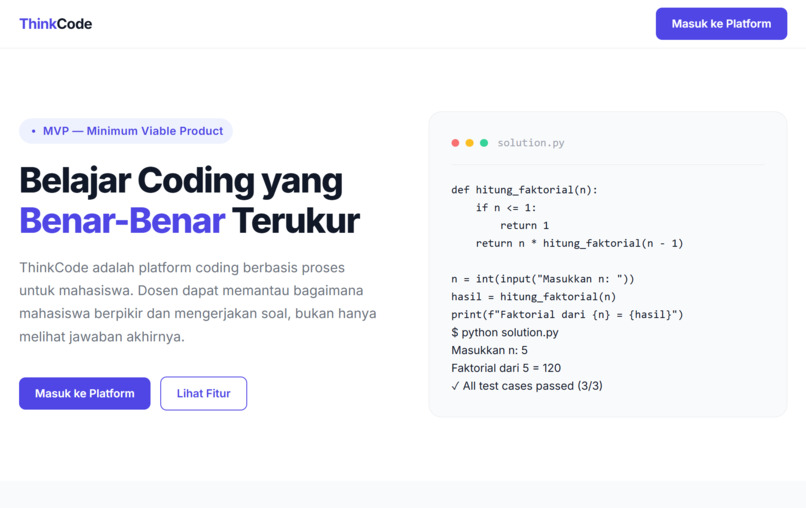
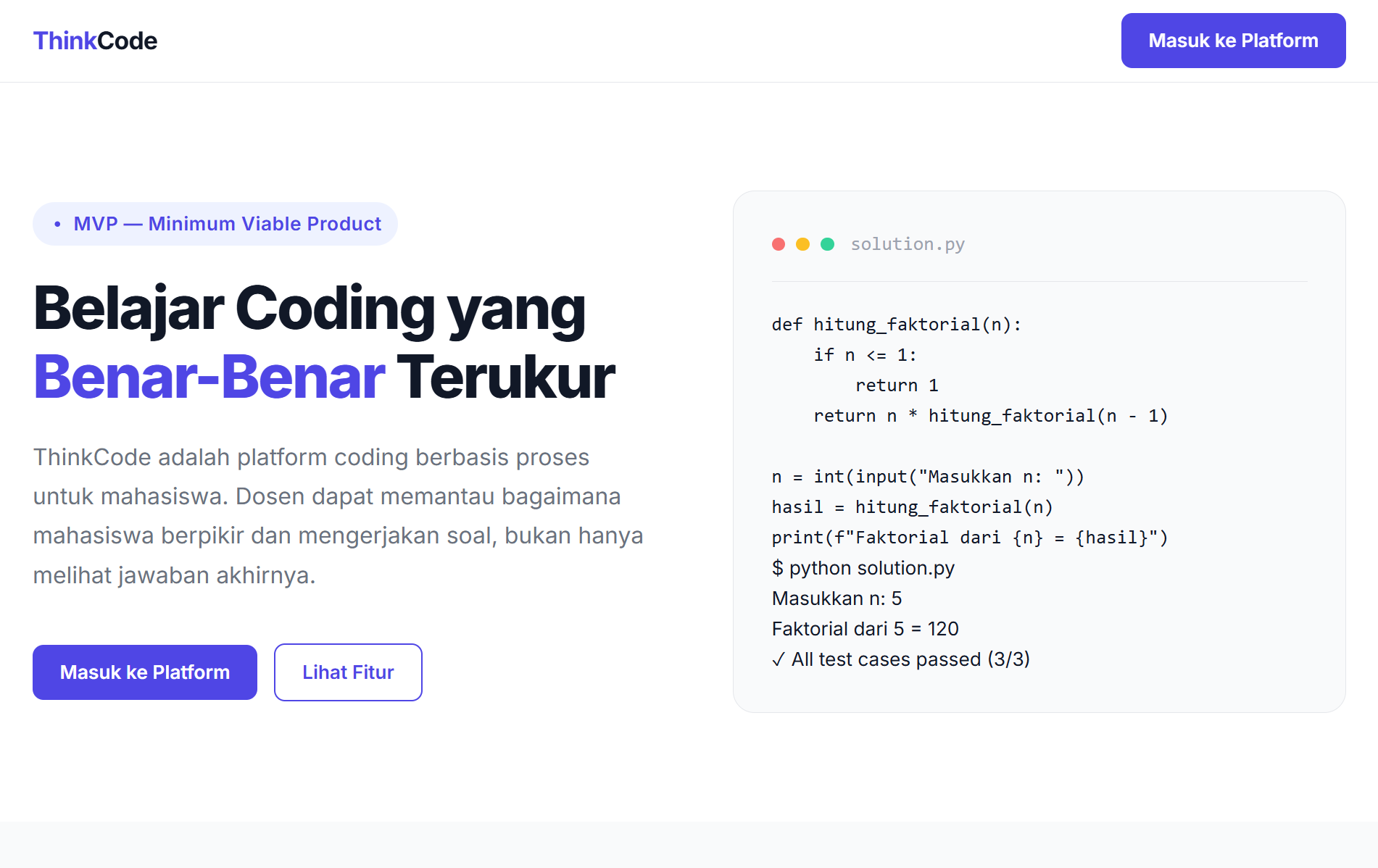
Landing Page — Platform overview seen by first-time visitors before registration
-
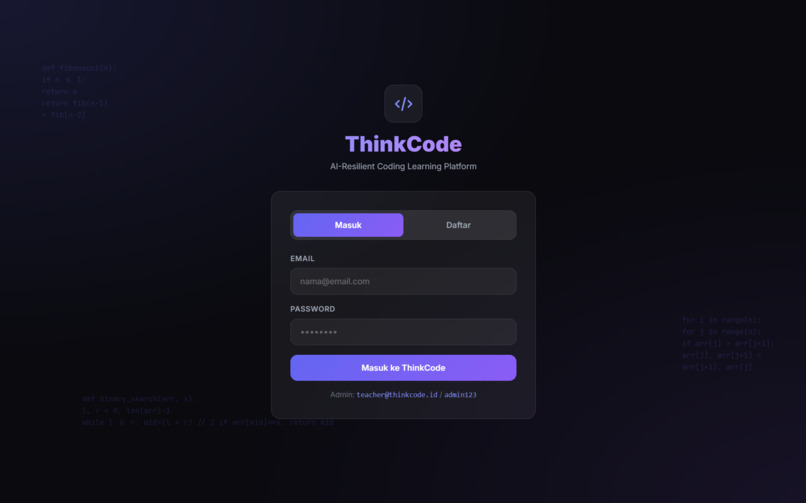
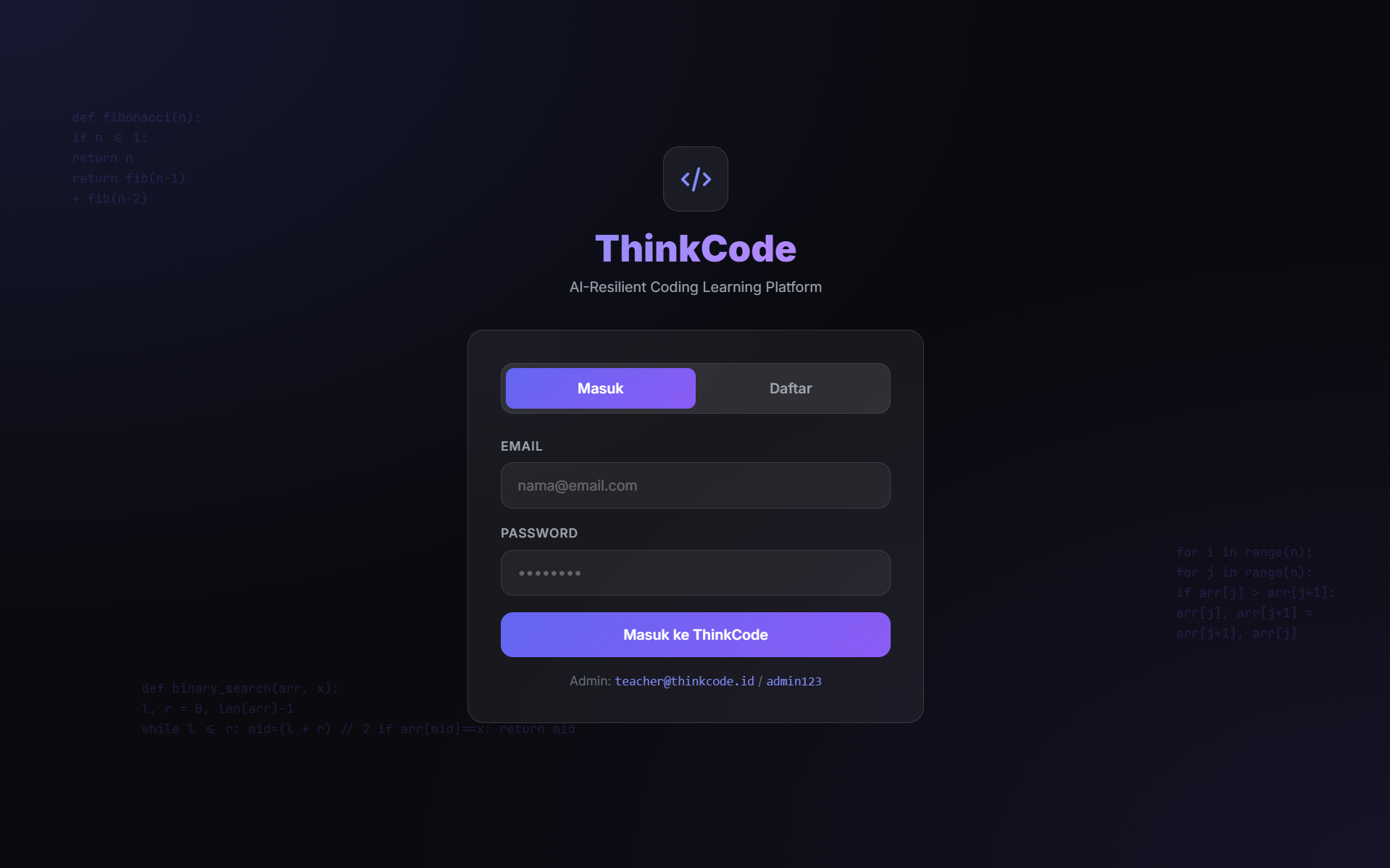
Authentication — Role-based login and registration for students and instructors
-
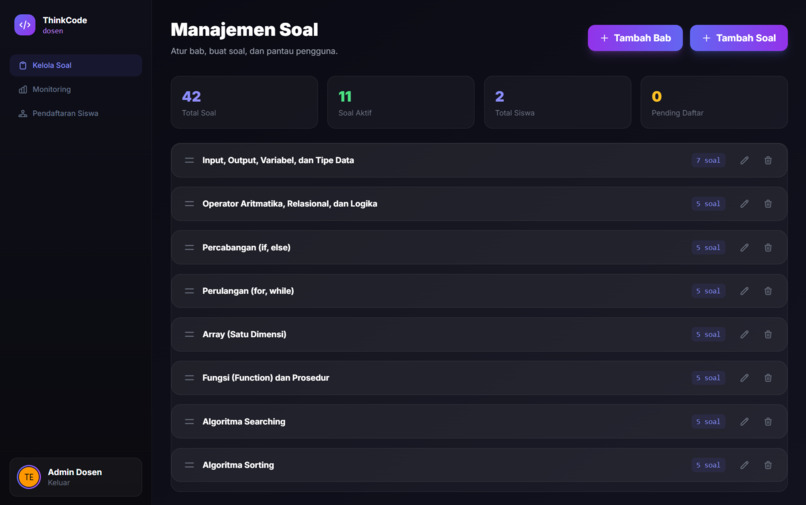
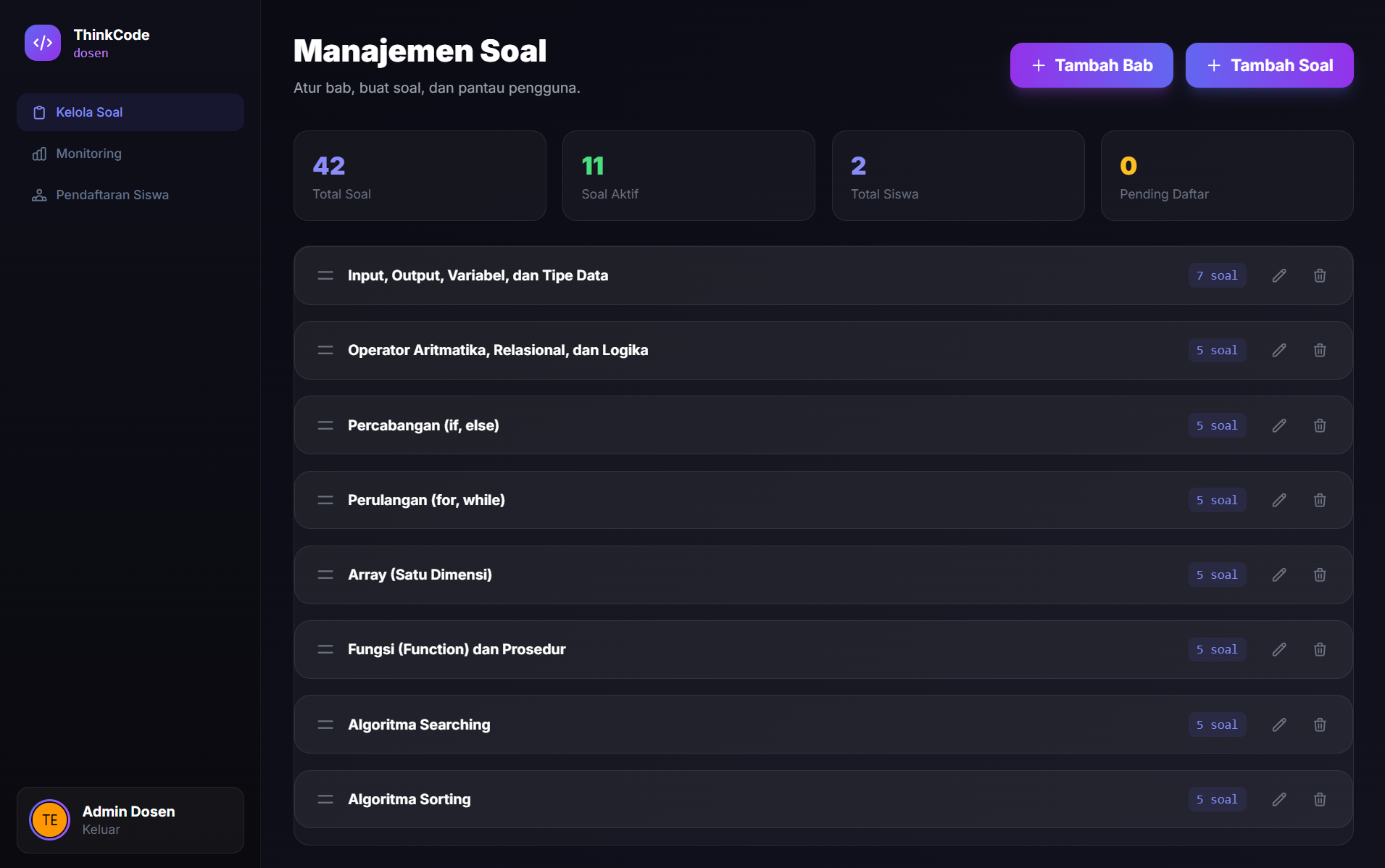
Problem Management — Instructor panel for creating, editing, and ordering assignment problems
-
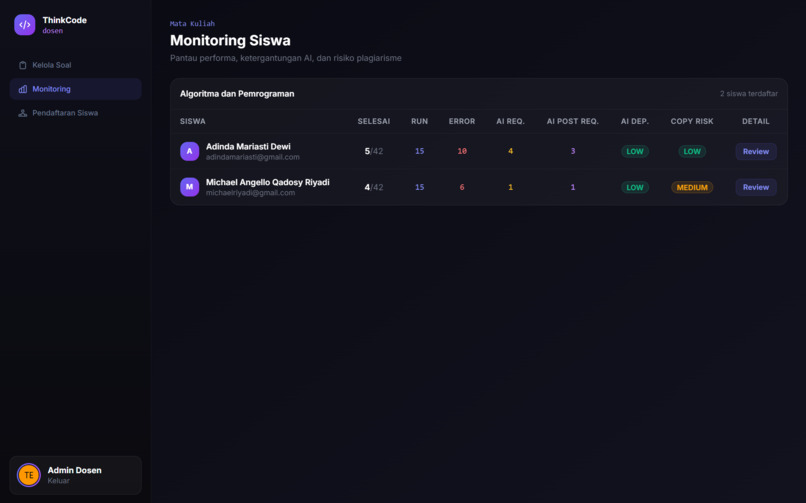
Student Monitoring Dashboard — Whole-class overview of submission statistics and integrity flags
-
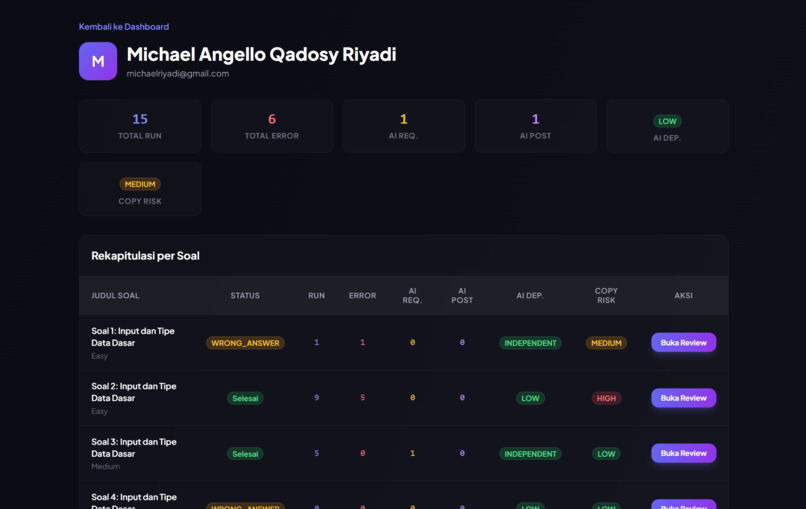
Per-Student Analytics — In-depth report of an individual student's scores and behavioral metrics
-
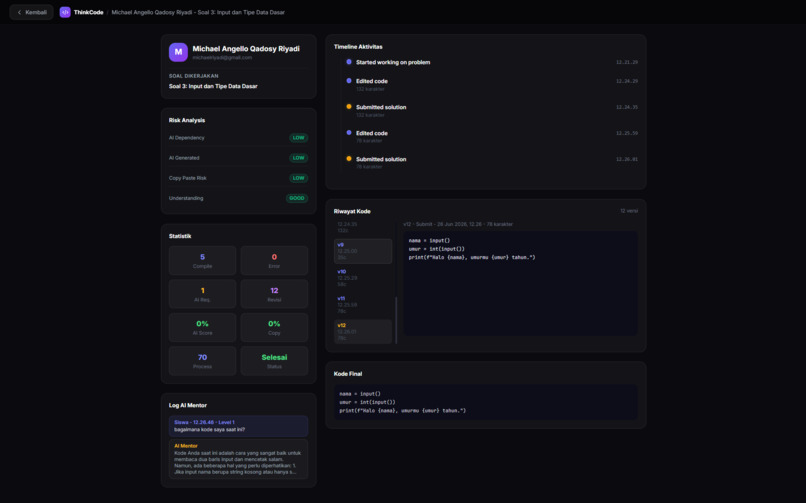
Submission Review — Full code history, test case results, and AI chat log for each submission
-
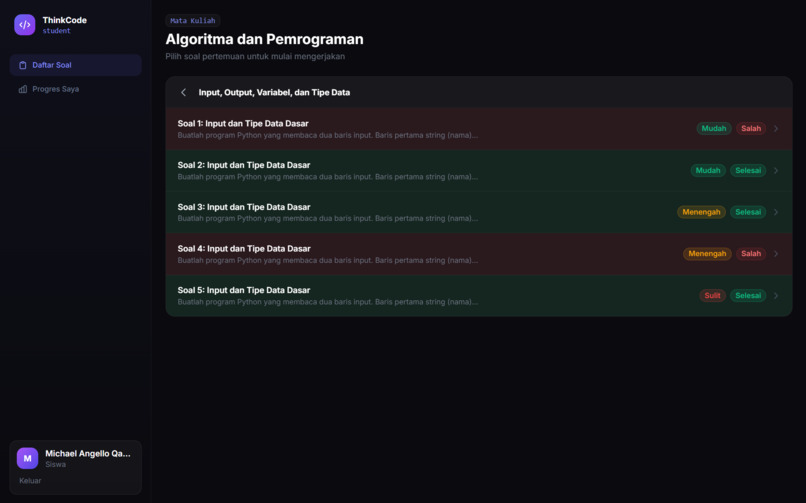
Problem List — Student view of available assignments with completion status indicators
-
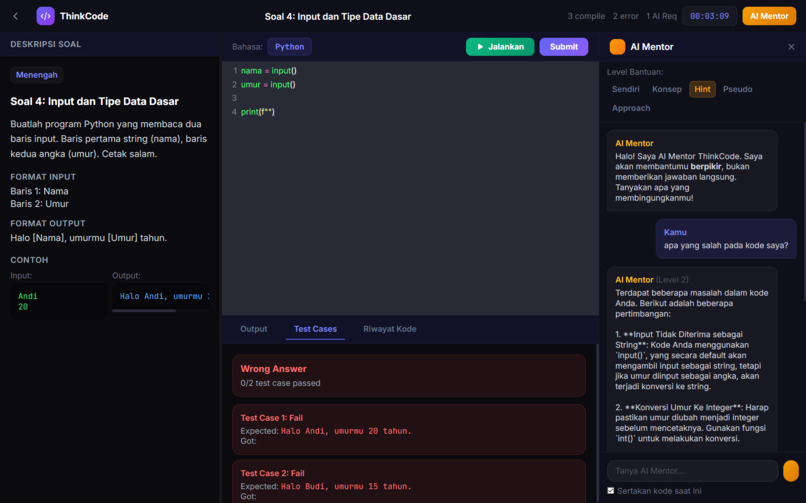
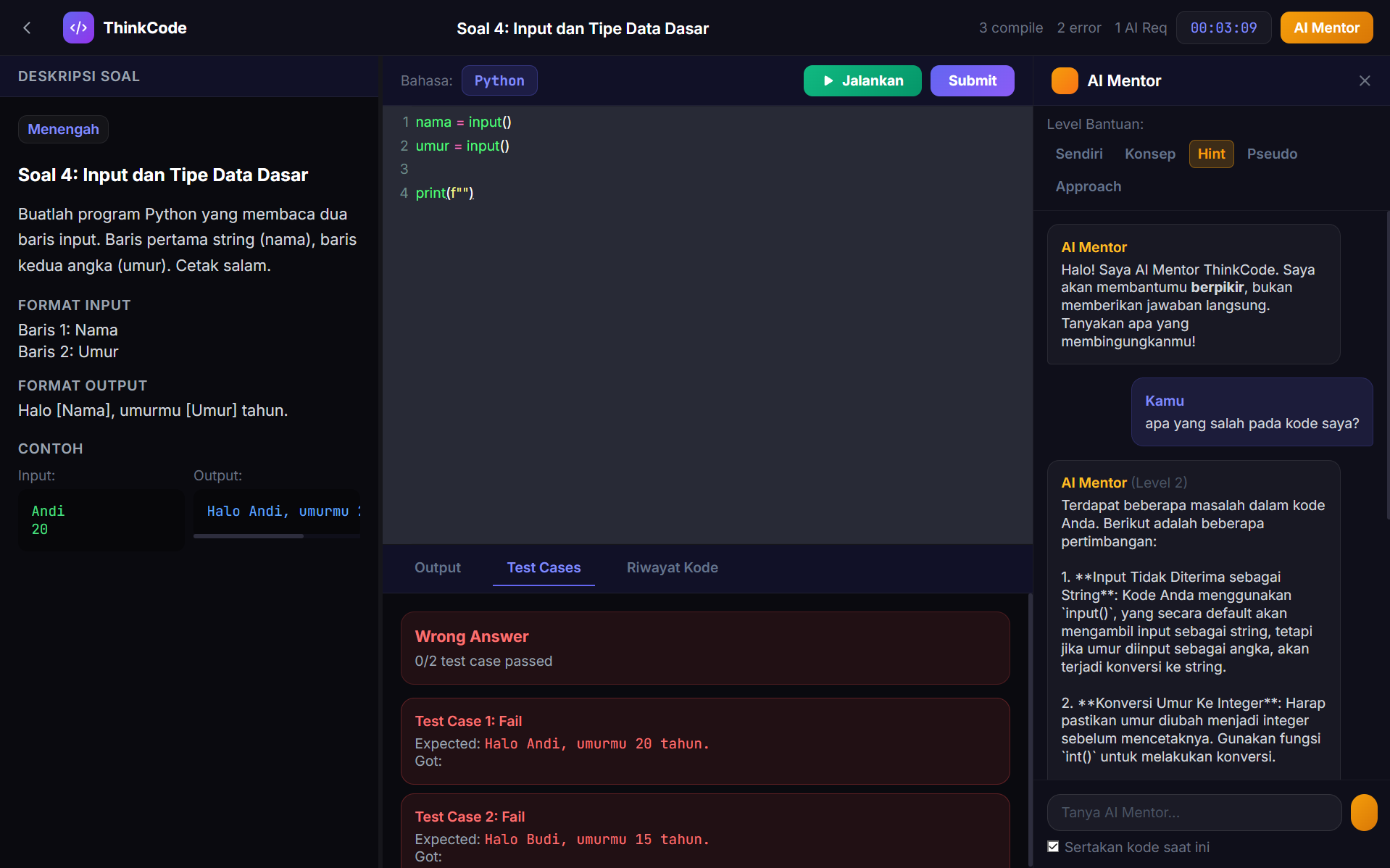
Workspace + AI Mentor — Integrated code editor, real-time terminal, and Socratic AI hint panel
-
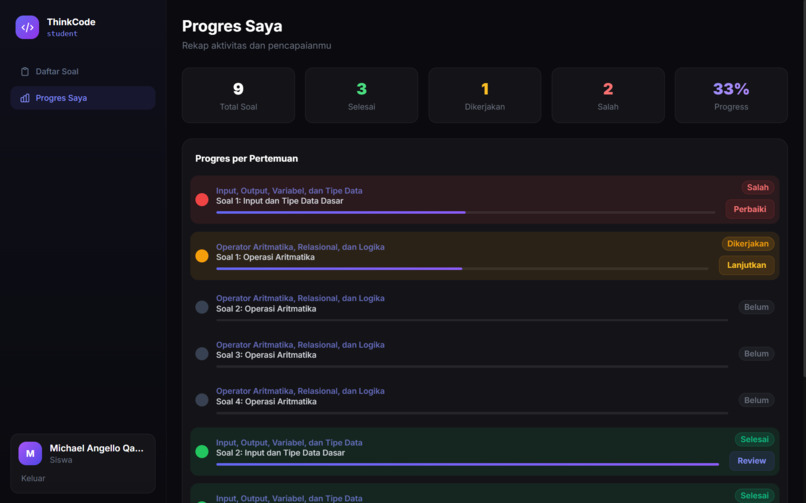
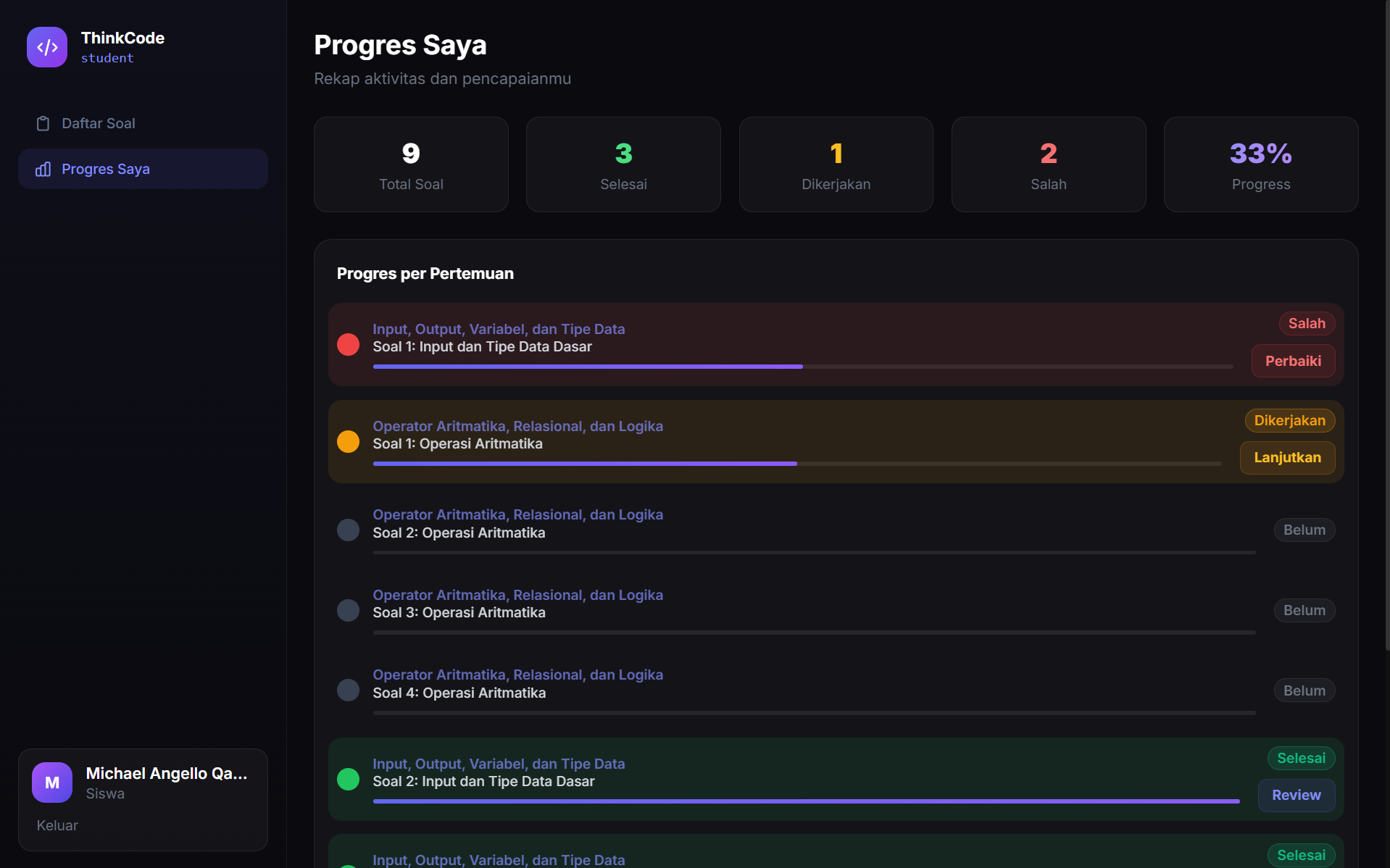
Learning Progress — Personal student dashboard for tracking completion and overall performance
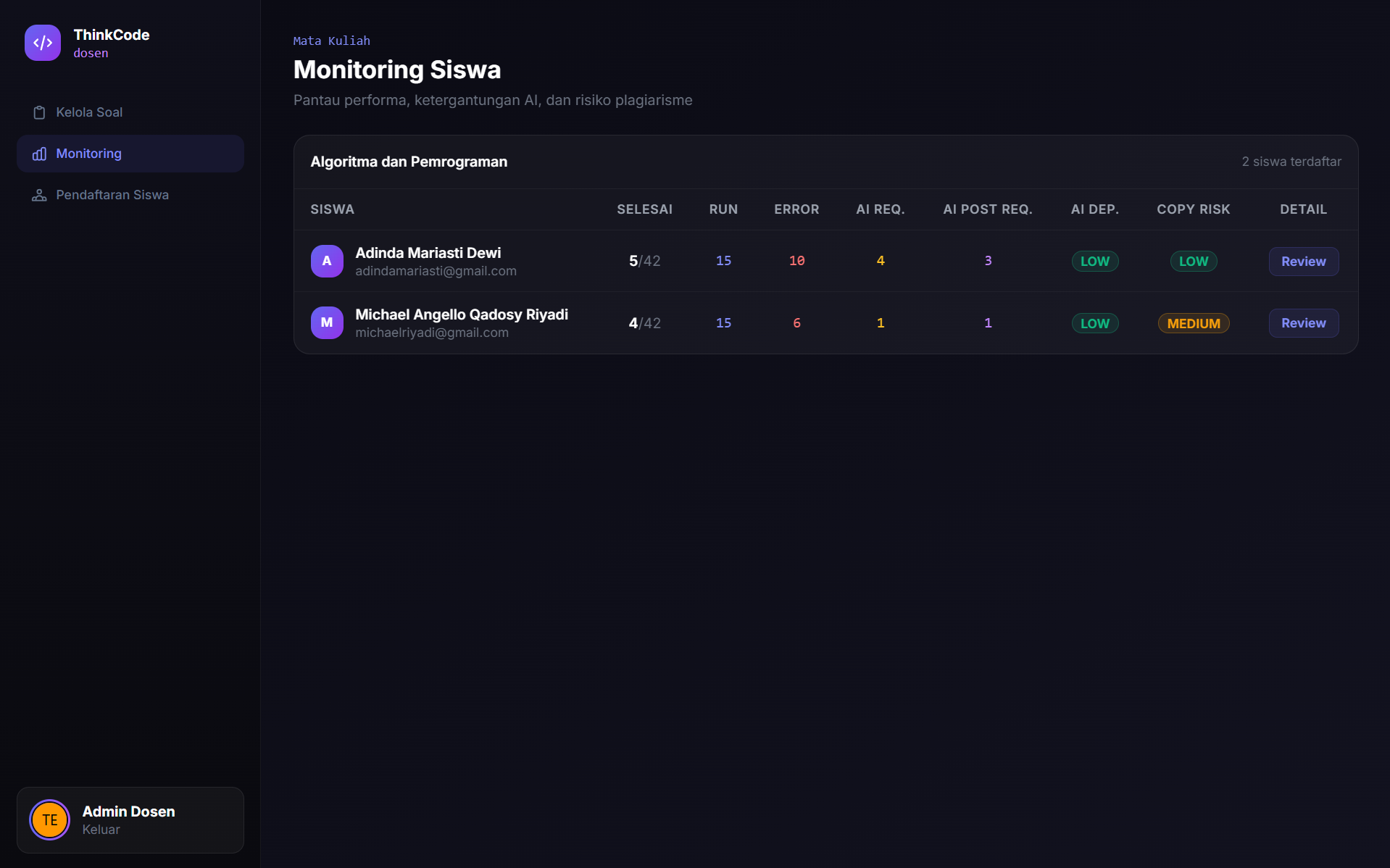
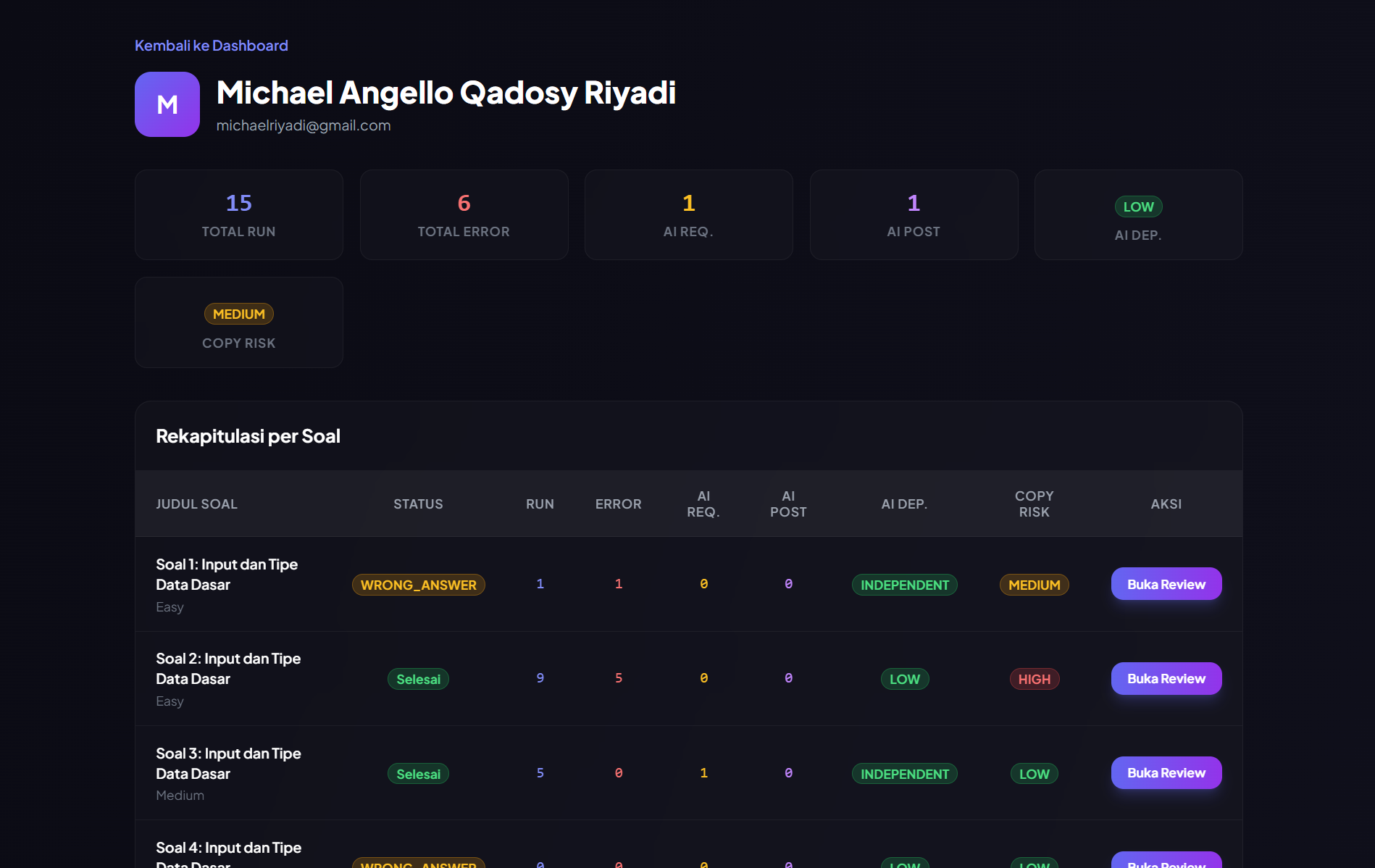
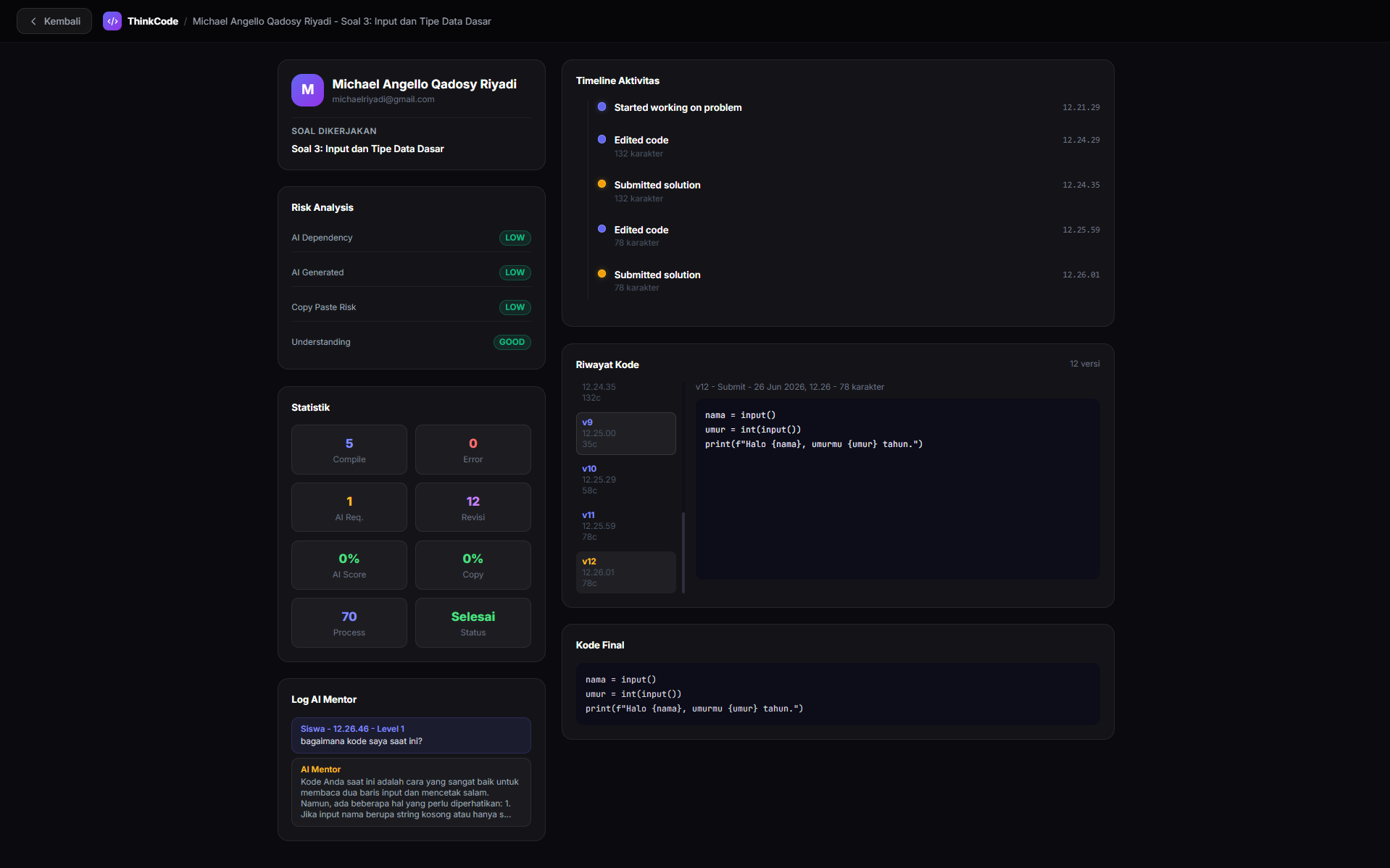
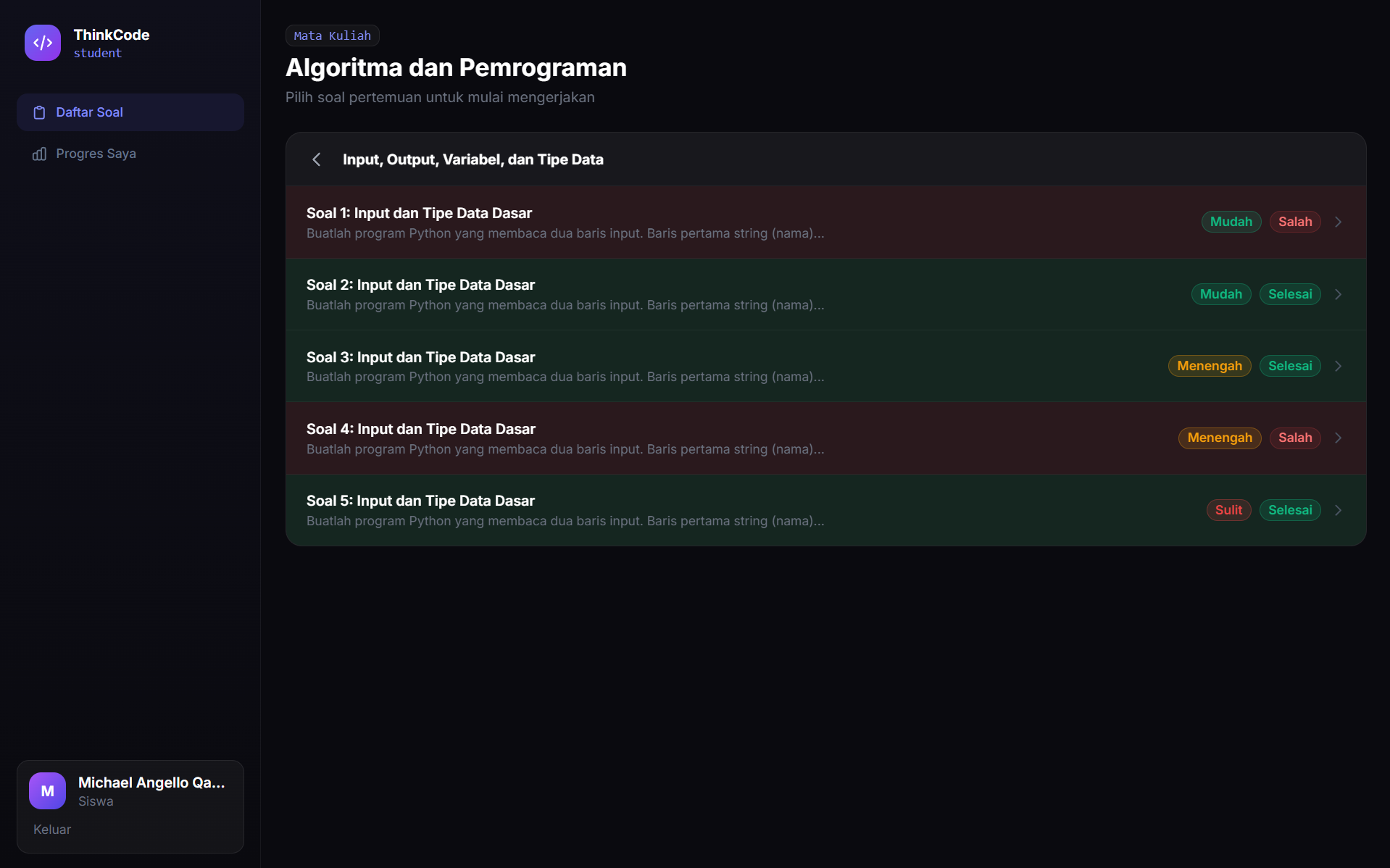
Inspiration
86.21% of Indonesian students use AI to complete coursework — yet standard automated judge systems only check whether the final code runs, not how it was built. We watched students paste ChatGPT output, pass every test case, and still fail closed-book exams. Research confirmed what we were seeing: LLM use drops knowledge retention from 68.5% to 57.5% compared to conventional learners. We built ThinkCode because we believe the form of AI assistance — not just its availability — determines whether a student actually learns.
What it does
ThinkCode is a web-based programming assessment platform that uses a Socratic AI Mentor to guide students toward solutions without ever giving them the answer. Instead of banning AI, it redirects it. Key capabilities:
- 5-Level Socratic Scaffolding — students must unlock each hint tier sequentially, from metacognitive questions (Level 1) to partial solution repair (Level 5), forcing genuine cognitive effort before accessing more direct help.
- AI Dependency Score (AIDep) — a composite behavioral telemetry metric (0–1) derived from four sub-metrics: Copy-Paste Rate, AI Request Rate, Repeated Error Rate, and Cursor Idle Duration, giving instructors a real-time measure of cognitive dependency.
- Process-Based Assessment — final grades are adjusted by AIDep penalty:
Process Score = Output Score × (1 − 0.5 × AIDep), so a student who struggles and learns scores higher than one who pastes a perfect solution. - Sandboxed Code Execution — student code runs in an isolated Docker container with a 2-second time limit and 50 MB RAM cap, streamed live to the browser via WebSocket.
- Instructor Analytics Dashboard — real-time visibility into every student's compilation count, error rate, copy-paste ratio, AI query frequency, and process score breakdown.
- 100% On-Premise AI — the LLM runs locally via Ollama (Qwen2.5-Coder:3B), so no student data ever leaves the institution's server.
How we built it
- Backend: Node.js + Express.js with WebSocket (
ws) for real-time terminal streaming - Database: SQLite via
better-sqlite3for lightweight, self-hosted persistence - Frontend: Vanilla HTML5, CSS3, JavaScript with CodeMirror as the embedded code editor
- AI Runtime: Ollama running
qwen2.5-coder:3blocally on an NVIDIA RTX 3060 (12 GB VRAM) - Auth: JWT-based role authentication (student / instructor)
- Sandbox: Docker child process isolation with strict CPU/RAM/time limits
- Telemetry Engine: Custom behavioral monitoring capturing paste events, cursor idle duration, AI request frequency, and repeated syntax errors in real time
- LLM Selection: We evaluated 4 candidate models (Qwen2.5-Coder:3B, Llama-3.2:3B, Phi-3.5-Mini:3.8B, StarCoder2:3B) against pedagogical metrics (Instruction Following Accuracy, Socratic Quality Score, Bug Detection Accuracy) and technical metrics (TTFT, TPS, VRAM) before selecting Qwen2.5-Coder:3B as the Socratic AI Mentor engine.
Challenges we ran into
- Keeping the AI Socratic under adversarial pressure. Students naturally tried to jailbreak the mentor — asking it to "act as a free assistant," encoding requests in Base64, or claiming urgency ("I have 1 minute left"). We built a 50-prompt adversarial evaluation suite across 5 attack categories to select the most instruction-compliant model.
- Quantifying something as fuzzy as cognitive dependency. There was no existing standardized telemetry-based construct for AI dependency in programming assessment. We had to design, weight (via expert judgment), and validate the AIDep metric from scratch.
- Balancing scaffolding with fairness. Penalizing students for using AI felt controversial. The sequential lock on hint levels — where Level 5 (partial fix) is only reachable after exhausting Levels 1–4 — was the design solution: the system forces effort before granting directness.
- Running a capable LLM on consumer hardware. The platform needed to be deployable by resource-limited institutions. Getting sub-150ms Time to First Token on a single RTX 3060 while simultaneously running a Docker sandbox required careful model selection and VRAM budgeting (Qwen2.5-Coder:3B peaks at only 2,808.5 MB).
Accomplishments that we're proud of
- Qwen2.5-Coder:3B achieved 86.0% Instruction Following Accuracy against 50 adversarial prompts — the highest of all 4 candidates — meaning it reliably refuses to hand over code even when students push back hard.
- Socratic Quality Score of 4.02/5 validated by 5 blind peer-reviewers with Krippendorff's Alpha = 0.71 (above the 0.667 acceptability threshold), confirming the mentor genuinely guides rather than answers.
- Pass rate jumped from 25.56% → 73.33% (effect size r = 0.55, strong; Z = −4.32, p < 0.001) when students had access to the Socratic AI compared to full isolation — proving the mentor meaningfully helps students solve harder problems.
- AIDep stayed low at 0.180 under Socratic AI access, not significantly different from the full-isolation condition (0.085; Z = −2.31, p = 0.021 > α_adj = 0.025) — confirming that structured Socratic scaffolding helps students succeed without creating new AI dependency.
- The entire stack runs on a single consumer GPU, making it feasible for Indonesian universities with limited infrastructure to self-host without sending any student data to third-party services.
What we learned
- The form of AI assistance matters more than its availability. Unmonitored baseline (K1) students had an AIDep of 0.773 and finished tasks in a median of 6.25 minutes — but only because they copy-pasted. Socratic AI users (K3) took 12.06 minutes and actually solved harder C4-level problems with far lower dependency. The constraint is the curriculum.
- High pass rate can be a red flag, not a success signal. K1 showed 88.89% pass rate paired with 0.773 AIDep — meaning the leaderboard looked great while real learning was absent.
- Behavioral telemetry reveals what grades hide. A student who submits a perfect first attempt in 4 minutes and a student who struggles through 20 failed compilations before solving it are indistinguishable by output score alone. AIDep separates them.
- Students accept restrictive AI policies when the rationale is transparent. UAT-3 (the policy of not giving direct code forces independent thinking) scored 4.10/5 — the highest of all UAT items — and UAT-5 (copy-paste penalty is fair) scored 4.03/5. Restriction is acceptable when it feels pedagogically justified.
What's next for ThinkCode
- Multi-language sandbox support (Java, C++, JavaScript) beyond the current Python environment
- LMS integration with Moodle and Google Classroom API for institutional adoption
- Adaptive difficulty engine that adjusts problem complexity based on each student's historical AIDep and pass rate
- AIDep weight validation via Analytic Hierarchy Process (AHP) to replace the current expert judgment approach with a quantitatively validated weighting scheme
- Longitudinal study with multi-institution counterbalanced design and larger sample to measure long-term knowledge retention and transfer
- Mobile-responsive interface for broader accessibility
- Exportable analytics reports (PDF/CSV) for institutional reporting and accreditation evidence
Hasil Diskusi
Experiment Design: Within-subjects repeated measures across N = 30 students (Semester 3–4, Informatics Engineering, Telkom University Surabaya) in three controlled conditions:
| Condition | Setup | Pass Rate | Median Duration | AIDep |
|---|---|---|---|---|
| K1 – Unmonitored Baseline | No supervision, open internet | 88.89% ± 15.21 | 6.25 min [IQR: 4.10–8.30] | 0.773 ± 0.124 |
| K2 – Full Isolation | Camera + screen monitoring, browser locked | 25.56% ± 20.15 | 19.76 min [IQR: 15.20–24.15] | 0.085 ± 0.042 |
| K3 – Socratic AI Access | Supervised + 5-level Socratic mentor | 73.33% ± 18.54 | 12.06 min [IQR: 9.45–15.20] | 0.180 ± 0.065 |
Key Statistical Findings (Friedman + Wilcoxon post-hoc, Bonferroni α_adj = 0.025):
- Pass Rate K3 vs K2: Z = −4.32, p < 0.001, r = 0.55 (strong effect) — Socratic AI significantly improves performance vs. no help
- AIDep K3 vs K2: Z = −2.31, p = 0.021 > α_adj, r = 0.29 (not significant) — Socratic AI does NOT significantly increase dependency vs. isolation
- AIDep K1 vs K3: Z = −4.78, p < 0.001, r = 0.61 (strong effect) — unmonitored free access creates dramatically more dependency than Socratic AI
LLM Selection Results (N = 50 adversarial prompts; N = 10 bug scenarios):
| Model | IF-Acc | Socratic Quality (1–5) | Bug Detection | Median TTFT | VRAM Peak |
|---|---|---|---|---|---|
| Qwen2.5-Coder:3B ✓ | 86.0% | 4.02 | 90.0% | 148.5 ms | 2,808.5 MB |
| Llama-3.2:3B | 82.0% | 3.48 | 70.0% | 222.5 ms | 3,314.5 MB |
| Phi-3.5-Mini:3.8B | 84.0% | 3.22 | 80.0% | 188.0 ms | 3,533.0 MB |
| StarCoder2:3B | 60.0% | 2.26 | 90.0% | 247.5 ms | 3,093.0 MB |
User Acceptance (N = 30):
- SUS Score: 71.17 (SD = 4.44) — Marginal / Grade C usability; room for UI improvement
- UAT Cronbach's Alpha: α = 0.85 (above 0.70 threshold — reliable instrument)
- Highest UAT item: UAT-3 — "The AI policy of not giving direct code trains independent thinking" → Mean 4.10/5 ✅
- Second highest: UAT-5 — "The copy-paste grade penalty is fair" → Mean 4.03/5 ✅
- Lowest UAT item: UAT-6 — "AI response speed" → Mean 3.73/5 (perceived as slow despite TTFT median of 148.5 ms)
Core conclusion: The form of AI assistance — structured Socratic scaffolding — rather than mere availability, is the determining variable in mitigating cognitive dependency in programming assessment.
Built With
- javascript
- llama
- llm
- python
- sql

Log in or sign up for Devpost to join the conversation.