Inspiration
Digital exploitation is accelerating. Fraudsters now use AI-generated messages, social media impersonation, and sophisticated psychological manipulation to deceive victims into transferring money. But the deeper problem is not that scams exist; it is that protection systems are fragmented. Each payment platform and social media network operates in isolation. When one platform detects and blocks a suspicious transaction, the victim is simply redirected to another platform where no alert exists. The scam succeeds not because detection failed, but because detection was not shared. This gap between social media platforms and payment systems is the core vulnerability that ThinkAgainAI addresses.
What it does
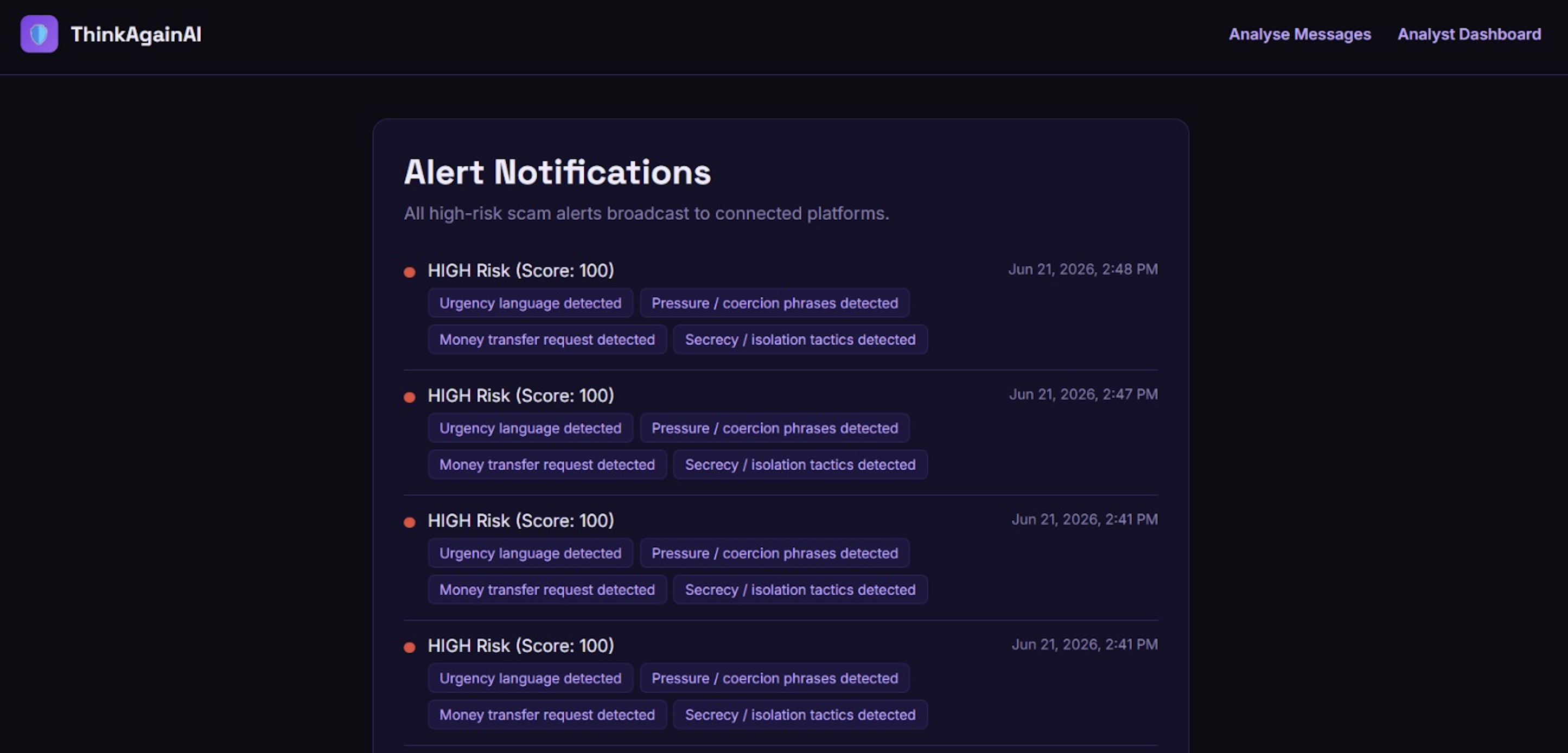
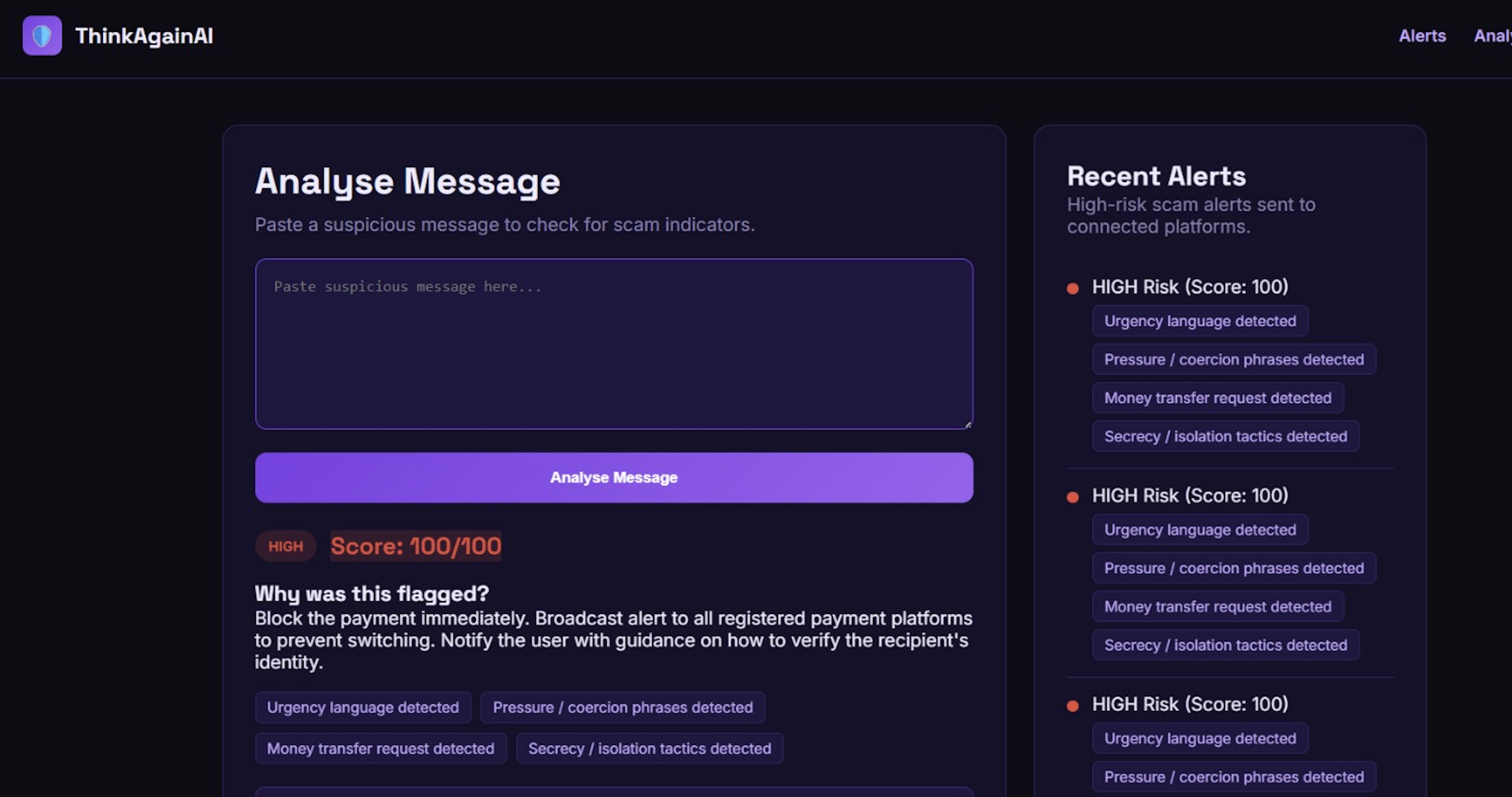
ThinkiAgainAI is a cross-platform digital exploitation detection system built on two core principles: detect early, and alert everywhere simultaneously. The system analyses conversation patterns using a fine-tuned BERT transformer model to identify manipulation tactics before a payment is made. When a high-risk conversation is detected, it simultaneously triggers alerts across all registered payment platforms, closing the gap that allows victims to bypass a block on one app by switching to another. The model classifies messages into three risk tiers: Low: payment proceeds normally Medium: user receives a contextual warning and can override High: cooling-off period enforced before override is allowed High + secrecy tactics detected: payment blocked, escalated to a human fraud analyst
Critically, the system never makes final decisions autonomously. Humans remain in control at every point where money or privacy is at stake.
How we built it
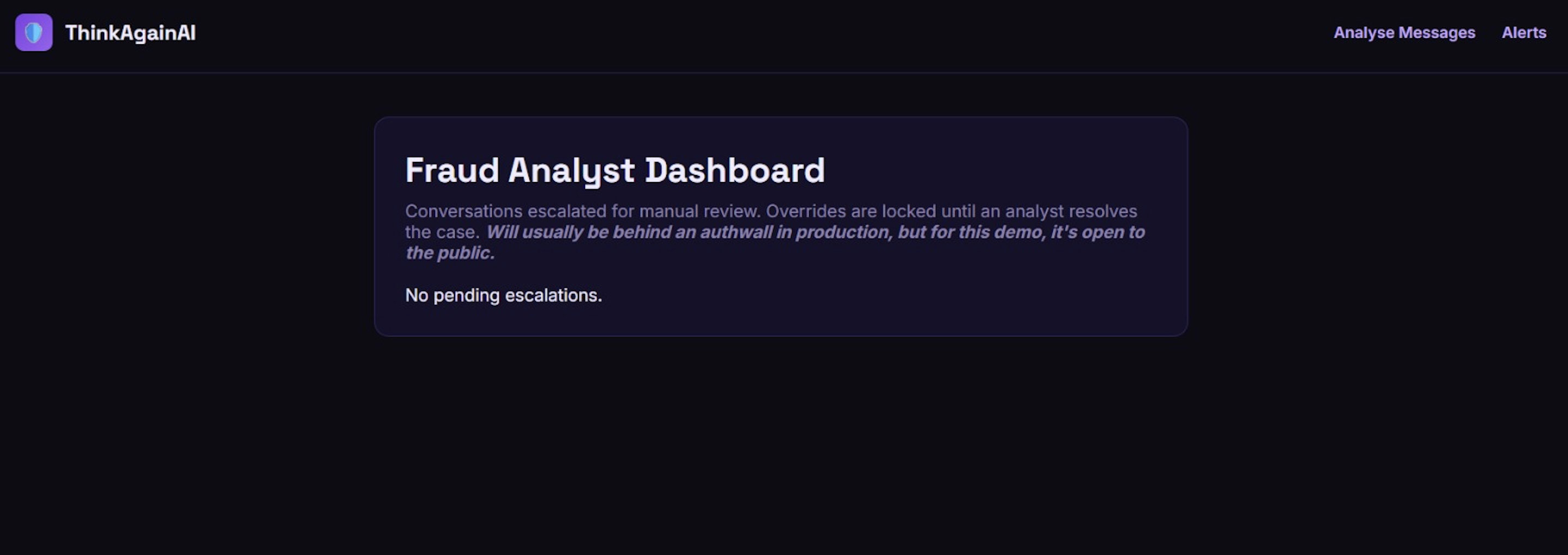
We took a fully iterative approach over seven days, with each team member working on an independent component that integrated into a single system. Person 1: NLP & AI Model (Sukhnaaz): Started with TF-IDF + Logistic Regression as a baseline, identified its limitations through rigorous testing, then fine-tuned BERT (bert-base-uncased) on a Tesla T4 GPU. Generated 4,153 synthetic scam conversations across six datasets covering impersonation, crypto scams, romance scams, fake emergencies, phishing, deflection tactics, and security bypass instructions. Upgraded from binary classification to three-tier Low/Medium/High risk, achieving 97% accuracy on 80 diverse real-world messages. Person 2: Backend & Alert System (Viswamedha): Built a FastAPI backend that receives messages, calls the NLP model, applies risk engine logic, and triggers simulated cross-platform webhook alerts simultaneously to all registered payment platforms. Implemented PostgreSQL persistence for alert history and feedback loops, escalation routing for analyst review, and a full REST API with 40-case test suite validation. Person 3: Frontend Dashboard (Aaron): Built a React analyst dashboard that displays real-time risk scores with colour-coded alerts, plain-language explanations of triggered features, and separate alert screens for Medium risk (user can override) and High risk escalated cases (payment blocked pending analyst review). Connected directly to the backend API. Person 4: Testing, Documentation & Demo (Emmanuel): Created synthetic test scenarios across all scam categories, coordinated end-to-end testing across all system components, prepared the Devpost submission documentation, and produced the demo video showing the full system working in a realistic exploitation scenario. All four services: database, NLP model, backend API, and frontend, run via Docker Compose with health checks gating startup order.
Challenges we ran into
Data availability: Existing public datasets for scam detection are either focused on generic SMS spam from 2011, email fraud, or platform-specific comment spam, none of which match the conversational patterns of modern cross-platform financial exploitation involving impersonation, social engineering, and payment coercion. We resolved this gap by generating high-quality synthetic training data across six datasets, carefully designed to cover the specific manipulation tactics ScamShield targets. Label consistency: Mixing heterogeneous datasets caused inconsistent label mapping during BERT fine-tuning. We resolved this by training exclusively on our synthetic data plus clean legitimate messages, producing consistent and reliable classification. Binary overconfidence: Our initial BERT model scored almost everything at either 0% or 99% with no nuance. We resolved this by introducing three-tier labelled training data with genuine medium-risk examples: messages containing one or two suspicious signals but with plausible innocent explanations. Cross-platform coordination: Explaining how alerts fire simultaneously across payment platforms required careful architecture design to ensure no message content is shared, only the risk signal.
Accomplishments that we're proud of
Building a three-tier BERT classifier that achieves 97% accuracy on diverse real-world messages, including subtle scams that deliberately avoid obvious keywords, through a fully iterative process that we documented honestly at every stage. We're also proud of the cross-platform alert architecture working end to end, and of keeping humans in control at every decision point throughout the system.
What we learned
BERT's contextual understanding makes it significantly more robust than keyword-based approaches, and it detects scams even when scammers deliberately avoid obvious trigger words. We also learned that responsible AI design is not just documentation; it shapes architectural decisions from the ground up. Every feature of our system was designed around the principle that AI should inform human decisions, never replace them.
What's next for ThinkAgainAI
Writing style deviation detection to flag when someone writes differently from their established pattern, multi-turn conversation analysis to detect escalating pressure across a full thread rather than individual messages, and a continuous retraining pipeline fed by confirmed scam reports so the model adapts as scam tactics evolve.
Built With
- bert-(huggingface-transformers)
- docker
- fastapi
- github
- google-drive-(model-hosting)
- jupyter-notebook
- pandas
- postgresql
- python
- pytorch
- react
- scikit-learn

Log in or sign up for Devpost to join the conversation.