Inspiration
The inspiration for Think-Aloud Debugger came from observing a common gap in existing debugging tools. While most tools are effective at identifying errors or suggesting fixes, they rarely explain the reasoning mistakes that caused those errors. In real-world development, bugs often arise from incorrect assumptions, misunderstood logic, or incomplete mental models rather than from syntax issues. This project was motivated by the idea that debugging should not only fix code, but also help developers understand why their logic failed and how to think more clearly in the future.
What it does
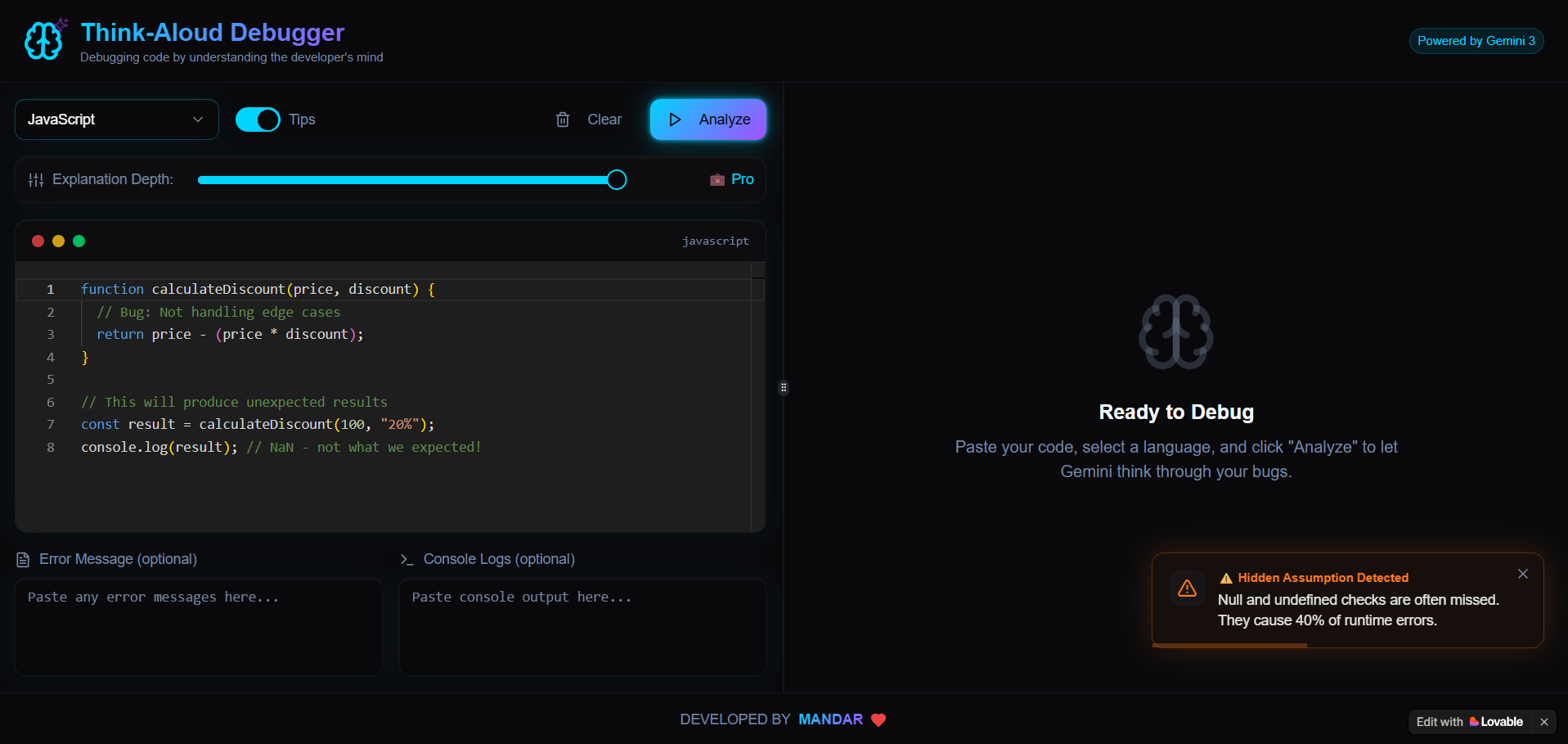
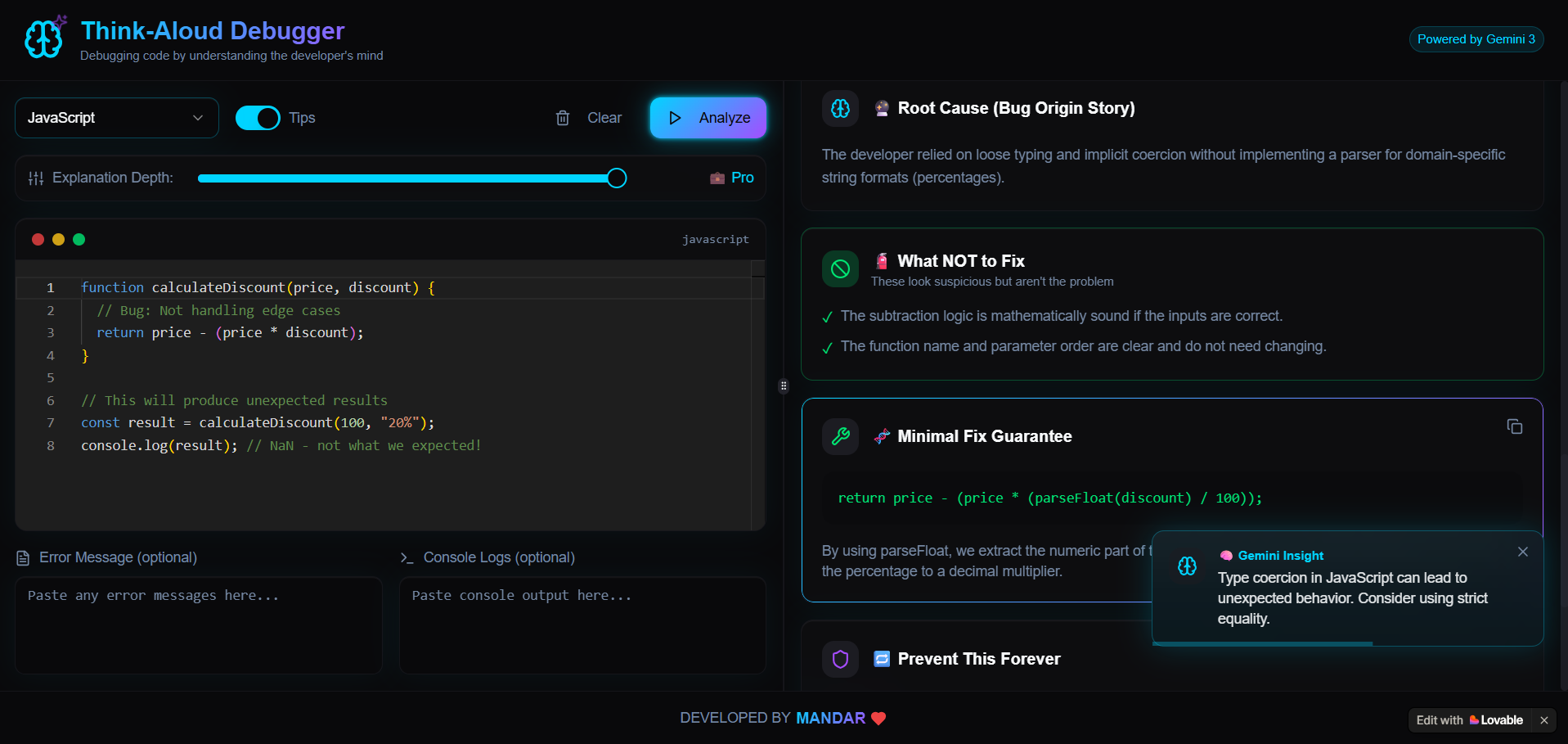
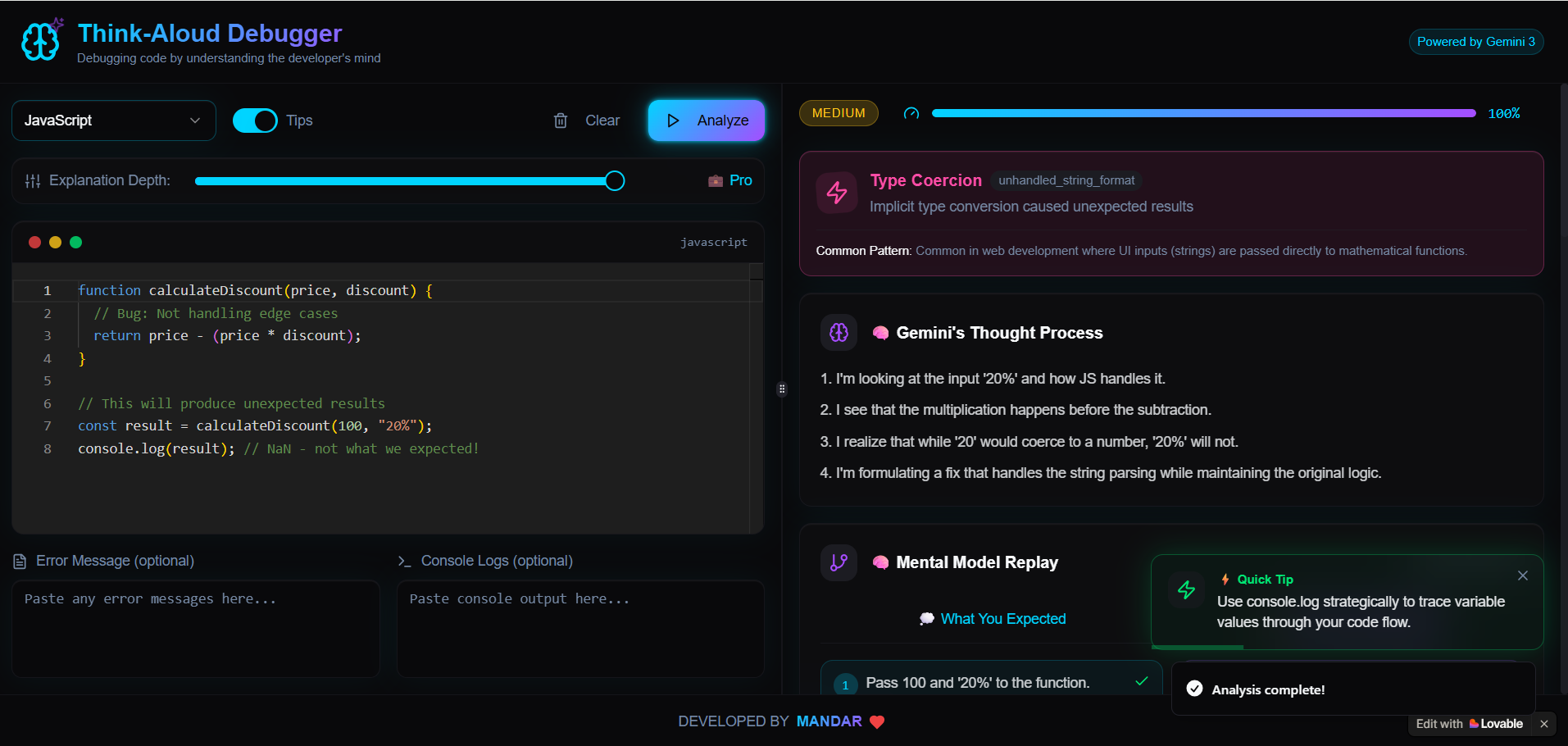
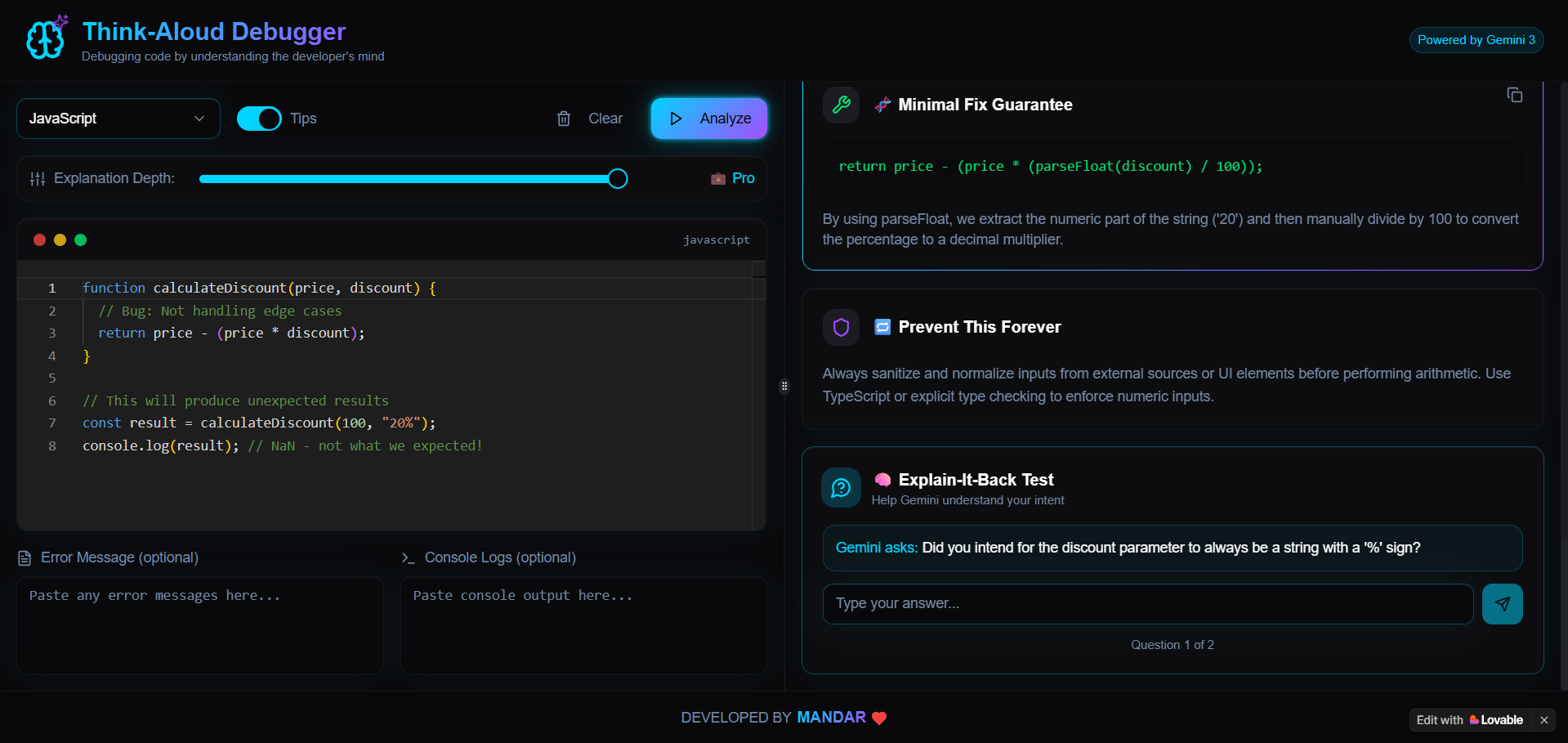
Think-Aloud Debugger is a web-based debugging assistant that analyzes source code and explains bugs by reconstructing the developer’s likely thought process. Instead of only reporting errors, it identifies implicit assumptions, explains where those assumptions break down, and provides minimal, targeted fixes. The tool supports code written in any programming language and can generate explanations in multiple human languages, making it accessible to a wide range of developers.
How we built it
The application was built as a web platform and deployed using the Lovable framework for rapid development and public access. The frontend offers a clean, dark-themed interface with an in-browser code editor for submitting code and error context. The backend integrates directly with the Google Gemini 3 API, which serves as the sole intelligence layer. Gemini 3 performs long-context reasoning on the submitted code to analyze behavior, infer developer intent, and generate structured, human-readable explanations.
Challenges we ran into
One of the main challenges was ensuring that explanations were detailed yet concise. Debugging logic can become complex quickly, and presenting too much information at once can reduce clarity. Another challenge was prompting the model to infer developer assumptions instead of simply restating errors. Maintaining consistent explanation quality across different programming languages also required careful prompt design and iteration.
Accomplishments that we're proud of
We are particularly proud of creating a debugger that focuses on reasoning rather than surface-level fixes. The system consistently produces structured explanations that highlight logical assumptions and mental model mismatches. Successfully building an AI-first application where Gemini 3 is central to the experience, rather than an add-on, is another key accomplishment.
What we learned
This project demonstrated the importance of prompt engineering when using large language models for reasoning-intensive tasks. Small changes in prompt structure had a significant impact on the quality of explanations. We also learned how to design interfaces and workflows that complement AI reasoning, ensuring that insights are presented clearly and effectively to users.
What's next for Think-Aloud Debugger
Future improvements include adding long-term memory to help identify recurring mistake patterns, visualizing mental model mismatches more clearly, and expanding explanation modes for different experience levels. Additional integrations with development workflows and version control systems are also planned to make the tool more practical for everyday use.
Developed by Mandar
Built With
- css3
- express.js
- gemini3api
- git
- googleaistudio
- html5
- javascript
- lovable
- monacoeditor
- node.js
- restapi
- vercel


Log in or sign up for Devpost to join the conversation.