-
-
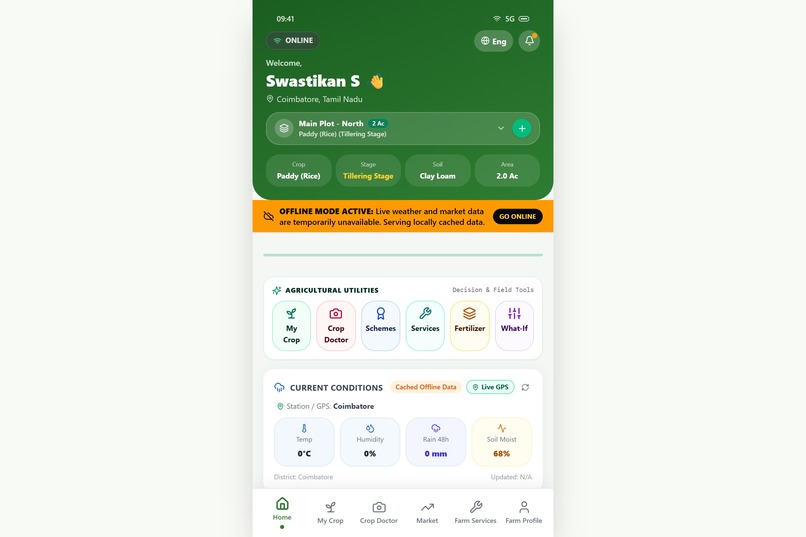
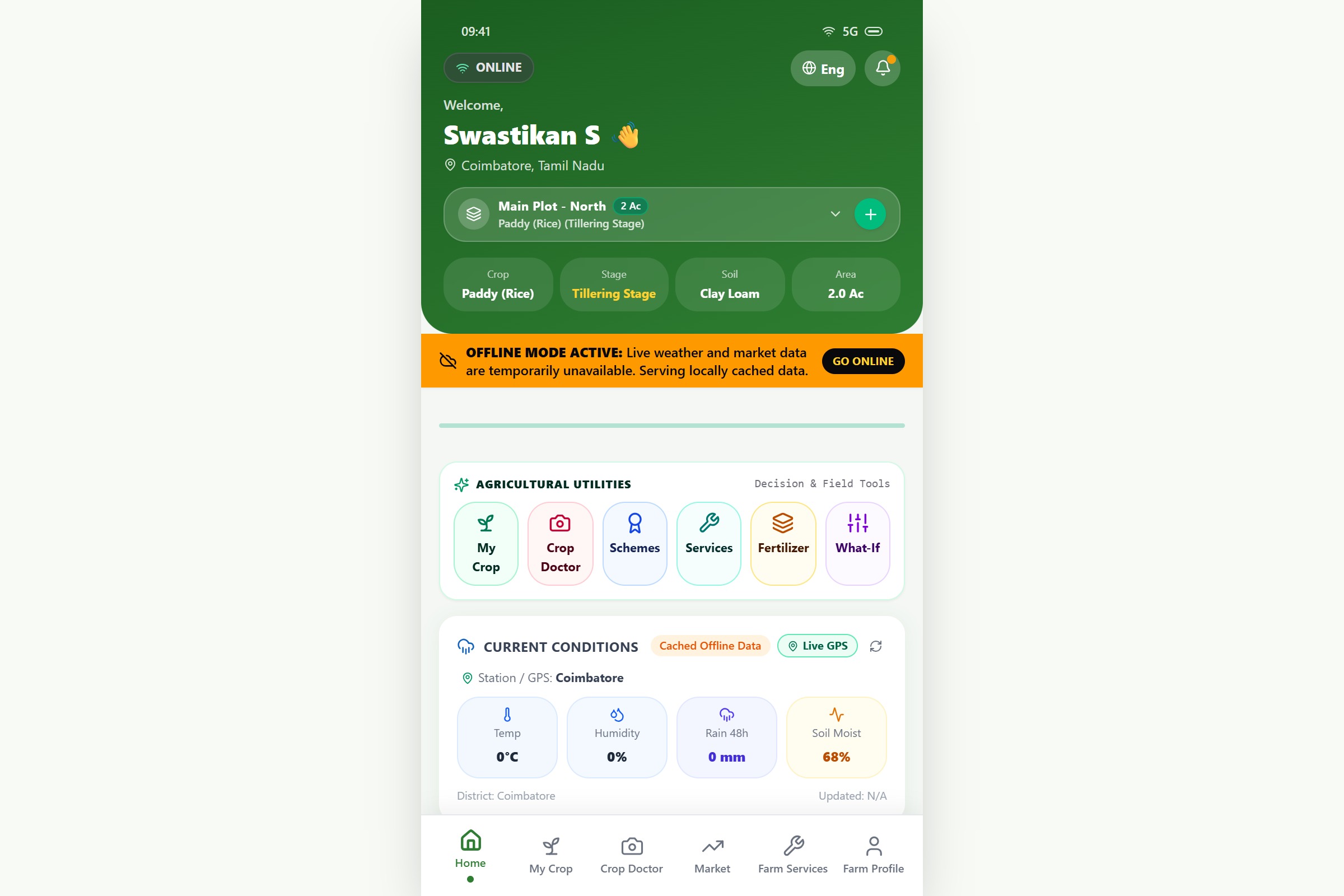
Main Dashboard & Intelligence
-
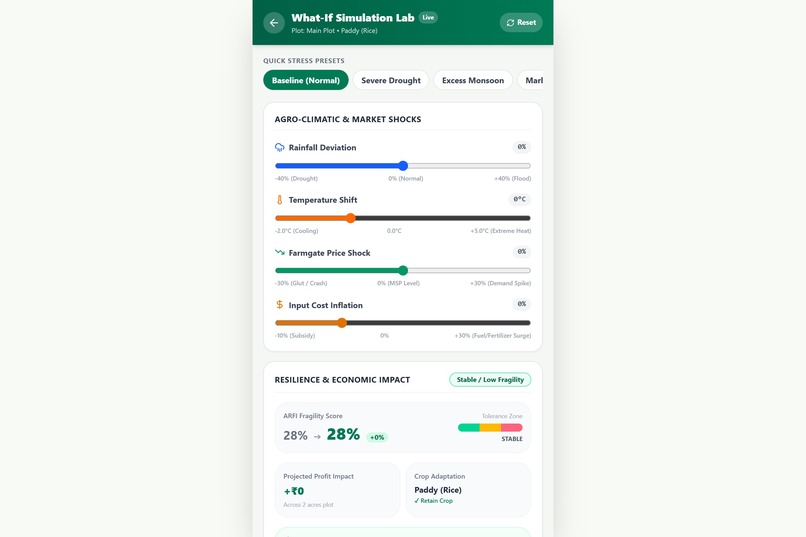
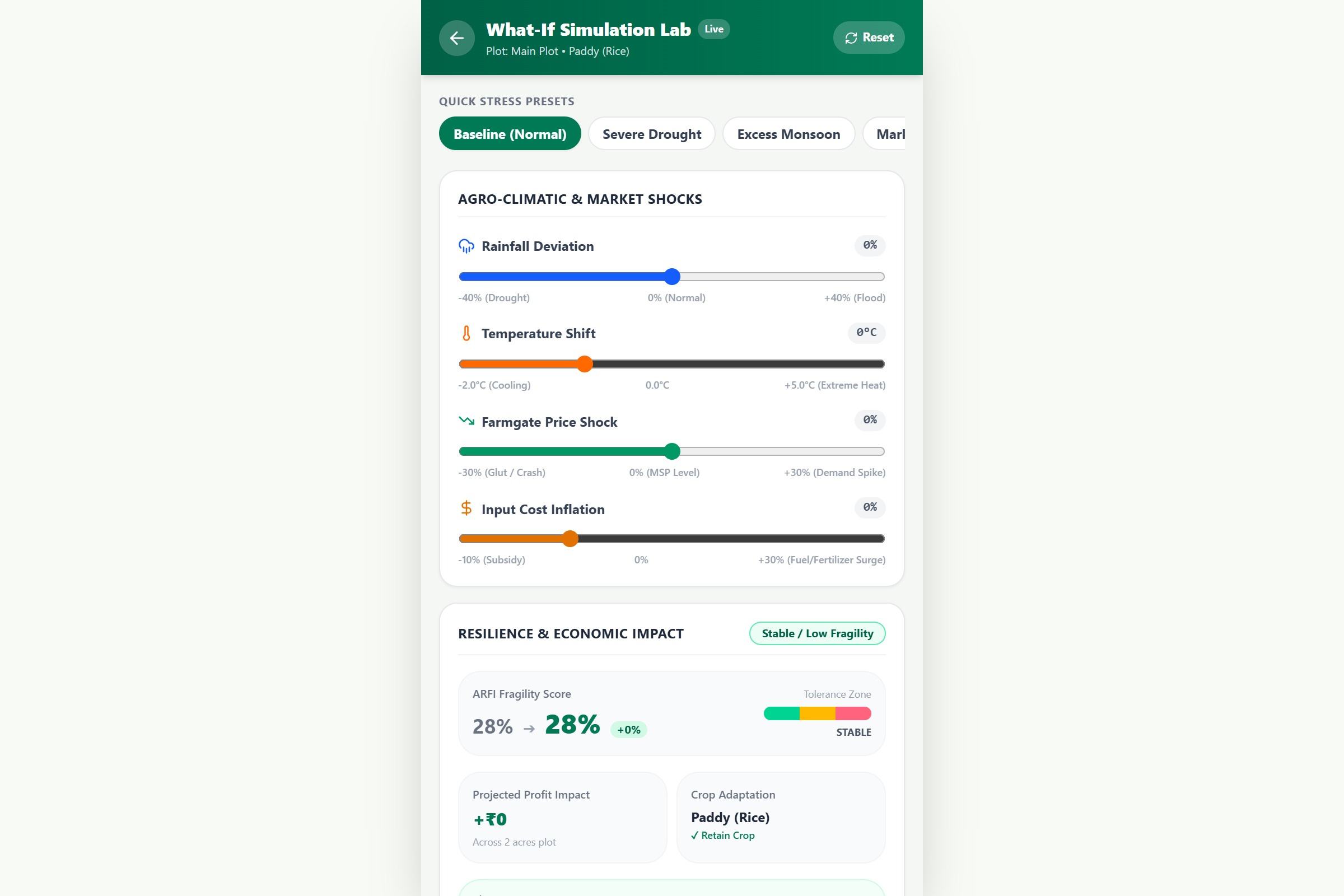
ARFI What-If Stress Lab
-
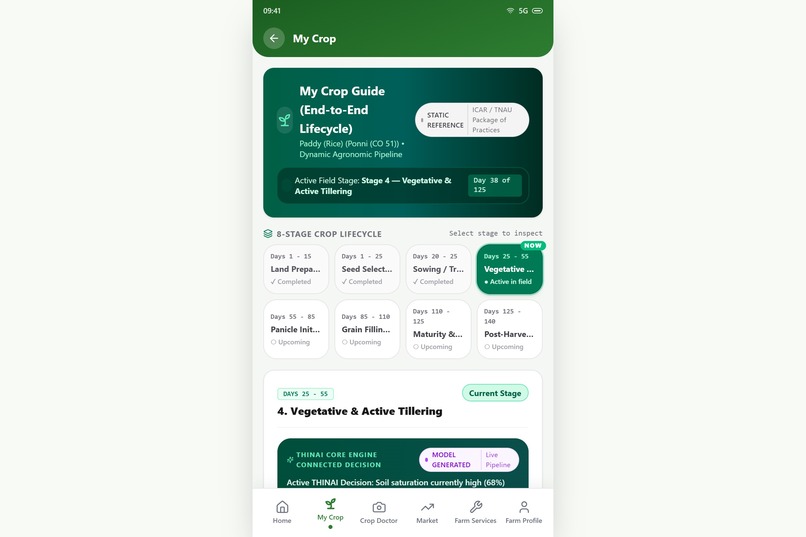
8-Stage Crop Lifecycle Guide
-
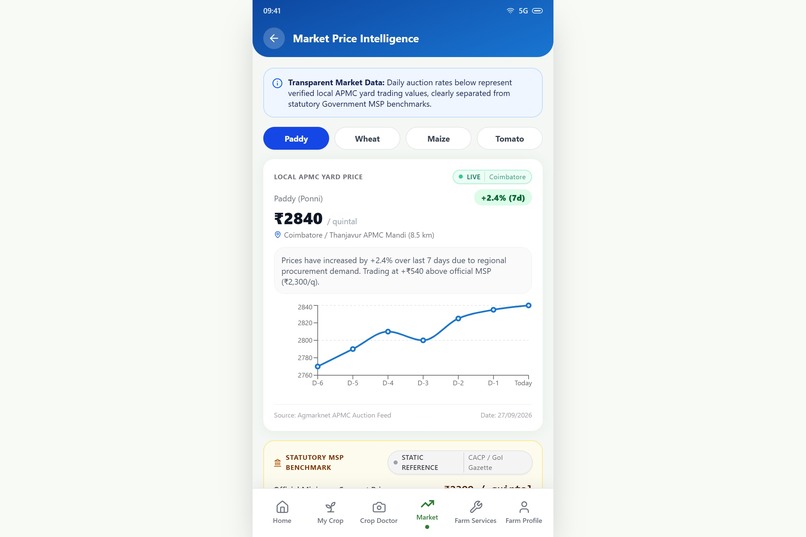
Mandi Market Intelligence
-
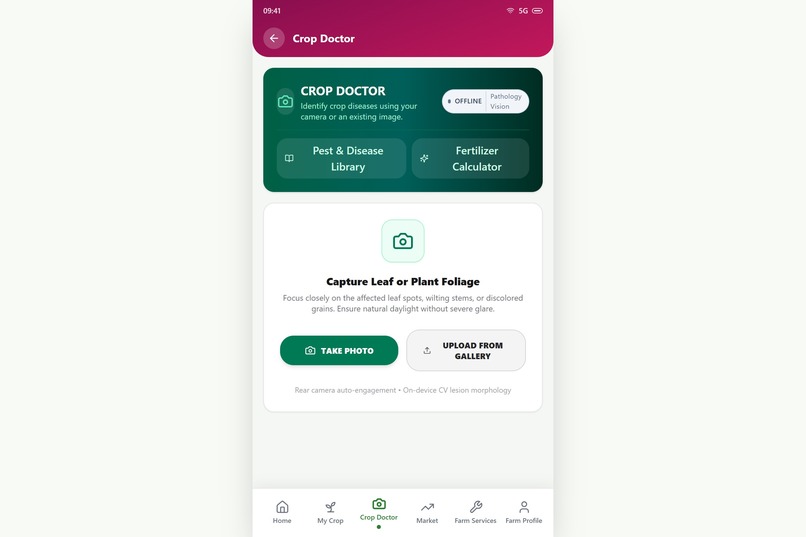
Camera Crop Doctor
-
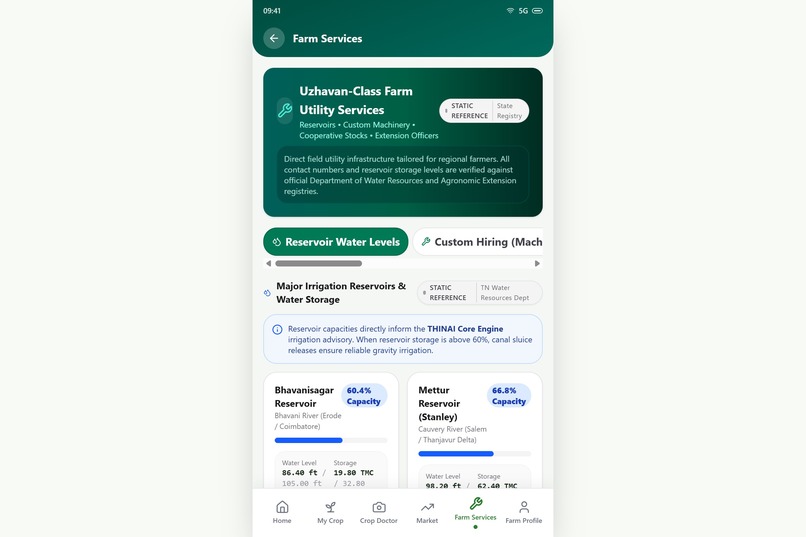
Uzhavan Farm Utility Services
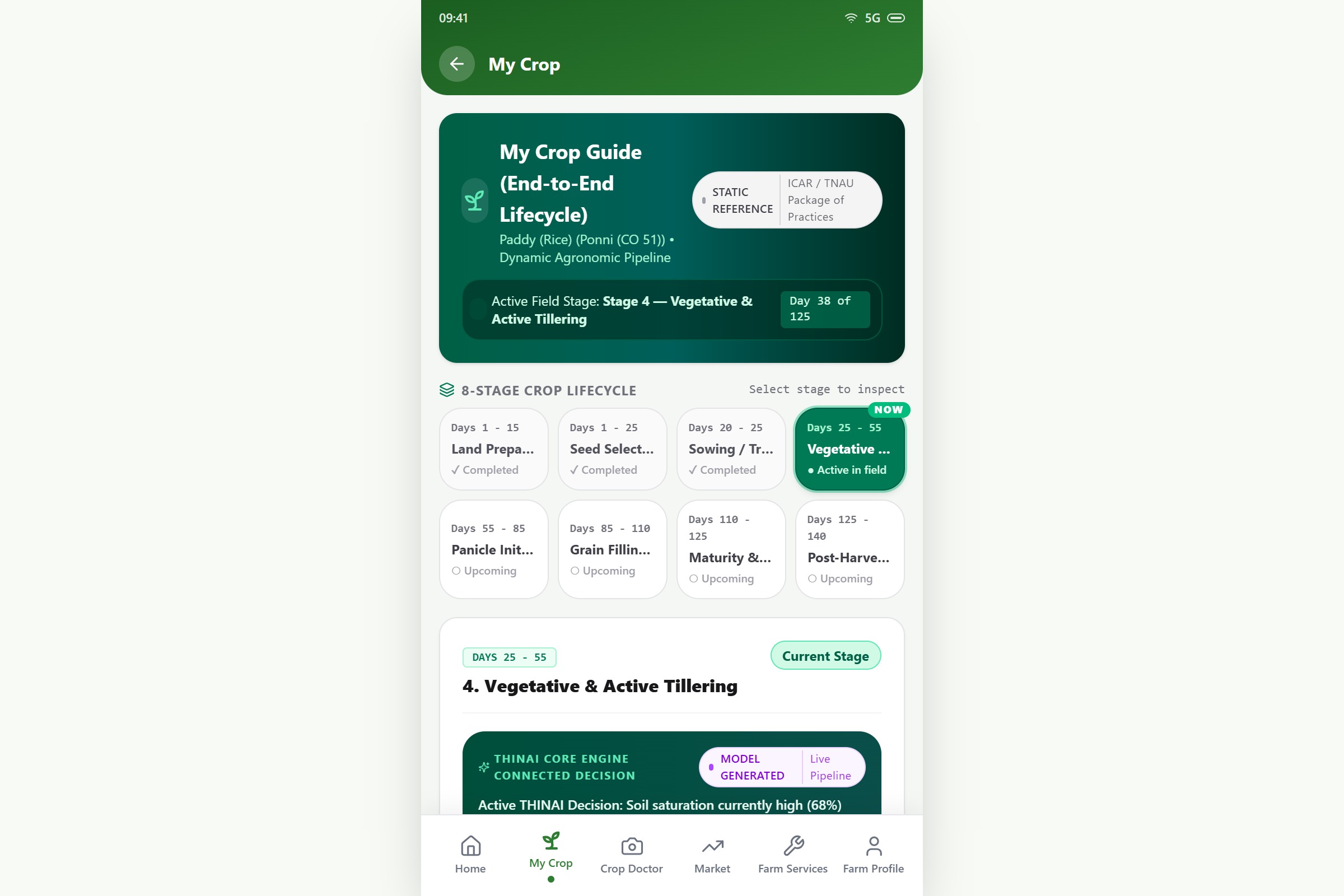
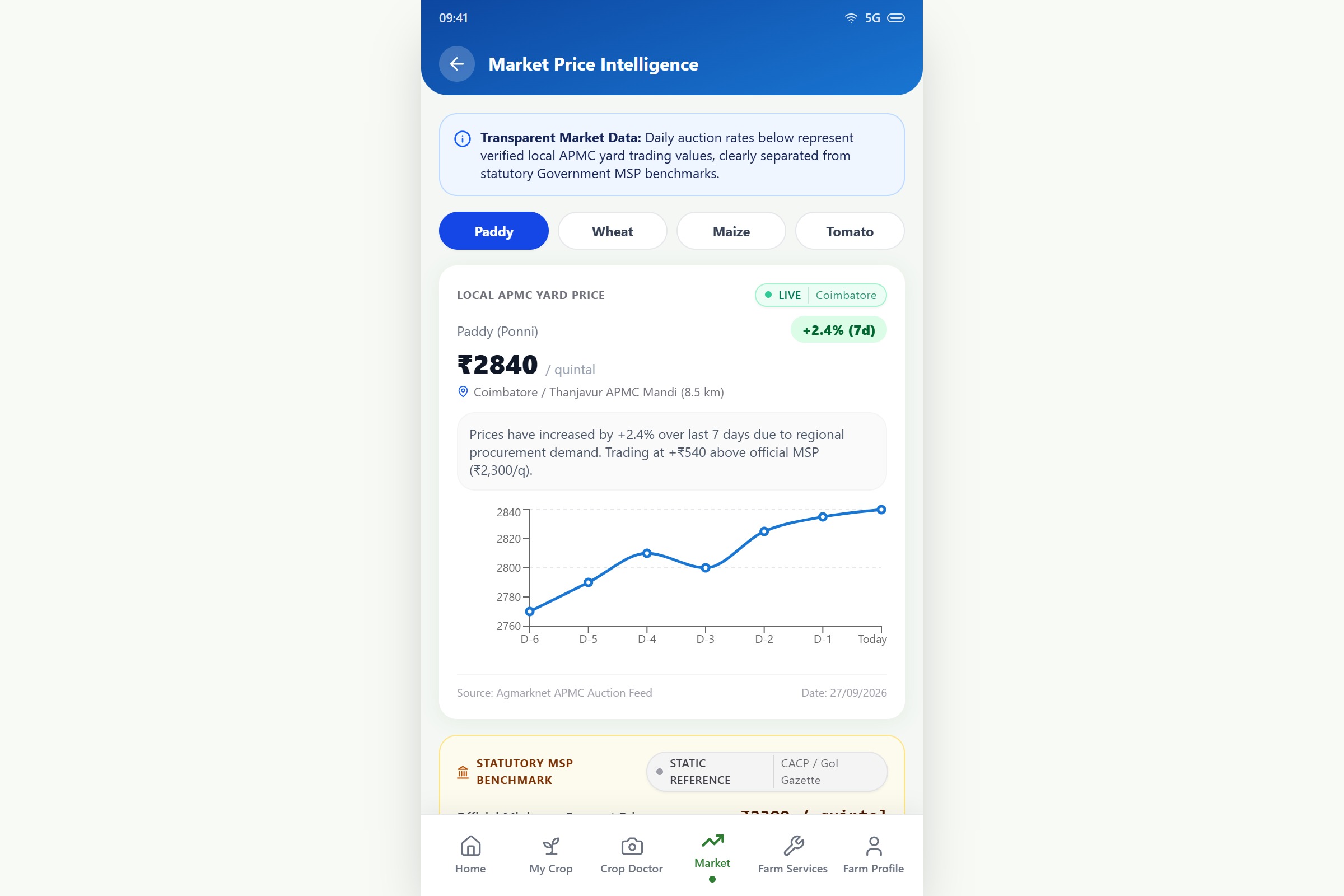
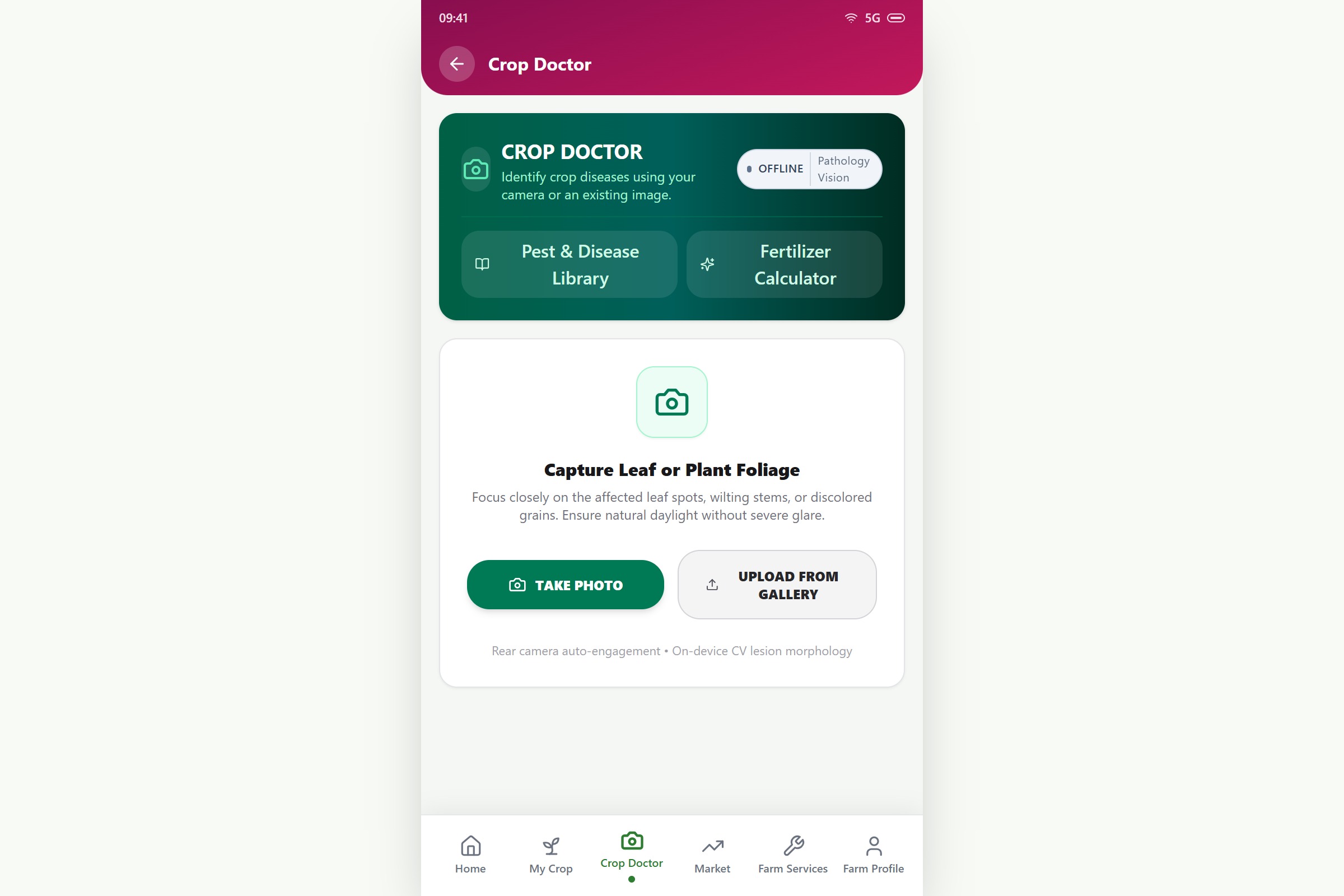
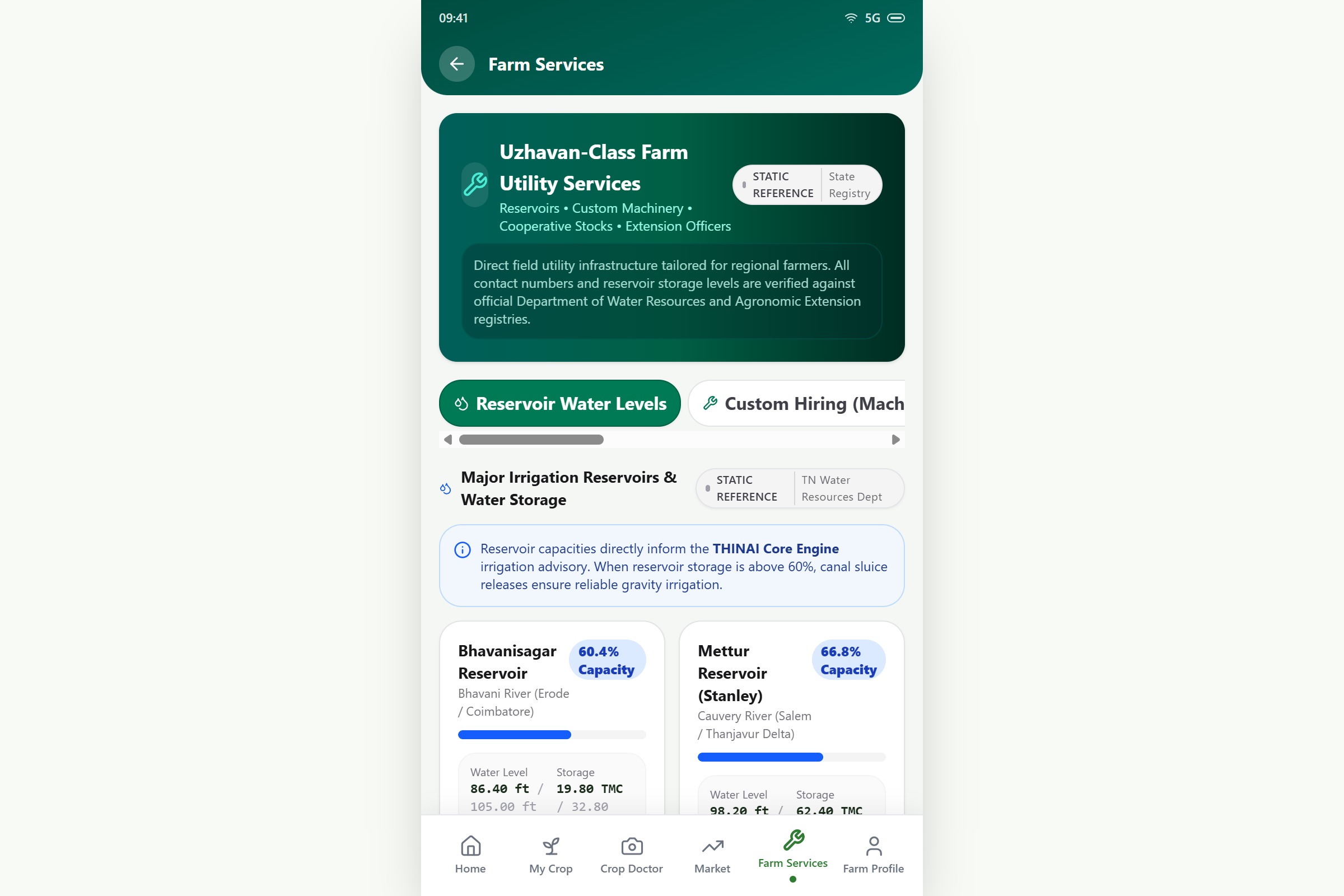
THINAI (திணை)
Technology for Holistic Intelligent Nurturing of Agricultural Intelligence
Inspiration
Smallholder farmers in rural India face unpredictable climate conditions, volatile agricultural market prices, and unreliable internet connectivity. Many agricultural applications depend on continuous internet access and provide recommendations without adequately explaining their risks.
Inspired by the five ecological landscapes of classical Tamil Sangam literature (Aintinai)—Kurinji, Mullai, Marutham, Neithal, and Palai—THINAI combines modern artificial intelligence with ecological awareness to support resilient agriculture and sustainable rural livelihoods.
What It Does
THINAI is an offline-first agricultural decision-support and agro-tourism intelligence platform designed for farmers, rural farm stays, and agro-tourists.
Transparent THINAI Core Engine: Analyzes soil saturation, 48-hour rainfall, temperature, humidity, market prices, and crop growth stage to generate water, disease, and market risk scores with understandable explanations. Agricultural Recommendation Fragility Index (ARFI): Evaluates how sensitive agricultural recommendations are to weather anomalies, market fluctuations, uncertain inputs, and changing environmental conditions. Camera-Based Crop Doctor: Uses plant-leaf images and computer vision models to help identify potential plant diseases, pests, and nutrient deficiencies. What-If Stress Testing: Allows users to simulate drought, extreme rainfall, and market price crashes before making agricultural decisions. Offline-First Architecture: Stores farm records, scans, and calculations locally using IndexedDB and Dexie.js, queues changes, and synchronizes data when connectivity returns. Agro-Tourism and Sangam Landscape Trails: Connects travelers with rural farm stays through crop lifecycle information, sustainable farming experiences, and agricultural market transparency. Mathematical Formulation of ARFI
The Agricultural Recommendation Fragility Index (ARFI) is designed to quantify the vulnerability of agricultural recommendations under uncertain conditions.
ARFI = Σ(wᵢ × Cᵢ), for i = 1 to 6
ARFI = w₁R_data + w₂C_model + w₃U_pred + w₄S_sens + w₅R_stress + w₆D_risk
The weights sum to 1.00:
Data Reliability (R_data, weight = 0.20): Evaluates sensor completeness and data freshness. Model Consensus (C_model, weight = 0.20): Measures agreement among ensemble classifiers. Prediction Uncertainty (U_pred, weight = 0.15): Uses normalized Shannon entropy to quantify uncertainty in predicted probabilities. Scenario Sensitivity (S_sens, weight = 0.15): Measures changes in recommendations when input parameters are perturbed. Stress Robustness (R_stress, weight = 0.15): Evaluates recommendation stability under severe weather and market scenarios. Decision Risk (D_risk, weight = 0.15): Estimates potential economic downside relative to applicable Minimum Support Price (MSP) benchmarks.
Prediction uncertainty is calculated using normalized Shannon entropy:
U_pred = −(1 / ln K) × Σ(pₖ ln pₖ), for k = 1 to K
Here, pₖ represents the predicted probability of class k, and K is the number of candidate classes.
Fragility Classification:
ARFI below 0.35: Stable / Low Fragility ARFI from 0.35 to 0.65, inclusive: Moderate Fragility ARFI above 0.65: High Fragility — use a fallback recommendation or request additional data.
The component scores must be normalized consistently before aggregation. Higher ARFI values indicate greater recommendation fragility.
How We Built It Frontend: React 18, TypeScript, Tailwind CSS, Lucide Icons, and Vite. Mobile Runtime: Capacitor 6 with native Android camera integration. Offline Storage: Dexie.js and IndexedDB for local persistence, queued mutations, and conflict handling. Decision and ML Service: FastAPI, Python, Scikit-learn, Random Forest, and Gradient Boosting. Crop Diagnosis: PlantVillage-based computer vision models and diagnostic rules. External Data Sources: Open-Meteo for weather information and Agmarknet for agricultural market data. Data Transparency: LIVE, CACHED, and OFFLINE indicators communicate the origin and availability of data. Challenges We Ran Into On-Device Camera and ML Constraints: Optimizing image processing for resource-constrained Android devices while reducing memory consumption and preventing out-of-memory errors. Transparent Data Provenance: Clearly distinguishing live data, cached information, and locally generated results. ARFI Formulation: Combining six statistical dimensions into a normalized index that can be communicated through simple fragility categories. Offline Synchronization: Managing queued updates and conflicting changes when devices reconnect to the internet. Accomplishments We're Proud Of Developed a progressive web application and an Android APK for testing. Designed an explainable agricultural decision-support framework with risk scores and causal explanations. Proposed ARFI to communicate the sensitivity and uncertainty of agricultural recommendations. Integrated agricultural decision support with sustainable agro-tourism concepts. Designed an offline-first experience intended for rural areas with unreliable connectivity. What We Learned Offline-first architecture is essential for applications intended for areas with unreliable connectivity. Recommendation accuracy alone is insufficient when data quality and environmental conditions can change. Transparent risk communication can help users understand the limitations of AI-generated recommendations. Agricultural technology must account for local languages, environmental diversity, and practical farming constraints. What's Next for THINAI
Hyperlocal Soil IoT Nodes: Integrate LoRaWAN-enabled soil moisture and nutrient sensors. Voice-First Tamil Interaction: Develop Tamil speech interfaces that support rural dialects and users with limited literacy. District-Wide Pilot: Explore deployment across 50 eco-farms in the Pollachi–Coimbatore agricultural corridor in collaboration with local farming communities. ARFI Validation: Calibrate and evaluate the index using real agricultural data, expert feedback, and historical weather and market scenarios. Field Testing: Measure diagnostic performance, offline reliability, recommendation stability, and usability under real farming conditions.
Built With
- agtech
- android
- capacitor
- computer-vision
- dexie.js
- fastapi
- indexeddb
- iot
- katex
- machine-learning
- offline-first
- open-meteo
- pwa
- python
- react
- scikit-learn
- sqlite
- sustainable-development
- tailwindcss
- typescript
- vite

Log in or sign up for Devpost to join the conversation.