Inspiration
Prediction-market odds are quoted as fact: “Polymarket says 80%.” But a headline probability can sit on almost nothing. Sometimes there are only a few hundred dollars of orders behind the price, and a small trade can move it 10¢. There are also related contracts that can also contradict each other. For example, “BTC above $150K” can be priced higher than “BTC above $100K,” which is impossible. Gemini’s Liquidity Rewards Program pays market makers to provide liquidity, which is a step in the right direction but a reward formula can’t tell a reader whether the odds they’re looking at are stable or logically consistent. We wanted a tool that says how much weight a number deserves.
What it does
So, how does it work?
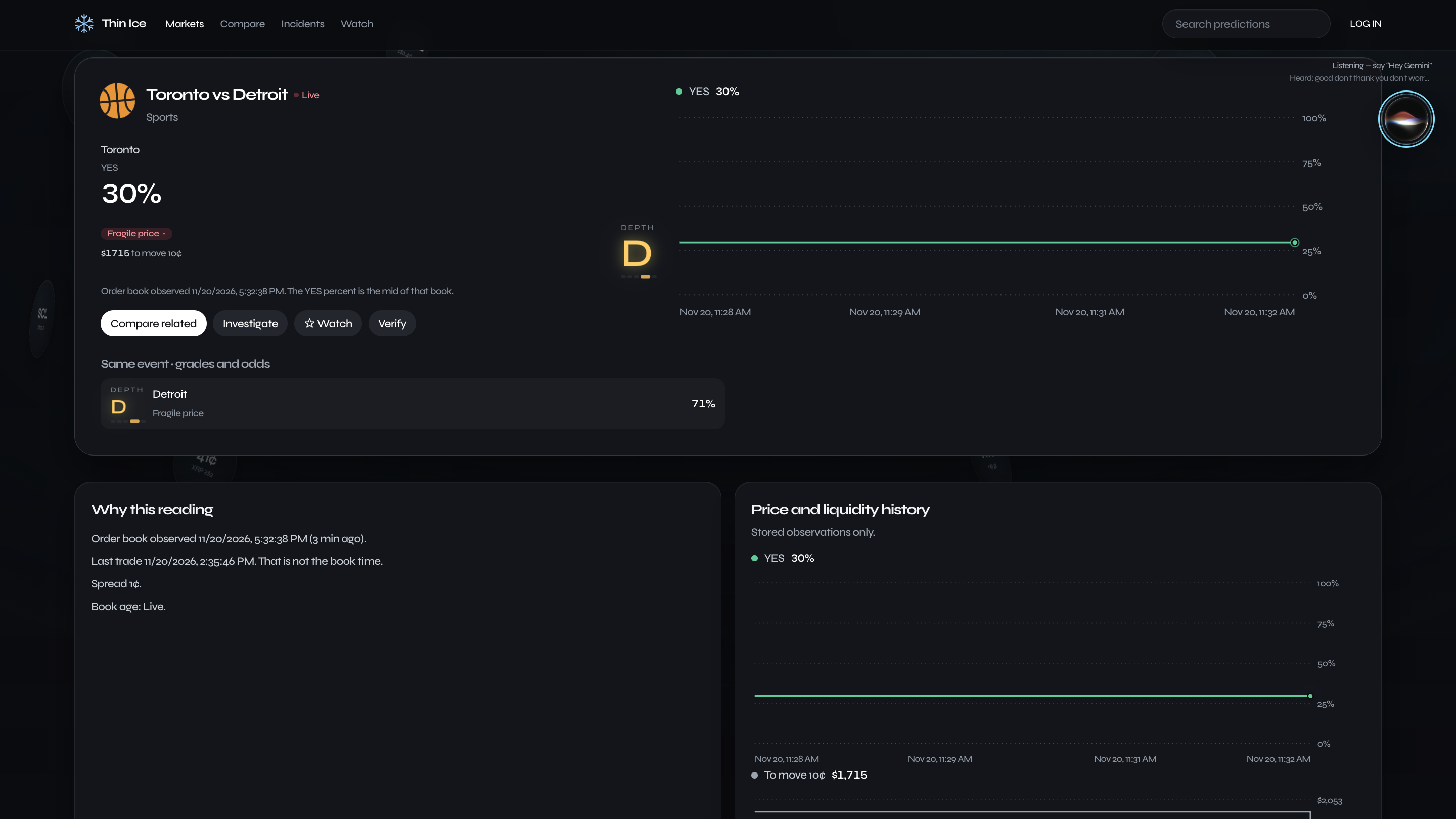
Thin Ice checks whether prediction-market prices are backed by usable liquidity and are logically consistent with related markets. It then takes unusual cases and publishes assessments anyone can verify.
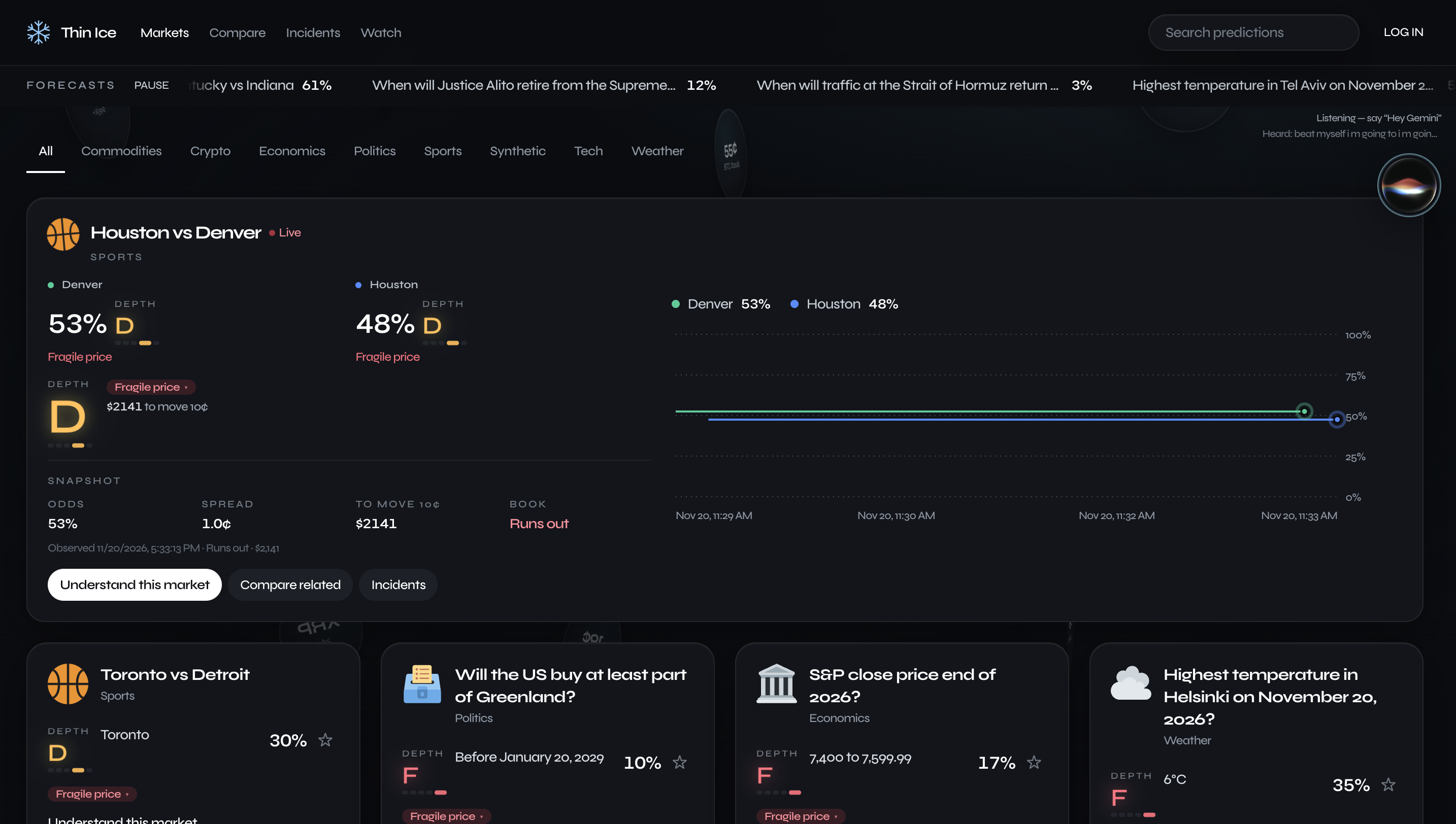
We grade our markets using the following :
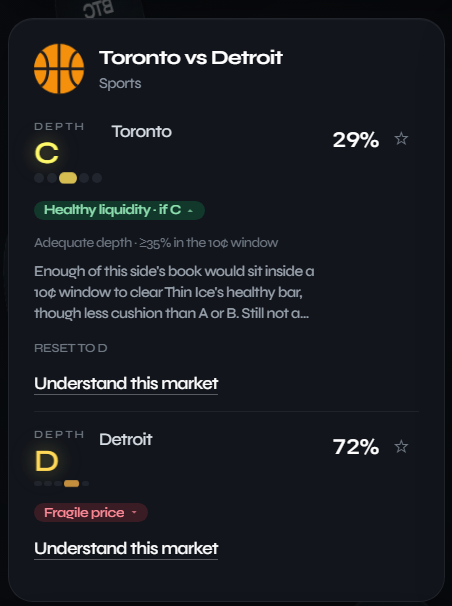
1) Liquidity grades (A–F): reads Gemini’s live order books to measure the dollars needed to move the odds 10¢, the slippage on $100–$5,000 trades, whether the visible book runs out, and how long markets stay thin.
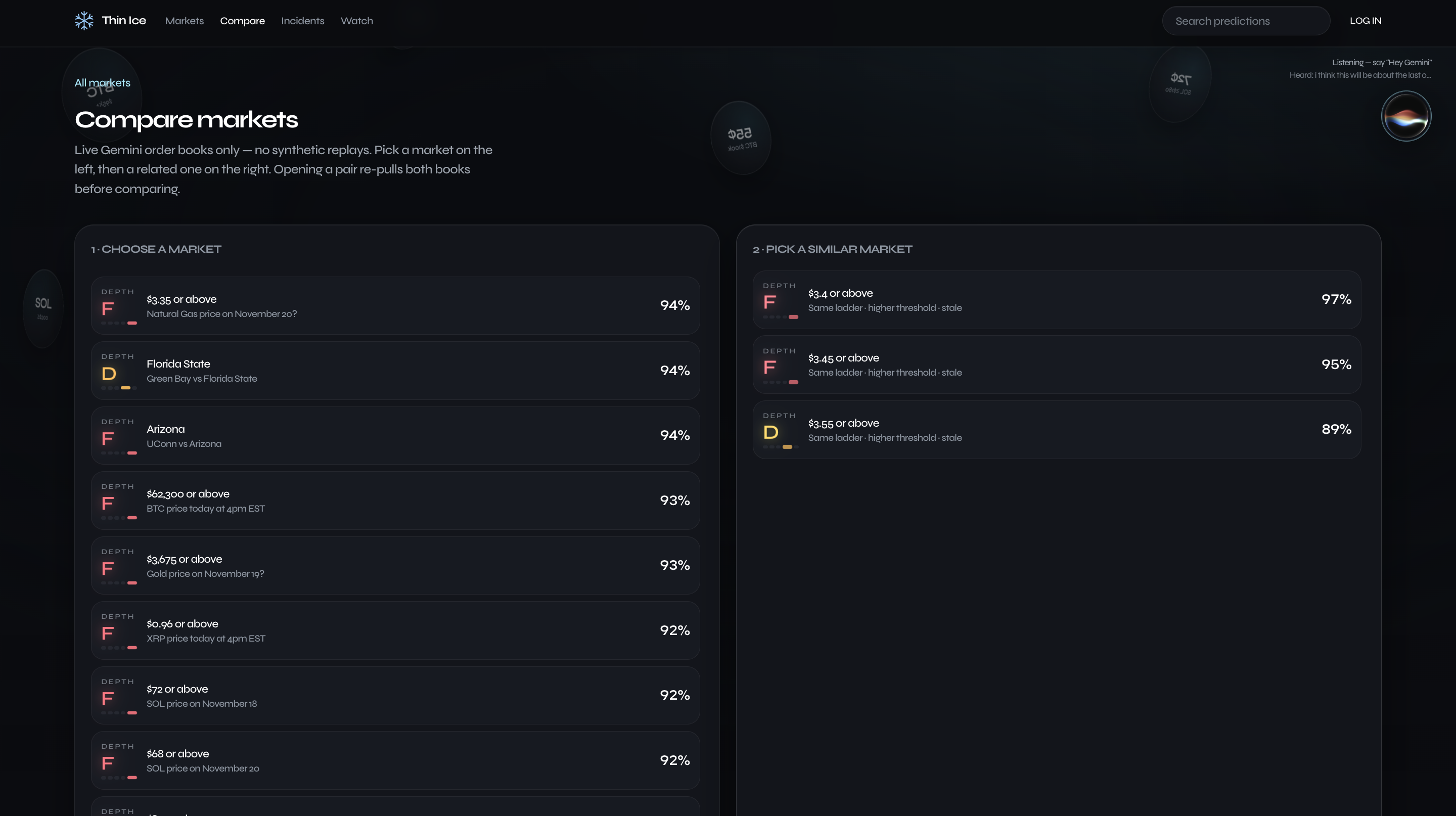
2) Consistency engine: builds a graph of related contracts (price ladders, deadline ladders, single-winner sets) and finds the nearest consistent prices. It then checks whether a contradiction holds at real bid/ask prices, in real size, after fees, with books recorded close together. A contradiction that only shows up in displayed prices is never called arbitrage.
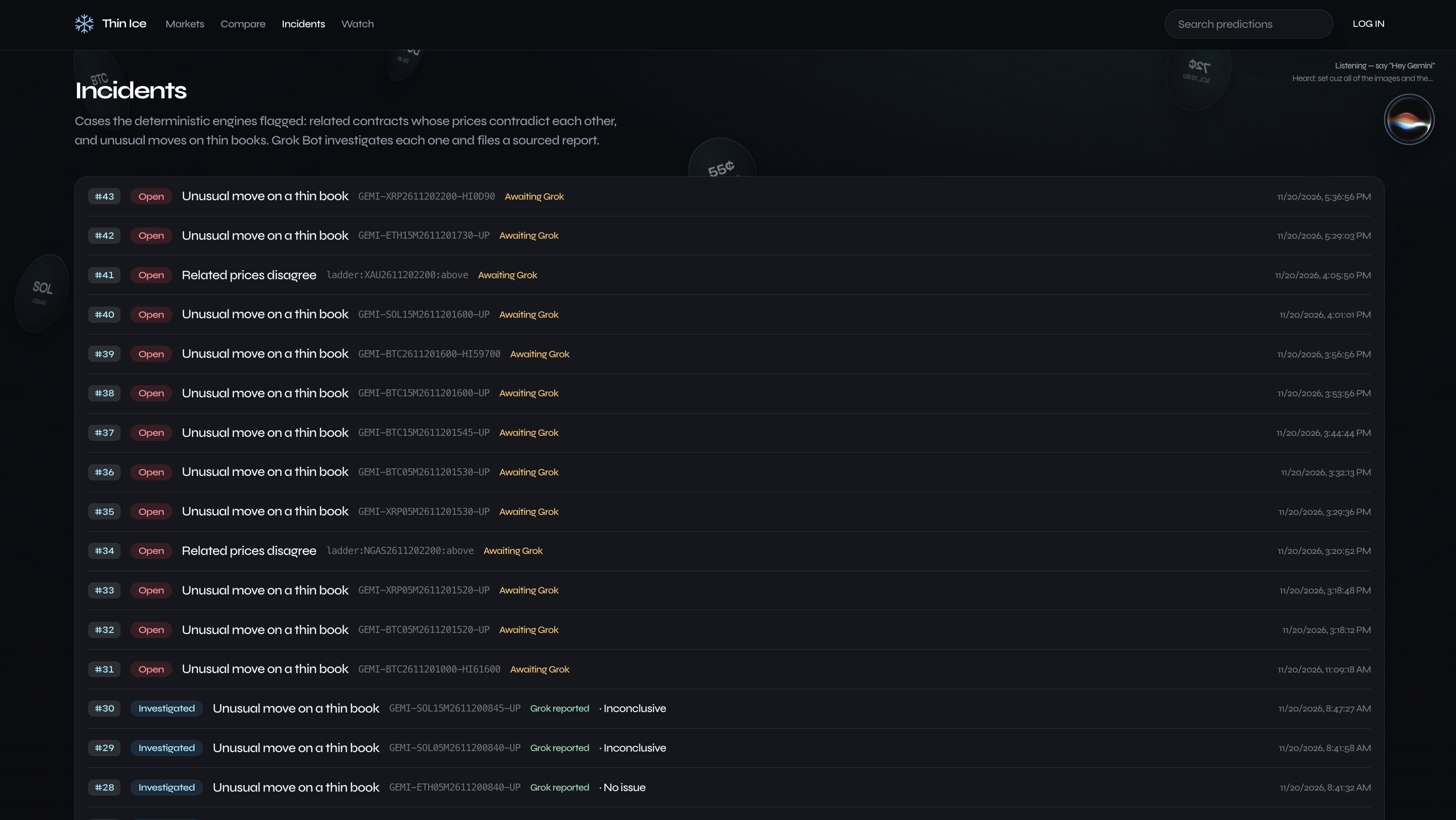
3) Grok Bot Sentinel: Grok investigates through our MCP tools (contract rules, history, fresh re-checks, news) and files a sourced conclusion: confirmed inconsistency, stale data, different rules or inconclusive.
4) Solana risk layer: assessments are hashed and recorded onchain with a grade and risk flags. A program (safe_payout) reads the latest assessment and pauses when a market is thin or inconsistent.
5) Dashboard: a market board with plain-language verdicts, a side-by-side compare lab, A–F “what-if” browsing, a watchlist, an incidents page, an embeddable badge, and a voice copilot you can wake with “Hey Gemini.”
How we built it
We used Python backend (FastAPI, SQLite) that records about 200 live Gemini order books and runs our liquidity and consistency engines, which uses regression and simplex projection to find the nearest coherent prices. Grok Bot investigates flagged cases through an MCP server, and two Anchor programs on Solana store hashed assessments that other programs can read and act on. The Next.js dashboard, deployed on Vercel, includes a voice copilot (ElevenLabs) whose numbers all come from our engines, never from the LLM.
Challenges we ran into
Gemini’s “categorical” events aren’t always mutually exclusive, and many contradictions turned out to be stale quotes or too little size. So we had to check contract rules, synchronized timestamps, executable prices and fees before calling anything a real inconsistency. Building the Solana programs on Windows meant using dependencies and scripting the tool through WSL.
Accomplishments that we're proud of
We are proud that we built an open, reproducible grading formula: anyone can take an onchain receipt, re-hash the snapshot and recompute the grade. We’re also proud of the full loop, from detection and execution-aware checking to a Grok investigation and an onchain assessment that a program can act on with a hands-free voice copilot.
What we learned
We learned that liquidity runs across time, it is not a single number. For example, one number at noon could be something completely different in the evening. We also found that math and an LLM work best with clear roles, where code does the calculations and Grok explains the results and gathers evidence.
What's next for Thin Ice
We want to expand to Kalshi and Polymarket so the same market can be compared across exchanges, and let anyone reply to a post quoting odds on X to get its Thin Ice grade. We also plan to measure how often liquidity disappears between Gemini’s reward snapshots, and to bring on more DeFi apps that use our onchain assessments as a risk oracle.
Built With
- anchor
- elevenlabs
- fastapi
- gemini-api
- grok
- httpx
- mcp
- next.js
- numenta-grok
- pytest
- python
- react
- rust
- solana
- solders
- sqlite
- tailwindcss
- typescript
- vercel
- websockets
