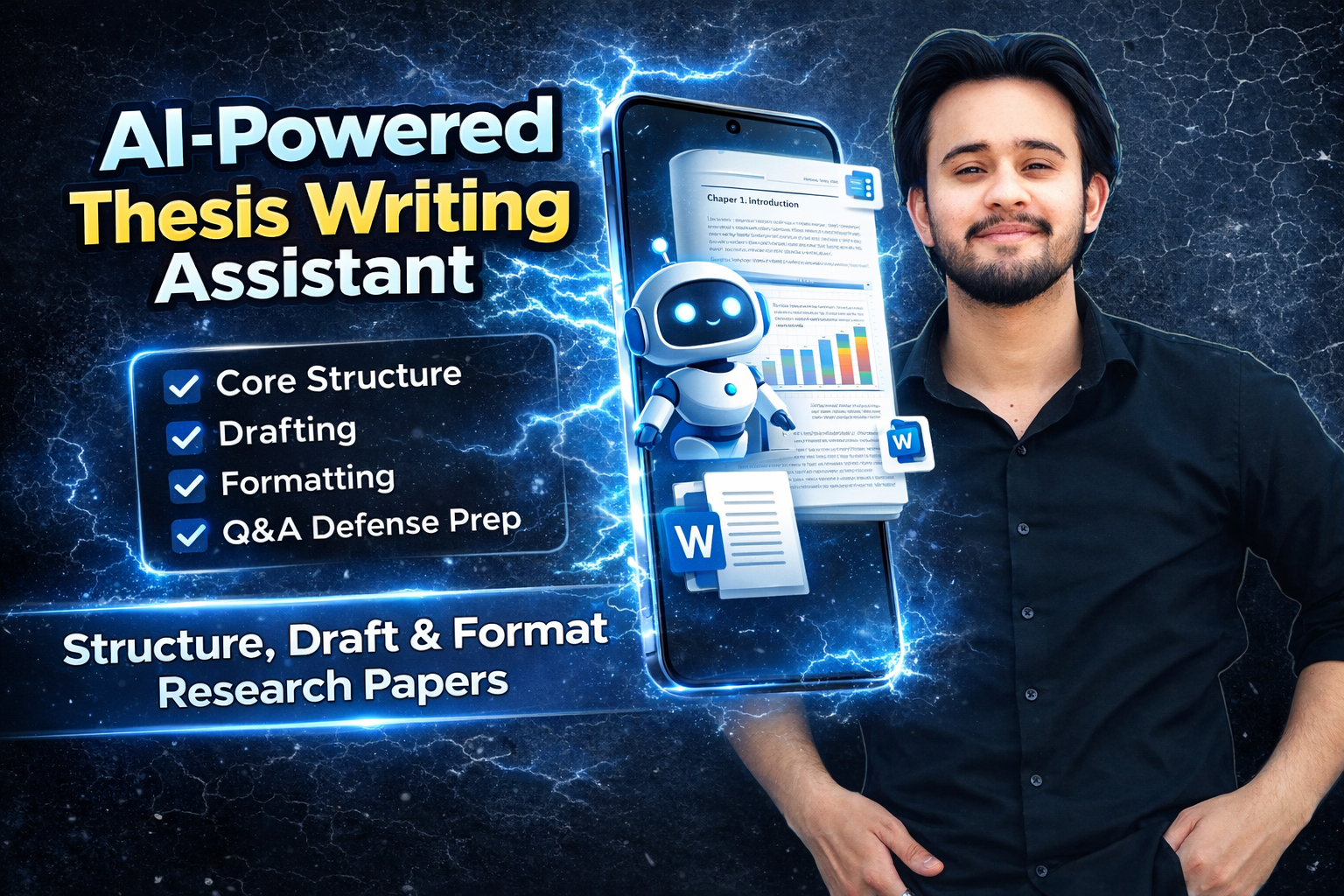
AI Thesis Assistant: A Comprehensive Platform for Automated Academic Writing Description: This AI-powered website assists users in generating a complete, structured thesis based on their specified criteria. The platform can produce documents of up to 800 pages, with full support for editing and exporting in Microsoft Word format. It also provides a Q&A section derived from the thesis content, enabling users to prepare for exams, interviews, or thesis defense presentations. The generated question paper and answers are downloadable as Word files.
How It Works – User Input Example: Users simply provide the following details:
Thesis topic
Group name (optional)
Members' names (optional)
University logo upload (optional)
Roll number and ECTS details
Option to upload a sample paper or follow the Standard Thesis Research Format outlined below
Custom criteria or additional pages can be added as needed
Standard Thesis Research Format (Provided by the Platform) Preliminary Pages (Before Chapter 1) Title Page – Thesis title, student name, roll number, degree, department, university, supervisor, year.
Declaration – Originality statement.
Certificate / Approval Page – Signed by supervisor(s) and department.
Acknowledgements – Formal thanks.
Abstract – 200–300 words summarizing problem, method, findings.
Table of Contents
List of Tables / Figures
List of Abbreviations (optional)
Chapter 1: Introduction Background of the Study
Statement of the Problem
Research Objectives
Research Questions / Hypotheses
Significance of the Study
Scope and Delimitations
Operational Definitions
Chapter 2: Literature Review Theoretical Framework
Review of Relevant Studies
Critical Analysis
Research Gap
Conceptual Framework
Chapter 3: Research Methodology Research Design
Population & Sampling
Research Instruments
Validity & Reliability
Data Collection Procedure
Ethical Considerations
Data Analysis Techniques
Chapter 4: Data Analysis & Results Descriptive & Inferential Statistics
Tables, Graphs, Figures
Interpretation of Results
Chapter 5: Discussion Discussion of Findings
Comparison with Previous Studies
Theoretical Explanation of Results
Chapter 6: Conclusion & Recommendations Summary of Findings
Conclusions
Practical Recommendations
Limitations
Future Research Suggestions
References (APA, MLA, Chicago, etc.) Appendices (Questionnaires, Forms, Extra Data) Common Formatting Rules (APA – Psychology Example) Font: Times New Roman
Size: 12 (Headings 14)
Line Spacing: 1.5 or Double (as required)
Margins: 1 inch
Referencing: APA 7th Edition (adjustable)
What the AI System Ensures While Writing
- Understands the Thesis Purpose A thesis is a research document that solves a problem, analyzes a system, or proposes a model.
It must combine existing literature + original work, demonstrating critical thinking, methodology, and results.
- Helps Choose a Strong Thesis Topic Topics should be:
Specific – not too broad
Solvable within the given timeframe
Relevant to the field
Example (Computer Science):
✅ Good: “An NLP-Based Intelligent Chatbot for Academic Assistance in Universities”
❌ Avoid: “Chatbot App”
Follows Standard Thesis Structure Chapter 1: Introduction – Background, problem, objectives, scope. Chapter 2: Literature Review – Existing research, gaps. Chapter 3: Methodology – System design, tools, algorithms, flowcharts. Chapter 4: Implementation & Results – Screenshots, testing, performance analysis. Chapter 5: Conclusion & Future Work – Summary, limitations, enhancements.
Applies Strict Formatting & Academic Standards Uses required font, size, spacing, margins.
Applies consistent referencing style.
Ensures plagiarism compliance (e.g., <15–20% similarity).
Supports figures, tables, appendices.
This platform is designed to save time, ensure structure, uphold academic standards, and empower students to focus on research quality while automating formatting and drafting workflows.
Built With
- aistudio
- gemini3pro

Log in or sign up for Devpost to join the conversation.