-
-
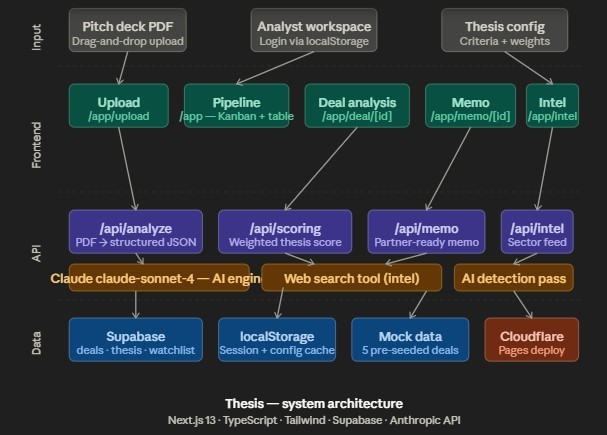
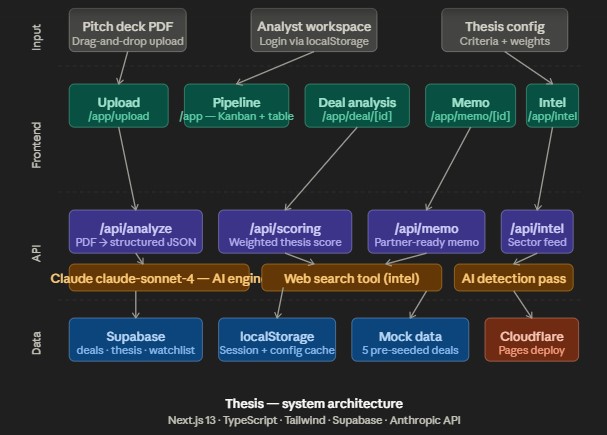
Thesis System Architecture Schematic
-
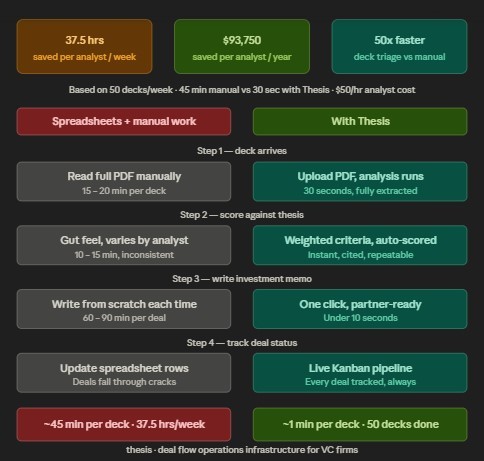
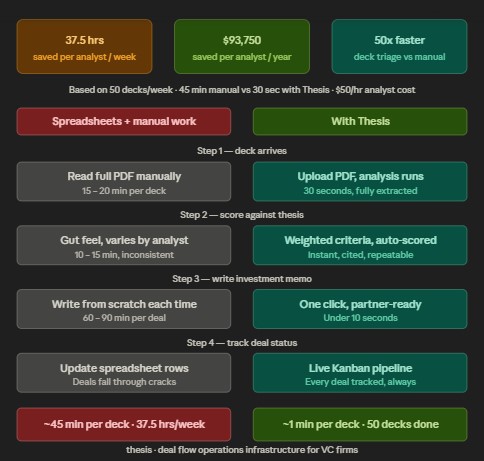
How Thesis Transforms VC Deal Flow
-
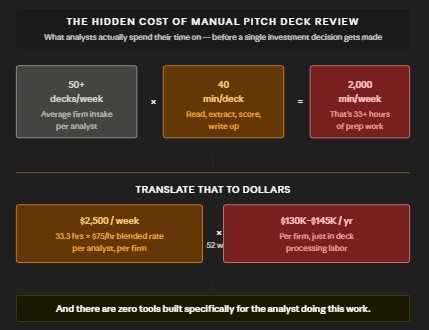
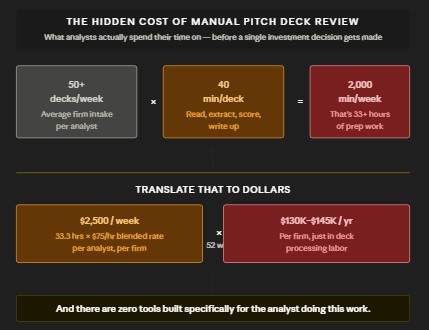
The Hidden Cost of Manual Pitch Deck Review
-
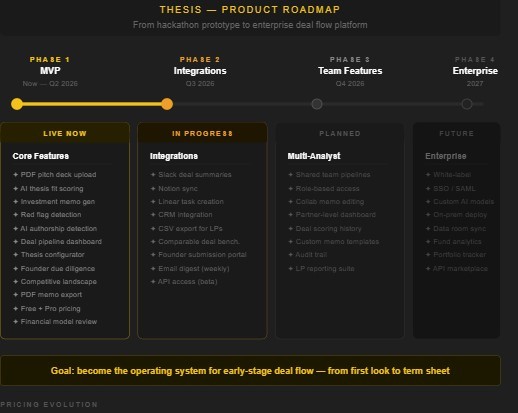
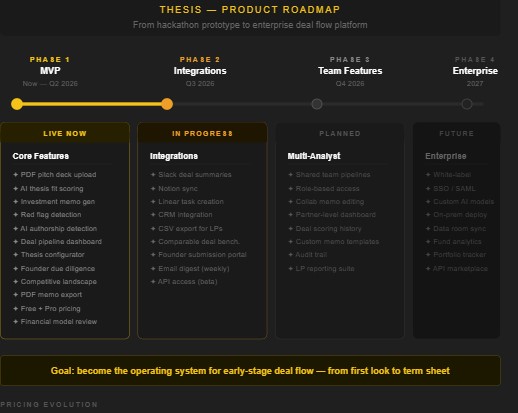
Thesis Product Roadmap
-
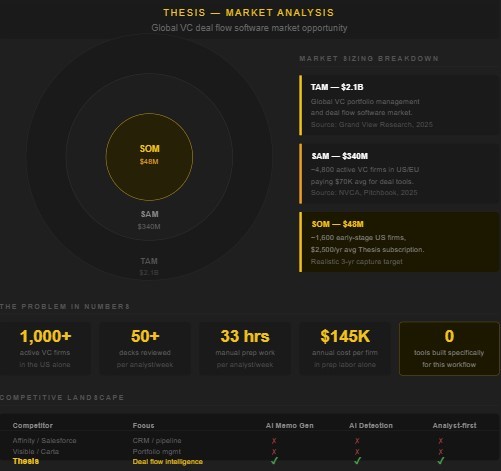
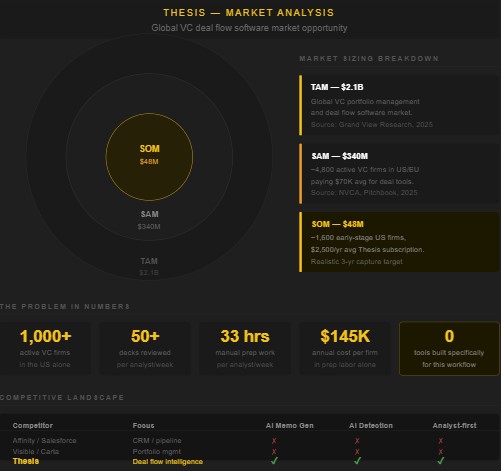
Thesis Market Analysis
-
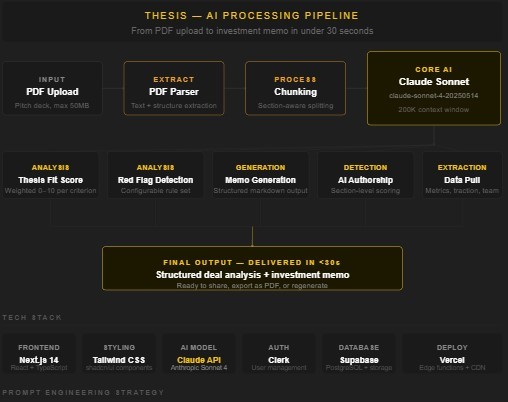
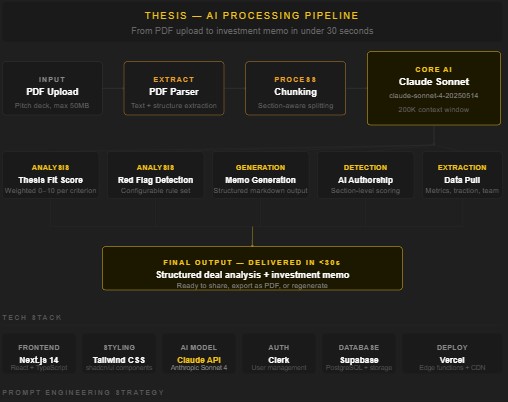
Thesis AI Processing Pipeline
-
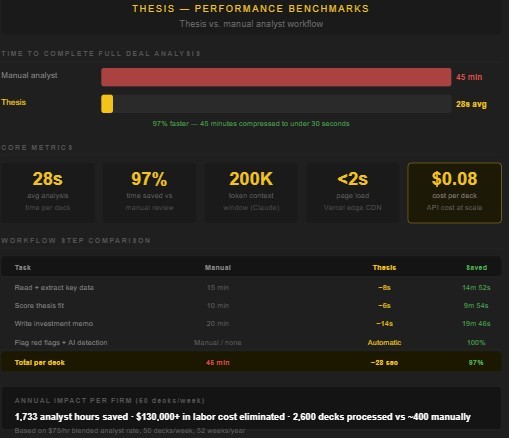
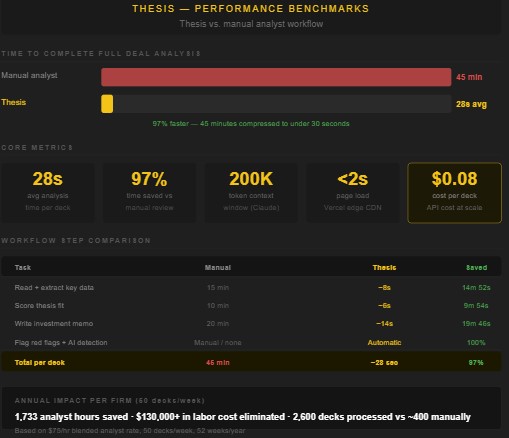
Thesis Performance Benchmarks
The Problem
I'm 16 and an incoming VC analyst at 1435 Capital Management, a Princeton-based early-stage fund. Before I touched my first deal, I already knew what the most painful part of the job would be.
Pitch decks.
Before writing a single line of code, I called people in the VC space and asked directly: would a tool that reads pitch decks and returns structured analysis actually be useful? Every single person said yes. One told me they spend more time reading decks than making investment decisions.
The average VC firm sees 50+ decks a week. Each takes 30 to 45 minutes to read, extract, score, and write up. That's 33+ hours of repetitive manual work per week before a single investment decision gets made. At $75/hr, that's $130K to $145K per firm per year, just on deck processing.
Every AI tool built for pitch decks helps founders write better ones. Nothing exists for the analyst reading 50 of them a week. That's the gap Thesis fills.
What It Does
Upload any pitch deck PDF. In under 30 seconds, Thesis returns:
- Structured deal data - market sizing, traction, team, business model, and asking terms pulled directly from the document
- Thesis fit scoring - every deal is scored against your firm's specific criteria, with a quoted reason from the deck for each score
- Red flag detection - no revenue model, uncited market claims, solo founder, unrealistic projections - surfaced automatically
- AI content detection - section-by-section breakdown of how much of the deck appears AI-generated, with flagged excerpts and just plain English reasoning so it isn't confusing. Because analysts deserve to know what they are actually reading.
- Investment memo - one page, structured for partner review, written to sound like a human analyst wrote it. Ready to share without editing.
- Deal pipeline - Kanban board and sortable table tracking every deal from first look to final decision
- Thesis configurator - each firm defines their own criteria with custom weights so every analysis reflects what that firm actually cares about, not just a generic rubric
- Analyst notes - private per-deal notes that save automatically, so your thinking stays attached to each deal
How I Built It
Track: FinTech & Developer Tools
Next.js 14, TypeScript, Tailwind CSS, Framer Motion, Anthropic Claude API, Supabase, Vercel. Built solo.
The core insight: Claude reads PDFs natively as document content blocks. No parsing libraries, no chunking, no preprocessing. The full deck goes in, structured JSON comes out.
The thesis configurator stores each firm's scoring criteria so every analysis is calibrated to that firm's actual investment focus. The memo generation uses a separate prompt tuned to produce something that reads like a senior associate wrote it, not a chatbot summarizing a summary.
Full technical documentation, including architecture diagrams and API references, is available in the GitHub repository README.
Challenges
The pitch deck problem was harder than I expected. Some decks are 8 slides. Some are 47. Some cite market size with a third-party source. Some just say "the market is big." I built fallback handling throughout, so if something cannot be extracted with confidence, it shows as "Not stated" rather than a made-up number. In VC, a confidently wrong number is way worse than no number at all.
Another challenge was getting the investment memo to read like a human wrote it took more iterations than anything else in this project. There is a real difference between an AI summary and something a partner would actually read on like a Monday morning. That difference really drove every single prompt revision until it cleared the bar that I wanted.
Impact and Scalability
So the primary user is a first or second-year analyst at an early-stage VC firm, usually at a fund under $500M AUM, where one analyst is doing the work of three, and nobody has built internal tooling. The secondary user is the GP who reads the memo and makes the call.
There are roughly 6,000 VC firms in the US. Every single one of them has analysts doing this manually right now.
The architecture is already multi-tenant ready through Supabase, so scaling to multiple firms and analysts is a config change, not an entire rebuild.
What's next for Thesis
Thesis is still early, but I know exactly where it's going. Next up is Slack integration for deal summaries, comparable benchmarking so analysts can see how a startup stacks up against similar-stage companies, and Notion and Linear integration to turn deal feedback into actual tasks. After that, multi-analyst support with shared pipelines and CSV export for LP reporting.
I'm joining 1435 Capital Management this summer and Thesis is coming with me on day one. Winning the community spotlight at Hack the Tech would put Thesis in front of developers, founders, and industry experts across the global Hack the Tech network, and I'd greatly appreciate the kind of visibility that helps turn a solo build into something real firms can actually use. That's the next step, and I'm not stopping till it gets there.
Team
Nivas Palaniappan - solo. Product, design, frontend, backend, AI prompt engineering. Non-tech background. Built the tool that the other side of the table has always needed
Incoming VC analyst at 1435 Capital Management.
Built With
- antropic-claude-api
- framer-motion
- next.js
- supabase
- tailwind-css
- typescript
- vercel


Log in or sign up for Devpost to join the conversation.