-
-
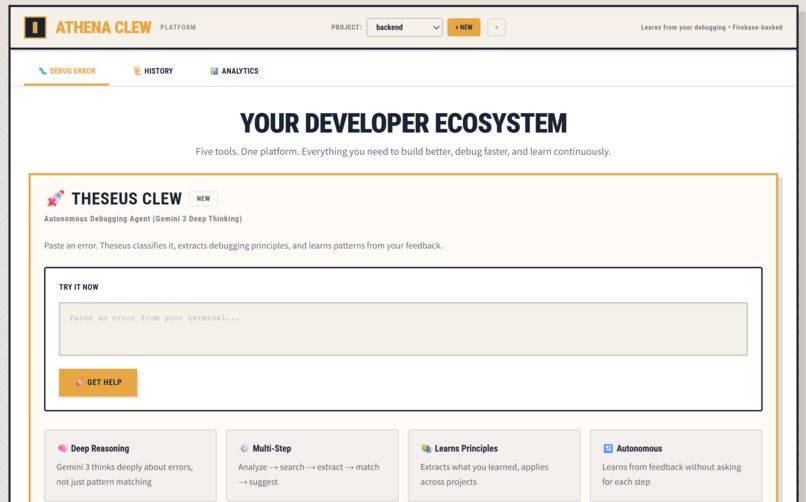
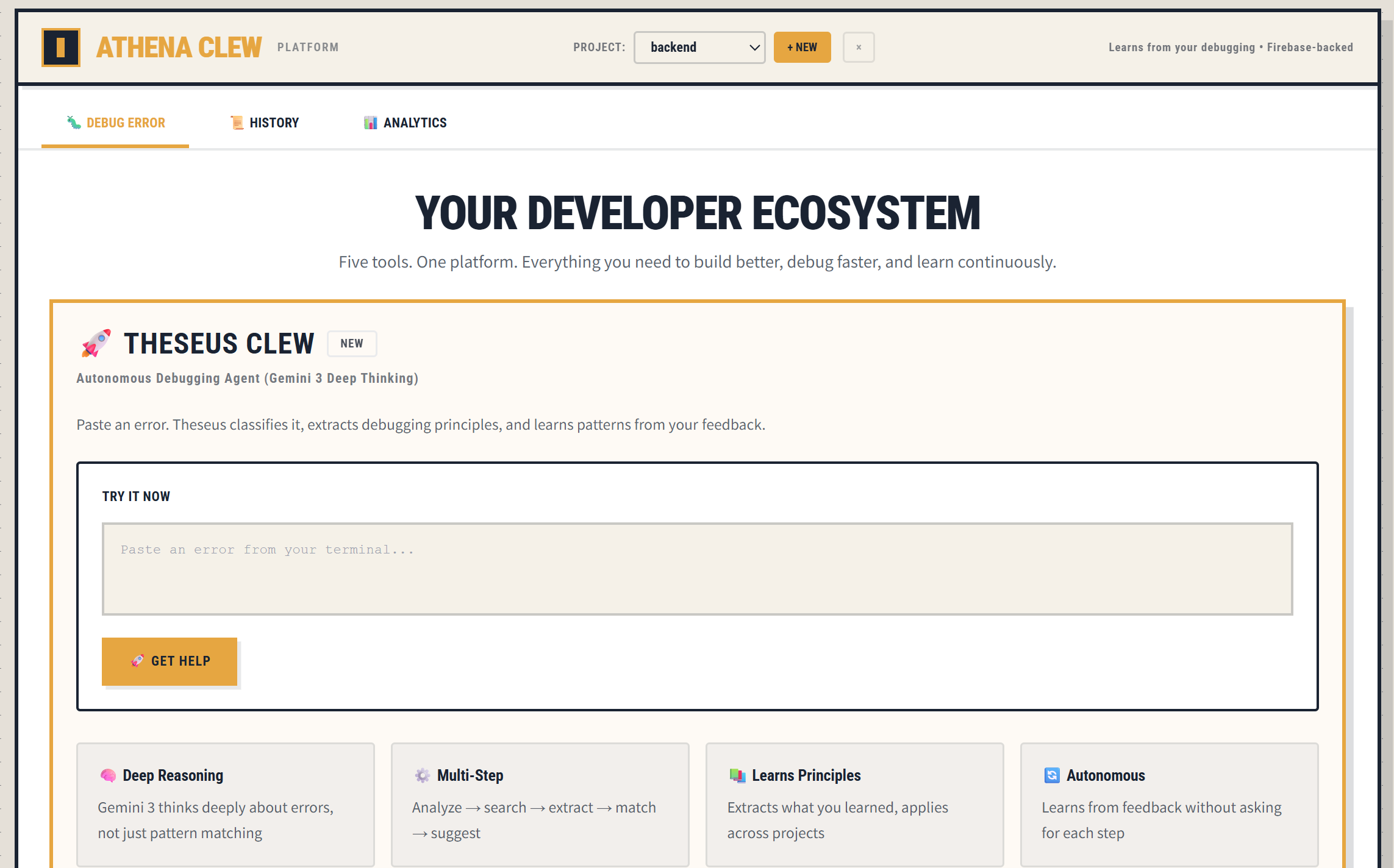
Theseus Clew on the Athena Clew Platform
-
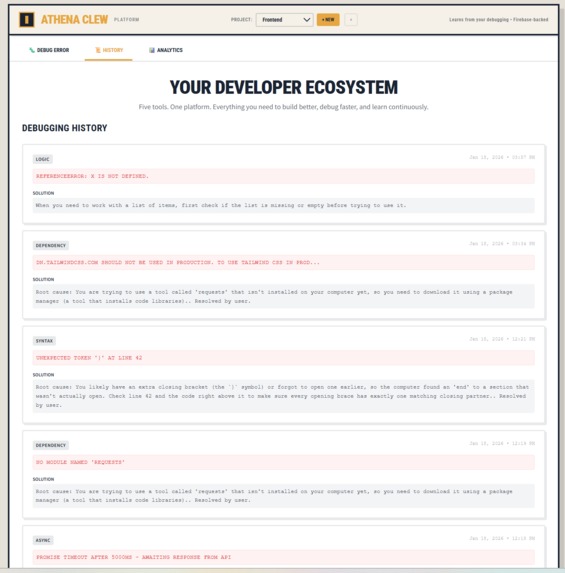
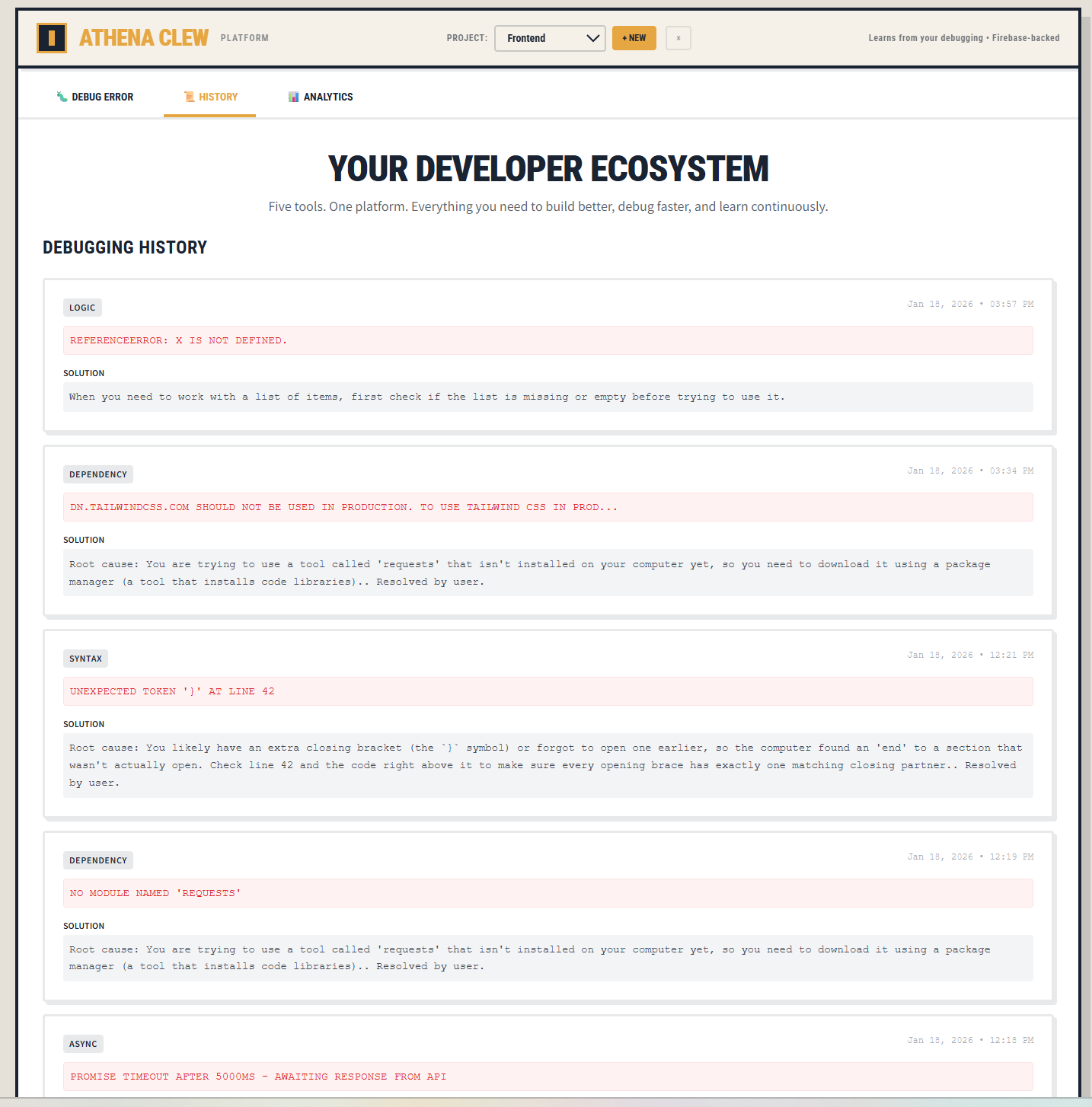
Debugging History
-
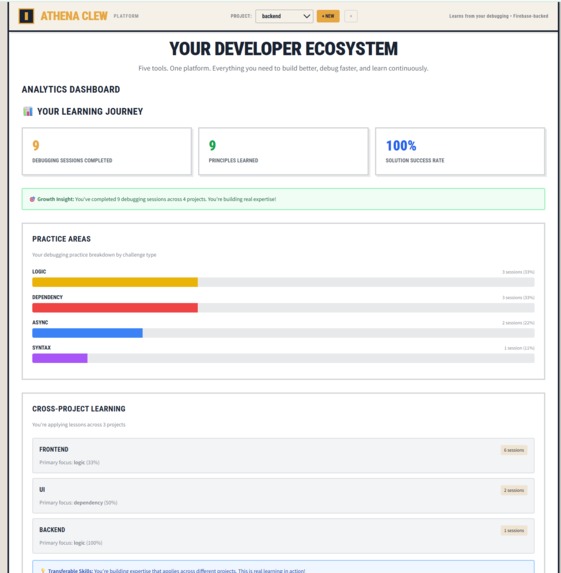
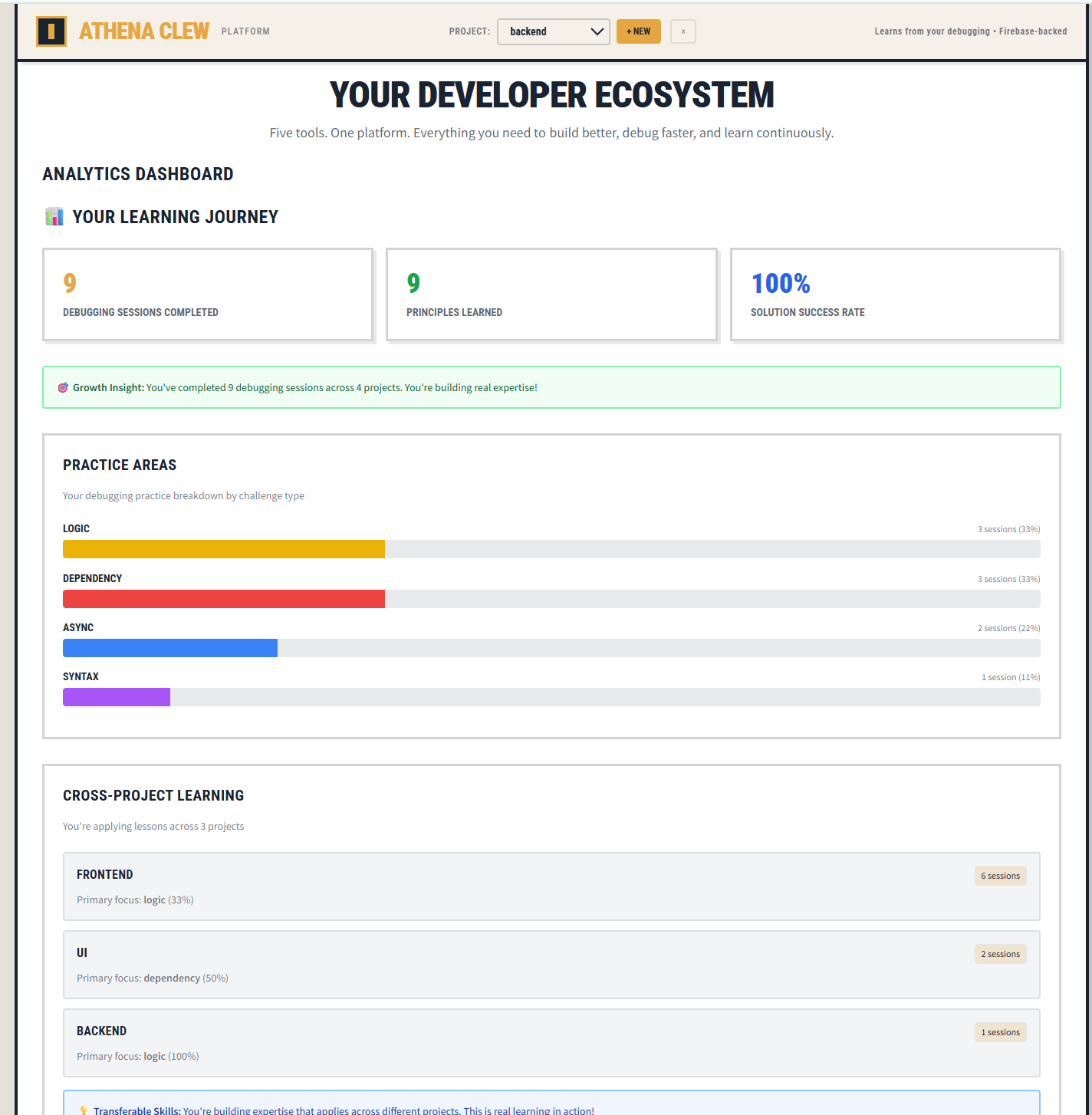
Analytics Tracking
-
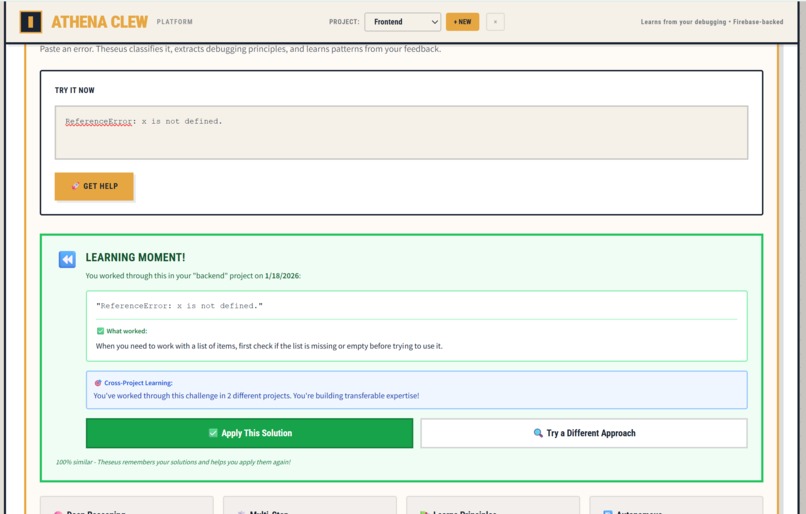
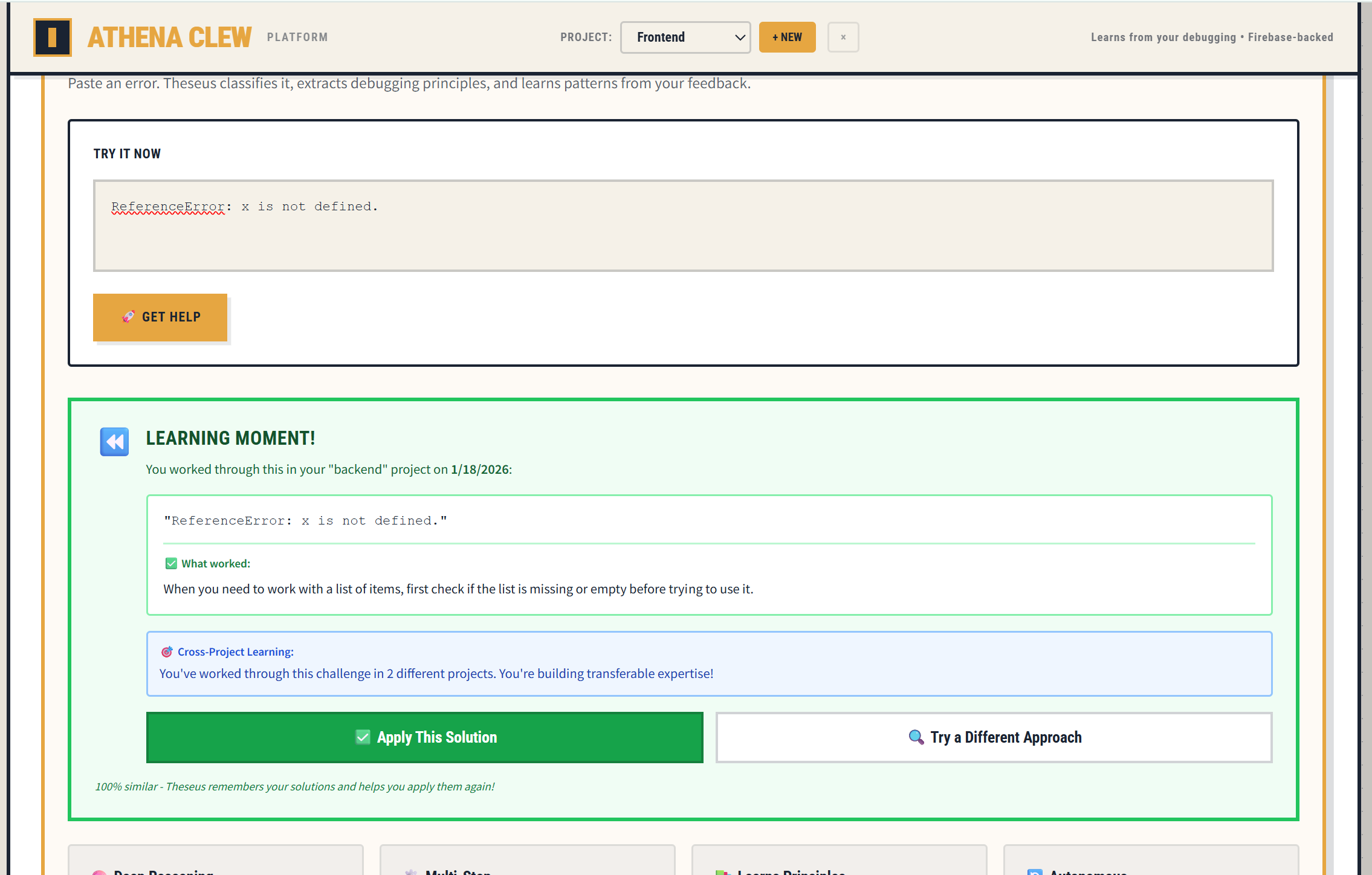
Cross Project Memory
💡 Inspiration
Modern AI coding assistants are powerful, but they suffer from a critical limitation: they forget.
Every debugging session is treated as a one-off interaction. Context is lost, fixes are forgotten, and developers are forced to rediscover the same solutions across projects. While working across multiple codebases, I kept encountering the same bugs and explaining the same fixes—without any transfer of learning.
Theseus Clew was inspired by a simple question:
What if every bug you fixed made you permanently better?
Instead of generating disposable answers, I wanted to build an AI agent that could remember how problems were solved and reuse that knowledge over time.
⚙️ What it does
Theseus Clew is an autonomous debugging agent with memory.
I paste an error message or stack trace into the app, and the agent:
- Analyzes the error and its root cause
- Searches my past debugging history within the current project
- Falls back to cross-project memory when relevant
- Recalls previously successful solutions and principles
- Generates a reasoned explanation and suggested fix
When a solution proves helpful, Theseus automatically extracts a generalized rule (formatted as “When X, then Y”) and stores it in a persistent knowledge base. Over time, the agent learns to recognize recurring issues and surface relevant past solutions—even across different projects.
The result is a system that transforms debugging history into long-term, reusable intelligence.
🛠️ How I built it
Theseus Clew is part of the Athena Clew Ecosystem, a modular platform of AI agents that share memory, reasoning, and identity.
The system is built using:
- Gemini 3 Deep Thinking for multi-step reasoning, classification, and principle extraction
- Firestore for persistent session, project, fix, and principle storage
- Vanilla JavaScript and Tailwind CSS (CDN) for a simple, transparent frontend
- Google Cloud Run for scalable, containerized deployment
At its core is a five-step autonomous orchestration pipeline:
- Deep error analysis
- Historical fix search (project-first, cross-project fallback)
- Principle extraction from successful fixes
- Similarity-based matching using Jaccard scoring
- Autonomous learning when a fix is confirmed as helpful
All steps are logged, test-covered with Jest and Playwright, and designed to degrade gracefully when AI services are unavailable.
🚧 Challenges I ran into
AI reliability and rate limits
Gemini calls required deterministic fallbacks so the app would never block users or fail silently.Cross-project memory without embeddings
Instead of vector databases, I implemented fast, client-side Jaccard similarity, achieving near-zero latency with no additional infrastructure.Schema design under time pressure
I designed a multi-project Firestore schema from day one to avoid painful migrations later.SDK-specific pitfalls
The Firebase AI Logic Web SDK required careful handling of configuration formats and backend selection.
Each challenge reinforced the importance of simple, resilient design choices.
🏆 Accomplishments that I'm proud of
- Built a stateful AI agent, not a stateless prompt wrapper
- Enabled cross-project debugging recall with no extra user effort
- Designed and shipped a multi-project memory architecture
- Implemented a personal analytics dashboard that visualizes debugging growth
- Delivered a fully deployed, tested, and documented application within hackathon constraints
📚 What I learned
- Persistent memory dramatically increases the usefulness of AI tools
- Simple algorithms often outperform complex systems for MVPs
- Designing for extensibility early prevents costly refactors
- AI agents must fail gracefully to be trustworthy
- Debugging is fundamentally a learning problem, not just an answer-generation task
🔮 What's next for Theseus Clew
Part of the Athena Clew Ecosystem
Next steps include:
- Documentation and external knowledge lookup integration
- Improved similarity and ranking strategies
- Team-based and shared learning modes
- Deeper integration with other Athena Clew agents (Janus, Ariadne)
- Expansion from personal memory to collective debugging intelligence
Theseus Clew is designed as a foundation for long-term learning—not just a single-use debugging tool.
🤖 Built With AI Assistance
This project was built by a solo developer with AI co-pilots (Claude by Anthropic and AntiGravity).
All architecture, design decisions, debugging choices, and tradeoffs were made by me.
Human-approved. AI-assisted.

Log in or sign up for Devpost to join the conversation.