-
-
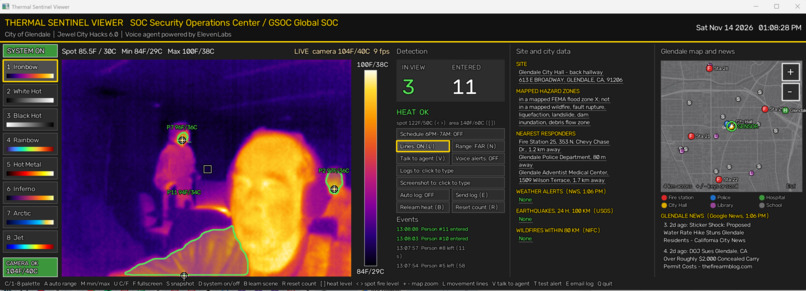
Thermal Sentinel V2: AI-powered thermal security for Glendale with people detection, fire alerts, and ElevenLabs voice assistance.
-
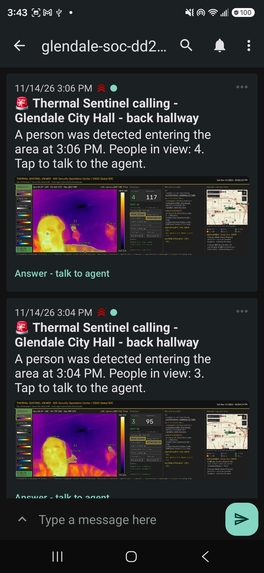
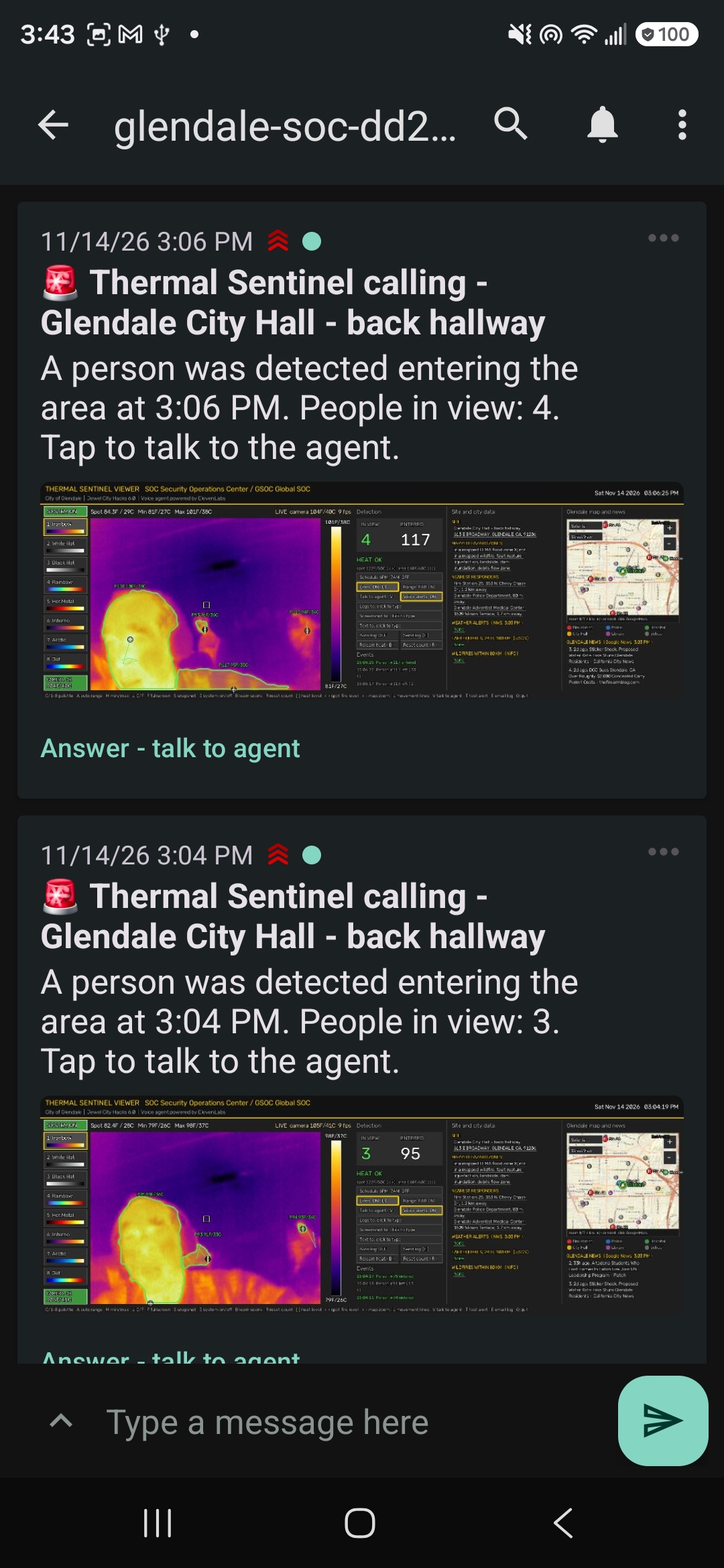
Text and image alerts via ntfy, with ElevenLabs VoIP voice access instead of Twilio calls and SMS. Twilio support coming soon.
-
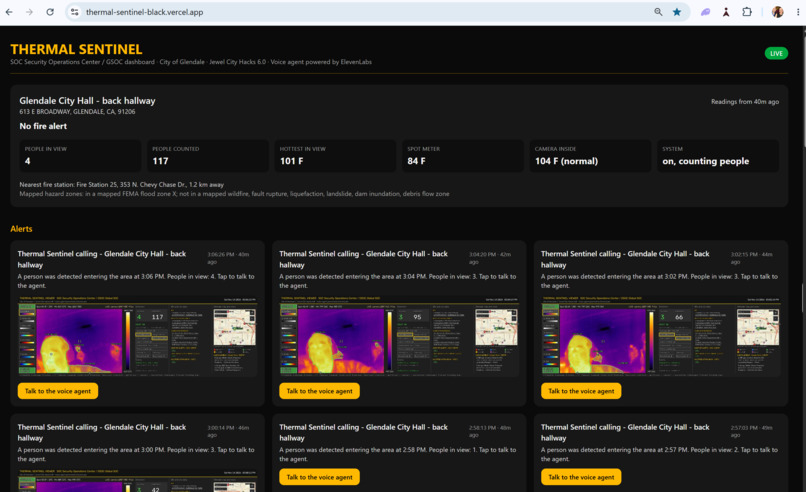
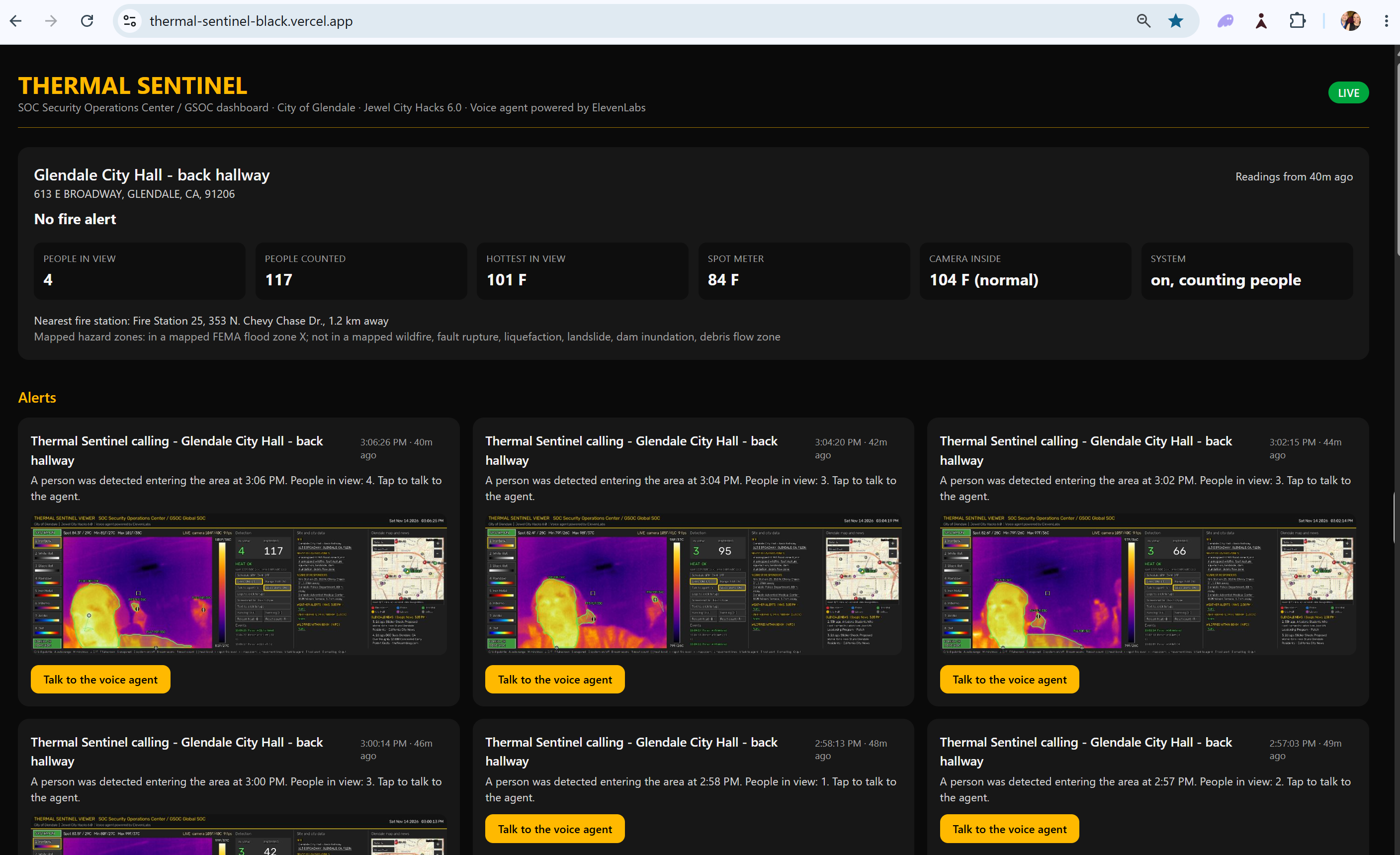
Yep. Vercel web dashboard shows people counts, temperatures, live updates, screenshot alerts, and access to the ElevenLabs voice agent.
Inspiration
What it does
How we built it Inspiration
Our mission is to help make Glendale a safer city for residents, small businesses, and public facilities.
Inspired by Jewel City Hacks 6.0's theme, "Think Globally, Build Locally," we wanted to create an affordable security solution that helps protect people and property, improves emergency awareness, and potentially reduces liability and the burden on city resources.
Thermal Sentinel Glendale GSOC combines a compact thermal sensor with artificial intelligence to provide continuous security monitoring, early fire-hazard detection, and immediate alerts while keeping a human operator in control.
Our vision is to make intelligent security monitoring accessible to Glendale's businesses, residents, libraries, schools, and city government.
What it does
Thermal Sentinel is a privacy-conscious AI security operations center with human oversight.
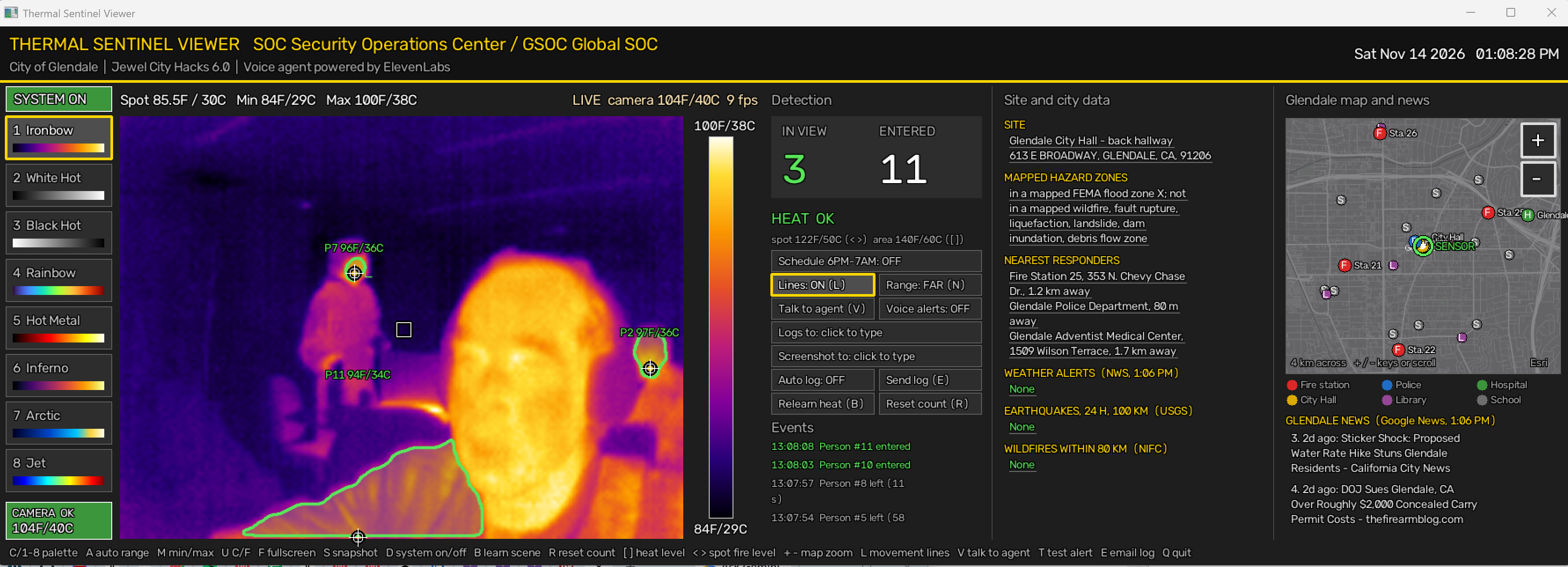
A compact FLIR thermal sensor detects and counts people through body heat, tracks movement, and identifies unusual heat sources that could indicate fire hazards.
When activity or a potential hazard is detected, the system immediately sends a mobile push notification through the free ntfy app, including a thermal snapshot.
An ElevenLabs AI voice assistant announces alerts, answers questions about sensor activity, and provides updates through the computer or directly on a mobile phone using an internet-based voice connection.
The system also integrates Glendale GIS MCP, interactive city maps, local hazard zones, nearby police and fire stations, hospitals, National Weather Service alerts, earthquake and wildfire information, and Glendale news.
A Vercel web dashboard provides remote access to sensor information, alerts, and the ElevenLabs agent.
A human operator reviews incidents and decides whether emergency services need to be contacted.
How we built it
We connected a FLIR Lepton thermal sensor to a GroupGets PureThermal USB board, operating through a Windows 11 Razer laptop.
Using Python 3.13, OpenCV, and NumPy, with Claude as our AI coding assistant, we developed thermal people detection, counting, movement tracking, and heat-hazard alerts.
We integrated ElevenLabs Agents for voice interaction, ntfy for internet-based mobile push notifications, and Glendale GIS MCP and ArcGIS for geographic and emergency information.
We built our remote web dashboard using v0 and Vercel.
We also developed code for integrating Twilio telephone calls and SMS notifications. However, because activating a paid phone number would involve additional costs, we decided not to use Twilio for the hackathon.
Instead, we used the free ntfy app to send notifications over the internet, with one-tap access to the ElevenLabs voice assistant directly on the phone. Twilio can be activated later if funding becomes available.
The software is also packaged for potential deployment on Raspberry Pi and NVIDIA Jetson systems.
Challenges we ran into
Our main technical challenge was accurately tracking and displaying the number of people detected on the thermal camera screen. We worked through the tracking and counting issues and successfully fixed them.
Our second challenge was mobile communication. We wanted to provide telephone calls and SMS alerts through Twilio, but we did not want to pay for a phone number during the hackathon.
We solved this by using ntfy to send free internet-based push notifications to mobile phones, with the ElevenLabs AI voice assistant accessible directly through the phone's web browser.
This gives users both mobile alerts and AI voice communication without requiring a paid telephone number. Twilio integration remains available for future deployment.
Accomplishments that we're proud of
We are especially proud that we were able to build and integrate this entire system within just a few hours during Jewel City Hacks 6.0.
We successfully combined FLIR thermal hardware, Python computer vision, ElevenLabs AI, mobile alerts, Glendale GIS information, and a Vercel web dashboard into one working prototype.
We demonstrated how a compact, affordable thermal sensor can become the foundation of an intelligent security operations center.
Most importantly, we created a solution with the potential to help make Glendale safer for residents, businesses, and city government.
What we learned
We learned that modern AI tools and accessible hardware make it possible to develop a sophisticated security monitoring prototype in just a few hours.
We also learned that this technology has the potential to scale beyond a single sensor into a larger security monitoring system serving the City of Glendale, local businesses, and residents.
What's next for Thermal Sentinel Glendale GSOC Security Operations Center
Our next goal is to secure funding and present Thermal Sentinel to the City of Glendale for potential deployment.
We want to work with Glendale city government, public safety and emergency departments, municipal facilities, local businesses, and residents to explore real-world applications.
With funding, we plan to expand the system from a single thermal sensor to multiple sensors connected through a centralized security operations dashboard.
Our vision is to deploy an affordable, AI-assisted security solution throughout Glendale, helping improve public safety, reduce monitoring costs, and potentially lower liability and the burden on city resources.
Built for Glendale. Designed to scale globally.
Live Dashboard: https://thermal-sentinel-black.vercel.app
