-
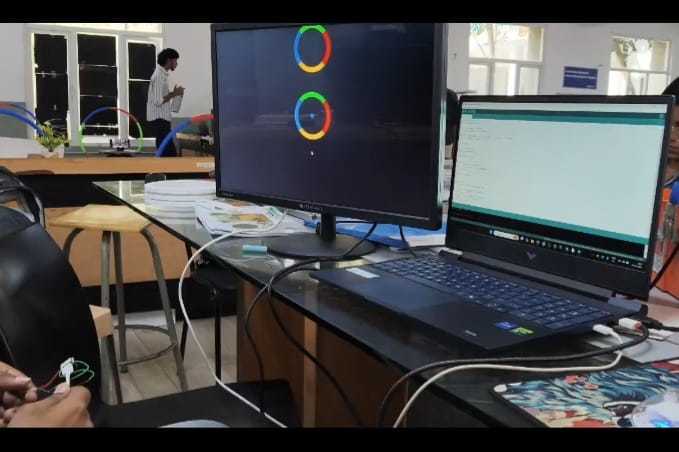
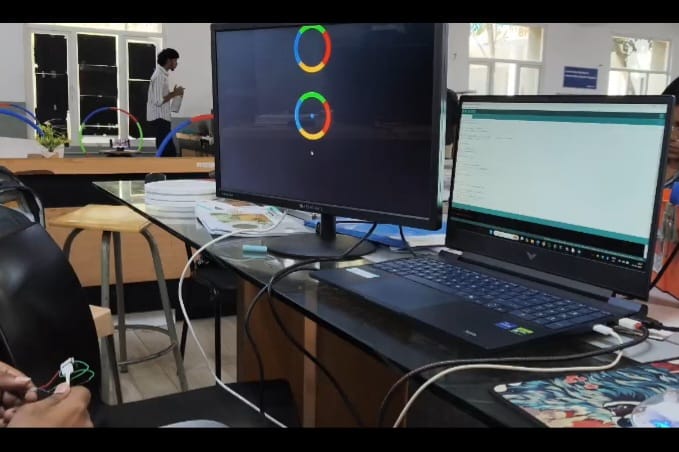
Working of therapy kit using Flux sensor
THERASTEPS: Sensor-Based Gamified Therapy for Autism Skill Development
Autism Spectrum Disorder (ASD) is a neurodevelopmental disorder, not a disease, and therefore cannot be cured. According to global health estimates, approximately 1 in 127 people worldwide and 1 in 31 children in recent CDC reports are affected by autism, with prevalence continuing to rise each year. Despite increasing diagnosis rates, many autistic children face delayed intervention, limited access to therapy, and fragmented long-term support, which restricts their developmental potential. However, with structured and consistent intervention, autistic children can significantly improve cognitive ability, attention, communication, motor coordination, emotional regulation, and daily life skills. The key challenge today is that traditional therapy is often repetitive, resource-intensive, difficult to personalize, and hard to sustain long-term engagement. THERASTEPS is an interactive sensor-based therapy system designed to enhance essential developmental skills in autistic children through gamified, movement-driven therapy sessions. Instead of passive screen time, THERASTEPS integrates smart sensors, wearable gadgets, motion-detection modules, transmitters, and receivers that allow children to control on-screen therapy games using real-world physical actions. When a child moves, jumps, reaches, or interacts using a connected gadget, the system detects the movement and replicates it inside the game environment, transforming therapy into an engaging and immersive learning experience. By providing guided, self-driven therapy through intelligent games, THERASTEPS significantly reduces the dependency on continuous therapist supervision, keeping children engaged for longer periods while encouraging consistent physical activity and structured skill development without requiring constant therapist presence. Different therapy games and customized gadgets are developed to address specific developmental challenges. For example, to improve gross motor skills, children with balance or standing difficulties use movement-based games that strengthen posture and motor control, while children with speech, memory, attention, or cognitive challenges interact with targeted therapy modules. A behavioural learning game helps children distinguish healthy choices from unhealthy ones, reinforcing positive decision-making through real-time feedback, encouragement, and corrective guidance. Additionally, by analysing children’s game scores, behavioural responses, and performance patterns, the system can help identify potential autism-related developmental traits, supporting early observation and data-driven insights. Unlike ordinary entertainment games, THERASTEPS functions as a structured daily therapy platform, ensuring that children learn through play while improving focus, understanding, self-control, and routine-based learning habits. The system also records daily performance scores, therapy responses, and behavioural progress, enabling caregivers and therapists to track improvement on weekly and monthly timelines. This data-driven tracking allows measurable evaluation of progress, personalized therapy adjustments, and evidence-based developmental monitoring. By combining sensor technology, interactive gaming, personalized therapy, and progress analytics, THERASTEPS provides a scalable, affordable, and engaging solution to support autistic children in building independence, confidence, and real-world functional skills, ultimately improving their quality of life and long-term developmental outcomes. Integrated AI will analyse recorded scores, behavioural data, and therapy performance to generate objective performance insights, track improvement trends, measure skill development over time, and recommend personalized intervention adjustments based on individual progress patterns.

Log in or sign up for Devpost to join the conversation.