-
-

Therapy Tracker logo
-
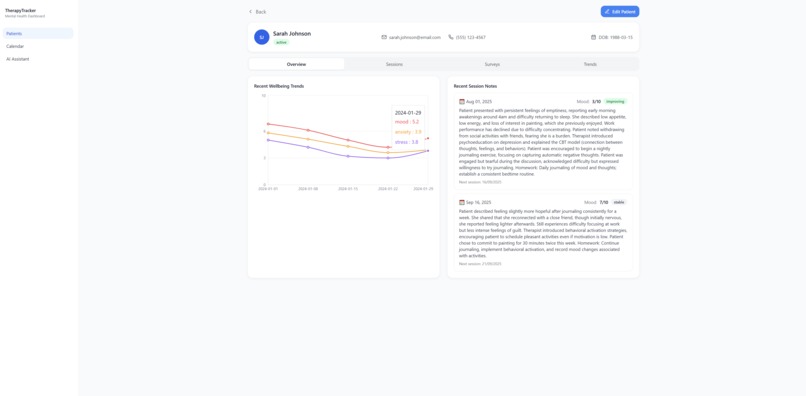
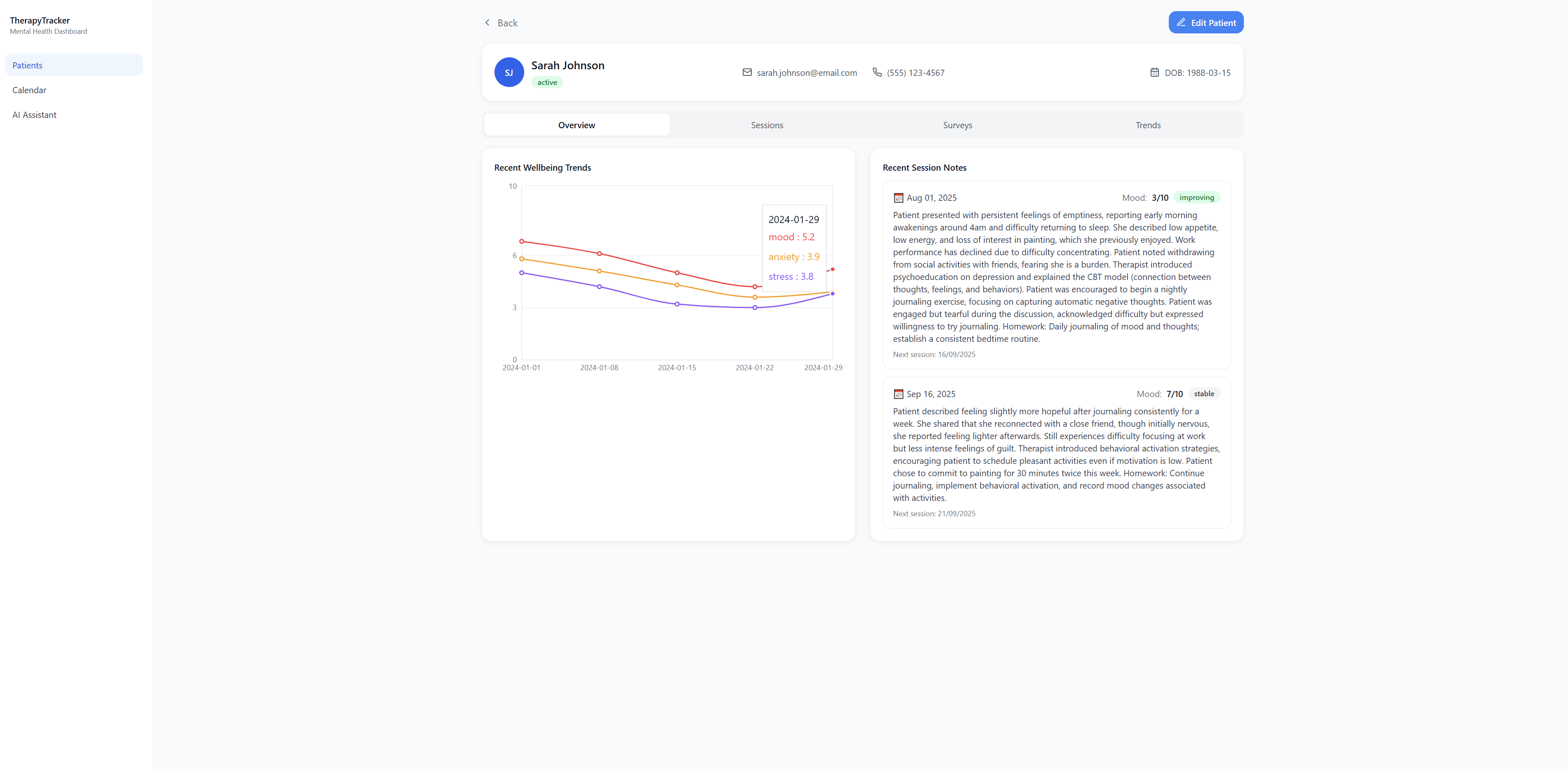
Therapy Tracker patient page
-
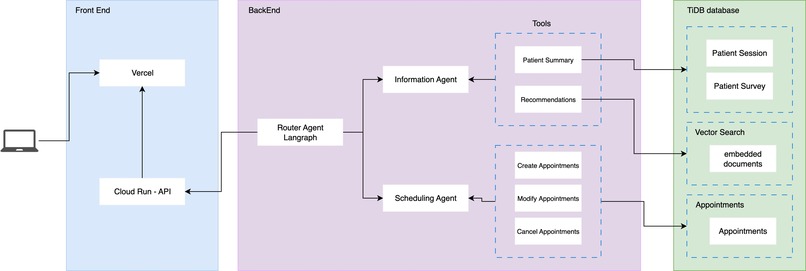
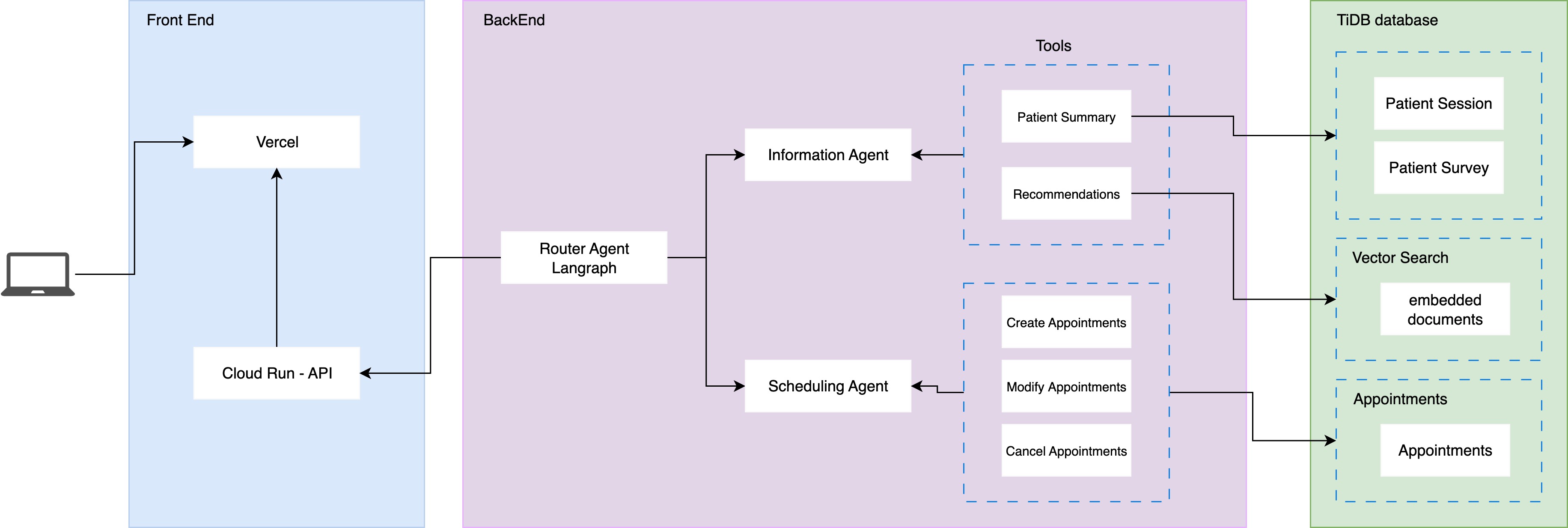
Architecture Diagram

Inspiration
Therapists today spend up to half their time on administrative tasks like note-taking and scheduling, leaving less time and energy for actual patient care. We wanted to design an AI-powered assistant that doesn’t replace therapists, but instead empowers them by giving time, focus, and control back where it belongs: with the therapist.
What it does
Therapy Tracker is a multi-agent AI assistant built on TiDB vector search. It:
- Generates concise summaries of past therapy sessions.
- Seamlessly organizes and manages therapist schedules.
- Provides research-backed recommendations using RAG (Retrieval Augmented Generation) and context-aware suggestions from similar cases.
How we built it
- Data ingestion & vectorization: Patient session notes and research papers are embedded and stored in TiDB Serverless with vector search.
- Multi-agent architecture: A swarm of specialized agents (summarization, scheduling, recommendation)
- LLM integration: Used for summarization and contextual reasoning, combined with RAG to ground outputs in evidence-based sources.
Challenges we ran into
- Designing a smooth workflow for multiple AI agents to coordinate without conflict.
- Ensuring recommendations are clinically relevant and trustworthy, not just AI-generated.
Accomplishments that we're proud of
- Successfully implemented a multi-agent architecture with TiDB vector search powering context retrieval.
- Created a working assistant that can automate up to 50% of administrative load for therapists.
- Built a system that highlights how AI can augment care quality without trying to replace human professionals.
What we learned
- How to design and orchestrate multi-step, multi-agent AI workflows effectively.
- The power of TiDB vector search for grounding LLM outputs in reliable data sources.
- The importance of designing AI for empowerment, not replacement, especially in sensitive fields like healthcare.
What's next for Therapy Tracker
- Expand support for more clinical workflows beyond therapy notes and scheduling.
- Integrate voice-to-text transcription for live session note automation.
Data Flow and Integration
1) React Front End (Vercel)
- Next.js/React app deployed on Vercel.
- Chat + scheduling UI; data fetching via React Query/SWR.
- Calls backend over HTTPS (REST API)
2) API Layer (Cloud Run).
- Exposes endpoints (e.g.,
POST /chat)
3) Router Agent (LangGraph)
- Classifies each request and routes to:
- Information Agent (questions, summaries, recommendations)
- Scheduling Agent (create/modify/cancel appointments)
4) Information Agent → Tools
- Patient Summary: reads structured data from TiDB tables (Patient Session, Patient Survey).
- Recommendations: runs RAG over domain docs via vector search (see §6), blends with patient context, returns cited answers.
5) Scheduling Agent → Tools
- Create / Modify / Cancel Appointment tools operate on TiDB Appointments.
6) Vector Search (TiDB) with Text Embeddings
- Ingestion pipeline (batch or on-demand):
- Chunk source docs (guidelines, SOPs, FAQs).
- Generate vectors using a Text-Embedding-Large model (e.g.,
text-embedding-3-large). - Upsert into TiDB vector columns with metadata
{doc_id, chunk_id, source, tags}.
- Retrieval:
- Encode the user query with the same model.
- Similarity search
- Return top-k chunks to the Information Agent for synthesis and citation.
7) Datastores (TiDB)
- OLTP tables: Patient Session, Patient Survey, Appointments.
- Vector index: embedded document chunks.
8) Response Assembly
- Agents package tool outputs, attach citations, and send structured answers to the API.
- API streams tokens back to the React app for responsive UX.
9) Observability & Safety
- End-to-end tracing (API → Router → Agents → Tools → DB).
- PII/PHI logging rules; encryption in transit/at rest.
- Rate limiting and abuse checks at the API edge.
10) Front-End UX - UI renders streamed tokens, citations, and appointment confirmations. - Optimistic updates for scheduling; reconciles when final server state arrives.
TiDB Cloud account Email: [email protected] FrontEnd github: https://github.com/VanessaTong/therapytracker/tree/main

Log in or sign up for Devpost to join the conversation.