-
-
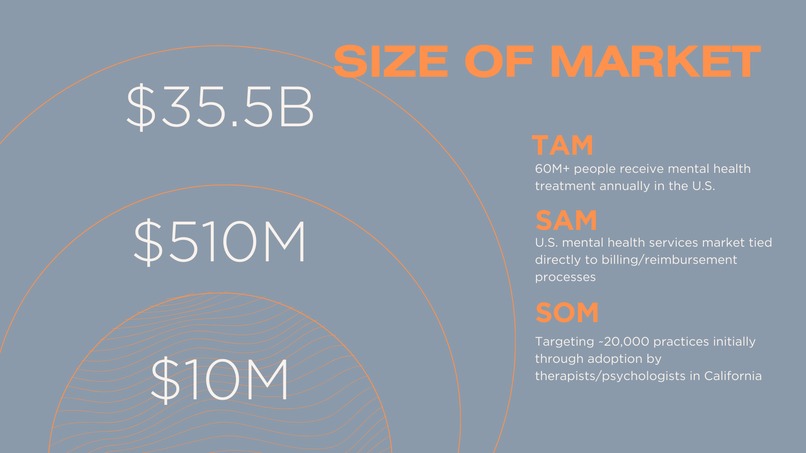
Slide 5 - Market
-
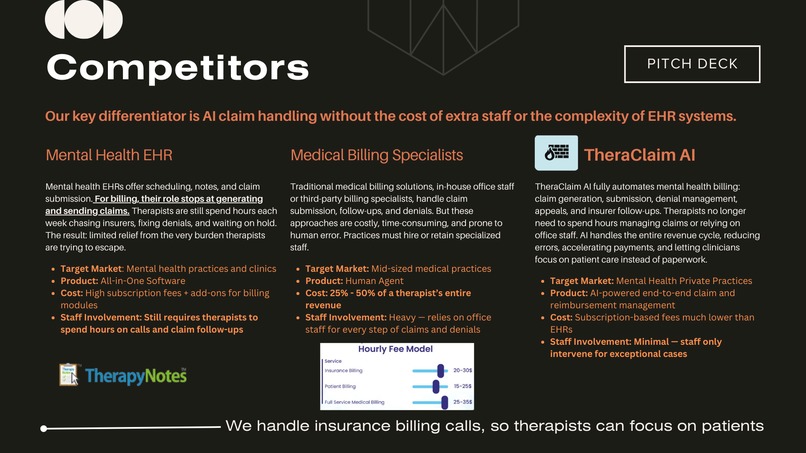
Slide 4 - Competition
-
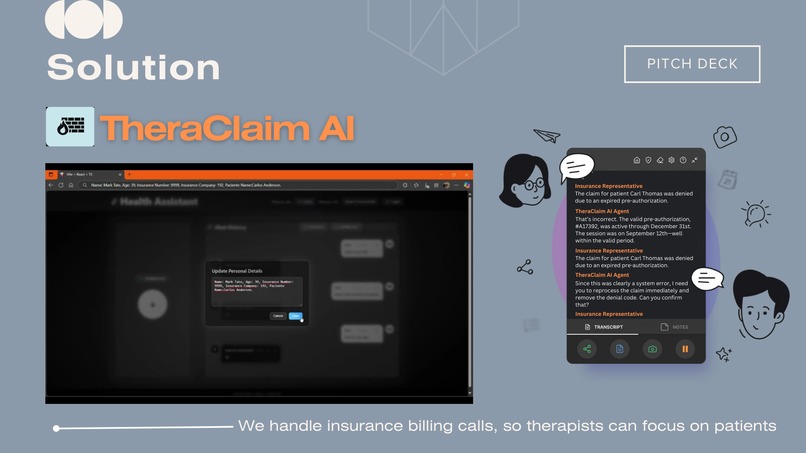
Slide 3 - Solution & Demo
-
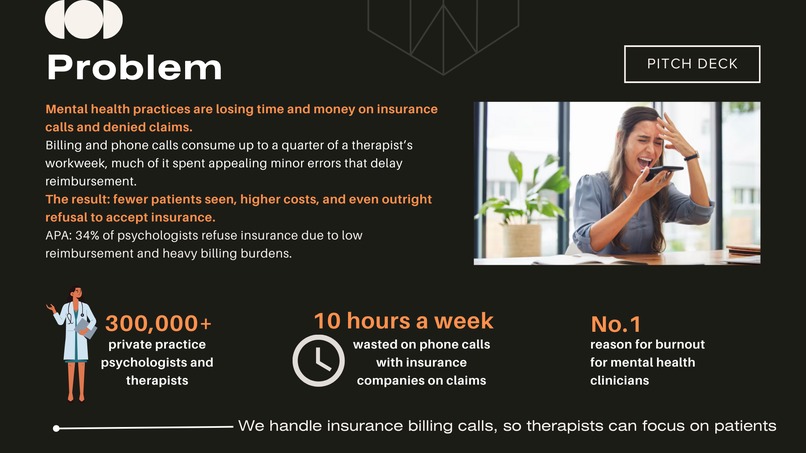
Slide 2 - Problem
-
Slide 8 - Join Us
-
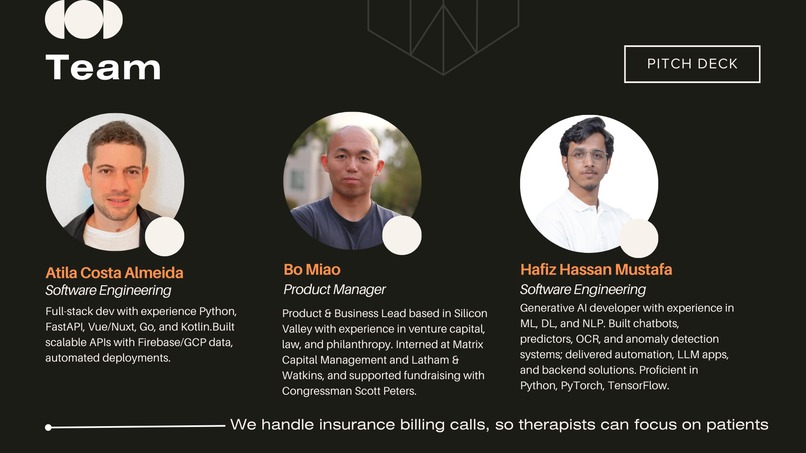
Slide 7 - Team
-
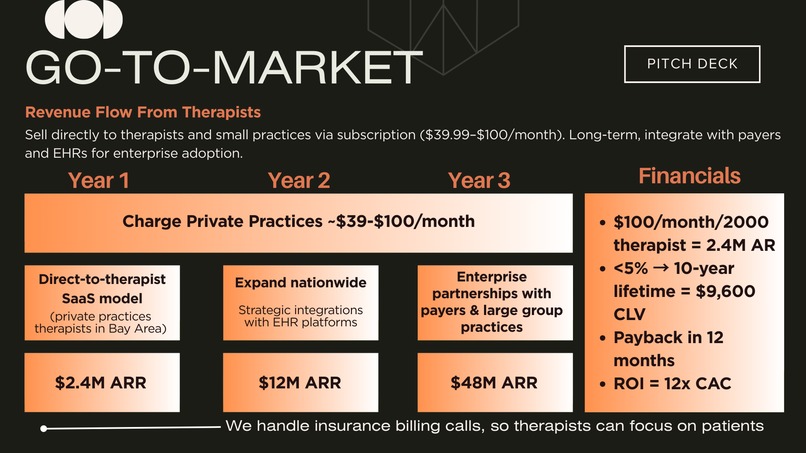
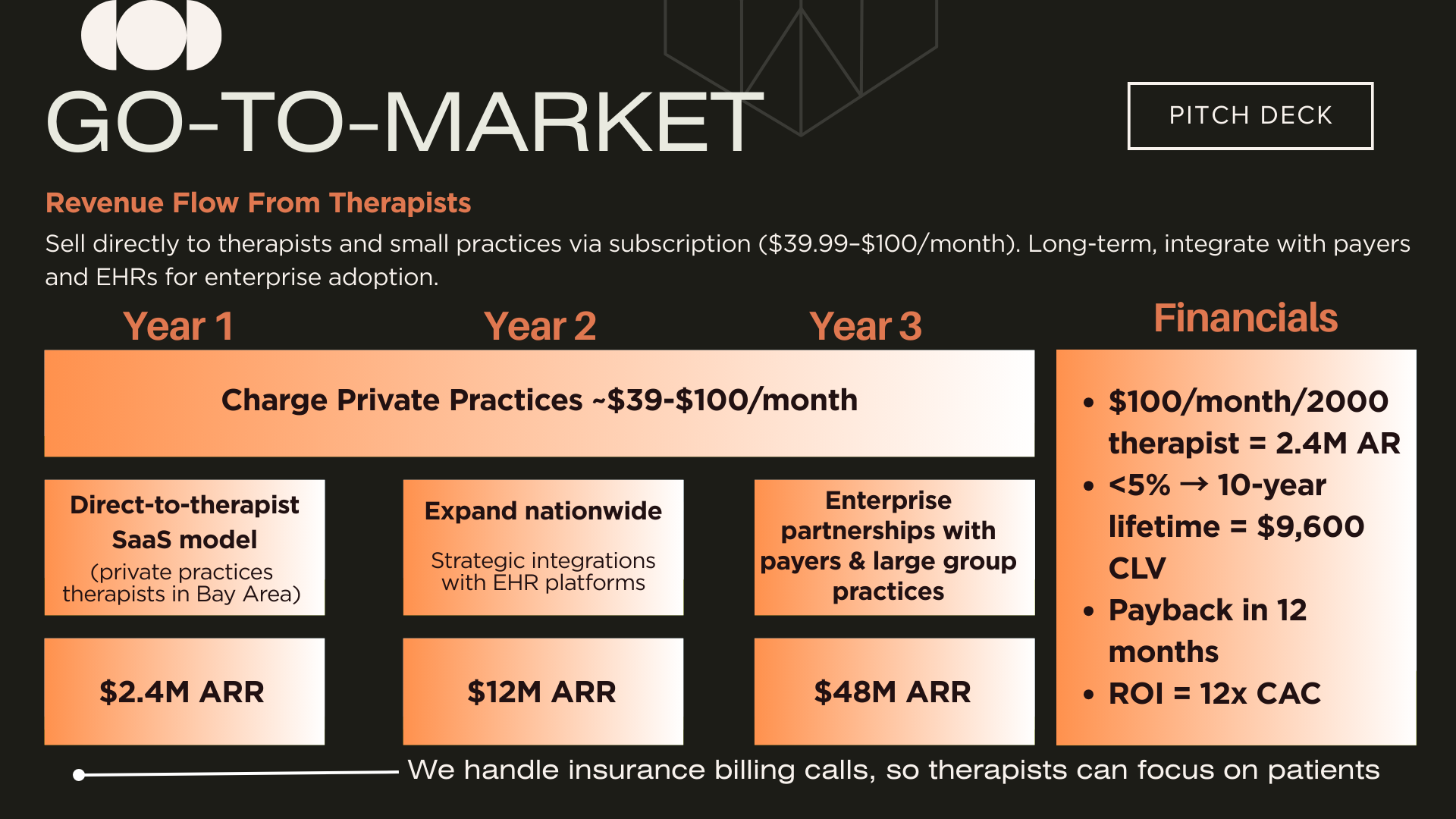
Slide 6 - Go to Market
-

Slide 9 - Thank you
-

Slide 1 - Title
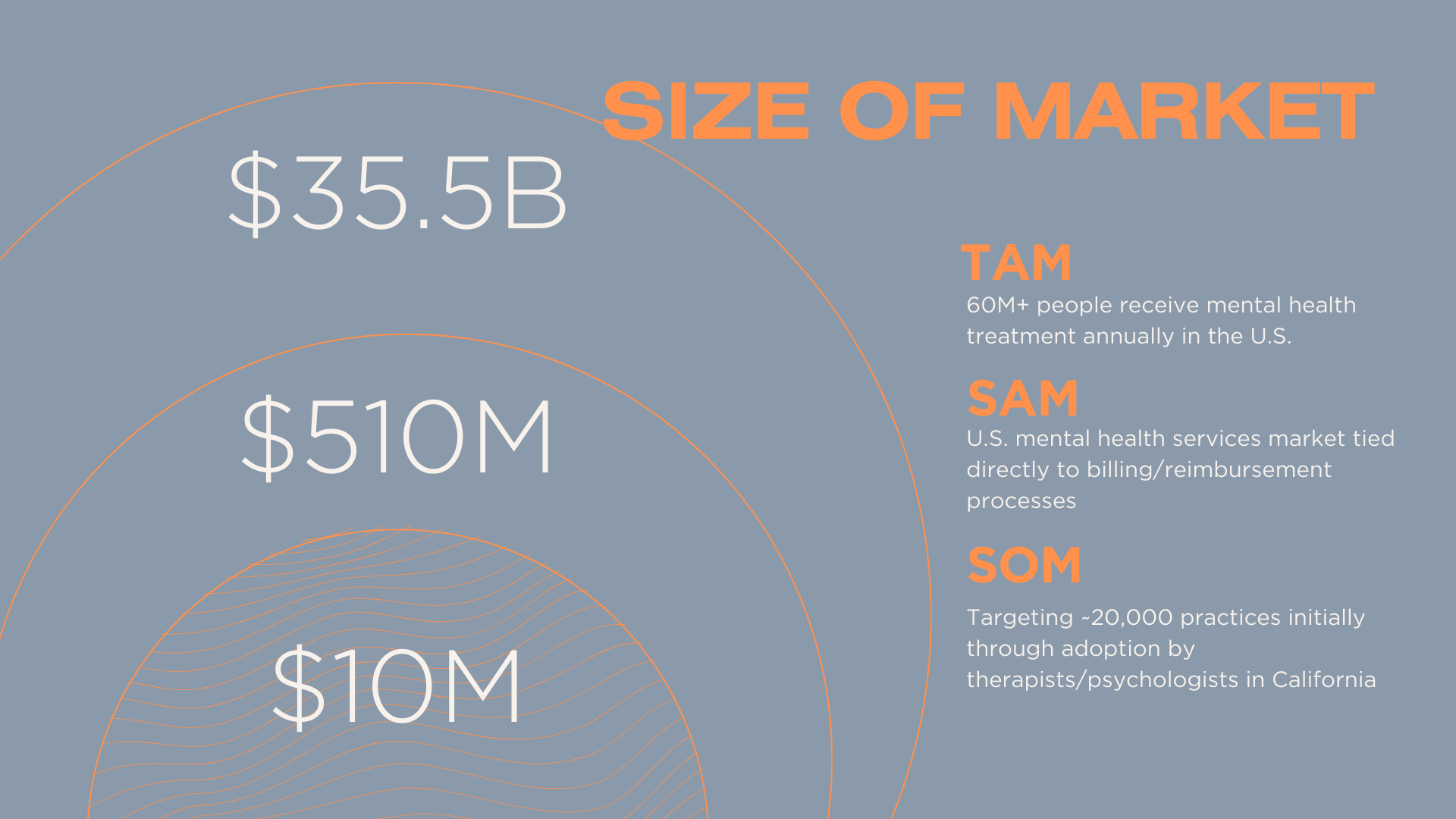
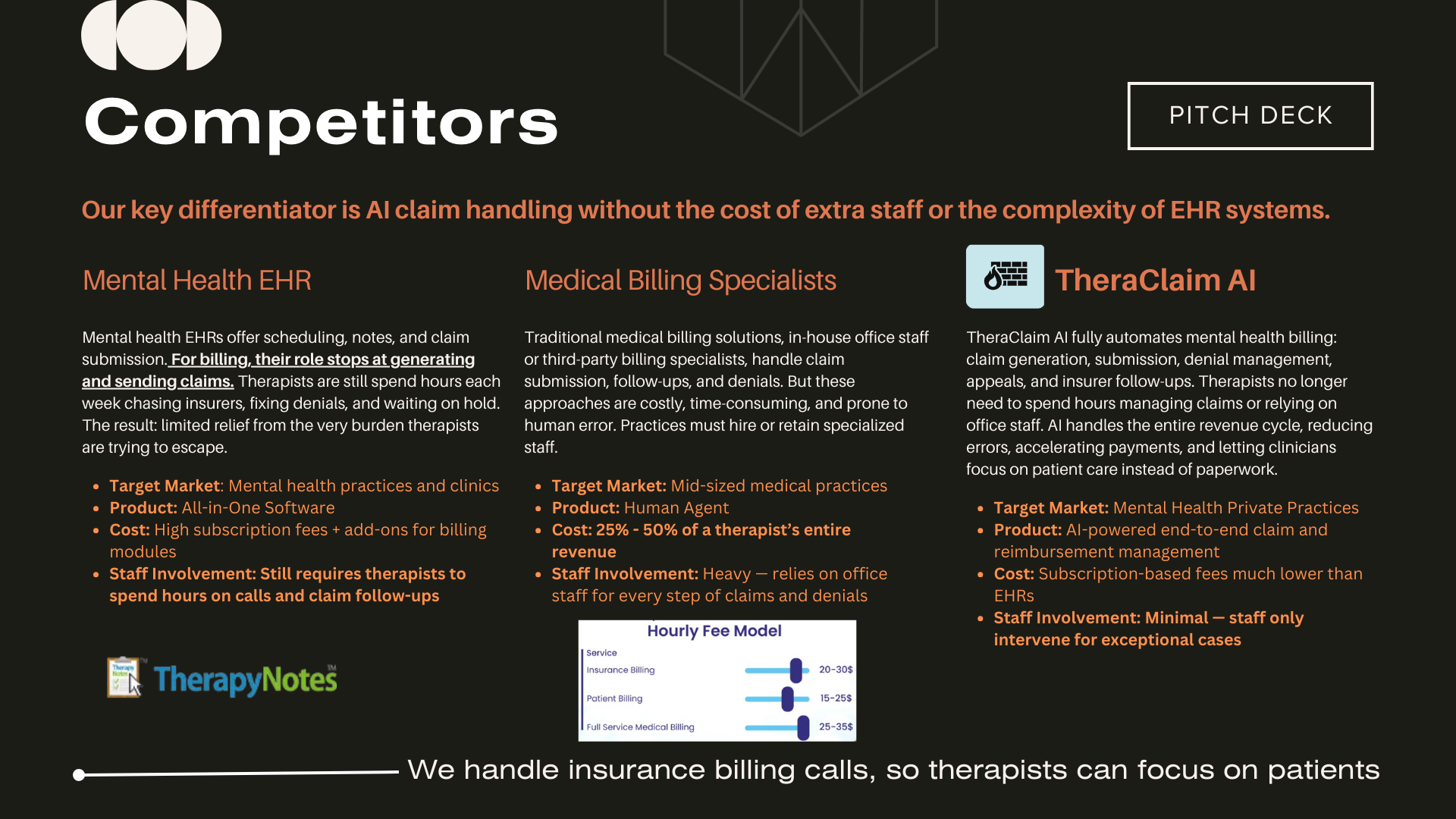
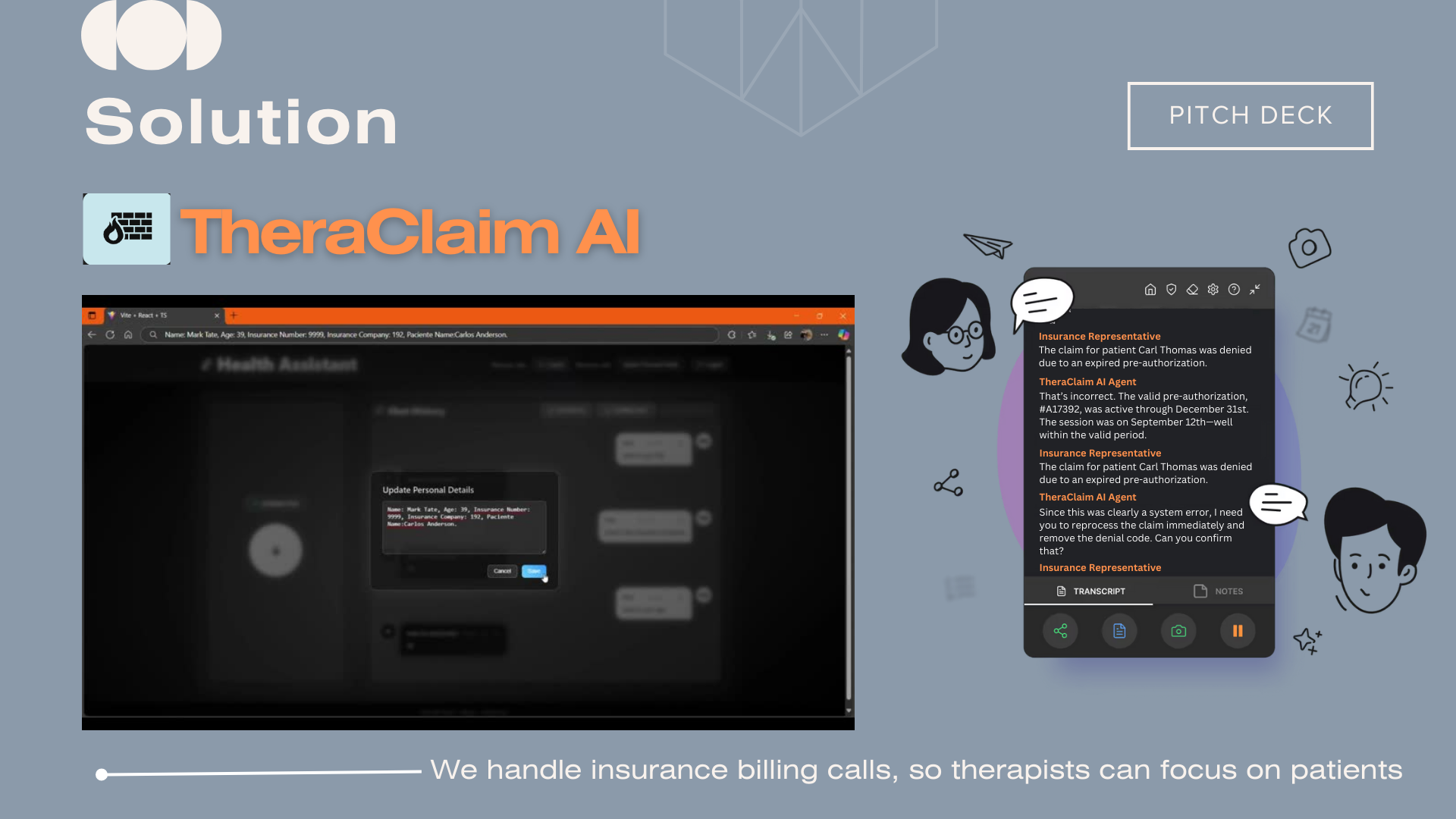
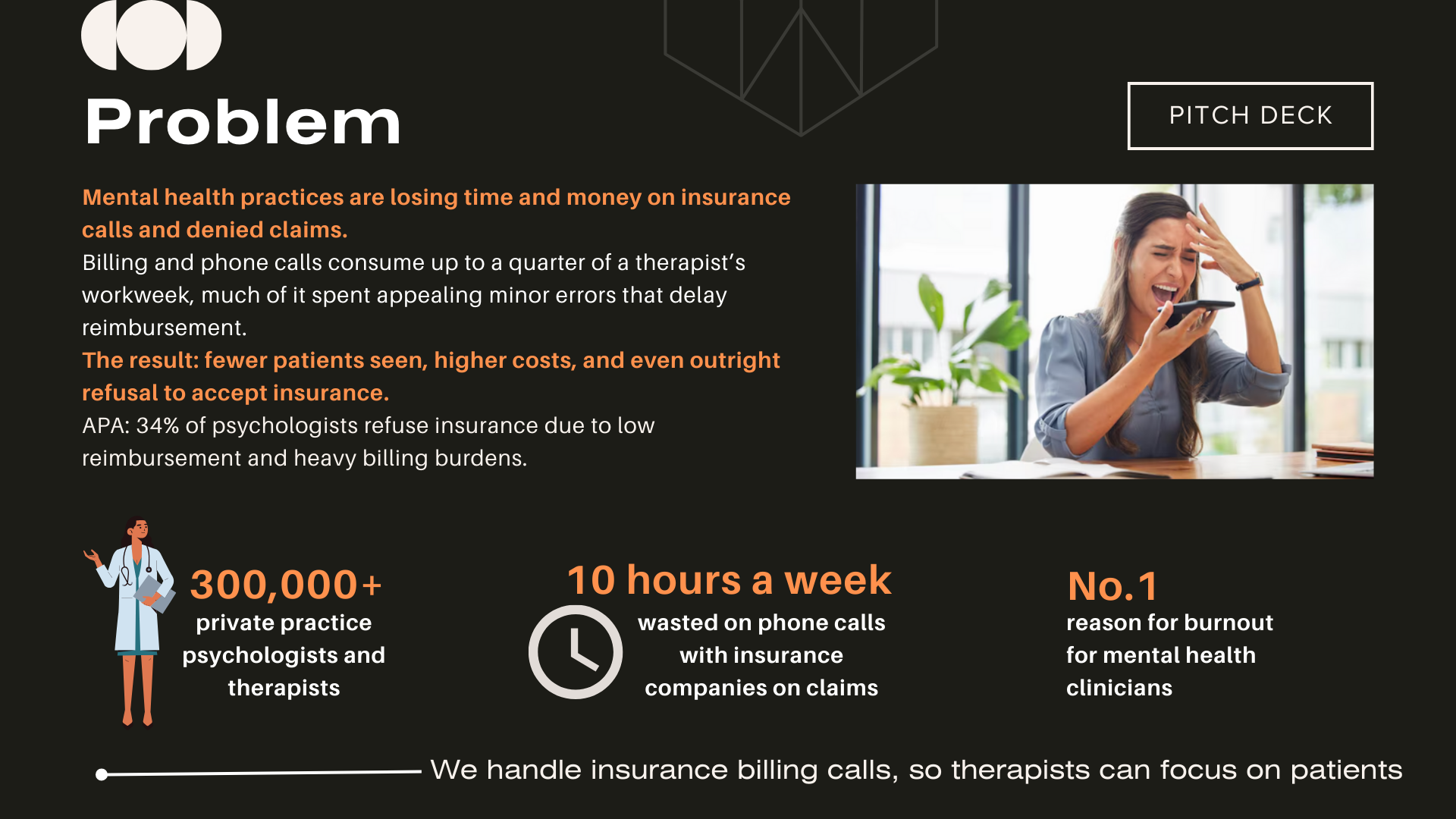



Gallery Above
1) Video - Product Demo at 0:51 - 1:48 2) Images after the Video are the Pitch Deck shown in video
See the link below at "Try It Out" for the working demo
Inspiration
In the U.S., nearly 1 in 5 adults experiences a mental health disorder each year, yet millions struggle to access care. Therapists face growing demand, but their ability to help is limited—not by lack of skill, but by administrative hurdles.
The American Psychological Association reports that 34% of psychologists do not accept insurance, citing low reimbursement rates and the burden of billing. For those who do handle their own insurance, billing and phone calls can consume 10 or more hours per week, roughly a quarter of a full-time workweek. Much of this time is spent appealing denied claims, often caused by minor errors like incorrect codes, mismatched documentation, or expired pre-authorizations. On top of that, reimbursement for mental health services is often lower than other medical services and can take 30 days or longer, creating cash-flow stress for small practices.
The result: therapists are overworked, patients wait longer for care, and costs rise. Critical mental health support is delayed or inaccessible, impacting individuals, families, and communities.
We seek to bridge this gap by handling insurance billing calls, so therapists can focus on their patients.
What it does
TheraClaim is designed to streamline insurance billing and phone calls for mental health therapists, allowing them to focus on patient care rather than hours on billing calls. The platform leverages real-time AI to assist with claim management, answer billing questions, and guide therapists through complex insurance processes.
As a proof-of-concept developed for the hackathon, TheraClaim AI currently operates as a general healthcare assistant rather than a full billing tool. Users can input key information—such as therapist name, specialty, insurance provider, and patient details—so the AI can reference this data when responding to queries. It handles natural language questions, maintains limited context from the last 10 interactions, and supports microphone input for a conversational experience. At this stage it still requires prompt guidance to answer accurately and does not yet handle live phone calls or claims. However, the prototype demonstrates the core engine—data capture, contextual memory, and voice interaction—that can be extended into a real-time insurance billing assistant, reducing administrative burdens and improving practice efficiency for mental health providers.
How we built it
TheraClaim is an end-to-end application designed to streamline insurance billing and support therapists in real time. The frontend is built with React, providing a responsive and intuitive interface for users. On the backend, Django manages data, workflows, and the connection between the user and the assistant.
To create real-time interaction, we use WebSockets, enabling seamless communication between the therapist and the AI assistant. Conversations are stored in a SQLite3 database, allowing the assistant to “remember” up to the last 10 interactions, providing contextually aware support.
For voice interaction, we integrate Google’s Speech Recognition Library for accurate speech-to-text, and the Web Speech Synthesis API for text-to-speech, complete with controls for volume, pitch, and speed. The AI itself runs on Groq’s GPT-OSS-20B, handling all text-to-text processing to generate helpful, context-aware responses.
Together, this stack allows TheraClaim to assist therapists efficiently, handling insurance calls and billing tasks while remembering context and responding naturally, making insurance management simpler, faster, and more intuitive.
Challenges we ran into
One challenge we ran into was LLM processing speed. Since this is a speech-to-speech platform, users expect responses faster than a typical text-to-text system. Depending on the model, users could be left 'waiting too long.' Fortunately, the OSS model from ChatGPT performs very quickly, so the overall user experience remained strong.
Accomplishments that we're proud of
1) End-to-end AI product development: Built a natural, conversational healthcare assistant combining speech-to-text, LLMs, and text-to-speech.
2) Seamless multimodal workflow: Delivered an integrated voice interaction system that responds naturally and in real-time.
3) Collaborative full-stack execution: Coordinated frontend, backend, and cloud components to deliver a fully functioning, scalable application.
What we learned
1) Gained deep insights into the mental health and insurance landscape, understanding therapy workflows, claims processes, and the broader healthcare system, highlighting how technology can help address real-world health challenges.
2) Time management & deadlines: Learned to complete all application features within set timelines.
3) Cloud deployment & scalability: Gained experience with containerization, cloud deployment on Oracle Cloud Infrastructure (OCI), networking, API security, and frontend-backend integration (Netlify + OCI).
4) Multimodal AI integration: Hands-on experience combining speech-to-text, large language models (LLMs), and text-to-speech into a seamless workflow.
5) Voice interaction pipeline: Understood real-time audio capture in React, Python backend processing, transcription with Groq + OpenAI, intent processing with LLMs, and generating human-like voice responses.
6) Cross-stack collaboration: Strengthened full-stack and AI engineering skills by working across frontend (React), backend (Python/FastAPI), and cloud infrastructure.
What's next for TheraClaim AI
Next, we plan to refine and scale the AI platform: improving real-time responsiveness, enabling it to handle phone calls, expanding coverage across therapy types and insurance scenarios, and integrating feedback from providers to maximize impact in addressing the mental health crisis.
Built With
- django
- googlespeechrecognitionlibrary
- groqapi(gpt-oss-20b)
- react
- sqlite
- websockets
- webspeechsynthesisapi


Log in or sign up for Devpost to join the conversation.