-
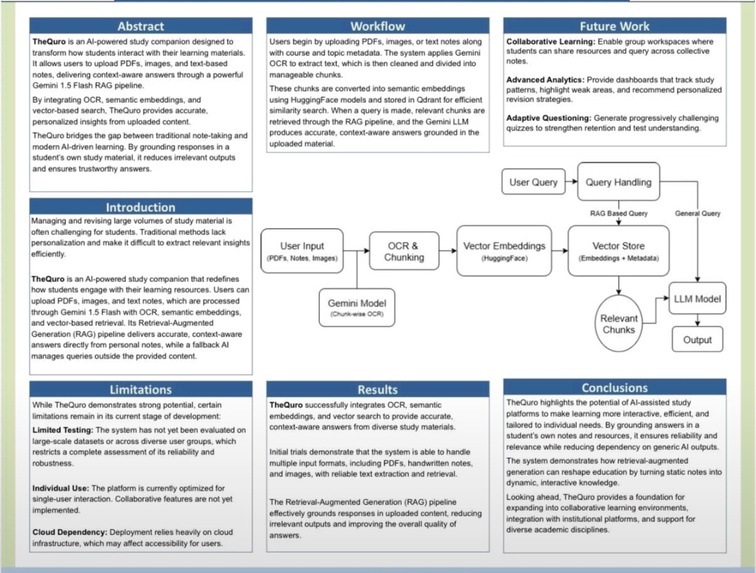
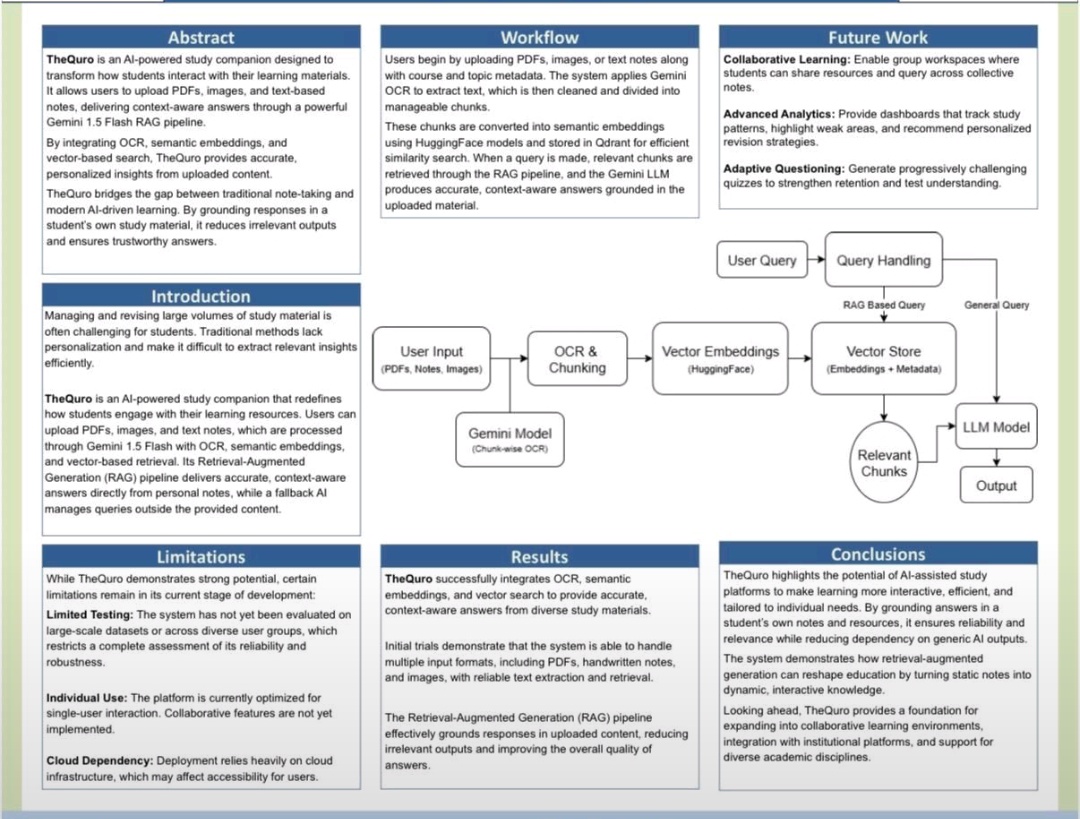
Workflow
Here is the raw Markdown code, exactly as-is, with no rendering:
About the Project – TheQuro: RAG-Driven Study Partner
Inspiration
As students, we constantly deal with unorganized PDFs, lecture notes, and screenshots scattered across devices. Finding a single answer often feels harder than learning the actual concept. During this 48-hour hackathon, we wanted to build something that we ourselves would use daily — a tool that turns any study material into instant, trustworthy answers.
That idea became TheQuro, an AI-powered study companion that understands our notes, not the internet.
What We Built
TheQuro is a Retrieval-Augmented Generation (RAG)–based AI study assistant where users can upload PDFs, images, and text notes.
The system then:
- Extracts text using OCR
- Splits content into meaningful chunks
- Converts them into vector embeddings
- Stores them in a vector database
- Returns contextual, grounded answers through an LLM
This ensures that users always receive responses grounded in their uploaded study material rather than generic AI outputs.
What We Learned
This project helped us explore:
- OCR pipelines for various document qualities
- Chunking strategies to improve retrieval accuracy
- Vector embeddings and similarity search
- Building an end-to-end RAG system within 48 hours
- Designing a minimal but functional user workflow
- Deploying AI components efficiently under time constraints
We also learned how crucial preprocessing and chunk structuring are for answer accuracy.
How We Built It
Tech stack used:
- OCR: Gemini Flash 1.5
- Embeddings: HuggingFace sentence-transformers
- Vector Database: Qdrant
- Backend: FastAPI (Python)
- Frontend: React
Pipeline overview:
graph LR
A[User Uploads PDFs/Images] --> B[OCR and Text Extraction]
B --> C[Chunking]
C --> D[Vector Embeddings]
D --> E[Qdrant Vector Store]
E --> F[Query Retrieval]
F --> G[LLM Generates Answer]
Challenges Faced
- OCR inaccuracies on handwritten or low-resolution images
- Chunk boundaries breaking formulas or diagrams
- Managing embedding latency within hackathon time constraints
- Ensuring answers stay grounded in the user's own notes
- Setting up the vector store and LLM pipeline quickly
- Coordinating frontend-backend integration in limited time
Final Outcome
In 48 hours, we built a functional AI study partner that:
- Understands personal study material
- Produces accurate, context-aware answers
- Helps students revise and learn more efficiently
The project represents a practical application of RAG systems tailored for students and real academic workflows.
Built With
- database
- fastapi
- gemini
- github
- html/css
- huggingface
- javascript
- python
- qdrant
- react
- render
- sentence-transformers
- vector
- vercel


Log in or sign up for Devpost to join the conversation.