-
-
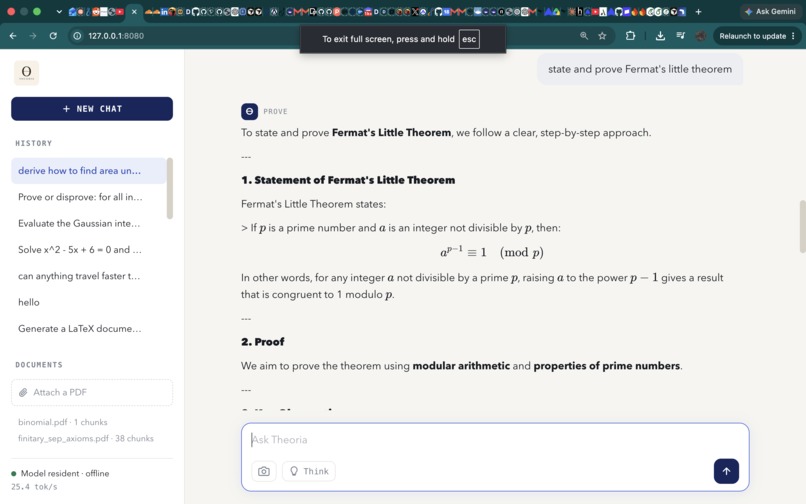
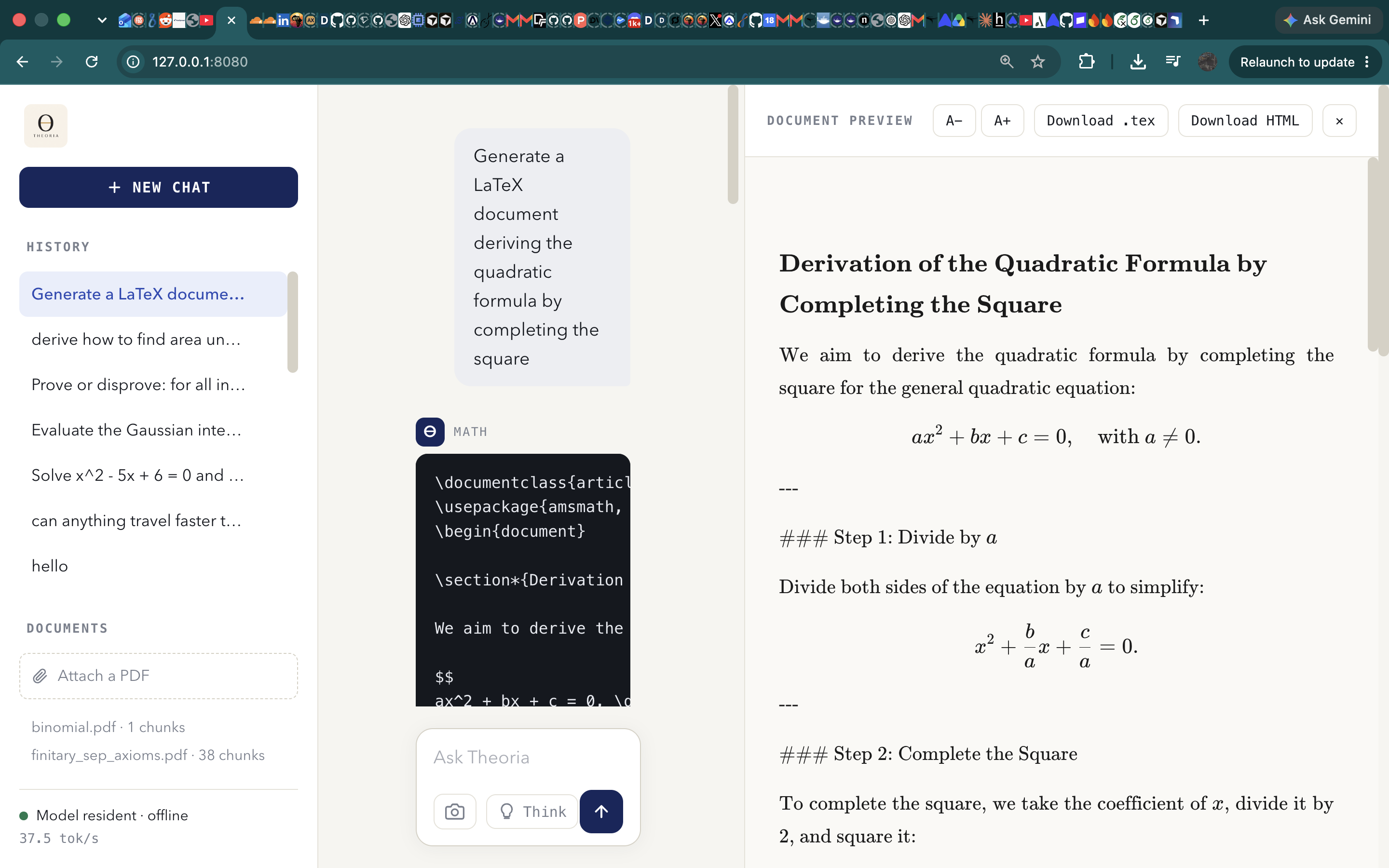
Theoria interface, deep math proof reasoning
-
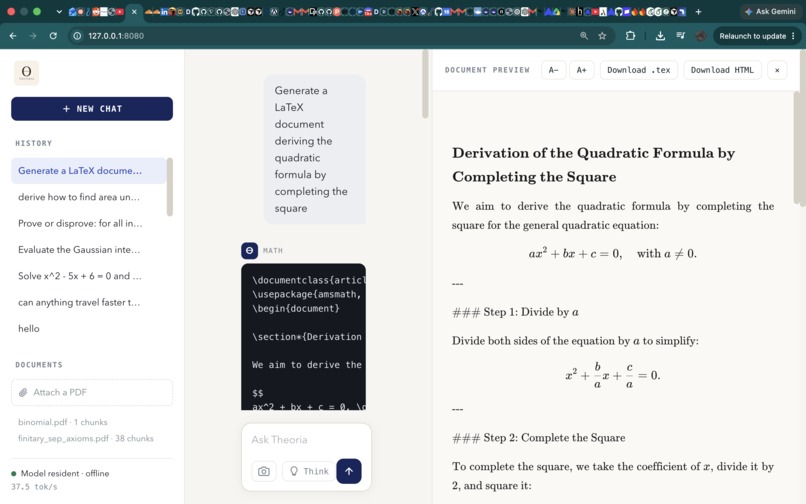
Generate tex in Theoria
-
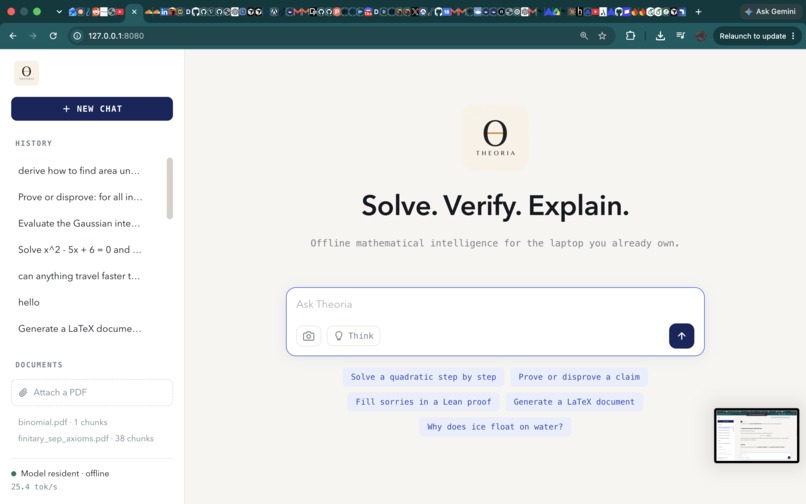
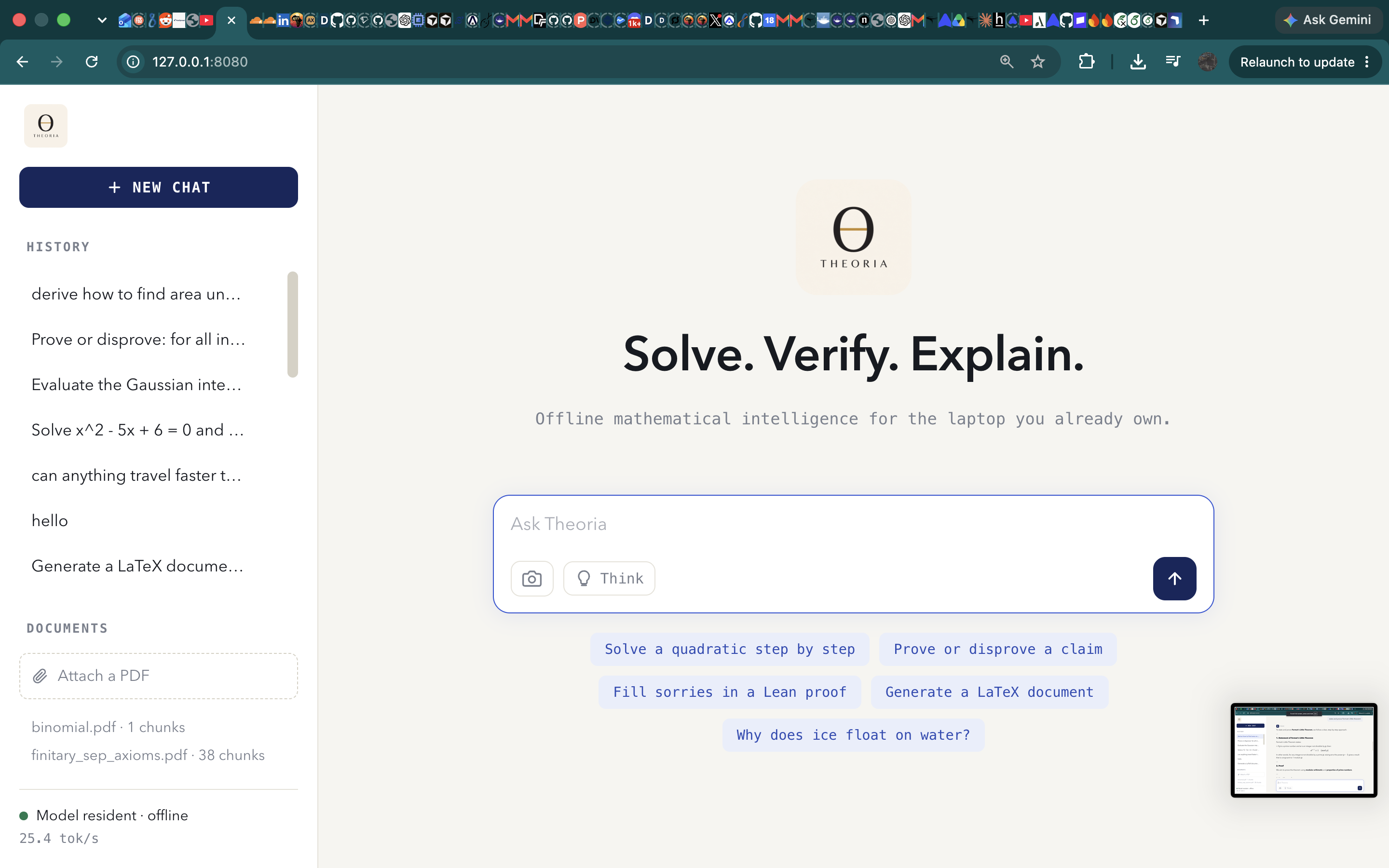
Theoria welcome
Inspiration
I teach undergraduate mathematics at the University of Zimbabwe — Real Analysis, Linear Algebra, ODEs/PDEs, Optimization — while pursuing a Ph.D. in Pure Mathematics at Rhodes University on separation axioms in the category of S-frames. In Zimbabwe, the bottleneck for my students is rarely talent. It is access: unstable connectivity, no GPU budget, and cloud tutors that vanish when data runs out.
That classroom reality is the brief for Theoria: an offline math & scientific reasoning assistant that fits the ADTC Standard Laptop (8 GB RAM, integrated graphics, Ubuntu). As someone who also reviews LLM-generated proofs (topology, logic, PDEs) for industry, I see daily how fluent text can still be wrong. Theoria’s goal is not a chat novelty — it is a private tutor that students can trust when the network is gone.
What it does
Theoria runs a compact GGUF model through llama.cpp and wraps it with load-bearing tools:
- SymPy for exact algebra, derivatives, and integrals (verification badge + fallback)
- Local RAG over curated math corpora and user PDFs
- Lean4 (TheoriaKit) for small formal checks where we can say “proved,” not only “plausible”
- Offline UI with KaTeX so answers render as real mathematics, e.g. solving $$x^{2}-5x+6=0 \quad\Rightarrow\quad x\in{2,3}$$ or differentiating via the chain rule $$\frac{d}{dx}\sin(x^{2})=\cos(x^{2})\cdot 2x.$$
How we built it
We bake-off’d small open models under ADTC constraints and shipped a model (~1.9 GB peak RSS on an 8 GB VM, ~11 tok/s generation). Stack: FastAPI + persistent llama-server, intent routing (so “hello” is not answered with a fake proof), SymPy/Lean tool loop, and a lightweight web UI. Telemetry is self-checked with the official profiler against the 7 GB ceiling and the fixed speed reference
$$
S_{\mathrm{perf}}=\min!\Bigl(\frac{\mathrm{TPS}}{15},1\Bigr)\times 100,\qquad
S_{\mathrm{eff}}=\frac{7-\mathrm{PeakRAM}_{\mathrm{GB}}}{7}\times 100.
$$
Challenges we ran into
- Accuracy vs. size — a 1.7B model cannot replace a lecturer; tools must carry exactness.
- Fine-tuning risk — an aggressive QLoRA mix collapsed generation
- Scoring honesty — the app helps students; audit metrics are model-only. We designed prompts and REPORT numbers for the naked GGUF on 8 GB-class hardware (VM thermals (N/A); physical audit applies (P_{\mathrm{thermal}})).
What we learned
On-device AI for Africa is a systems problem: model choice, quantization, RAM, and verification matter more than a flashy UI. Coming from time-scale calculus and pointfree topology into llama.cpp taught me the same lesson I give my students — beautiful arguments fail if they are not checked. Theoria is my attempt to put that discipline on every desk that already has an 8 GB laptop.
Built With
- fastapi
- gguf
- javascript
- katex
- lean4
- llama.cpp
- numpy
- python
- qwen
- rag
- sqlite
- sympy

