-
-
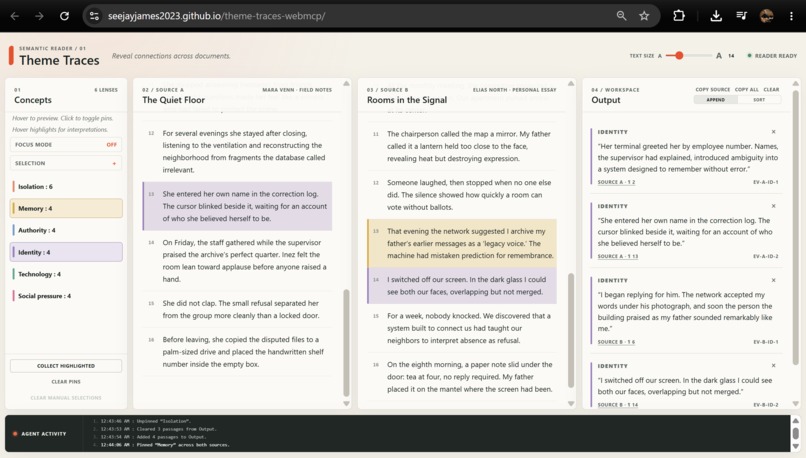
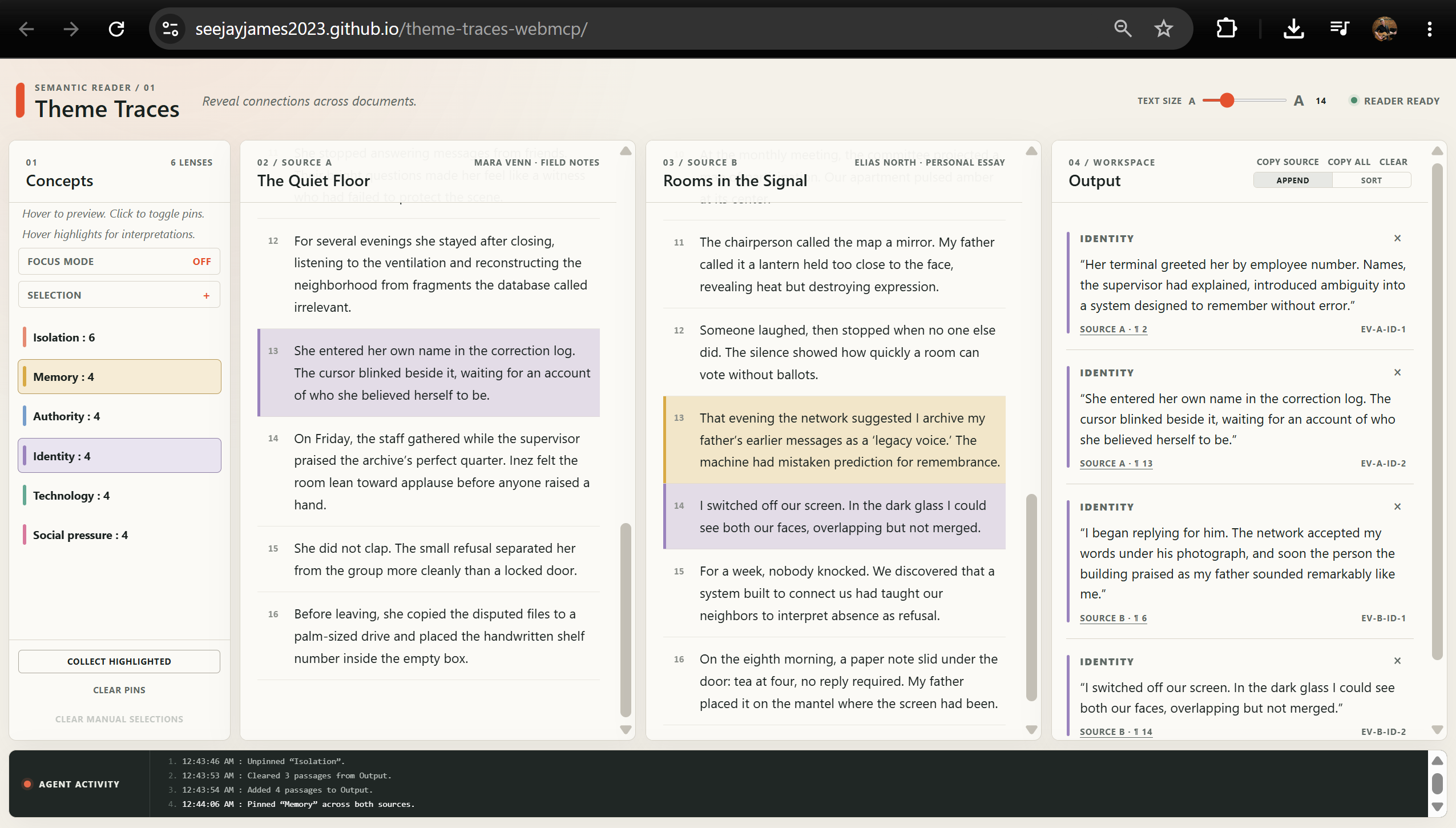
Theme Traces Screenshot
Inspired by: A love for generative and procedural media, now applied to text. Load documents, semanticize, and spin new meanings!
What it does: The demo takes two documents that have been “pre-semanticized” by ChatGPT to extract the top handful of themes across both. You can interact with them manually in a number of ways, but specifically, there are MCP tools exposed for nearly every UI element. So it’s easy to not only query the documents for various interpretations, but also manipulate selections, highlighting, etc via your agent.
How I built it: Codex for the main building, ChatGPT in a separate window for brainstorming, refining, etc.
Challenges I ran into: There were a few snags (stale or cached versions), but it was quite straightforward overall. The deployment of the finished version was especially smooth. Having the second chat window let me separate the processes.
Accomplishments that I’m proud of: This was one of my first times using a workflow like this, and my first time writing for MCP tools. So there were a lot of new concepts, but it’s making sense, and I can really see the possibilities.
What I learned: That there’s really no end to how much you could expose as agent tools for your apps! Allowing natural-language prompts to intelligently control your applications is a game changer for developers.
What's next for Theme Traces: Expanding on the main idea to allow any number of documents to be loaded into memory, keeping the 2-up view mode for readability. Adding other visualization modes like graph/node, scatterplot with concepts as axes, and animated “playfields” for the text elements…drop in some concepts as “magnetic nodes” and text will be attracted to or repelled by them, form new configurations, then at any point you can freeze the animation and get snapshots. Will probably use WebGL for that.
Built With
- chatgpt
- codex
- css
- html
- javascript

Log in or sign up for Devpost to join the conversation.