-
-
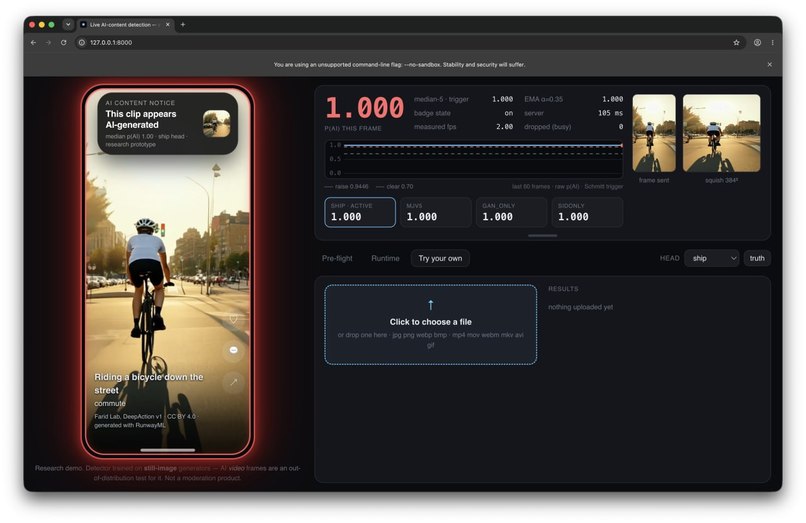
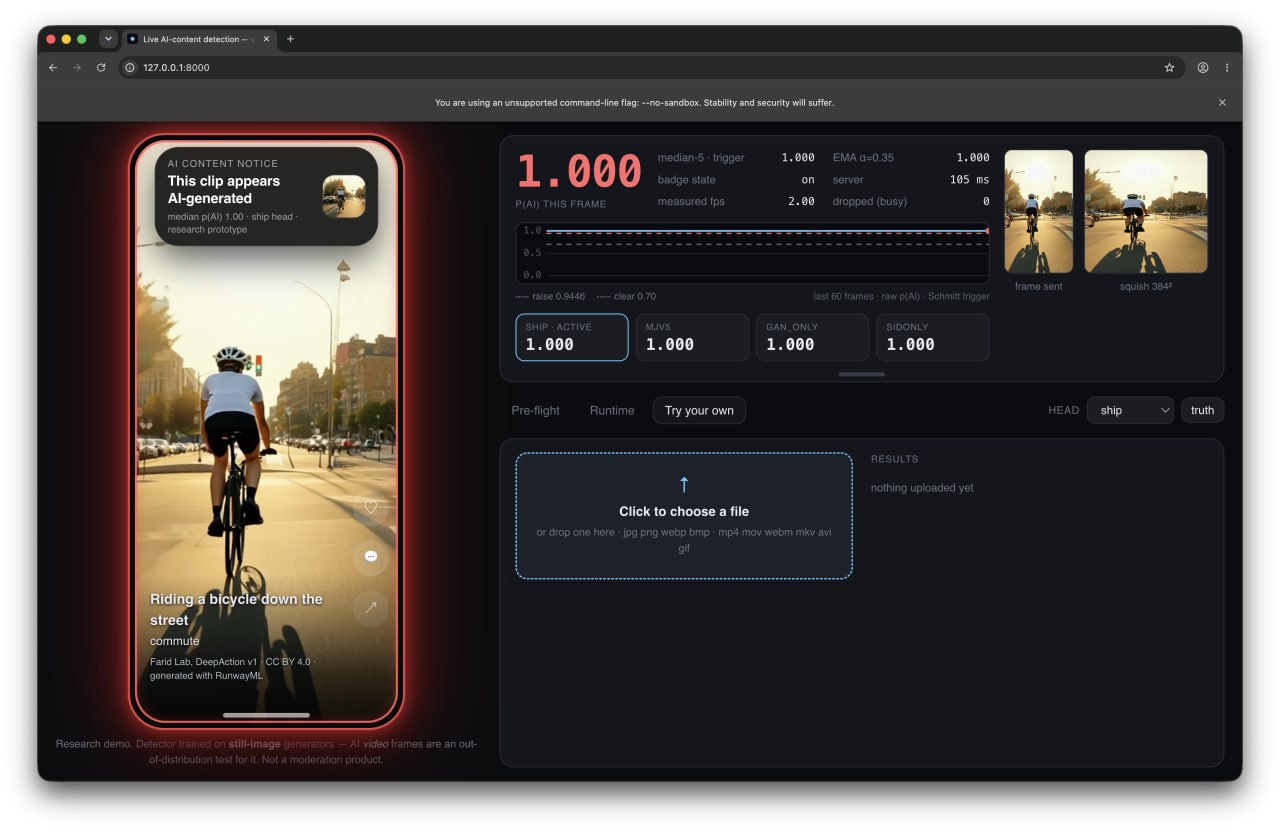
THEIA on a web application
-
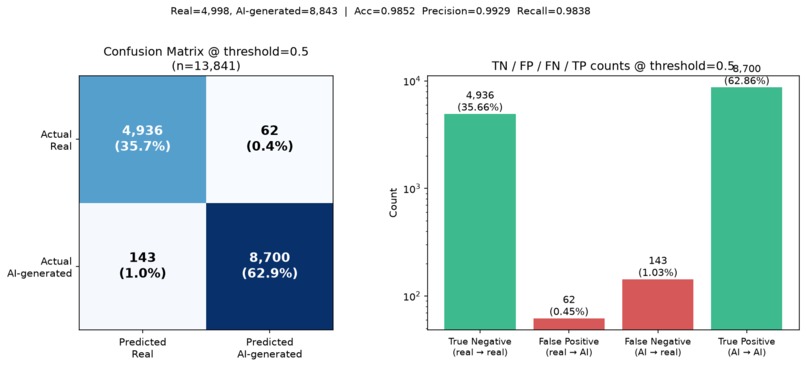
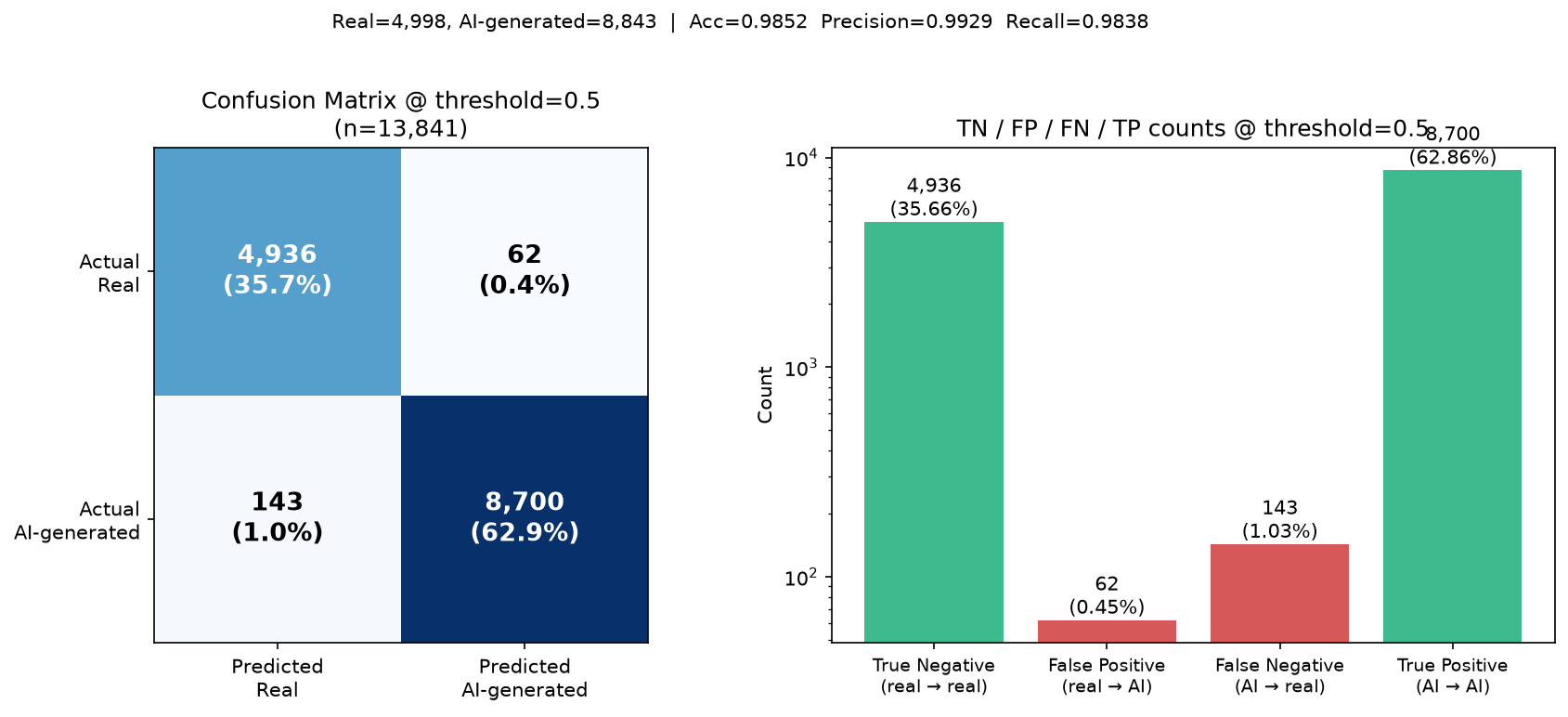
Confusion matrix, error analysis
-
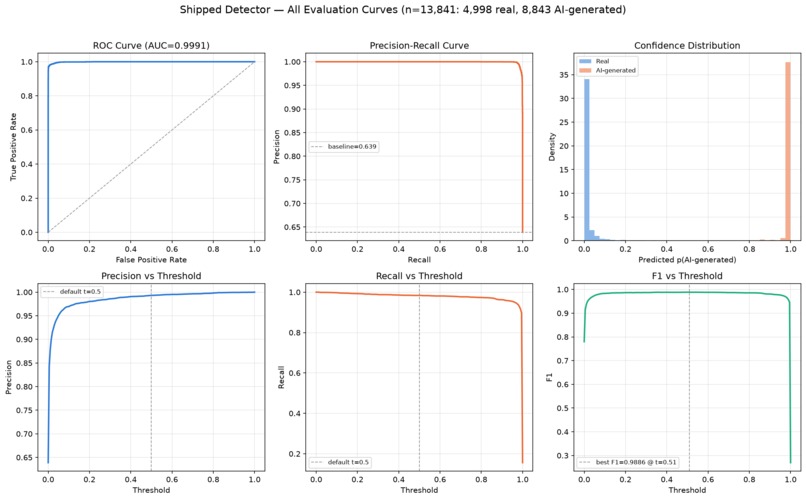
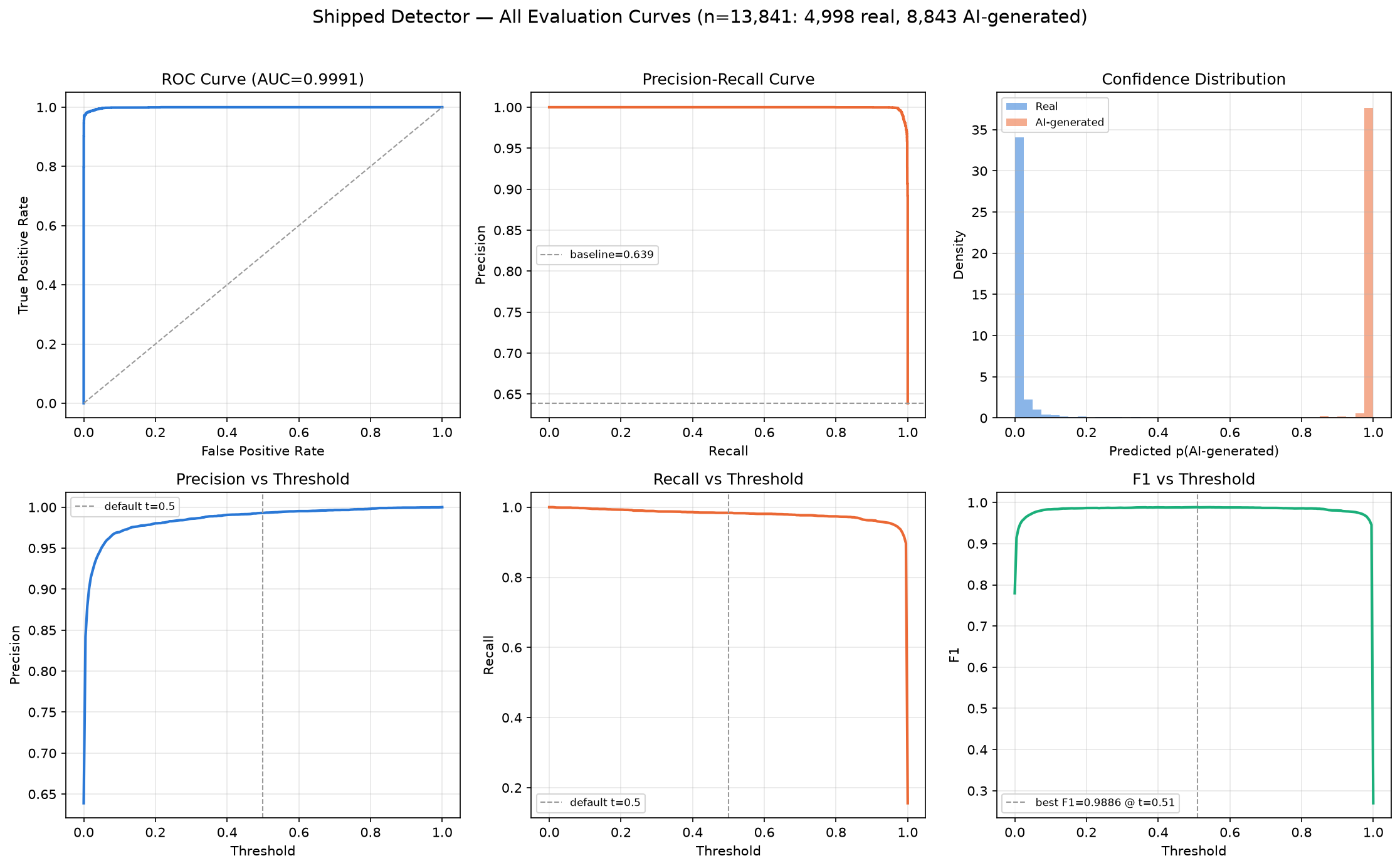
Recall, precision, F1 curves
THEIA 👁️ by QTPies
(Note: In Greek mythology, Theia is the goddess of sight and shining light: the perfect namesake for a model designed to see through synthetic deception).
Motivation 💡
In the age of viral media, AI-generated images are fueling real harm: from scam product listings to synthetic photos used to impersonate real people during breaking events.
However, we discovered a massive vulnerability in current moderation systems: real-world wear and tear. During our testing, we found that AI-generated images initially flagged by standard detectors completely bypassed detection after simply going through TikTok’s native compression and re-upload process. Standard detectors rely on fragile metadata (like C2PA) or invisible watermarks that vanish after a screenshot or WhatsApp forward.
We built THEIA to be a "Zero-Trust" pixel-level detector. We designed it to hold up after real-world transformation, because catching AI-generated images only matters if the model still works after the image has been through what every file online actually goes through.
Key Features ✨
- Media Upload Gateway: Seamlessly upload suspected images or videos.
- Live Dashboard Scoring: Intuitive visual breakdowns of the media's authenticity.
- Real-Time Probability Engine: Instant, granular confidence scoring
p(AI-generated) ∈ [0,1]based on semantic pixel structure, not metadata.
Our Unique Value Proposition 🛡️
Instead of chasing lab-only benchmark scores, we optimized for genuine robustness.
- Zero-Trust Metadata: We ignore fragile metadata entirely, focusing only on the robust, structural anomalies left by generative AI.
- Scientific Rigor over Hype: During development, we caught two real problems that other teams would have shipped. First, we identified a hidden resolution shortcut that was incorrectly flagging real, low-resolution photos as fake 87% of the time. Second, we actively falsified and retracted a wrong assumption about our own performance gains.
- True Generalization: We deliberately shipped the model variant that generalized best to unseen data, rather than the one that simply overfit to the organizer's designated benchmark.
Accomplishments We're Proud Of 🏆
By leveraging a frozen backbone and aggressive stacked-transformation training (compressing, blurring, and injecting noise), THEIA achieves state-of-the-art robustness:
- Baseline Accuracy: Clean ROC-AUC of 0.9991.
- Transformation Robustness: On our worst single-transform cell (heavy Gaussian noise $\sigma=0.10$), the model held strong with a 0.9951 AUC (a max degradation drop of only 0.0039).
- External Generalization: Achieved 0.9917 AUC on completely out-of-distribution, independent test sets.
How We Built It 🛠️
🛢️ Datasets & Leakage Prevention
- Training (Reals/Fakes): SID_Set (24 shards), WildFake (LAION reals, Midjourney v5, 6 GAN families), and COCO test2017 reals.
- Validation: 4,998 COCO val2017 reals + 8,843 DALL-E 3 fakes (organizer-designated).
- External Generalization Sets: Community Forensics-Eval (CVPR 2025, 10+ generators) and RRDataset.
- Security: Data leakage was prevented via strict pixel-content hashing, enforced automatically before every single training run.
💻 Tech Stack
- Models:
google/siglip2-giant-opt-patch16-384(1.164B base, frozen backbone). - Core ML: PyTorch, scikit-learn, SciPy, NumPy, pandas, torchvision, Hugging Face (Transformers, Accelerate, safetensors).
- Image Processing: Pillow, Kornia.
- Visualization: Matplotlib, seaborn.
What We Learned & What's Next 🚀
Taking inspiration from recent literature, we realized that data quality and curation matter far more than sheer architectural complexity.
Looking forward, our roadmap includes:
- Edge Deployment: Because THEIA is strictly restricted to a
<2Bparameter model (1.164B), it maintains a highly lightweight memory footprint. Our next step is optimizing the model for on-device mobile deployment (iOS/Android). - Latency & Scalability: Transitioning the Python backend into scalable, production-ready microservices to handle high-throughput, real-time video frame analysis with sub-second latency.
- Video Temporal Analysis: Expanding beyond frame-by-frame detection to analyze temporal flickering and inconsistencies across full video files.
Built With
- accelerate
- huggingface
- kornia
- matplotlib
- numpy
- pandas
- pillow
- pytorch
- scikit-learn
- scipy
- torchvision


Log in or sign up for Devpost to join the conversation.