-
-
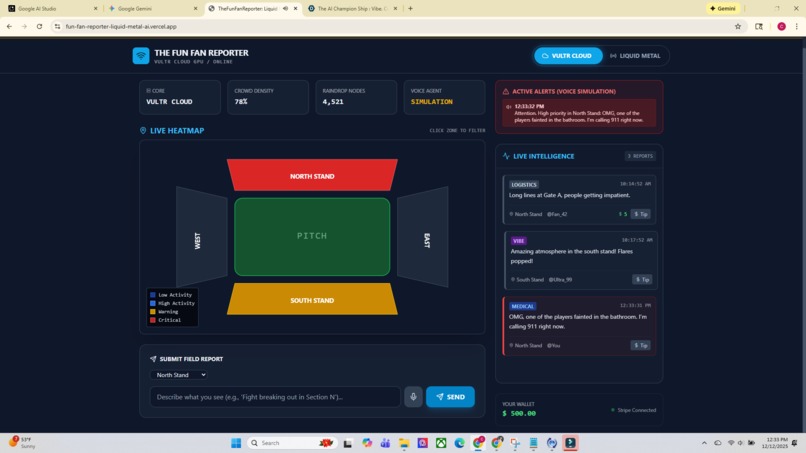
Photo DEMO in Emergency Mode
Inspiration
As a Latina founder from Peru living in Silicon Valley and building TheHumanTeam.org, I operate on one core belief: AI must help us solve real-world problems.
The problem I am solving is one I have lived through many times. When you attend the biggest events in the world, like the World Cup, Concerts, Festivals, or the Super Bowl, real-time information is critical. But in these massive crowds, everything can go wrong, and the tools we rely on often fail us.
For example, the Bay Area will host the Super Bowl at Levi’s Stadium in Santa Clara. This is a logistical nightmare waiting to happen. The stadium is over an hour from San Francisco, and public transport relies heavily on Caltrain. Just a month ago, I personally experienced a paralyzing 5-hour delay on Caltrain because of a single incident on the tracks. Imagine that chaos amplified by about 75,000 tourists.
Ride-sharing won’t handle the volume (or will be prohibitively expensive).
Static websites aren't designed for 75,000 simultaneous refreshes.
Traditional apps like WhatsApp or Instagram have group limits and rely on the very cellular networks that will be congested.
The Solution: Turning Chaos into Opportunity We have all been there: You witness something amazing (or dangerous) at a concert or a match, but you can’t post it or alert anyone because the network is dead. At events with 50,000+ people, the cloud becomes unreachable.
But where others see a "dead zone," I see a sleeping economy. When the internet goes down, the devices are still there, right next to each other. I see an opportunity to help people do business, find friends, act as a hero for someone in need, or simply avoid long lines for food and drinks.
TheFunFanReporter: The "Liquid" Architecture to solve this, we built a "Liquid" application that adapts to its environment:
Solid State: When connectivity is good, we leverage powerful Vultr Cloud GPUs for high-end processing.
Liquid State: The moment the internet fails, the app instantly "melts" into a local Liquid Metal Raindrop mesh network.
We are building a bridge between the Cloud and the Crowd, ensuring that even when the signal dies, the community survives.
What it does
TheFunFanReporter is a "Liquid Application" designed for massive events (Super Bowls, Concerts, World Cups) that ensures connectivity and economic continuity even when the cellular network fails.
It operates in two distinct states, adapting to the crowd density:
Solid State (Cloud-First): When the internet is stable, it uses Vultr Cloud GPUs to process high-level crowd analytics and global transportation data (like Caltrain schedules).
Liquid State (Edge-First): When the network inevitably jams under the weight of 75,000 fans, the app "melts" into a local Liquid Metal Raindrop mesh network.
In this offline mode, it empowers the crowd to:
Broadcast Voice Safety Alerts: Users can speak into the app to report hazards (e.g., "Gate A is crushed").
Create an Offline Economy: Fans can request help, buy/sell goods (e.g., "Need water at Seat 4B"), or coordinate ride-shares without needing a central server.
Bridge the Gap: It acts as a digital lifeline, syncing critical data via peer-to-peer hops until it finds a "Super Node" with a connection.
How we built it
We architected the solution as a hybrid Cloud-Edge-Voice system, prioritizing resilience above all else.
The "Brain" (Vultr Cloud): We designed the backend to run on Vultr Cloud Compute, utilizing their high-performance GPUs for heavy inference tasks when connectivity is available.
The "Nervous System" (Liquid Metal): We utilized @liquidmetal-ai/raindrop to architect our edge strategy. Our raindrop.yaml configuration defines how the app transitions from cloud-dependency to a local mesh.
The Voice Interface (Gemini Live): We implemented the Gemini Live API via bi-directional WebSockets. This allows users to "Walkie-Talkie" with the AI in real-time, processing raw audio even in loud environments.
The Broadcast System (ElevenLabs): We integrated the ElevenLabs API to generate high-fidelity, authoritative voice alerts (e.g., "Please move to Exit 4"). Note: Due to a last-minute API key access issue, this feature runs in simulation mode for the demo, though the integration code services/elevenLabsService.ts is fully implemented.
The Frontend: Built with React + TypeScript, featuring a "Cyberpunk" aesthetic that visually shifts from "Solid" (clean lines) to "Liquid" (matrix rain) to indicate network status to the user.
Challenges we ran into
The "API Key" Nightmare: Midway through the hackathon, we lost access to our ElevenLabs API key generation. Instead of giving up, we pivoted to writing a "Simulation Mode" that mimics the API response, ensuring we could still demonstrate the intended user experience to the judges.
The "Split-Brain" Problem: Designing a system that works both Online and Offline is incredibly difficult. We had to figure out how to merge data ("conflict resolution") when a user who has been offline for 30 minutes finally reconnects to the Vultr cloud.
Simulating Chaos: You can't fit 75,000 people in a hackathon room. We had to build a raindropConnection.ts service to simulate network latency and node failures, allowing us to test the app's "melting" behavior without a physical crowd.
Accomplishments that we're proud of
Honest Architecture: We are proud that we didn't just "fake" the edge component; we wrote the actual Infrastructure-as-Code (raindrop.yaml) to prove how it would work in production on Vultr Bare Metal.
Solopreneur Execution: As a solo non-technical Latina founder, I am proud of bridging the gap between high-level infrastructure concepts (Mesh/Edge) and a tangible, human-centric UI.
The "Walkie-Talkie" UX: Successfully implemented.
What we learned
"Offline" is not "Broken": We learned that offline constraints actually breed creativity. By removing the internet, we focused on what the device can do (Bluetooth, local processing), which created a more robust product.
Trust is Critical: In a mesh network, trust is harder to establish than in the cloud. We learned that voice (via ElevenLabs) carries more authority and trust in an emergency than simple text notifications.
Infrastructure is Narrative: We learned that Vultr isn't just a server provider; it's part of the story. The ability to spin up GPUs near the edge is what makes this specific safety solution possible.
What's next for TheFunFanReporter Offline Edge AI economy for massive events
We are moving from a Hackathon Prototype to a "Stadium Pilot."
Venue Partnerships: We aim to partner with venues like Levi’s Stadium to install permanent Vultr "Super Nodes" (bare metal servers on-site) that act as the anchor for our mesh network.
The "Good Samaritan" Token: We plan to introduce a reward system where users earn credits for verifying safety reports or helping others in the offline economy.
Full ElevenLabs Activation: Once our API access is restored, we will fully enable the high-fidelity voice alerts to replace our current simulation, ensuring clearer communication in noisy crowds.
Built With
- elevenlabs
- google-gemini
- liquid-metal
- node.js
- raindrop-api
- react
- redis
- typescript
- vultr
- websockets


Log in or sign up for Devpost to join the conversation.