-
-
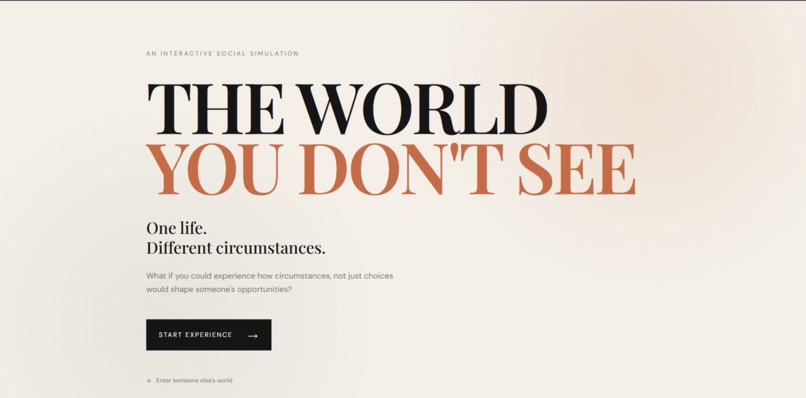
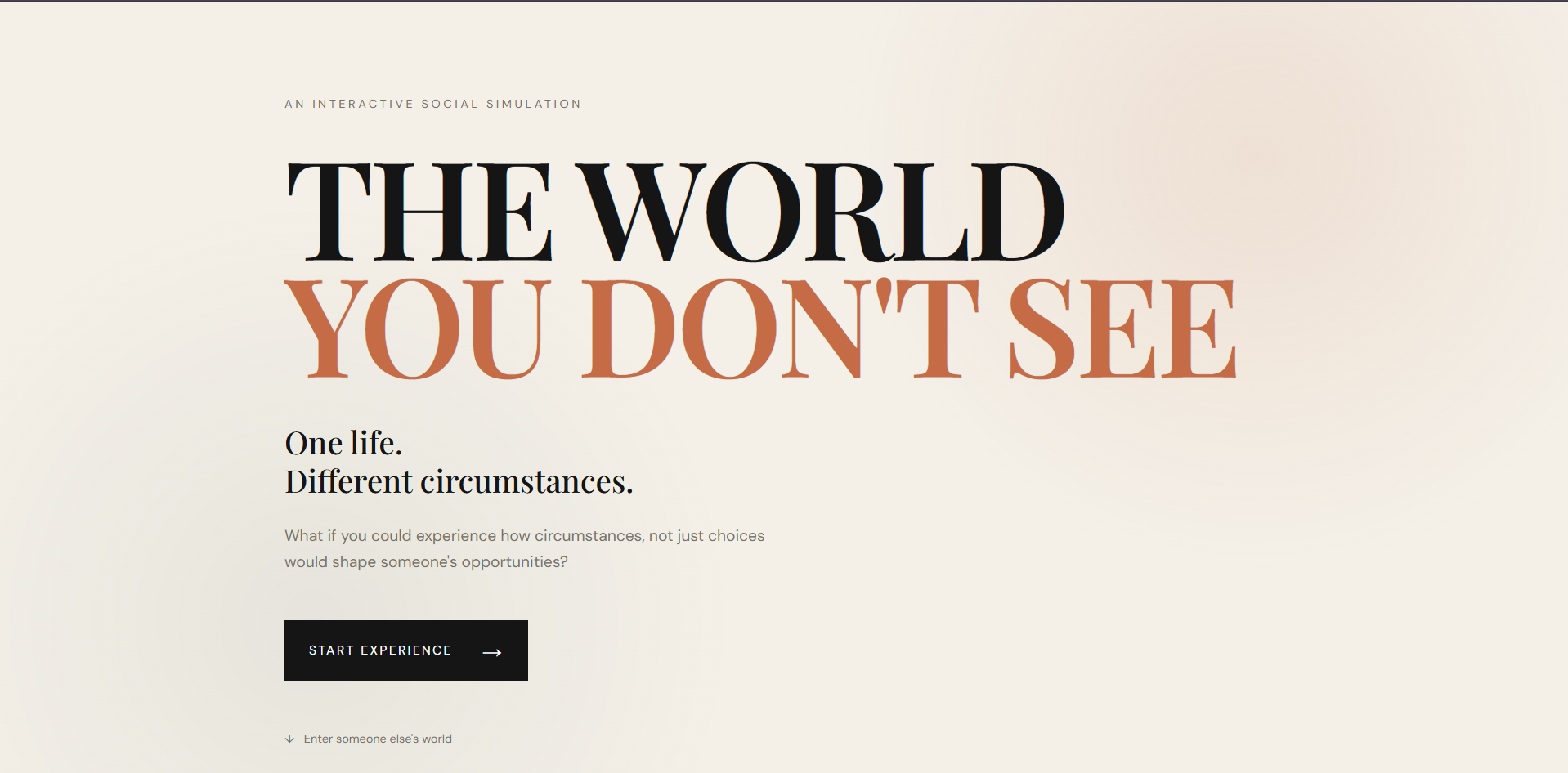
home page
-
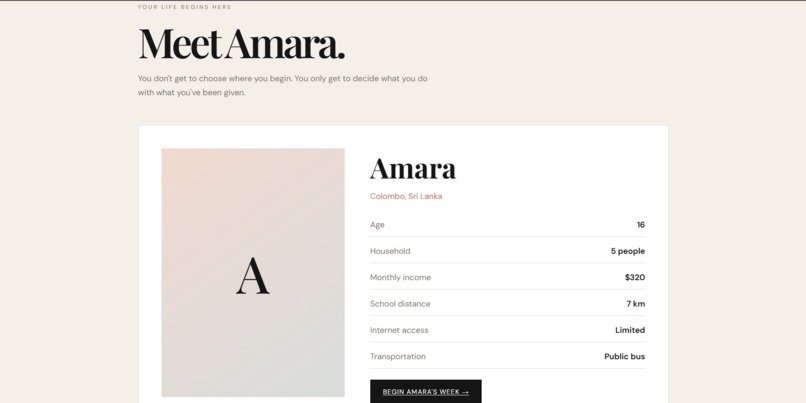
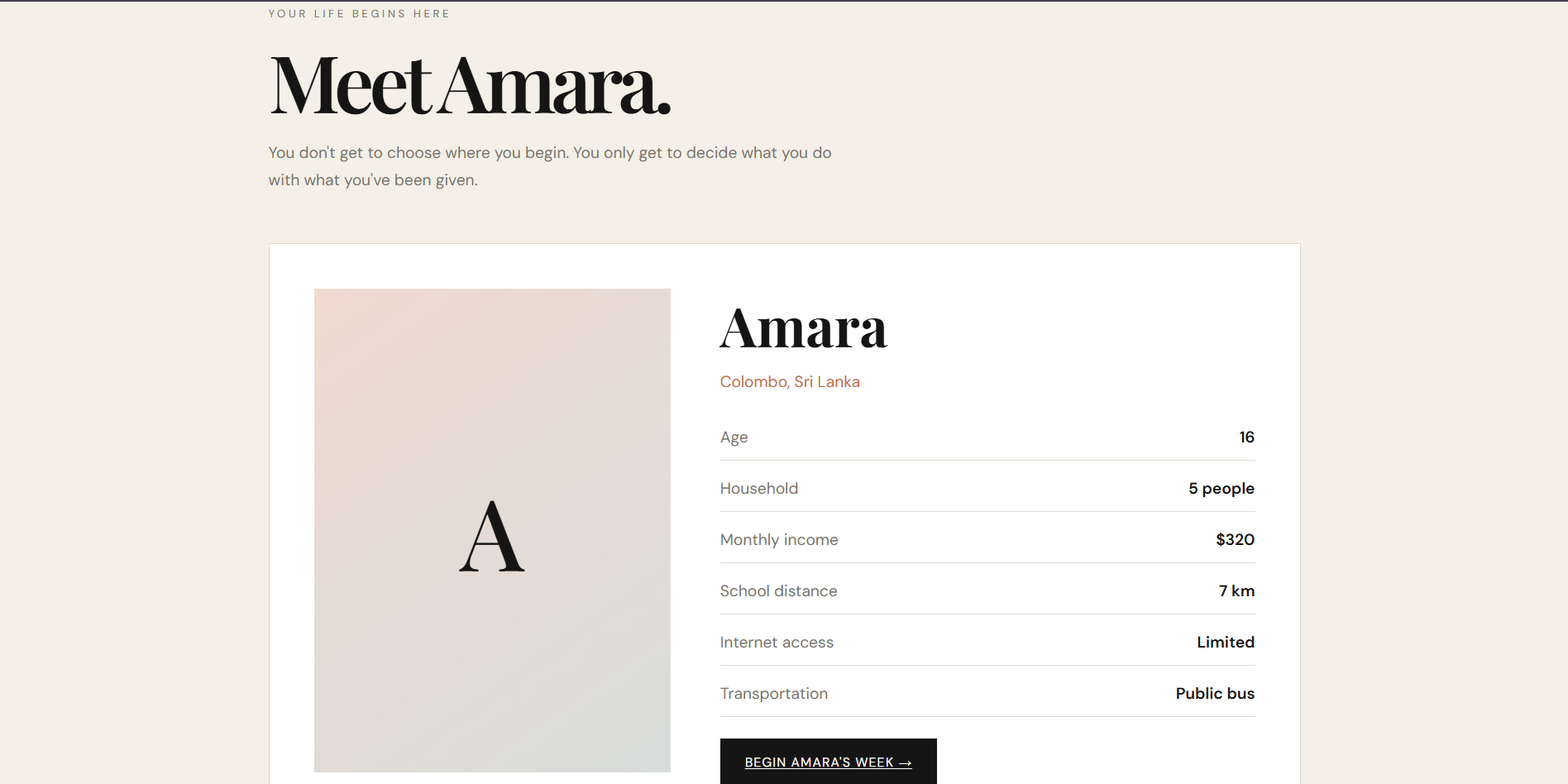
details of your candidate
-
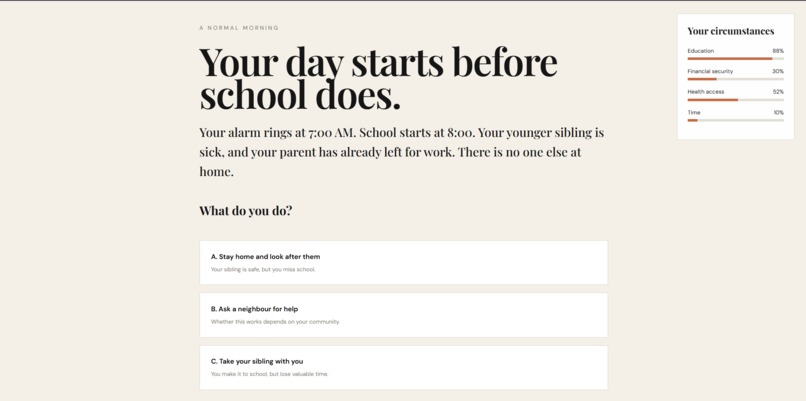
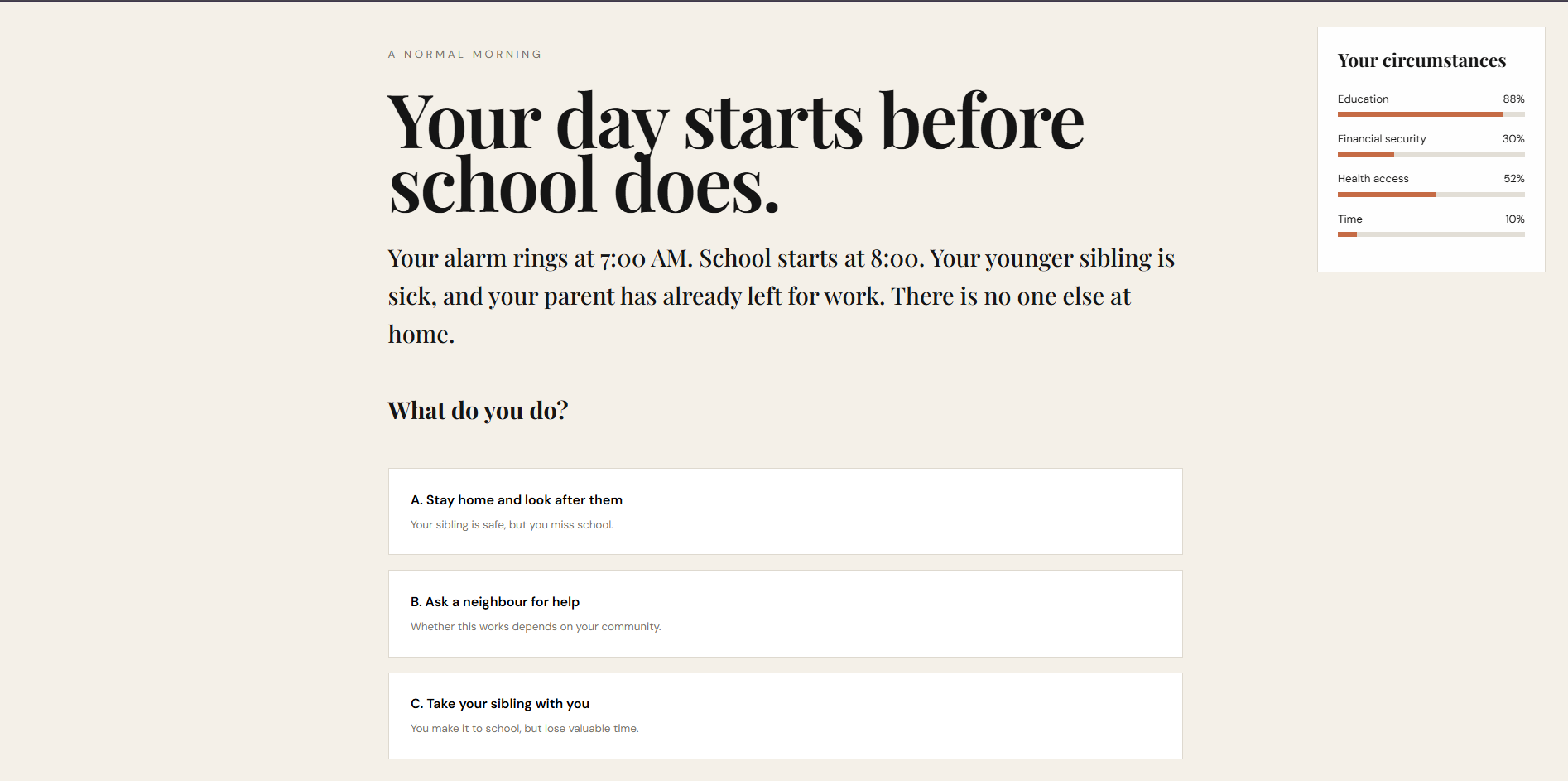
user is given the opportunity to make a few choices based on situations that could actually happen
-
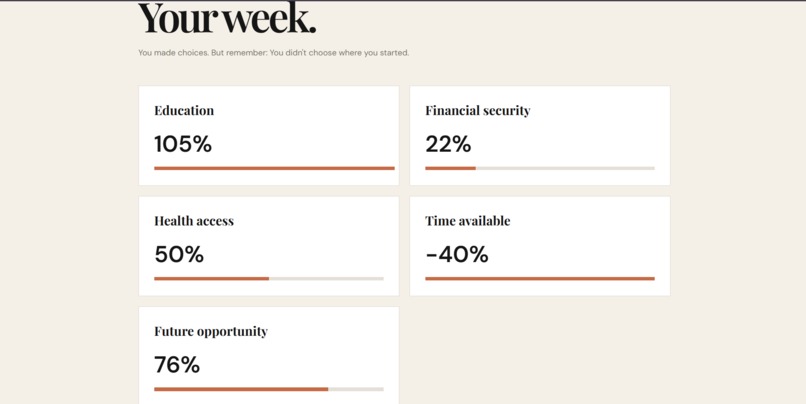
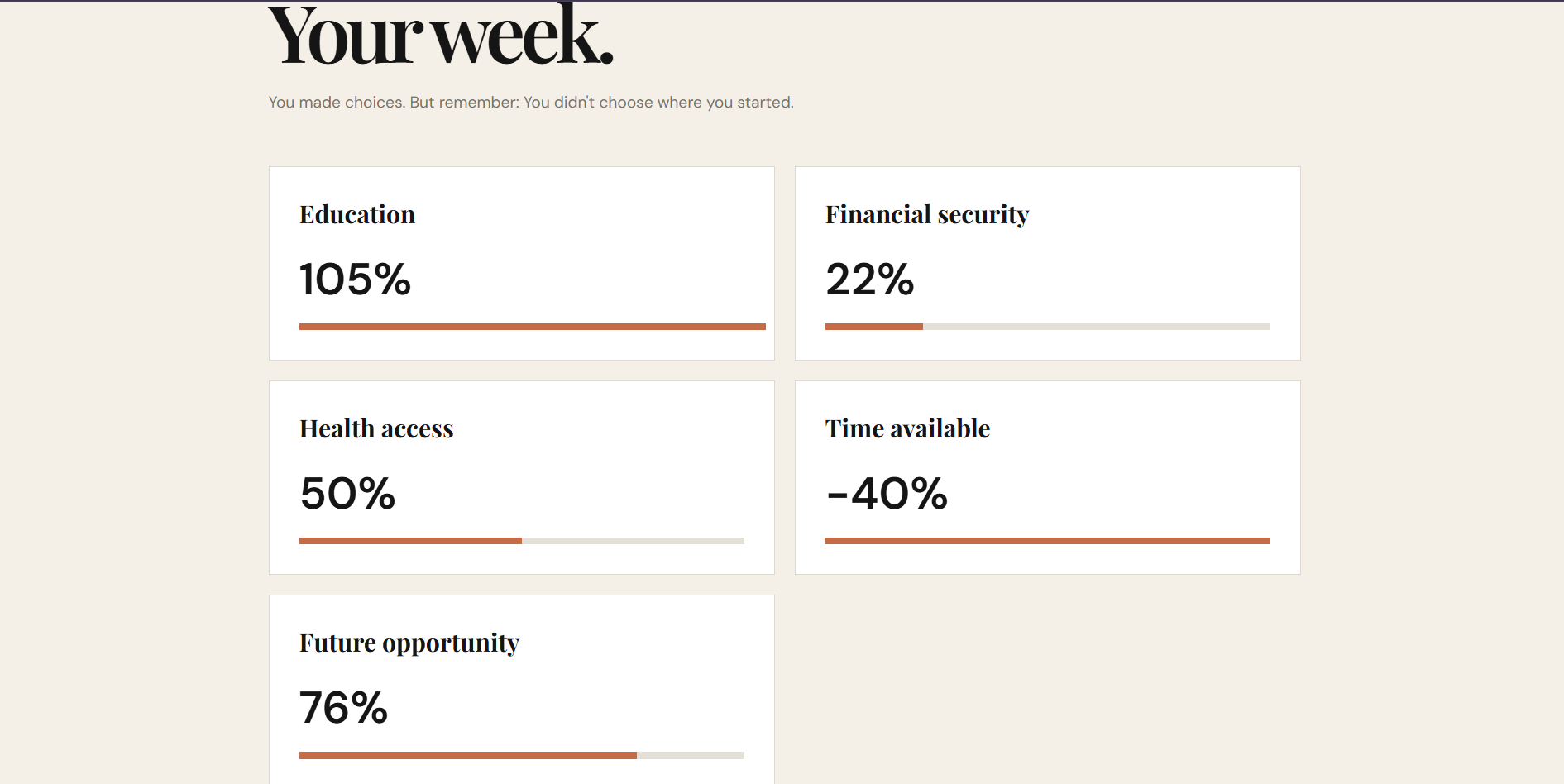
user would be given statistics based on their choice of answers for the previous questions
-
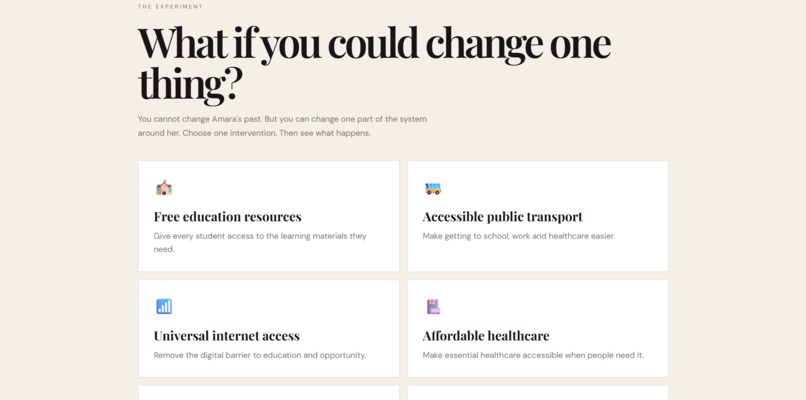
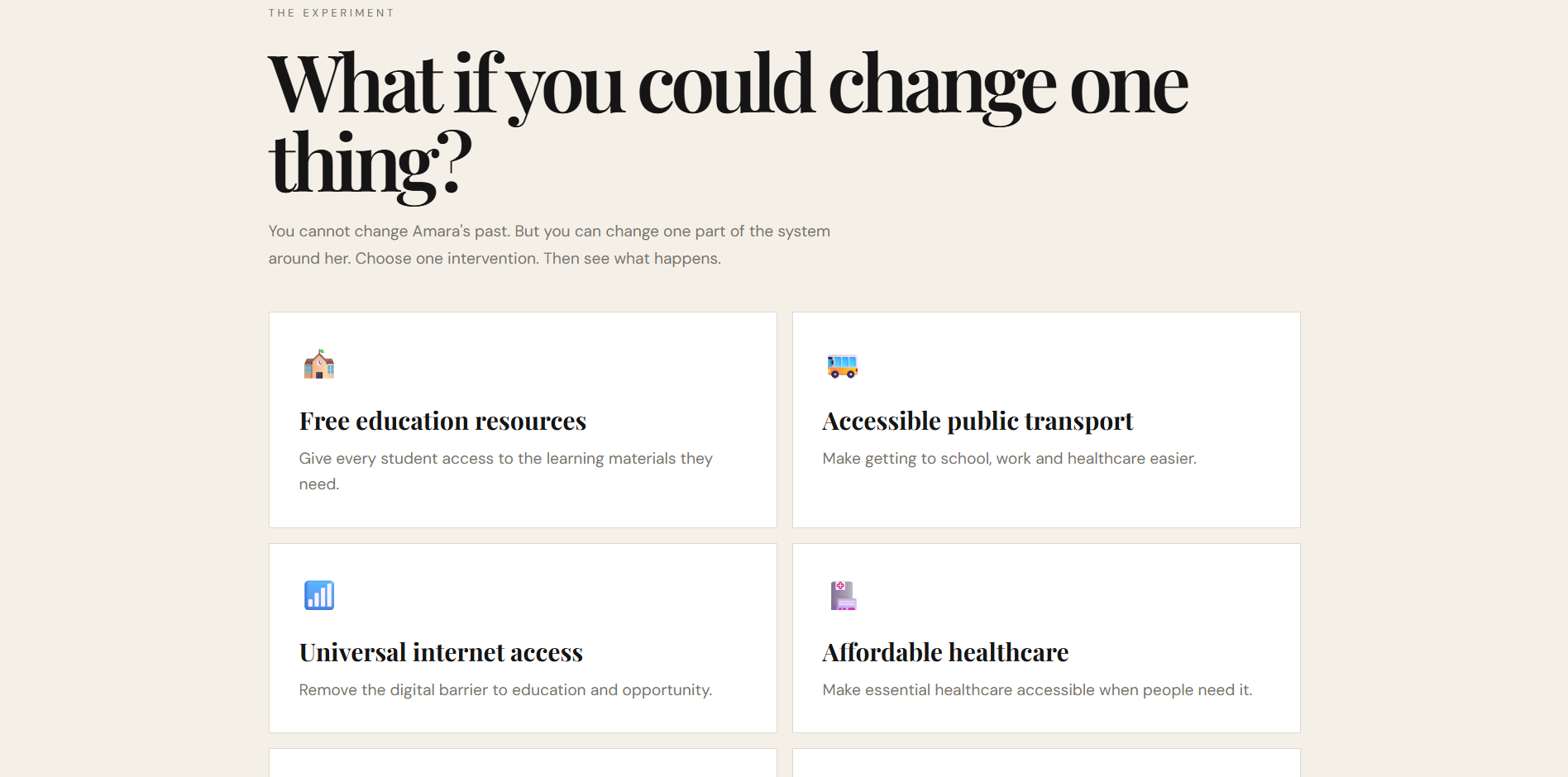
user gets one chance to change one thing about the candidates life
-
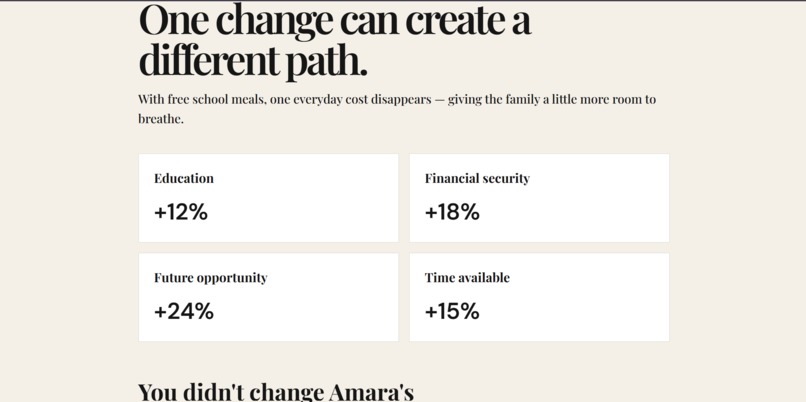
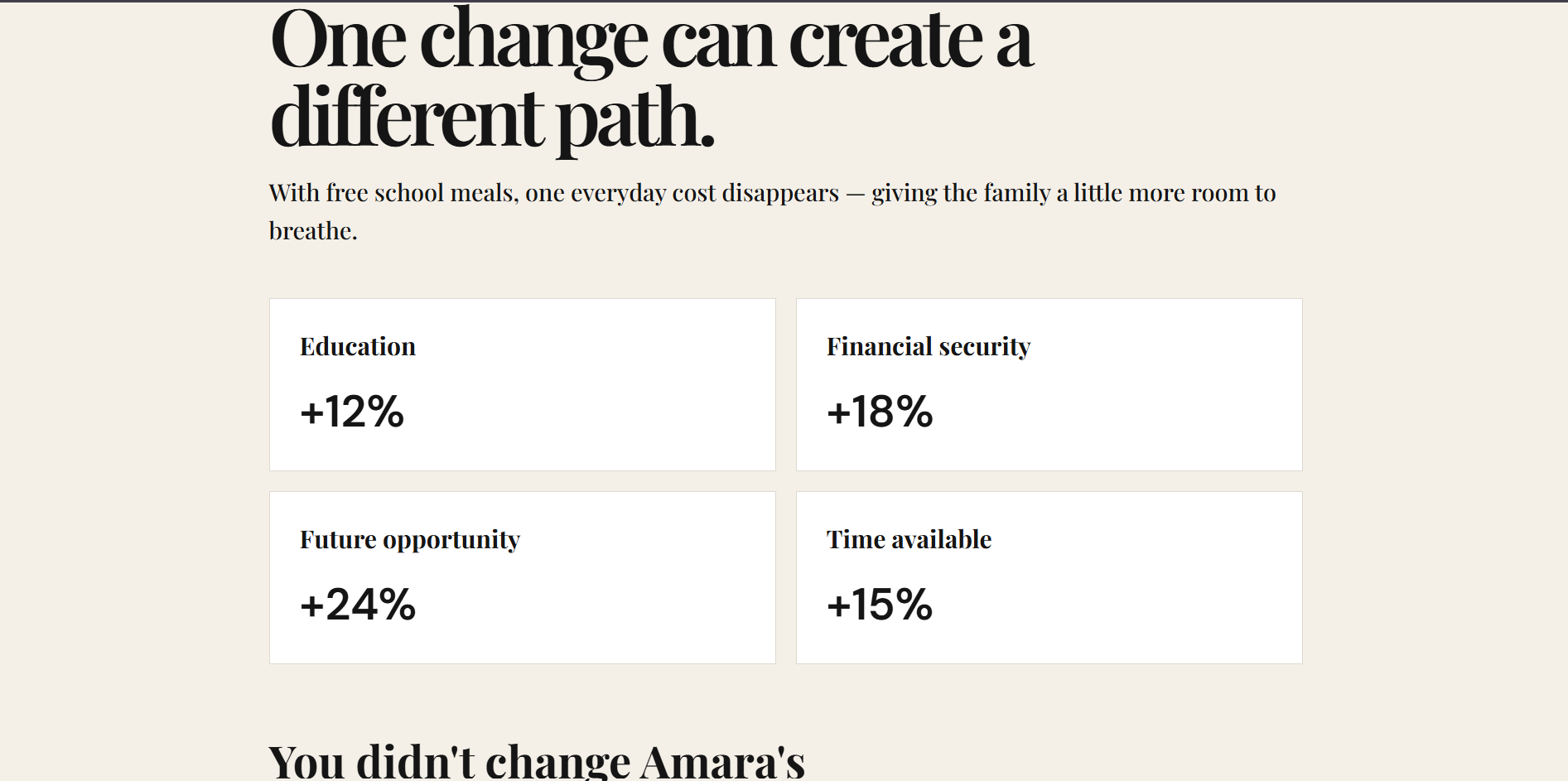
user gets updated statistics
Inspiration
We live in a world where statistics about poverty, inequality, climate disasters, accessibility, and education are constantly shared. We see numbers like millions of people affected by a crisis, but it can be difficult to understand what those numbers actually mean for an individual. That led me to ask: "What if, instead of simply reading about someone else's circumstances, you could experience them?" This question inspired The World You Don't See, an interactive simulation designed to help users understand how circumstances can shape the choices and opportunities available to a person. The project focuses on an important idea: the same decision can have completely different consequences depending on the circumstances surrounding it.
What it does
The World You Don't See places the user inside a simulated person's life. Users are given a set of circumstances, such as their access to education, transportation, financial resources, healthcare, technology, and family support. They then encounter everyday situations where they must make difficult decisions. There isn't always a "right" answer. Choosing one option might improve one part of the character's life while creating another challenge somewhere else. As the simulation progresses, these decisions influence different aspects of the character's wellbeing and opportunities.
At the end, users can ask: "What if one thing changed?" They can introduce a systemic intervention, such as affordable transportation, improved internet access, accessible healthcare, or free school resources, and see how that change affects the simulated outcome. The goal isn't to predict someone's actual life. Instead, it is to demonstrate how systems, circumstances, and access to resources can influence the choices people have available to them.
How I built it
I designed the project as an interactive web experience, focusing on making the simulation feel more like a story than a traditional educational website. The core of the project is a decision-based system: circumstances, choices, consequences, intervention and new outcomes. The interface presents situations to the user, records their decisions, updates the character's different life indicators, and produces an outcome based on those accumulated decisions.
The project combines:
- HTML for the structure of the experience
- CSS for the visual design and responsive interface
- JavaScript for the simulation logic, decision-making system, and dynamic outcomes
- Data and research to ground the scenarios in real-world issues
Rather than attempting to simulate every global problem, I focused on building a smaller, polished experience that demonstrates the concept effectively.
Challenges we ran into
One of the biggest challenges was deciding how to represent complex real-world issues without reducing them to overly simple numbers. Real people's lives cannot be accurately represented by a score, so I had to think carefully about how the simulation could communicate systemic barriers without claiming to predict real-life outcomes.
Another challenge was creating meaningful choices. I wanted decisions to feel realistic rather than having an obvious "good" and "bad" answer. This meant considering how one decision could create both positive and negative consequences.
I also had to balance the ambition of the idea with what could realistically be built within a hackathon. There are countless issues I could have included, but attempting to cover everything would have made the project less focused. I therefore concentrated on building a strong core simulation that could eventually be expanded.
Accomplishments that we're proud of
One of the accomplishments I'm most proud of is taking an idea that started as a simple question about inequality and turning it into an interactive technology project. I am proud that I challenged myself to build something beyond a traditional informational website. Instead of simply presenting statistics, I created an experience that encourages users to interact with a real-world issue, make decisions, and see how different circumstances can influence outcomes.
I'm also proud of the technical growth that came with building this project. I pushed myself to learn and apply new concepts in web development, particularly creating dynamic interactions and connecting the user's choices to changing outcomes. Most importantly, I'm proud that I used technology to explore a problem I genuinely care about. The World You Don't See is not just a project I built for a hackathon—it represents my interest in using engineering and technology to create solutions with meaningful social impact.
What we learned
This project taught me that building a social-impact technology project involves much more than writing code. I learned how important it is to translate a large, complex problem into an experience that people can actually understand and interact with. I also learned to think more carefully about how data is represented and how technology can influence the way people understand social issues. Most importantly, I learned that a successful solution doesn't necessarily have to solve an entire global problem. Sometimes, technology can create impact by helping people see a problem differently.
What's next for The World You Don't See
The current project is designed as a foundation that could be expanded into multiple scenarios covering different real-world issues, including:
- Climate disasters
- Education inequality
- Accessibility
- Housing insecurity
- The digital divide
- Gender inequality
- Healthcare accessibility
Future versions could incorporate more real-world datasets, additional scenarios, personalised simulations, accessibility features, and a wider range of interventions. Ultimately, I want The World You Don't See to become more than a simulation. I want it to encourage users to ask: "If changing one thing can change someone's outcome, what should we change?"

Log in or sign up for Devpost to join the conversation.