-
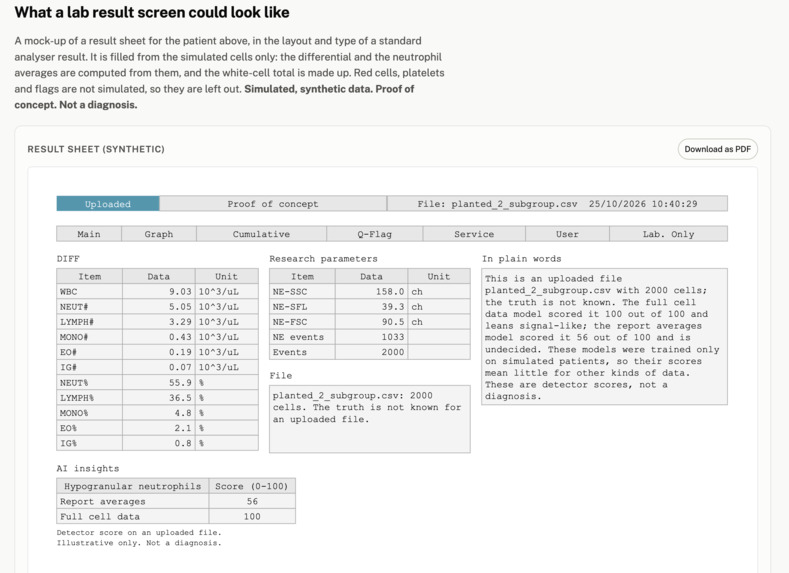
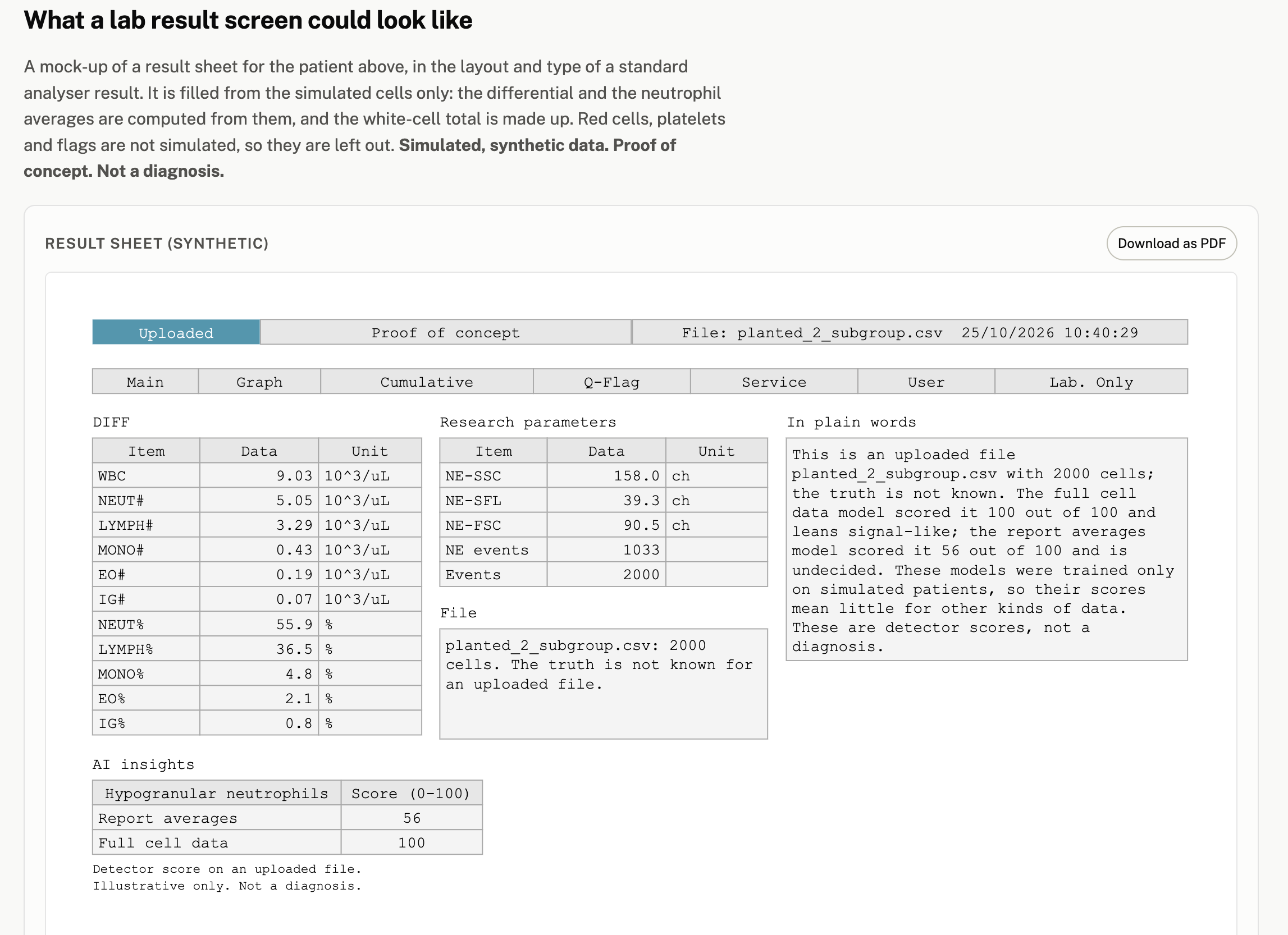
Example of ML prediction results being appended to exisiting clinical blood report
-
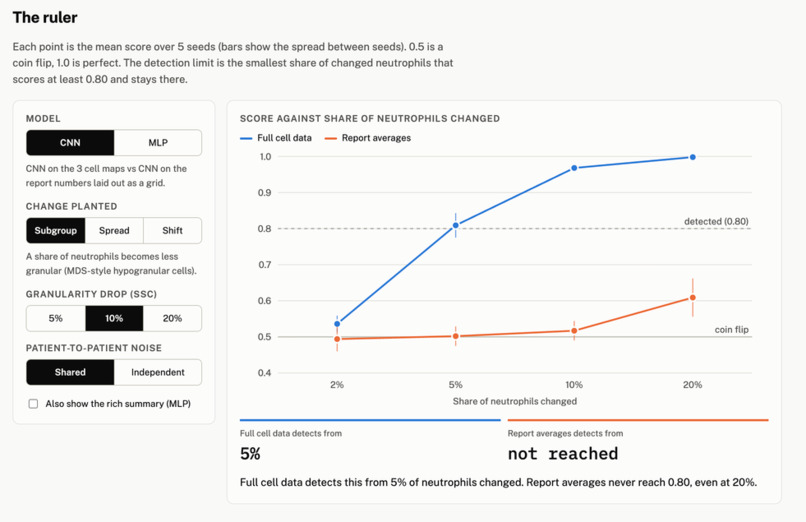
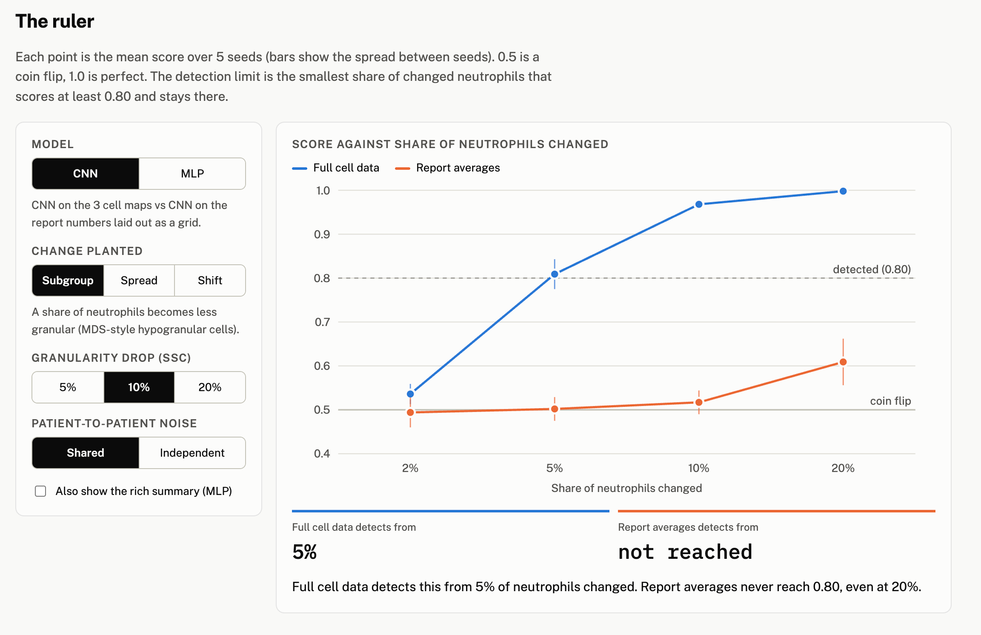
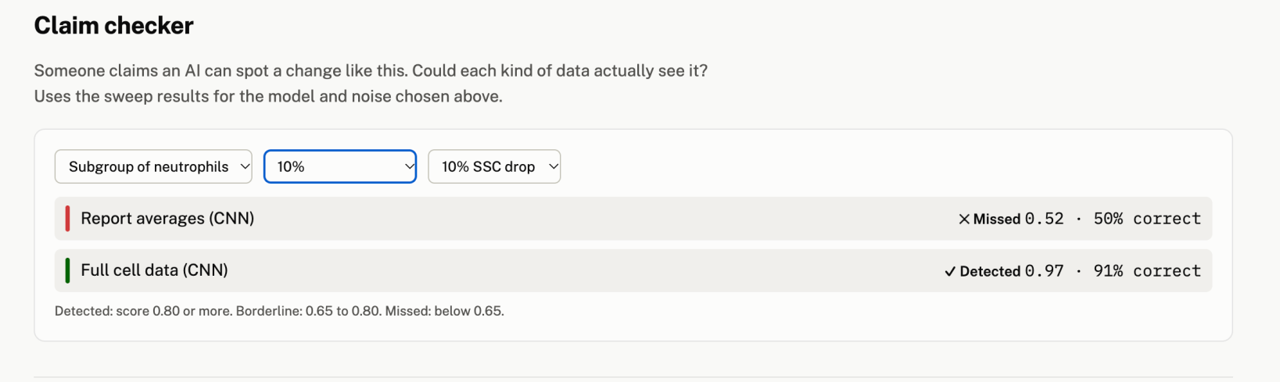
Results of training our CNN models demonstrating training on single cell data predicted disease more accurately than training on averages
-
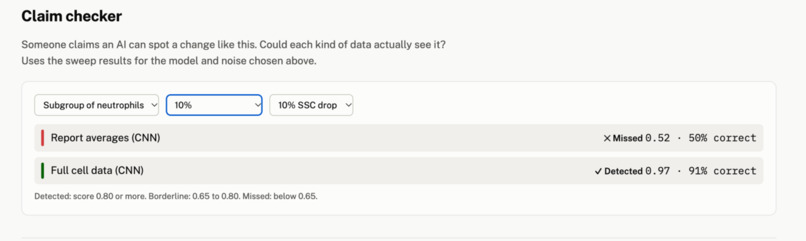
Exploring the data using AI tools to explain results in more simple language
-
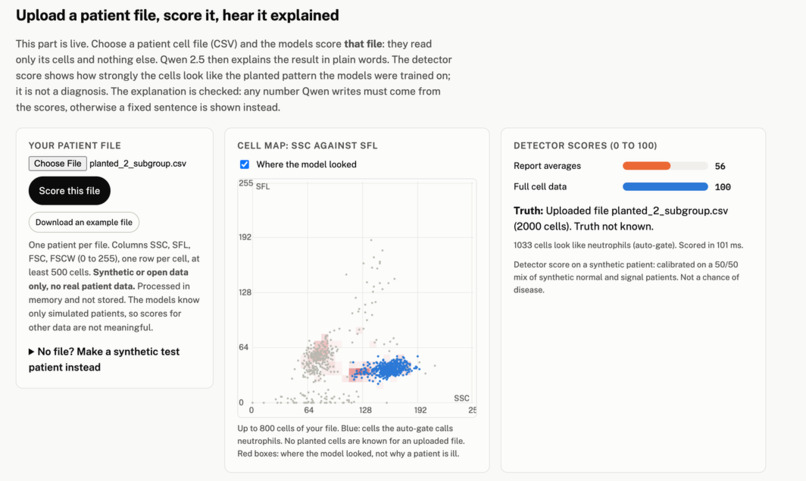
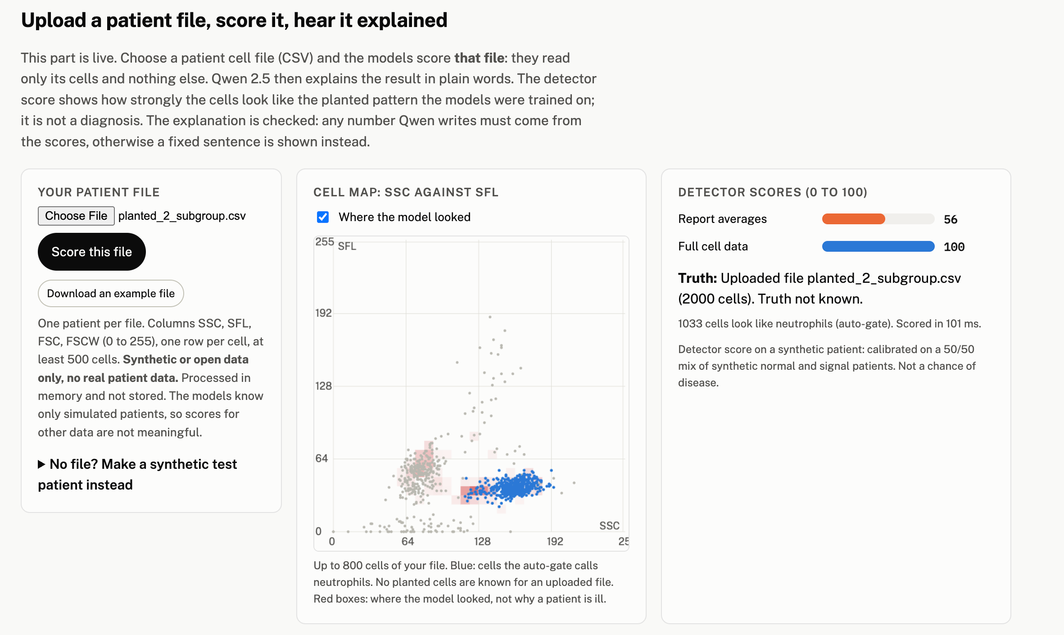
Interface for healthcare researchers to test individual blood analyser files on ML models with prediction of disease signatures calculated
-
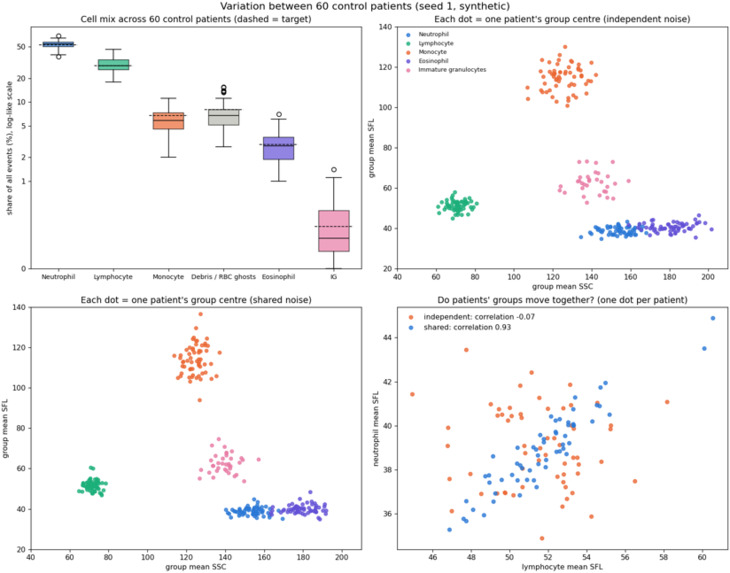
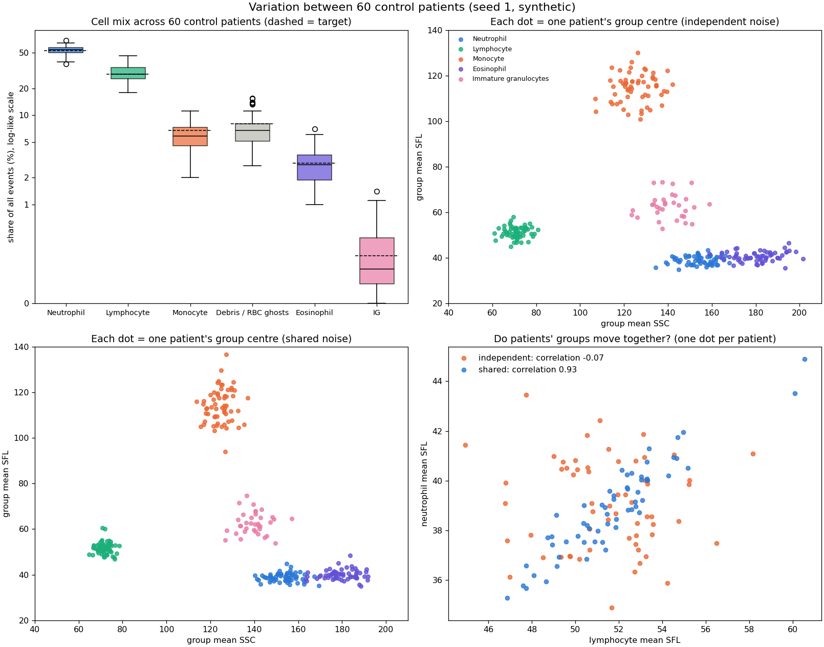
Validating our biological variation model in different cell types
-
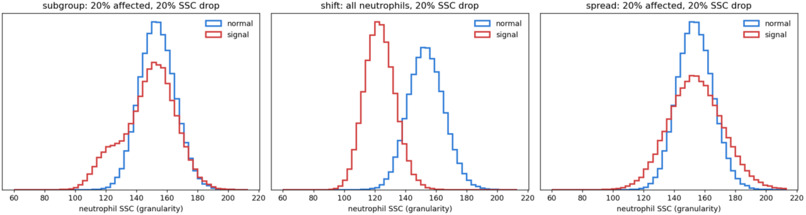
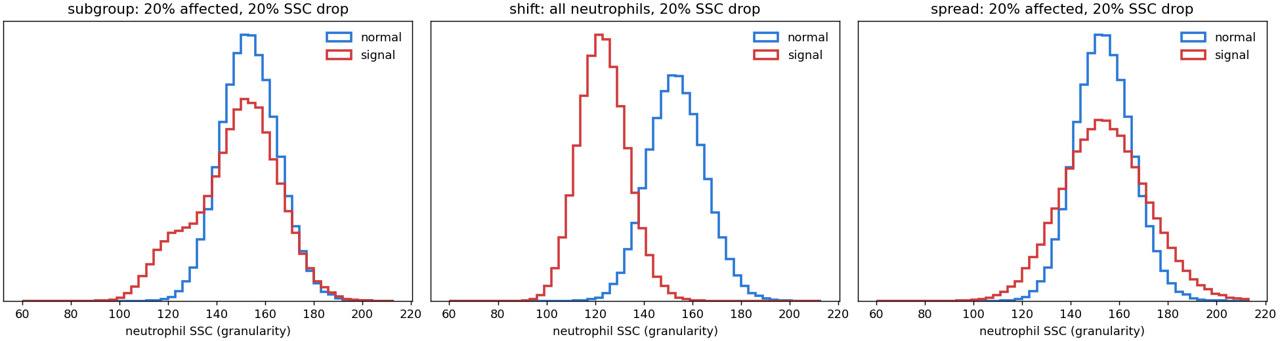
Validating that our disease signature injection works and alters neutrophil characteristics
Inspiration
Sam (BioMed PhD) is planning to use ML models in his research for flow cytometry data to identify subpopulations in blood data. He realised that NHS blood analyser work similarly to flow cytometers and a wealth of data is recorded and clinically annotated as part of routine health assessments, making an attractive data source for training ML models to predict disease signatures that are currently missed due to how data is presented to clinicians.
What it does
Our system generates synthetic blood analyser data for healthy controls and also a disease subset. Our CNN ML models are trained on the raw cell data from these synthetic datasets, as well as the averages that are currently presented to clinicians. The model will predict the presence of this disease signature i.e. hypogranular-neutrophil blood cancer signature.
How we built it
We generated synthetic data, utilising a research paper that provided raw files of body fluids ran through the same blood analyser used in many hospitals (Sysmex XN-1000) to keep the same data structure as files currently produced. This machine utilises lasers and detectors to record light scattering and fluorescent properties of cells in a single-cell manner, we used this reference file to model the properties of different cell types as well as biological variation and batch effects into synthetic Sysmex files for healthy controls. We also modelled in a myelodysplastic syndrome (blood cancer) disease signature, involving a reduction in neutrophil scatter properties at various strengths (proportion of cells affected and strength of signal change). We then trained the same type of AI model, a convolutional neural network (CNN), twice: once on the report averages that a routine lab report keeps (a grid of group averages and shares), and once on the full single-cell data (every cell of the patient, as three 32 by 32 count maps). Both models were tested on synthetic patients they had never seen, and both were trained on Kaggle GPUs. This lets us measure how small a change each can detect. With the same CNN, the full-cell data detected a change in 2% of neutrophils at a 20% scatter drop, where the report averages needed 10%. All data is synthetic, so this shows what is detectable, not that a real disease produces these changes.
Challenges we ran into
There are very few real complete Sysmex blood run datasets available online due to GDPR and ethical reasons, and so creating biologically accurate synthetic data was challenging to model. Similarly, capturing the breath of biological/batch variation that can occur is difficult without multiple references yet important to know whether our model can see disease signatures through the noise. Time constraints for ML training meant synthetic files contain less cells and less patients than would be desirable for training these models and so finding a compromise between computational scientists and biology experts was a long discussion.
Accomplishments that we're proud of
Despite training of models with 2000 cells per patient, models performed better at predicting the presence of disease signatures when trained in single-cell data compared to trained on clinical averages, making this an exciting proof on concept that these models can improve information presented to clinicians. The synthetic data generator could be used to model different diseases and healthy control making this a tool useful to healthcare researchers as well as clinicians.
What we learned
I think we have all learnt a lot as we came in with very different backgrounds and have taught each other something about our fields. Overall, I think we have learnt that tools that are well understood in the computer science world can be applied reasonably smoothly to the healthcare world with potentially big impact. One of the main challenges in integrating AI in healthcare is going to be consolidation of data across the NHS, rather than the current per-trust data management.
What's next for The Vampires
We may explore improving our model, getting true Sysmex full blood count data and improving on the synthetic data generator. We intend to publish our findings as a research paper to demonstrate these models may have clinical value in assessing blood data for disease prediction.


Log in or sign up for Devpost to join the conversation.