-
-
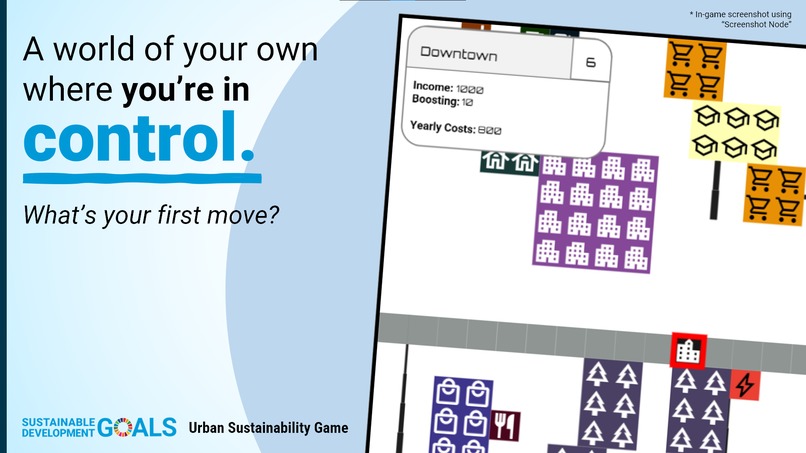
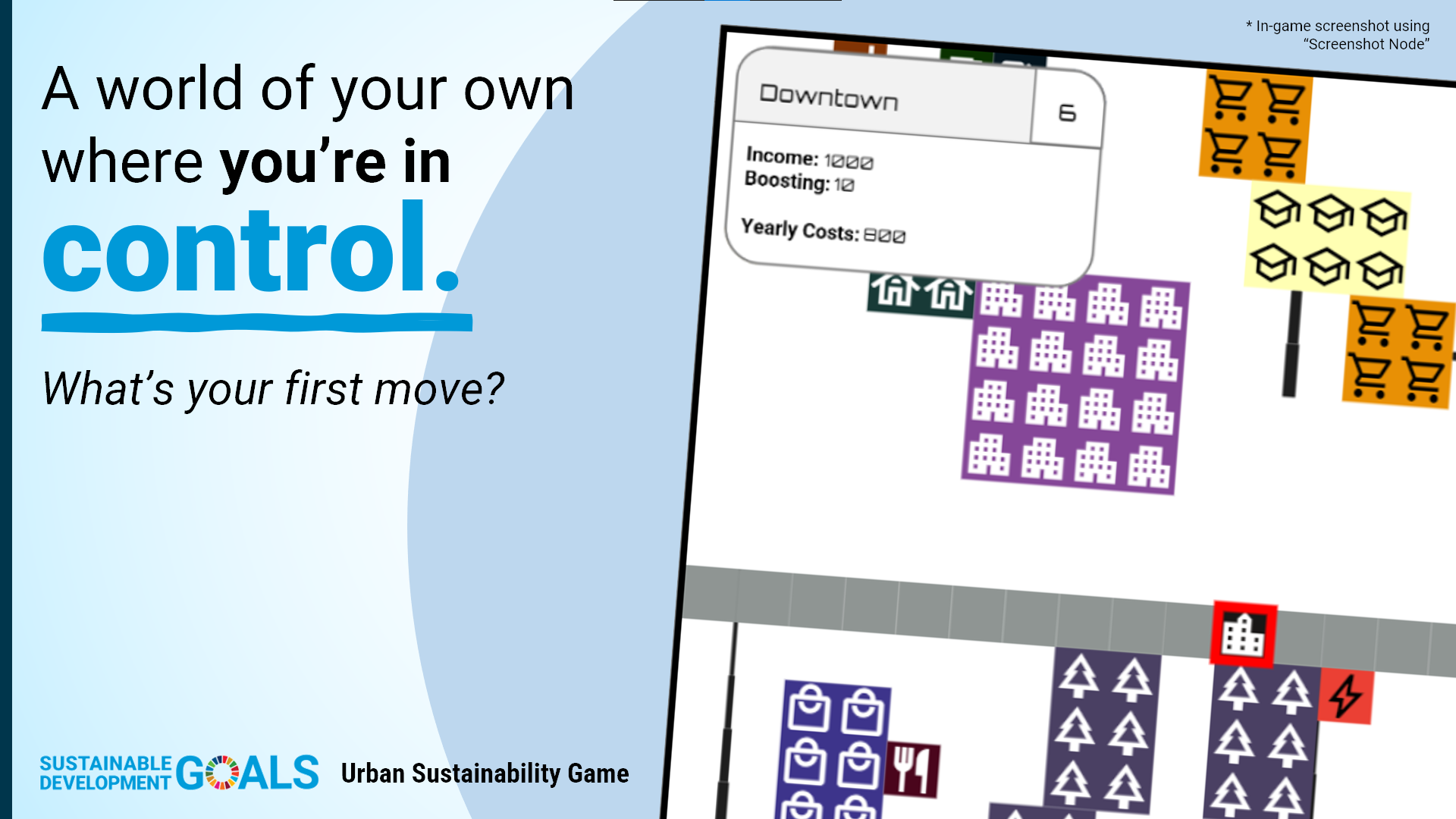
What is your first move to becoming more sustainable?
-
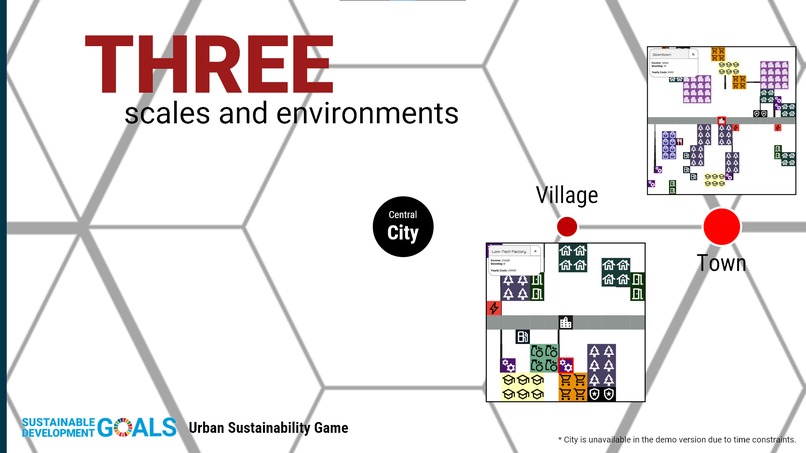
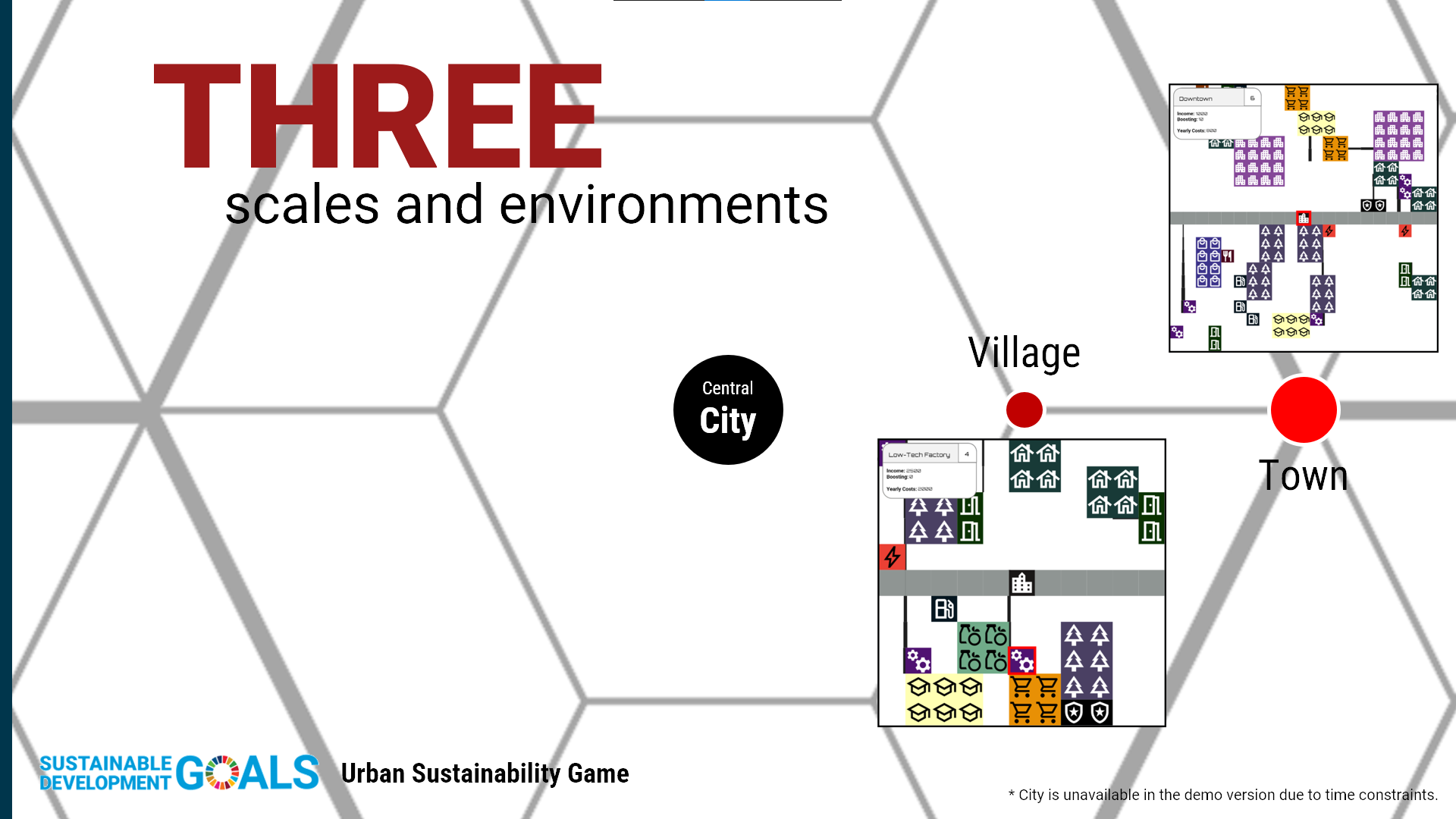
Three Scales for Three Unique Rounds
-
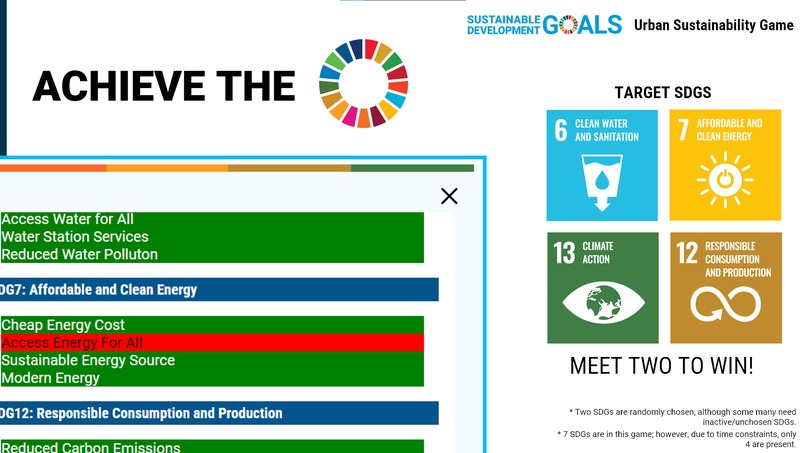
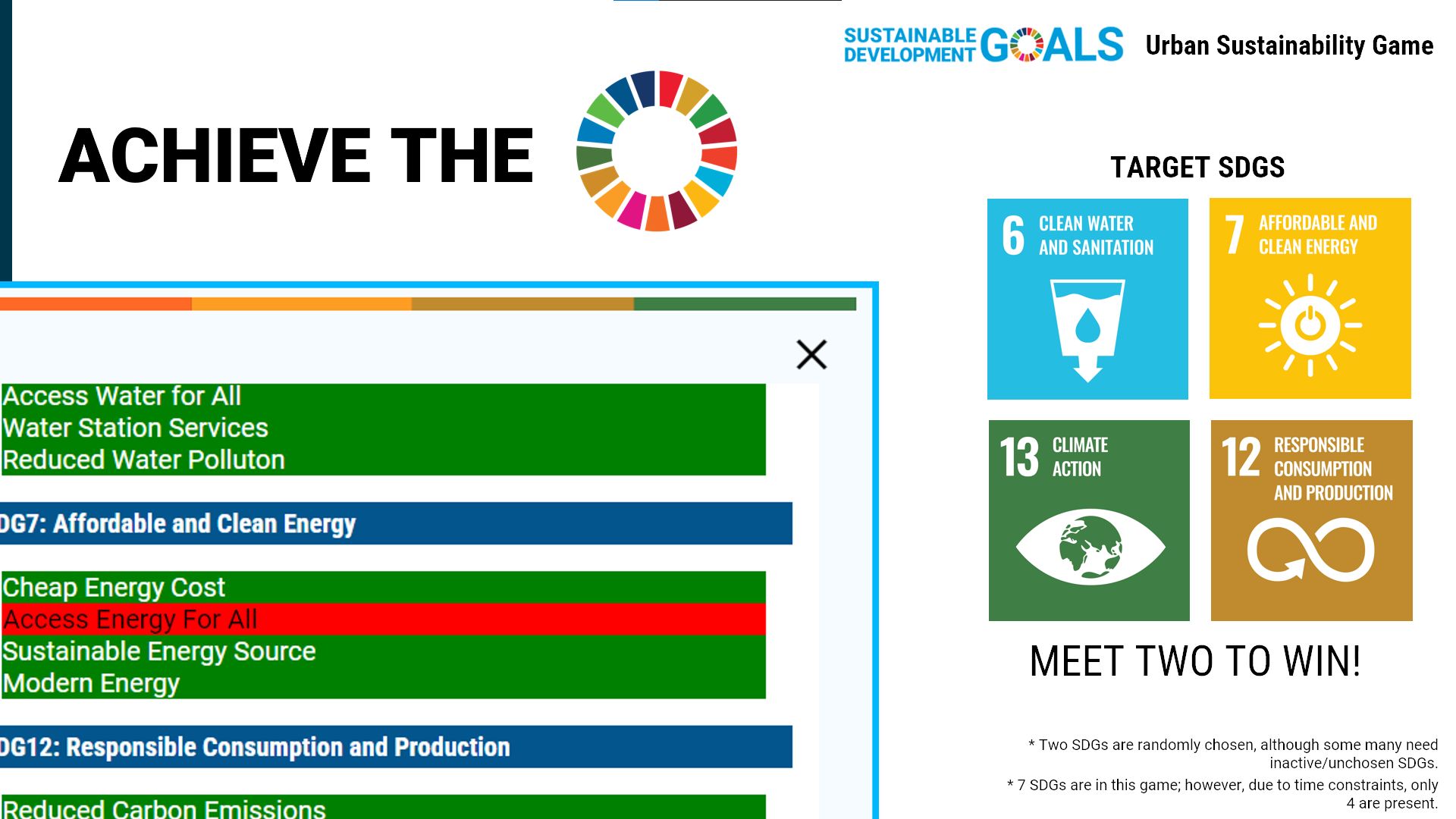
Check your progress on completing SDGs in your Municipal Report!
Inspiration
It all started within my class in AP Human Geography covering Unit 6: Cities and Urban Land-Use Patterns and Processes, way before the hackathon was presented. As an introduction to the unit, we participated in what was called the "Urban Game", a game showcasing the true effects of urban civilization and impacts on the region. After drawing countless numbers of houses and businesses at seemingly the worst possible locations for them (factories were found near homes and businesses) and dealing with overpopulation and overcrowding, I left that class wondering, "Could we have fixed that city somehow to be more sustainable and environmentally friendly? Could we have found a way to remove all those factories polluting the air and the world around us?" Fast forward to a couple months later at the start of April, when I was first introduced this hackathon. Keep in mind that I, nor the team have I assembled, have never done or even heard of a hackathon before, this is 100% our first attempt on trying to make something worthy of a submission. While thinking of ways to promote sustainability through the UN SDGs, I thought of reinterpreting and redesigning the "Urban Game" to not exactly be about urban sprawl. Instead, it's effectively an undo of what the game has done; you are able to form one of the more sustainable and on-track of societies. That's not to say that it was the only inspiration. Many other sources, both games and not games, have also inspired me to design the game the way it is:
- Mini Motorways by Dinosaur Polo Club inspired me to replicate its simple but straightforward UI design, as well as an idea of how I should create the game map. If it's all about figuring out how to get businesses connected, maybe I could find a way to show that sustainably...
- United Nations, what better way to get some design than from the supranational organization themselves.
What we are addressing
Our main problem is not about really the SDGs and the varying progress from all around the world. There is no doubt that progress has been made everywhere to achieve a more sustainable future. Simply put, we believe that the problem arises from:
- Being Unaware: According to The World Economic Fourm, many of the leading countries tend to be less known of the SDGs compared to countries actively participating in them; over 50% of the adults in the US do not know about any goals compared to those in India or Turkey.
- Being an Understatement: SDGs are nowhere easy to get and complete and are expected to take more than a couple months or years with enough funding. Based off the data in UNCTAD, SDGs cost around 5.4-5.7 trillion dollars to implement into our society. While this may seem like a small amount to many major economies, not every place in the world can achieve such level in their economies.
- Going in Reverse: Lately, the SDGs have not gone forward but backwards. According to UNStats, many of the SDGs have been reversing and backing away from the 2030 deadline; this could result in a huge decline in trust of many institutions and put upon more pressure for the years afterwards. If we want to stop this reverse, not only do we take actions to help shift gears to meeting the SDGs, but also getting more people involved in the process.
We believe that the first step for a more sustainable and healthy future is actively encouraging more to cooperate. The first step of awareness is to create awareness, and we are achieving it through a game promoting many of the UN's SDGs, in an environment that many of these effects take place and contribute in; cities.
Our Game
The Urban Sustainability Game allows you to simulate a semi-realistic city with many real world elements. Your goal is simple, meet the randomly selected SDGs and don't go in debt.
- Choose between three various map scales that all have different environments and conditions on meeting the world's SDGs. (For demonstration purposes only the "Town" scale is analyzed.)
- Plan your way through action cards and pick the best ones that could help make your city more sustainable. Should you build some low-tech factories so you can generate more money for higher-tech ones? Should you improve your filtration system while improving electricity access across regions? Get an emergency fund if you can't keep up? It's your choice to plan it out.
- Keep track of yourself through the Municipal Report and analyze your progress on meeting and stretching out from SDGs.
We focus on the following SDGs in order to drive up sustainability in the city:


For this demo, only these four SDGs are mentioned; however, real games would most likely incorporate more SDGs that are related to urban infrastructure and businesses within, as well as branching out to more rural areas (villages).
How we built it
We used GitHub to hold our project and coded mainly in HTML DOM JavaScript.
Challenges we ran into
This is one of our first hackathons to ever submit, and so many problems have rose within the last couple weeks of our project before the submission. We had to balance our life both with our schooltime and our recreational lives, and most of our time was devoted to making this project. We have encountered countless bugs and technical problems creating both the front-end and, more commonly, the back end of our projects (logic on SDGs, creating grid-spaces for our properties, street information, etc.) Additionally, due to the time constraints, many of our ideas that we had planned were ultimately cut out and scrapped, reducing our true potentials from this project. That isn't to say that we didn't encounter problems within our finished product either:
- Many of our intended ideas to help convey more useful information about SDGs were cut off (for instance, we also wanted to add construction periods where services were not available for a certain amount of time as they are realistically being made and integrated into the community)
- Scaling of income and action cards were not adjusted accordingly (you made way more money than the amount you lost); however, meeting SDGs were still something that could be missed with the reasonable amount of time.
Accomplishments that we're proud of
This is our first hackathon submission that we have ever done at all. We don't exactly know how Hackathons work, and this is our interpretation of it. We are proud of making the project within a short timespan, despite both the technical bugs and events that came across which slowed and sometimes halted our project.
What we learned
This is our first Hackathon project, and we learned a lot on how to create and strategize our project with the time we had left. Could we have made our project better? For sure! Even though we may have never accomplished all we wanted, that knowledge and drive for completion could be used for a future competition, possibly with a little bit more time. Game designing is definitely not hard or challenging, but the time constraints had forced us to cut off many of our ideas that could've pushed our game to its limits.
What's next for UNSDG: The Urban Sustainability Game
Depends on how many people choose to play and support this, we might consider finishing up what we had left. Who knows? We hope that this project can bring more light about the SDGs to more people and let them know that they have the power to build towards the SDG as a community. Sure, we may not be leaders of a government or a business, but we definitely can have a say on the future. This game tries to show the real costs of SDGs in both finance and time, not everything can be quickly done for a cheap price within various environments from villages to cities. However, like real SDGs, there are things that could be done for free; all it takes is agreement and cooperation. If we can advocate for more awareness and more community interaction, we may be able to meet SDGs within the given time period. For now, we are looking forward to meeting the SDGs in the years to come!
Citations
- “Global Survey Shows 74% Are Aware of the Sustainable Development Goals.” World Economic Forum, www.weforum.org/press/2019/09/global-survey-shows-74-are-aware-of-the-sustainable-development-goals/#:~:text=Global%20Survey%20Shows%2074%25%20Are%20Aware%20of%20the%20Sustainable%20Development%20Goals.
- “The Costs of Achieving the SDGs: About | UNCTAD.” Unctad.org, unctad.org/sdg-costing/about#:~:text=Cost%20of%20achieving%20the%20pathways&text=The%20resulting%20cost%20estimates%20for.
- Division, United Nations Statistics. “— SDG Indicators.” Unstats.un.org, unstats.un.org/sdgs/report/2023/breaking-through/#:~:text=The%20sobering%20picture%20of%20the. Accessed 2 May 2024.


Log in or sign up for Devpost to join the conversation.