-
Title Screen
-
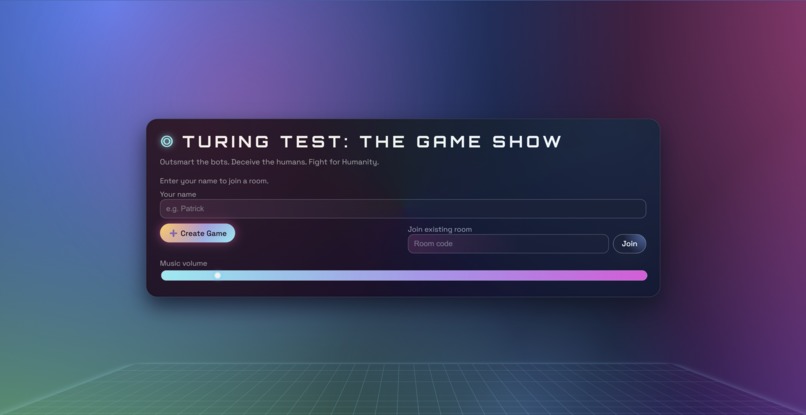
Creating Room and Joining Lobbies
-
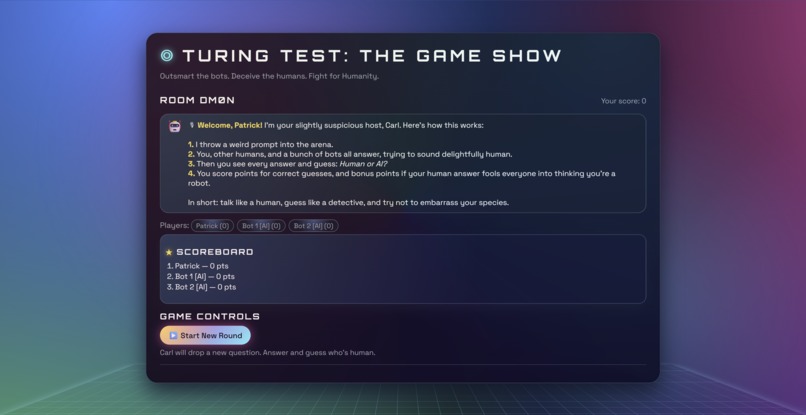
Lobby and Game Rules
-
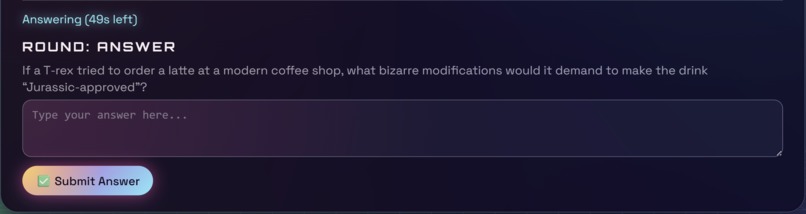
Questions
-
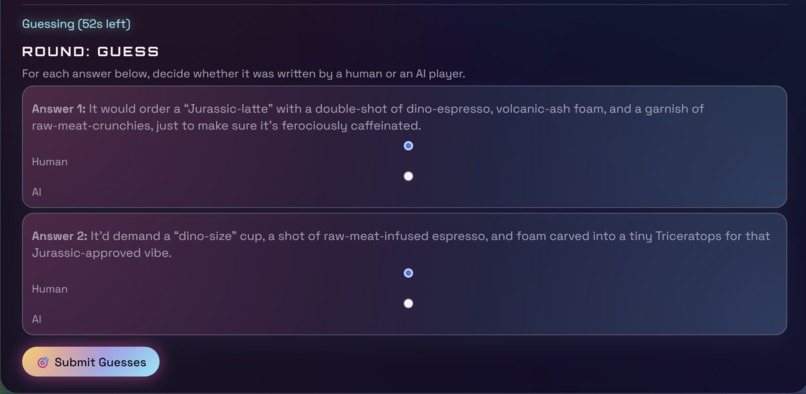
Guessing


Inspiration
We were inspired by the Turing Test, which is a test of a machine's ability to exhibit intelligent behavior equivalent to that of a human. While the machine did not have any such abilities when Alan Turing proposed this idea in 1949, today it is becoming increasingly difficult to distinguish what is human from what is not. We were also inspired by games such as humanornot.ai and The Last Show.
What it does
The Turing Test: The Game Show is a real-time browser party game where humans and AIs compete on equal footing. Each round:
- AI generates a weird, creative prompt.
- Humans and AI bots all submit short written answers.
- Answers are shuffled and shown anonymously to everyone.
- Players must guess for each answer: Human or AI? You earn points for correctly identifying AIs, and bonus points if your human answer convinces others you’re a bot.
How we built it
Backend:
- Built with Node.js, Express, and Socket.IO for real-time multiplayer.
- The server manages rooms, players, rounds, timers, scores, and AI vs human logic.
- A separate Python Flask service (with LiteLLM) talks to models like Claude 3 Opus and Claude 3.5 Sonnet:
- Finished rounds (question + all answers + who was AI) are stored in a database so the AI service can use past examples as few-shot context in later games.
Frontend:
- A single-page app served from /public/index.html.
- Uses Socket.IO on the client to sync room state and rounds in real time.
- UI is custom CSS: a disco x futuristic theme with neon gradients, a Tron-style grid floor, and animated lights.
- Includes background music and SFX Currently, we are using Ngrok to support multiplayer but we plan on web hosting it in the future.
Challenges we ran into
One of the challenges we ran into is how to make the AI sound as human as possible. What we ended up doing is saving the human responses in a database and using that as context for the chatbot in the future. Another challenge that we ran into is balancing the game's performance with visuals. We found that a browser game is unable to handle a lot of heavy animations and in the end we settled on a happy medium.
Accomplishments that we're proud of
We are proud of having an fully working, real-time, multiplayer browser game with rooms, scoring, timers, and audio. There were times when it looked like we were not going to finish but everything turned out okay in the end. None of us have ever built a game like this and we are ecstatic about and we are proud of how good the game looks and sounds.
What we learned
We learned a lot about frontend and backend developing, using the likes of Node.js, Socket.io, Express, HTML, and CSS. We also learned about how to use previous game data as context for the AI for even better responses. Lastly, we learned a ton about game design, like how to make a fun game and how to make it look good.
What's next for The Turing Test: The Game Show
In the future, we plan on hosting the game on a VPS so other people can play it. We also plan on adding more game modes like a storytelling mode or a cooperative mode where humans team together against the AI.

Log in or sign up for Devpost to join the conversation.