-
-
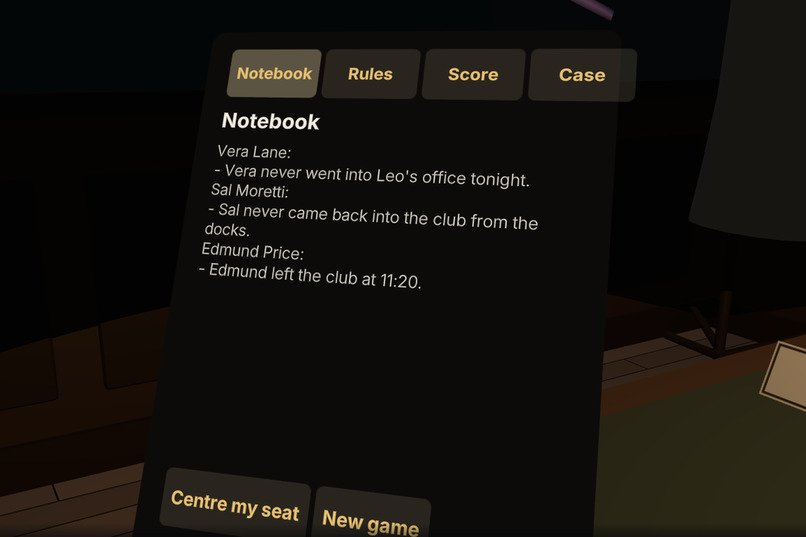
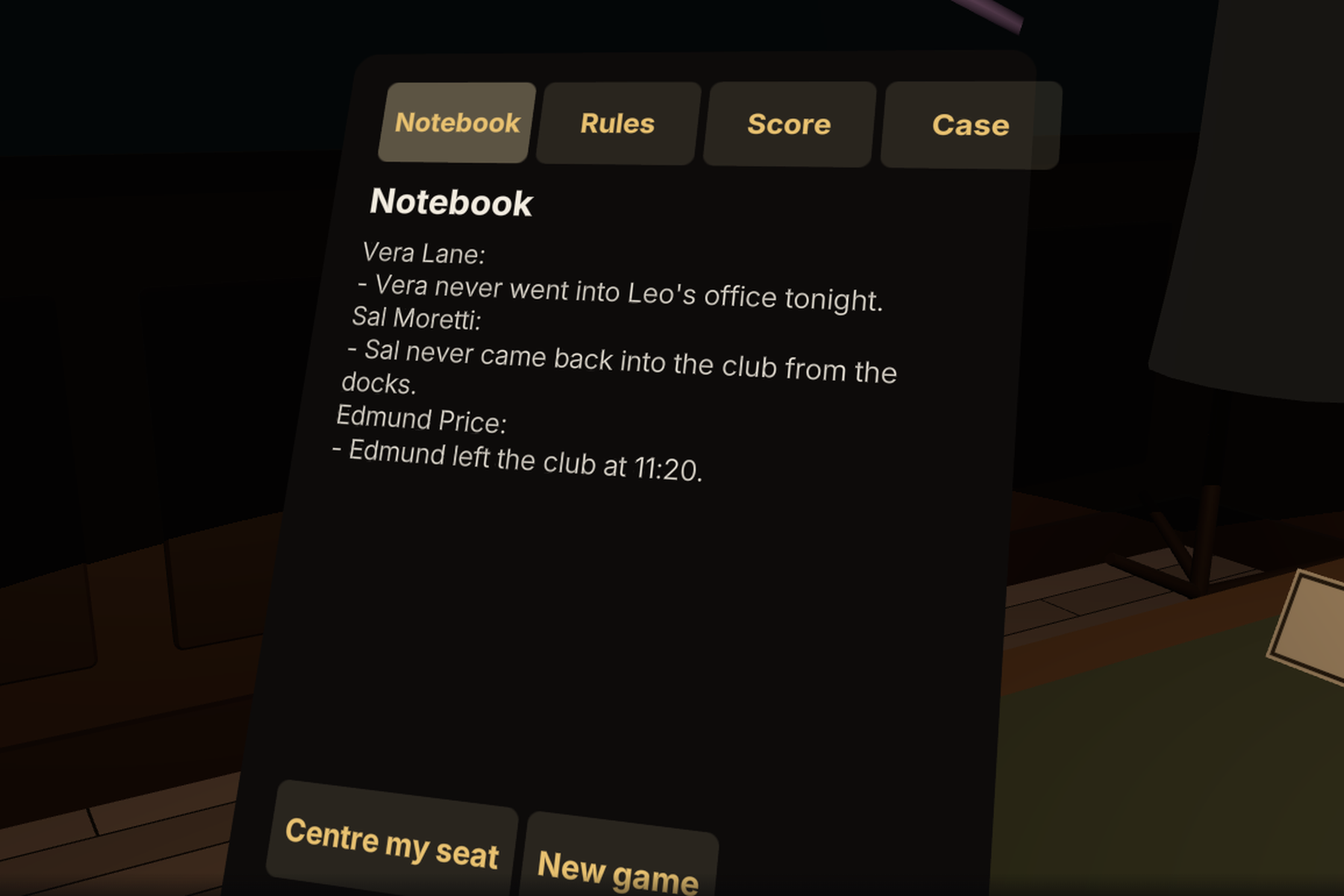
The notebook in your case folder writes down every claim each suspect makes.
-
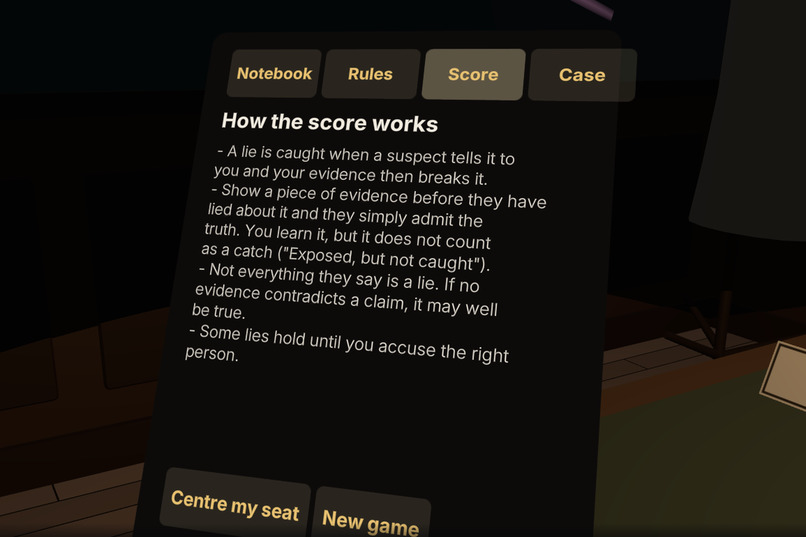
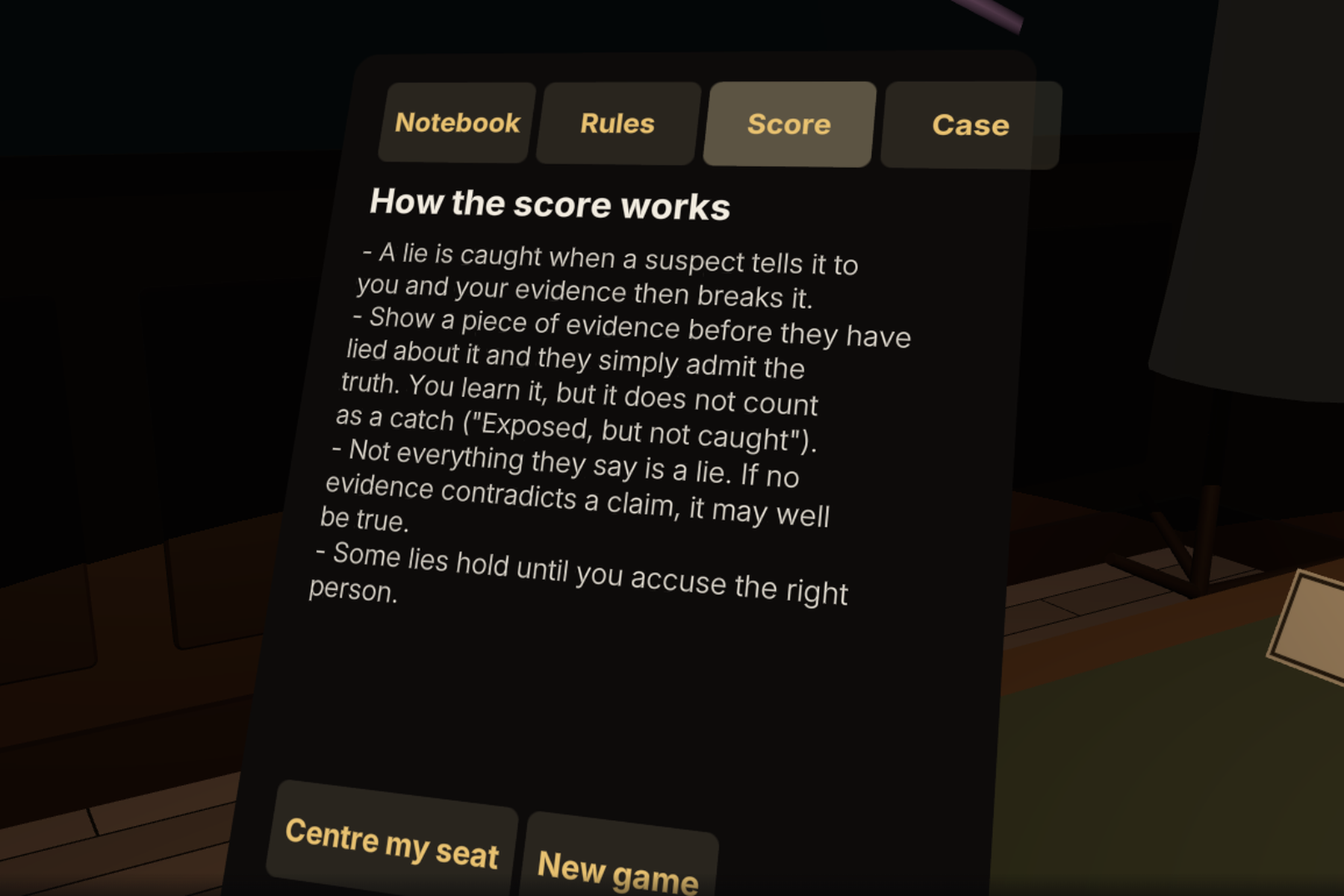
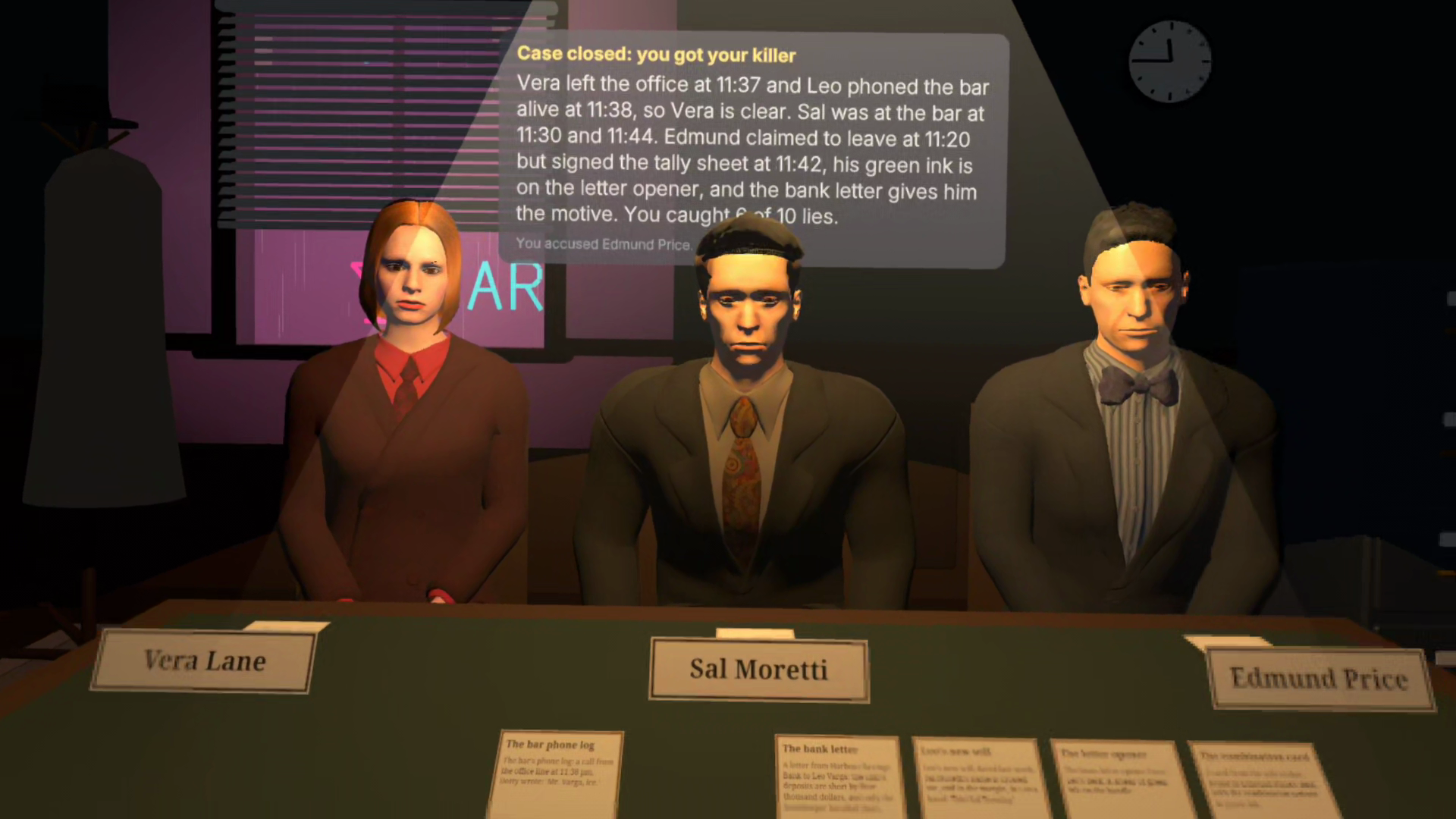
How the score works: a lie only counts as caught if they told it before you showed the evidence.
-
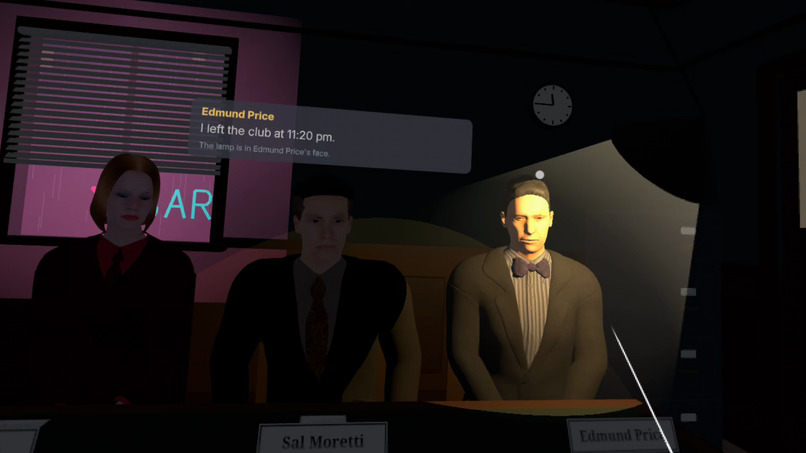
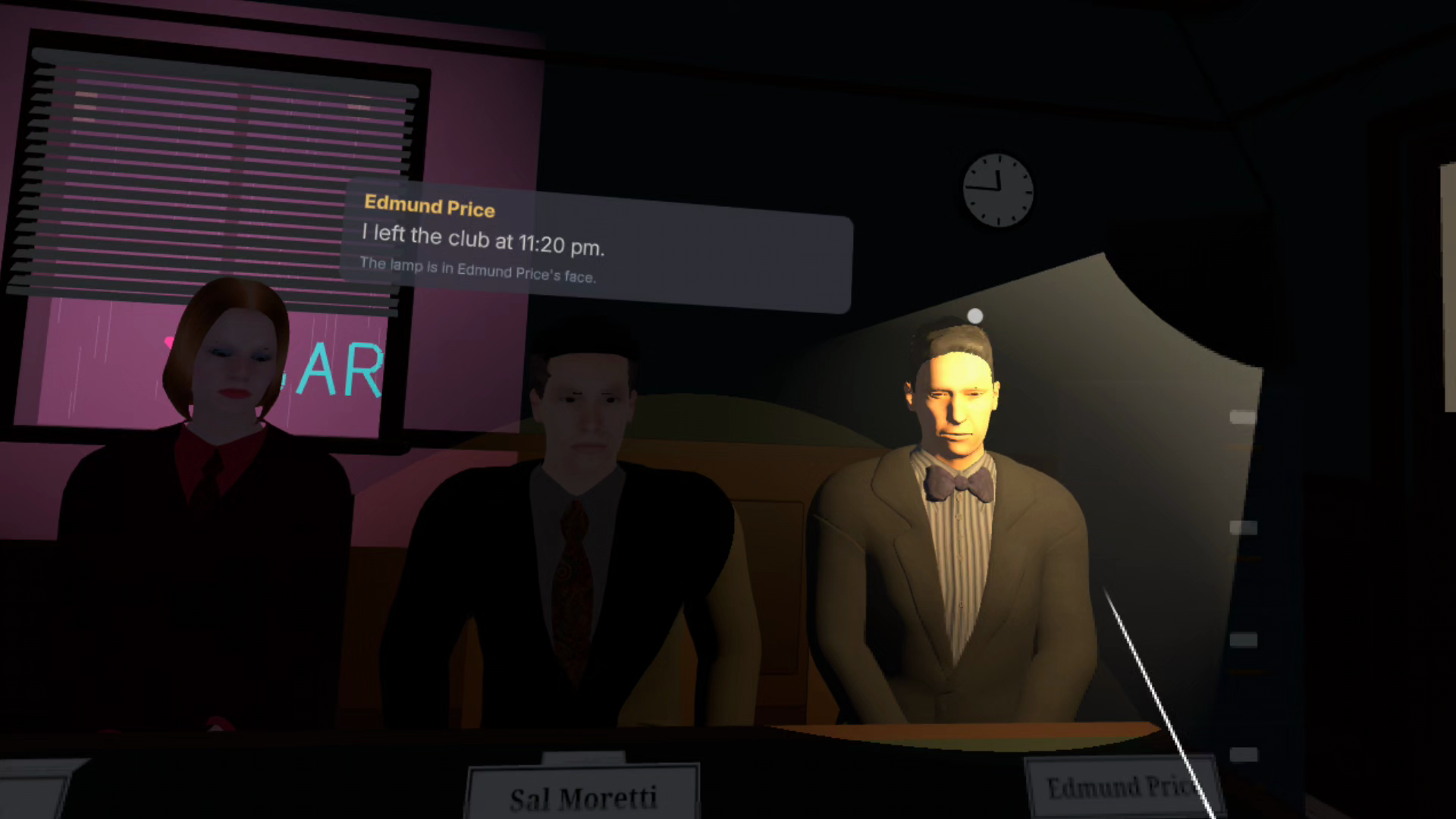
Turn the lamp on a suspect and the rest of the room falls dark.
-
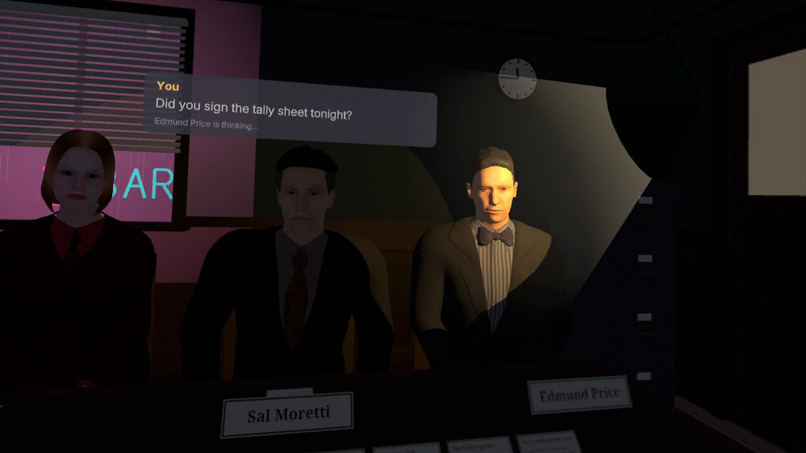
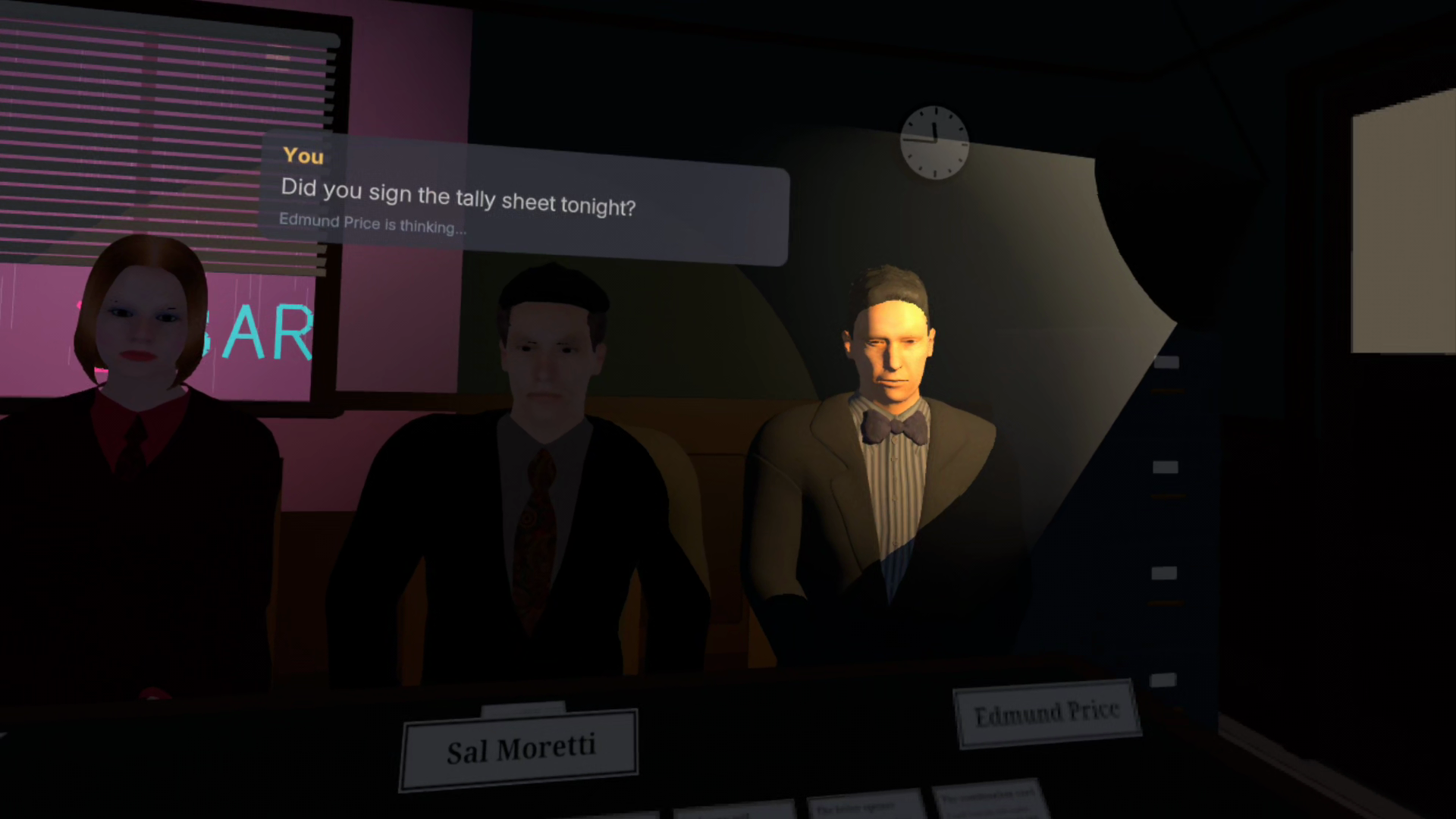
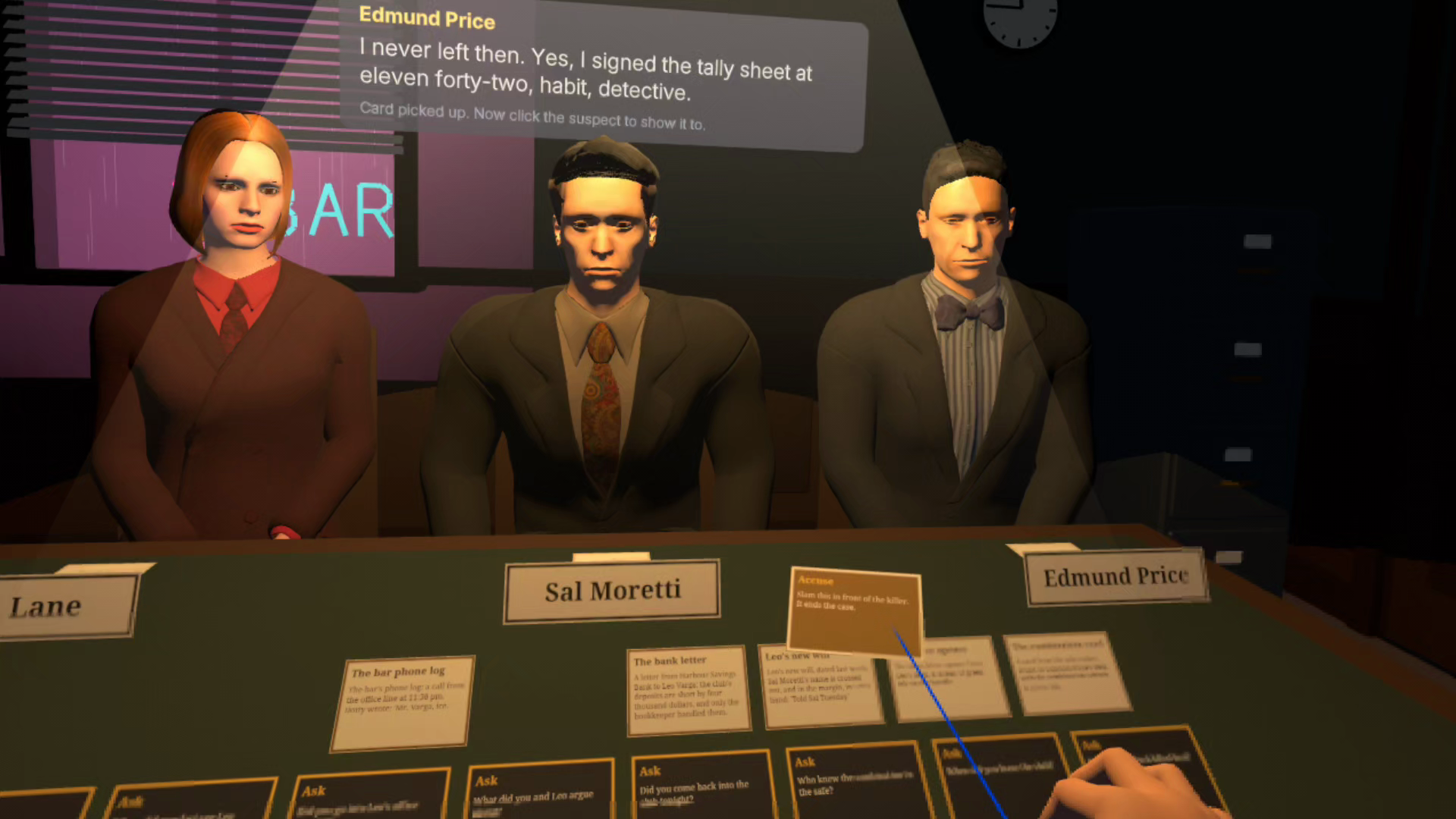
Ask anything in your own words. Here the detective asks Edmund out loud about the tally sheet.
-
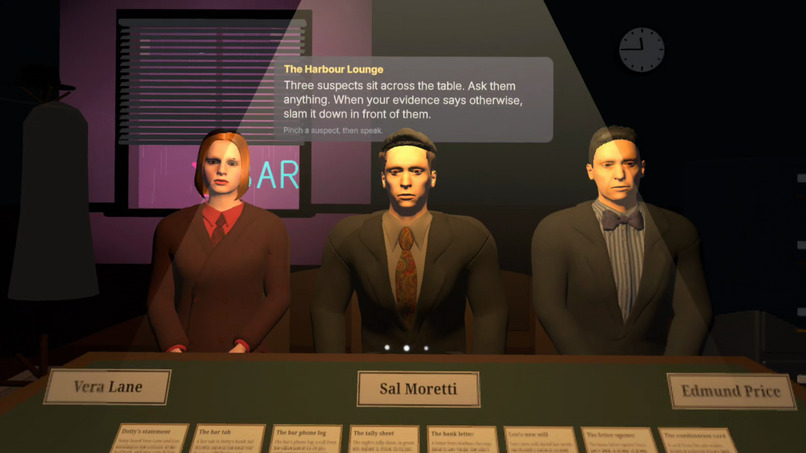
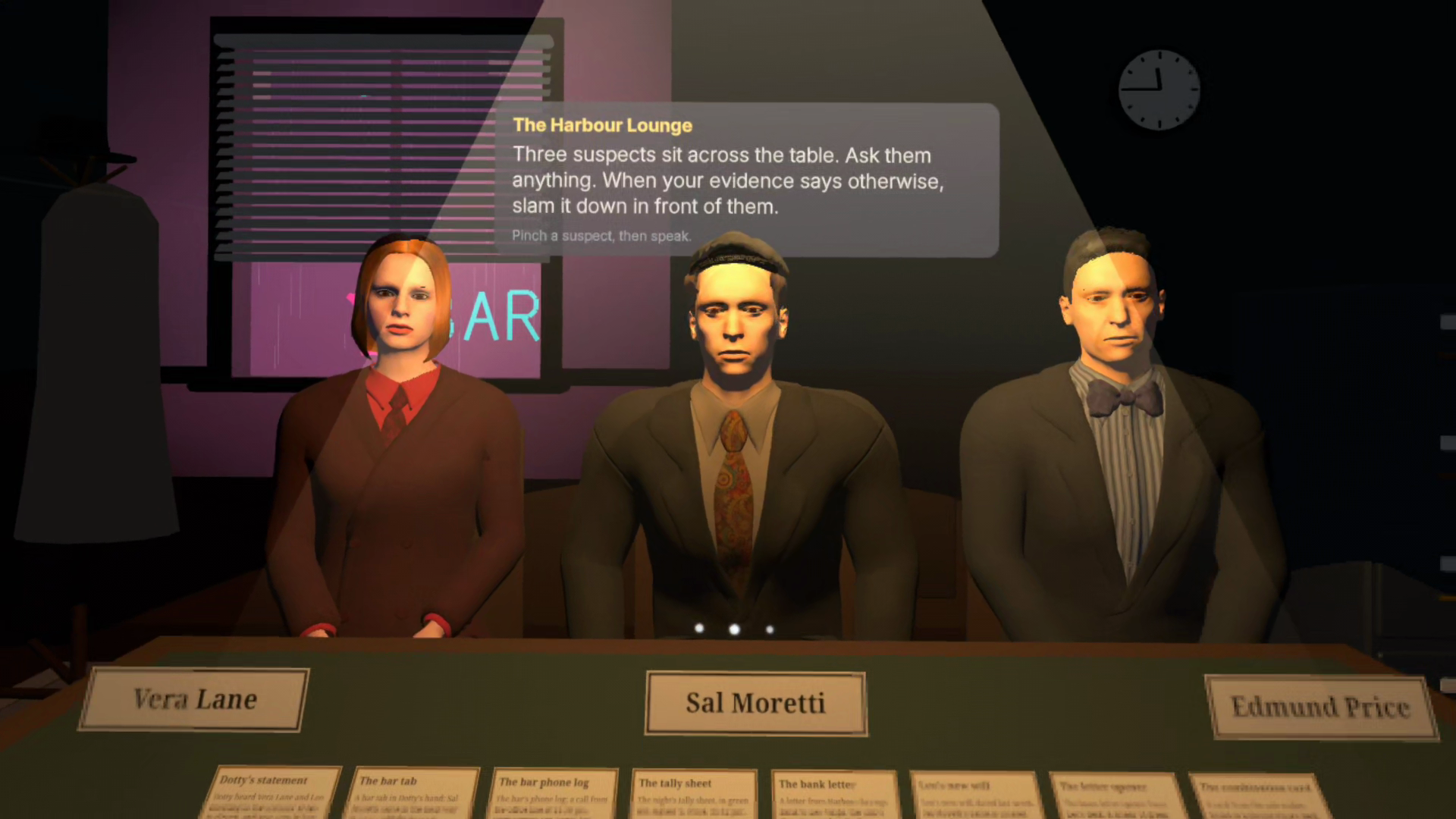
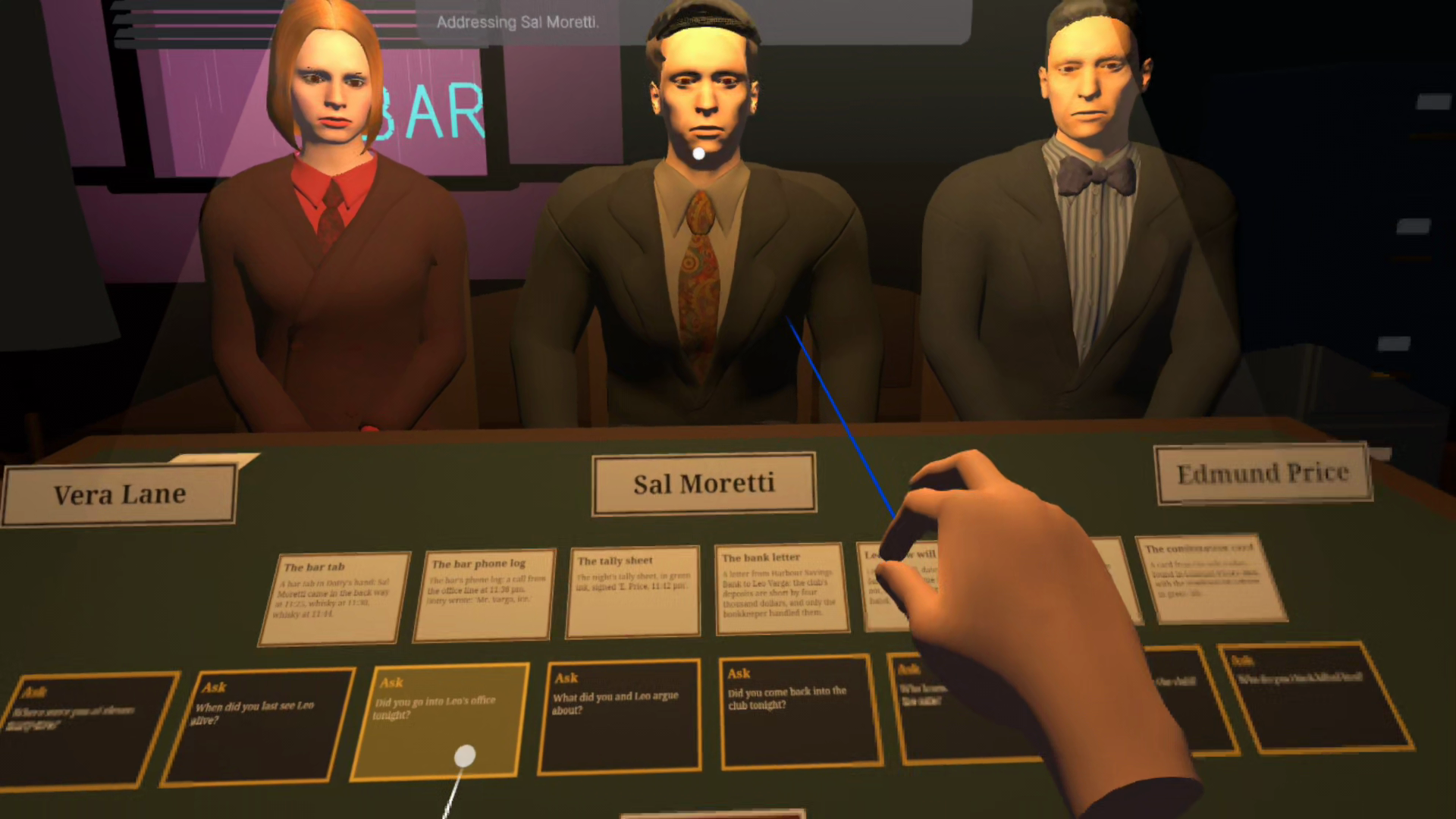
Three suspects across the table. The evidence and question cards are laid out in front of you.
-
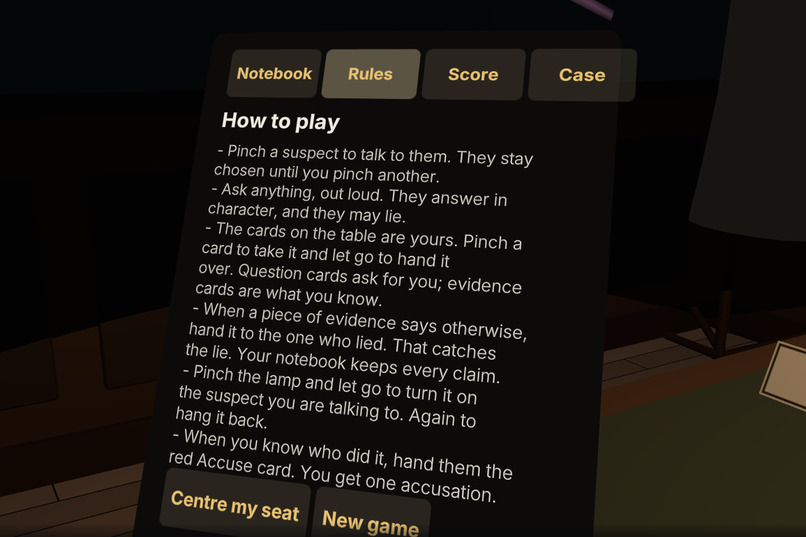
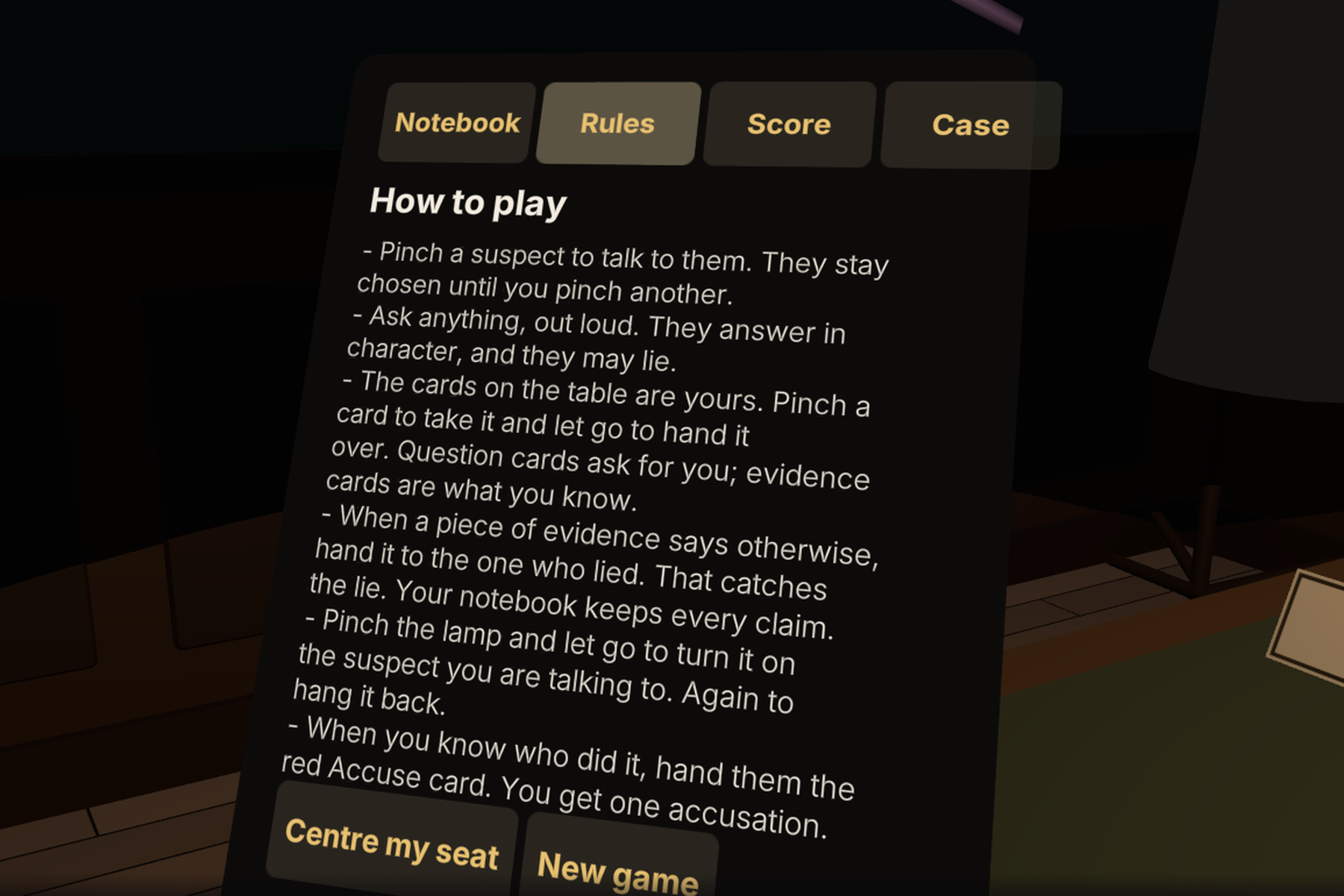
How to play, inside the headset: pinch a suspect, speak, hand over cards, use the lamp.
-
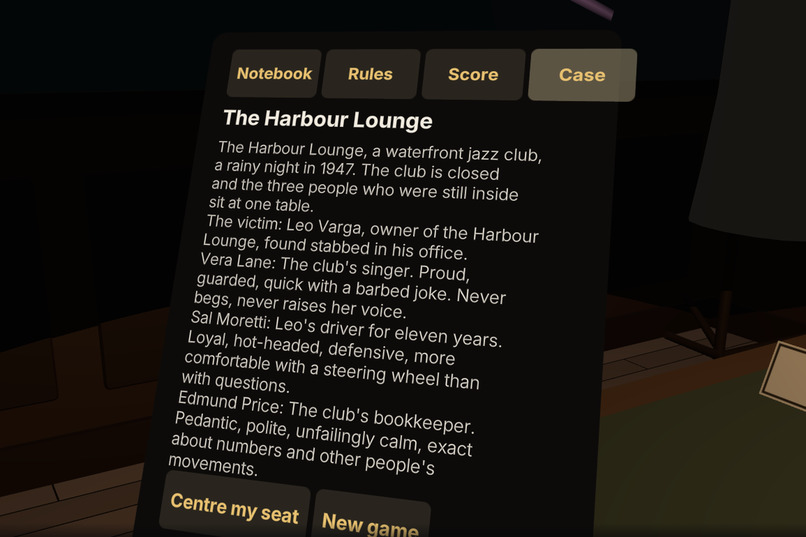
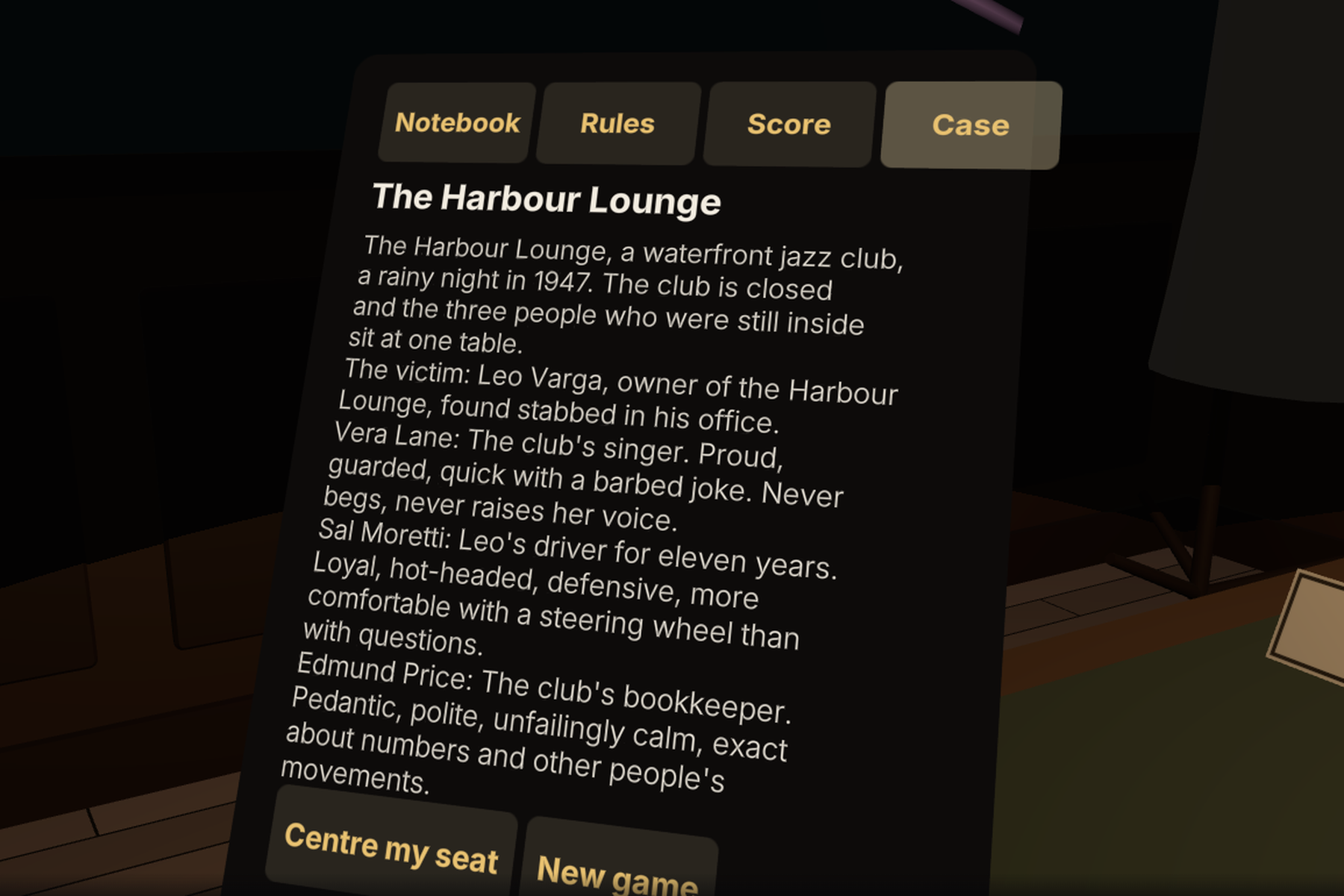
The case file: the Harbour Lounge, 1947, the victim and the three suspects.
-
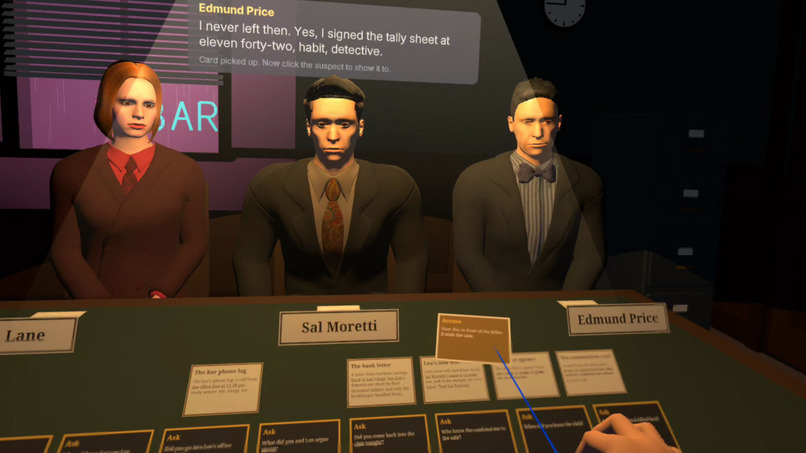
The evidence breaks the lie. Edmund admits he never left and signed the tally sheet.
-
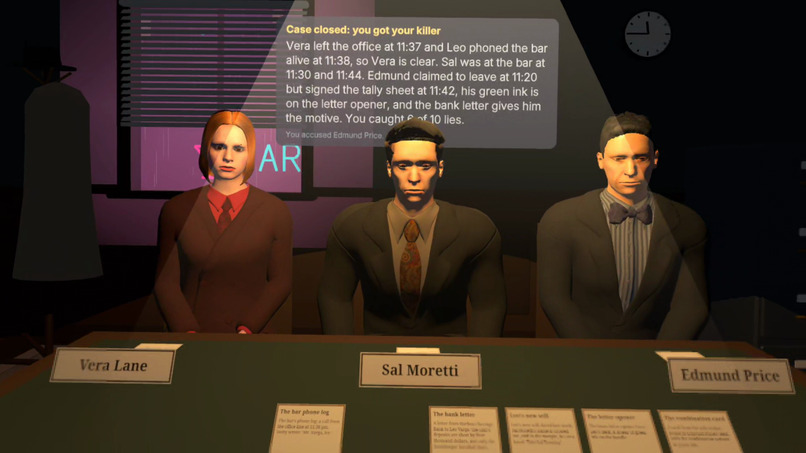
Case closed. The game shows what really happened and how many lies you caught.
-
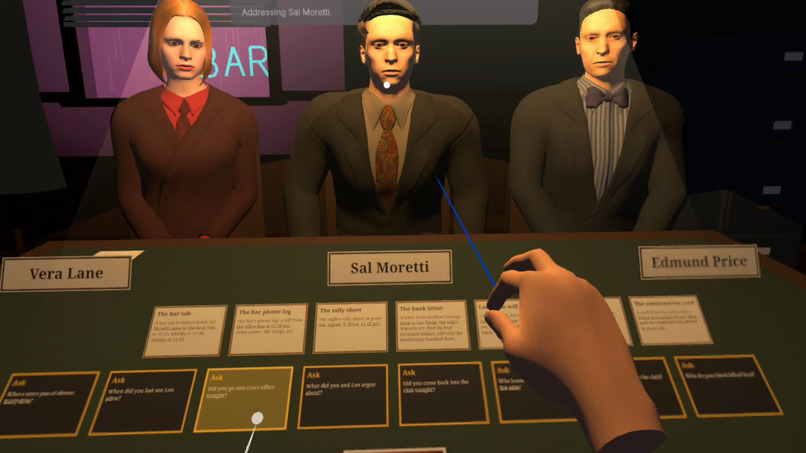
No controller. Reach out, pinch a card to take it, and let go to hand it to a suspect.
Inspiration
Every detective game has the same weakness: the suspects are written. Play long enough and you learn the dialogue tree, not the people. We wanted suspects who answer anything you ask, out loud, in their own voice, and who lie to you the way people do: improvising and adapting to what you just said.
The problem is that an AI allowed to lie will happily cheat. It invents a new alibi, contradicts the evidence on the table, or makes the case unsolvable. A mystery is only fun if it is fair. So the real question behind The Tell was: can you give an AI the freedom to lie, and still guarantee the game never cheats?
What it does

The Tell is a seated noir interrogation for Meta Quest. It is 1947, it is raining, and the owner of the Harbour Lounge jazz club has been stabbed in his office. Three people were still inside, and they are now sitting across the table from you.
The whole game is played with your hands and your voice. No controller is needed, and you can play it without speaking at all by using the cards.
- Pinch a suspect and speak. Ask anything in your own words; there is no dialogue tree. They hear you and answer in character, in their own voice. The voice comes from their head in 3D space.
- Or use the cards. Question cards on the table are there if you would rather not speak.
- Hand over the evidence. Pinch a card to take it and let go to hand it to the suspect you are talking to. If it breaks one of their lies, you see them crack.
- Turn the lamp on them. Pinch the lamp and it swings into the suspect's face. The pressure changes how they talk, never what they are allowed to say.
- Watch their bodies. Vera's eyes slide away, Sal shifts in his chair, Edmund swallows. A tell is a hint, never an oracle: liars show it most of the time, and honest people under pressure sometimes show it too.
- Name the killer. Your case folder keeps a notebook of every claim each suspect has made. When you are ready, you accuse, and the game shows you the truth.
No two interrogations are the same, and every one is solvable from the evidence alone.
How to play
- Open the game in the Meta Quest browser and press Enter VR. Allow the microphone when asked.
- Sit down. The three suspects are across the table from you.
- Ask out loud: pinch a suspect, then speak. They stay chosen until you pinch another.
- Use the cards: pinch a card to take it and let go to hand it to the suspect you are talking to.
- Lean on them: pinch the lamp to turn it on that suspect. Pinch it again to hang it back.
- Check your notes in the case folder on your left, and hand the red Accuse card to the killer when you are sure.
A full case takes 15 to 25 minutes. The game also runs in a desktop browser with keyboard and mouse.
How we built it
Each suspect is an AI agent with its own secrets and its own plan. On every turn it runs in two stages:
- Plan. The suspect sees the whole interrogation, its own secrets, the evidence on the table and how much pressure it is under. It decides which facts to admit, which to deny and which to dodge.
- Speak. A second call turns that plan into words, in the character's voice, without ever seeing the full truth. It cannot leak what it was never shown.
Between the two stages sits the truth ledger, which is code, not a prompt. The case is a set of facts, and each fact records who knows it and who may lie about it. Every plan is checked against the ledger before a word is spoken. A plan that invents a fact, contradicts evidence already on the table, or confesses too early is rejected and regenerated with the reasons. If it fails twice, the suspect falls back to a written deflection. A suspect is never silent and never allowed to break the case.
The tells are decided by code after the line has passed the ledger, and the headset receives only an animation cue. The AI is free to lie, but the body is honest by design. The odds are tuned so that the tells reward watching without solving the case for you. A lie shows the suspect's tell 70% of the time. An honest line shows it 5% of the time, rising to 25% as the pressure on the suspect grows, because nerves look like guilt. And the killer's denial of the crime itself shows a tell only 35% of the time, so the culprit is the hardest one to read.
The stack: WebXR on Meta's Immersive Web SDK, so the game runs from a URL in the Quest browser with nothing to install. A Python server runs the ledger and the agents over a websocket. The suspects run on gpt-oss-120b on fast inference hardware, so a suspect's answer is written in about a second and you hear it within about two. Voices are generated sentence by sentence, in parallel, with lip-sync driven by the phonemes. The characters are built with MPFB and their textures are compressed in KTX2, so they take a fifth of the texture memory they would otherwise need.
Challenges we ran into
- Making a liar consistent. Our first version asked one model to hold the truth, the lie and the dialogue at once, and it kept saying things it should not. Splitting planning from speaking fixed most of that. Measuring the rest was harder than fixing it: when we switched from a lenient AI auditor to a strict one, our passing score turned into a failing one. We kept the strict auditor. Under it, with everything else equal, the ledger cut contradictions from 24 to 13 in 240 lines and invented facts from 52 to 17. The model we ship made 9 contradictions in 240 audited lines and did not confess early once.
- Speed. An interrogation dies if the suspect thinks for four seconds. We measured every model we considered on time to a finished line, not just on quality, and chose the one that answers about twice as fast as the runner-up.
- The Quest itself. Three human characters, a lit room and live voices in a browser had to hold frame rate. We profiled in the headset and it holds about 85 fps (median) on Quest 3 with hand tracking.
- Hands only. Everything had to work without a controller and without a button. You pinch the suspect you want and speak, and you pinch a card or the lamp to use it.
What we learned
The interesting part of an AI character is not that it can talk. It is that you can trust what it is allowed to say. Constraints enforced by code, not by prompts, are what turn a chatbot into a game. We also learned to distrust our own measurements: the most valuable result in the project was the one that told us we were wrong.
What's next
More cases. A second case, Last Call, set three weeks later in the same club, is in testing. After that, a case editor, so anyone can write a mystery and the ledger keeps it fair. We are targeting a public launch in Q1 2027.
Built With
- blender
- caddy
- cerebras
- elevenlabs
- fastapi
- gpt-oss-120b
- groq
- iwsdk
- ktx2
- meta-quest
- mpfb
- openai
- openrouter
- python
- spacy
- three.js
- typescript
- ubuntu
- vite
- websockets
- webxr
