-
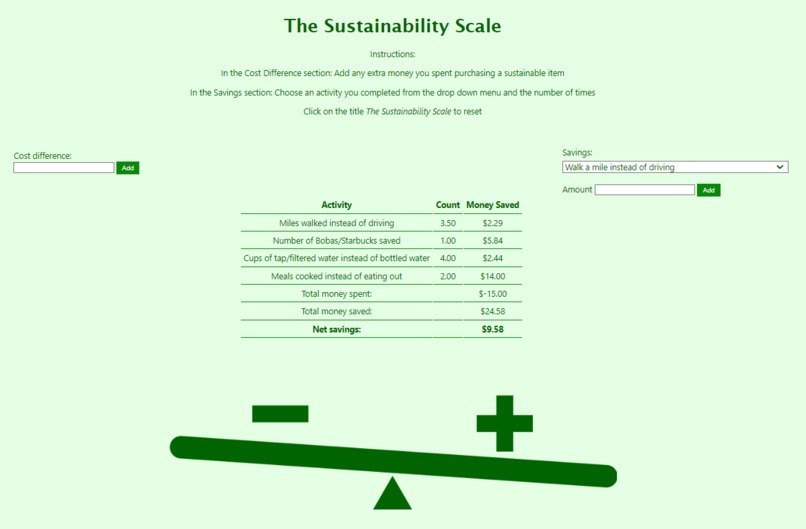
An image of the Sustainability Scale after user inputs

Inspiration
The number one reason why someone may not choose to live sustainably is because they think choosing sustainability is more expensive. Often, products marked as “sustainable” or “eco-friendly” are marked at a higher price than some less sustainable items. For example, while a typical plastic toothbrush will only cost $1, an eco-friendly one may cost around $5. This leads people to believing that choosing to be environmentally sustainable is not financially sustainable. Our app, The Sustainability Scale, is looking to change this perception of sustainability.
What it does
Our web app The Sustainability Scale helps users save money while making environmentally sustainable choices. When users purchase a “sustainable” or “eco-friendly” item, they will input the extra money they spent from choosing sustainability into the app, and the scale will tip towards the left, showing a net loss in money. Then, users can select from a drop down menu of environmentally friendly tasks to accomplish, such as walking a mile to save gas money, or drinking tap water instead of bottled water. By completing such daily tasks, the user can watch the scale tip towards the right as the net savings become positive. Through our app, we hope to show that making sustainable choices does not necessarily mean an expensive lifestyle, but rather it can prove to help save even more money.
How we built it
We built the web application using the Flask framework in Python for the backend, and we used HTML, Javascript, and CSS to design the frontend, with our graphics done with EaselJS. We utilized Git to simultaneously collaborate on different features of the project.
Challenges we ran into
The first big challenge was figuring out how to animate the scale in our web application. We didn't have a lot of experience with web application graphics, so it creating the scale with EaselJS was a new and difficult task. Another problem we ran into was how to send data between the backend and frontend. We first tried using SocketIO, but after experimenting, we found that using Flask routing to handle POST requests was the most seamless with EaselJS. The last major problem was creating a formula to calculate how the scale should move to allow the user to input any value. The scale does not move by a constant amount, but rather by a percentage depending on what the user inputs.
Accomplishments that we're proud of
We are proud of creating a working web application in less than 24 hours. It was stressful at first in the early stages, and we doubted if our project idea was feasible, but being able to see our vision through and come out with a working product is amazing.
What we learned
We learned how to pass data between the backend and frontend of the web app using form submission and Flask routing. We also learned how to design UI, as we had little to no experience with EaselJS, HTML, and CSS.
What's next for The Sustainability Scale
There are many ways we can expand upon The Sustainability Scale. The current data we use for prices are averages we obtained through research, but to increase accuracy, we could attach a database for the data and allow for user input to increase the customizability aspect of our app. Additionally, we hope to turn The Sustainability Scale into a mobile app for the ultimate user experience and convenience.


Log in or sign up for Devpost to join the conversation.