-
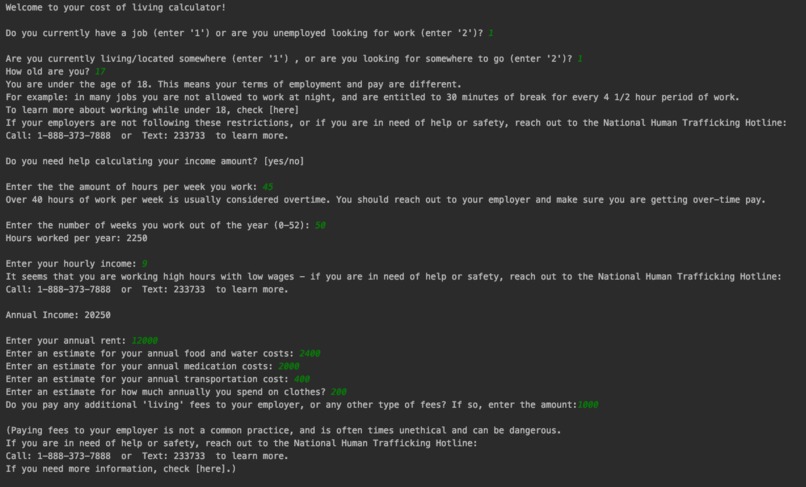
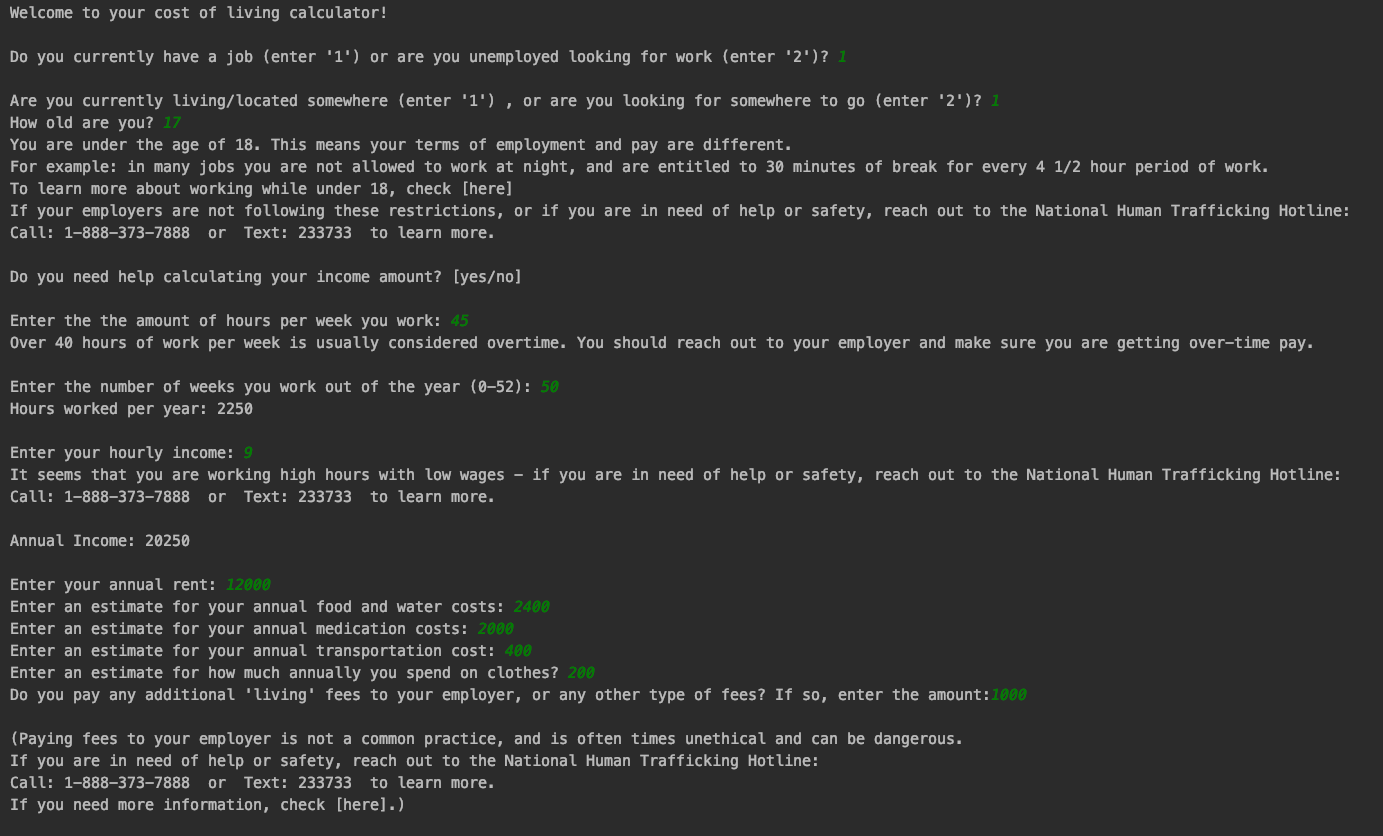
Sample output
Inspiration
This project was inspired by my teammate Catherine’s personal anecdote, with a former boss when she was underpaid:
“Most people, when they want a job, do not bargain correctly with the manager because they have no idea of their real needs. They will often underestimate and undersell themselves in order to get hired. If you want money, then do not settle for anything less or anything else. Not the company car, not flex time, not the corner office or casual day for you every day of the week. If you want money, you need to walk in with a certain number that you will not go below as an hourly rate — and be prepared to walk out. The most powerful word you have is the word ‘No!’ Without it, you are just someone else’s “yes-man”. So you must have reasons to back your “No!”. The value-method of your time I am giving you will help with that. You are not here to be liked, you are here to be paid. Give me three pages of paper, and I will show you the difference between an opulent life, a comfortable existence, and survival.”
The three pieces of paper were lists (different for everyone) of what we thought was important financially. The survival list had costs like “annual rent”, “annual food”, “medication”, “transportation”, “emergency visit to the hospital via ambulance”. Comfort meant “a dog/cat to feed with vet bills”, “better clothing to move through society”, “extra food”, and “personal car vs. public transportation”. For the opulent lifestyle, he showed us a magazine in print back then where things like Castles, English Lordships, and Private Jets were advertised in the classifieds.
Taking the final numbers for the annual salaries on the three different lists, he divided them all by 2000 hours to get his hourly target wages to negotiate for during the course of an entire year for each of the three categories (survival, comfortable, and opulent). He knew his personal minimum wage needed escape wage-slavery in any given geographic area or social circumstance. More importantly, everyone he taught saw how little hard cash it took to successfully jump lifestyle categories or tumble.
- Physical requirements for “Survival” needs that many close to that status lack are steady access to clean water, food, shelter, sleep, clothing, medical help, and reproduction rights.
- Most endangered workers are strategically deprived of at least three things on this level by management — deliberately — so that they cannot leave their situation.
- To be “Comfortable” goes well past “Survival” by addressing safety, employment, resources, health, and property.
- Monetary “Opulence” is fluid. After “Comfortable” wants have been answered, Opulence varies from person to person based on individual taste and access to options.
What it does
The Survival Calculator takes multiple inputs, such as an individual’s current income, working location, and age, and helps them calculate their budget and ideal salary for the different levels: survival, comfort, and opulence. If the individual does not meet the income requirements for basic survival needs, help is given to lower their budget or increase their income. If they do meet basic survival needs with money left over, additional “comfort” expenses are taking into consideration when making their budget.
If an individual is out of either an income or place to live, the calculator will help them find a job with an hourly or salary income, and combine that information with location data to find an affordable way of life.
Throughout the use of the Survival Calculator, there are checkpoints that may flag circumstances involving human trafficking or slave labor. For example, if a high number of hours worked per week combined with a low hourly pay is present, a flag will appear indicating to the user that this might be an unethical situation and resources for help and information are offered.
Additional examples of this are if a user enters an age below ‘16’ and indicates that they are looking for a job, place to live, or both. Resources for emergencies or urgent needs, as well as human trafficking hotline information will be listed.
How I built it
The Survival Calculator is built solely in Python, with no additional libraries or imports needed. It was written in the IDE PyCharm.
Challenges I ran into
Time constraint.
Accomplishments that I'm proud of
Everything!
What I learned
I learned that calculating information solely on just how to survive is a more difficult and complicated task than I originally thought. I imagined how stressful and disheartening it could be to find all of this information and make these calculations by oneself without any help. As I was working, I was constantly thinking of additional variables and scenarios to be considered in the calculations!
What's next for The Survival Calculator
There are a few things coming up for the Survival Calculator.
First, more variables and scenarios are going to be added, to account for as much flexibility in use as possible.
Next, creating a GUI to make the calculator easier and more intuitive to use.
Finally, we want to make it available for public use. Either accessible on mobile device applications, or having a hosted website for users.
Built With
- pycharm
- python


Log in or sign up for Devpost to join the conversation.