-
-
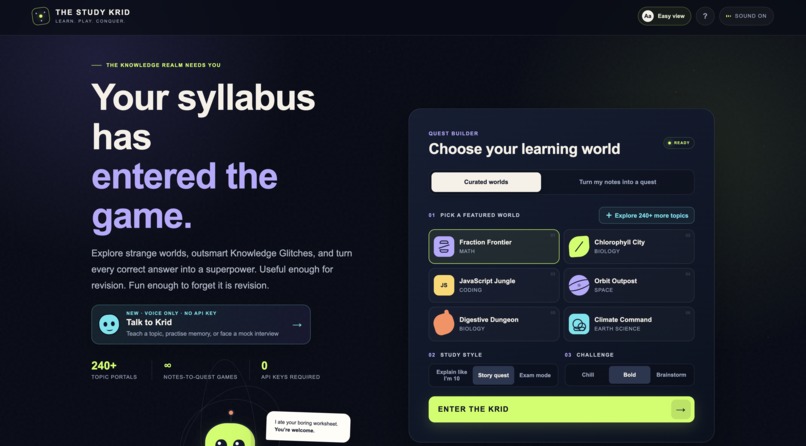
The Study Krid game app
-
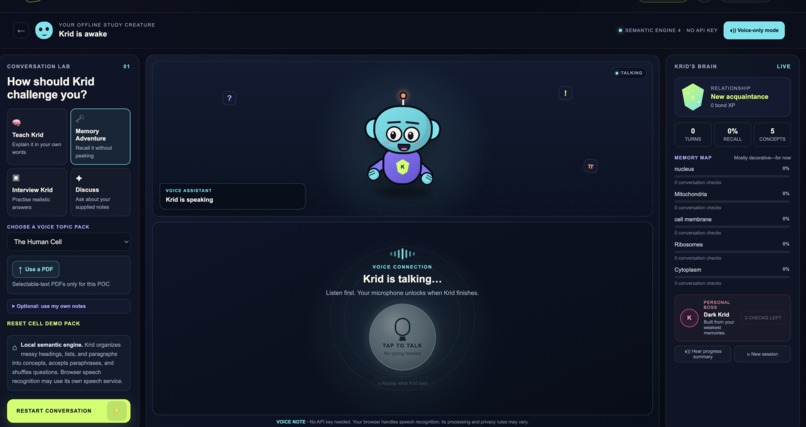
Meet Krid
-
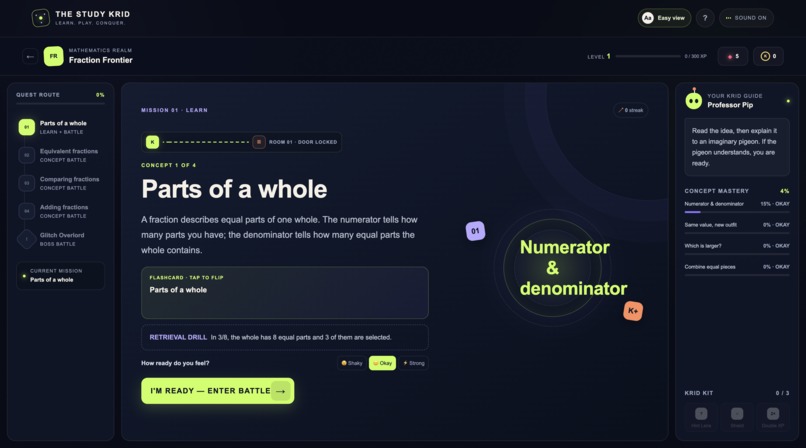
The quiz quest
-
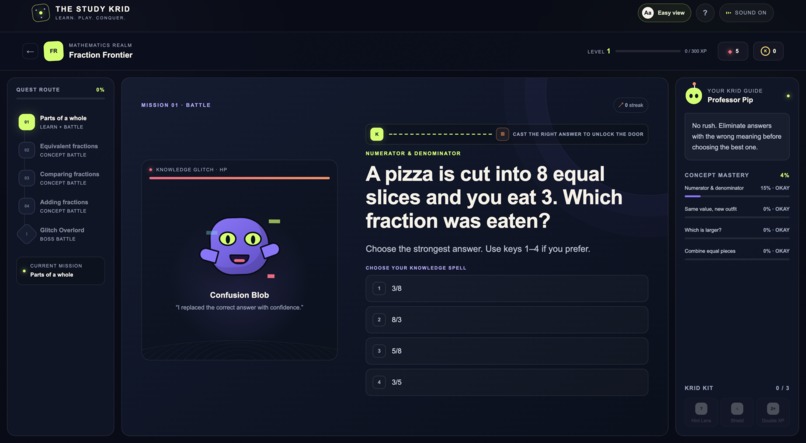
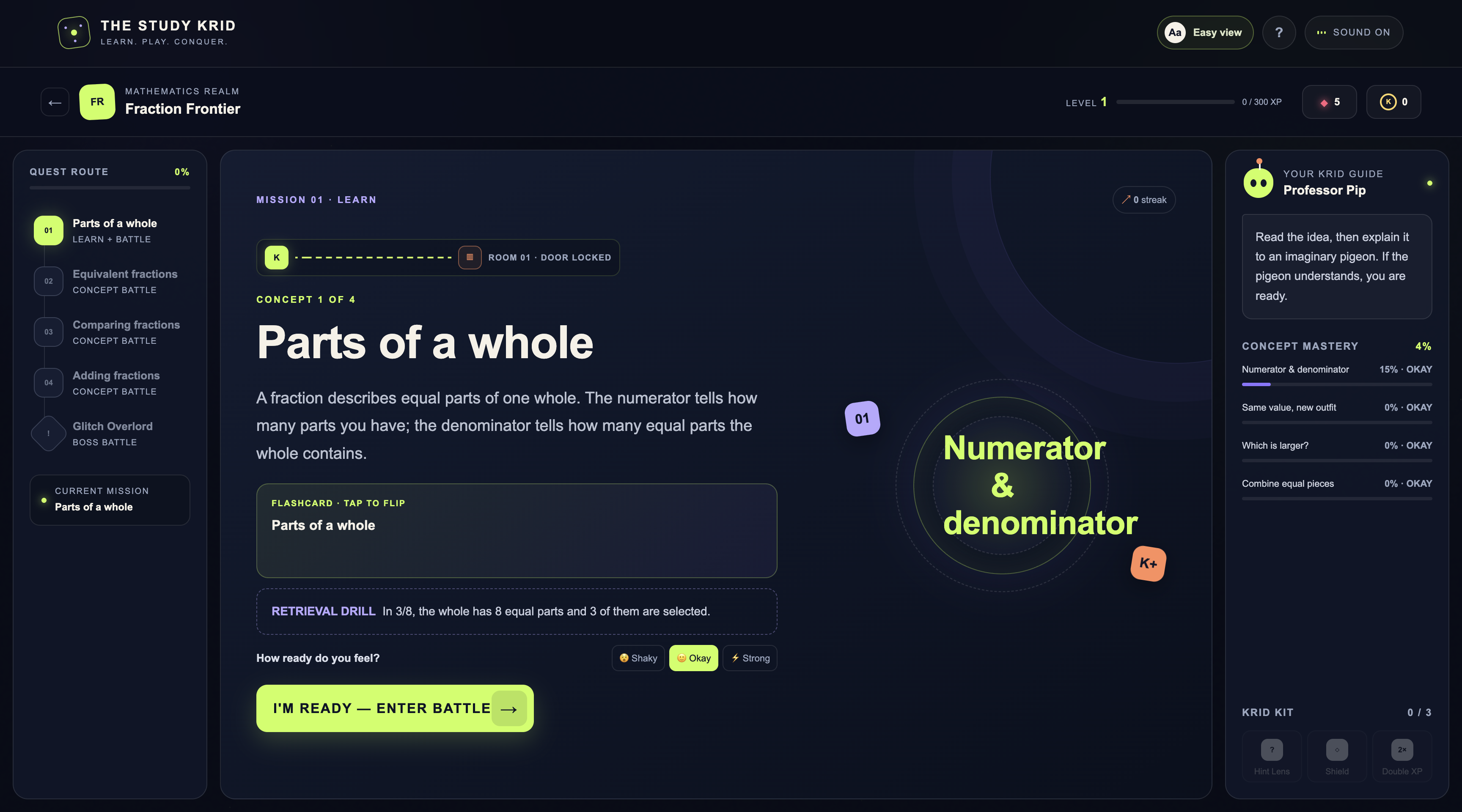
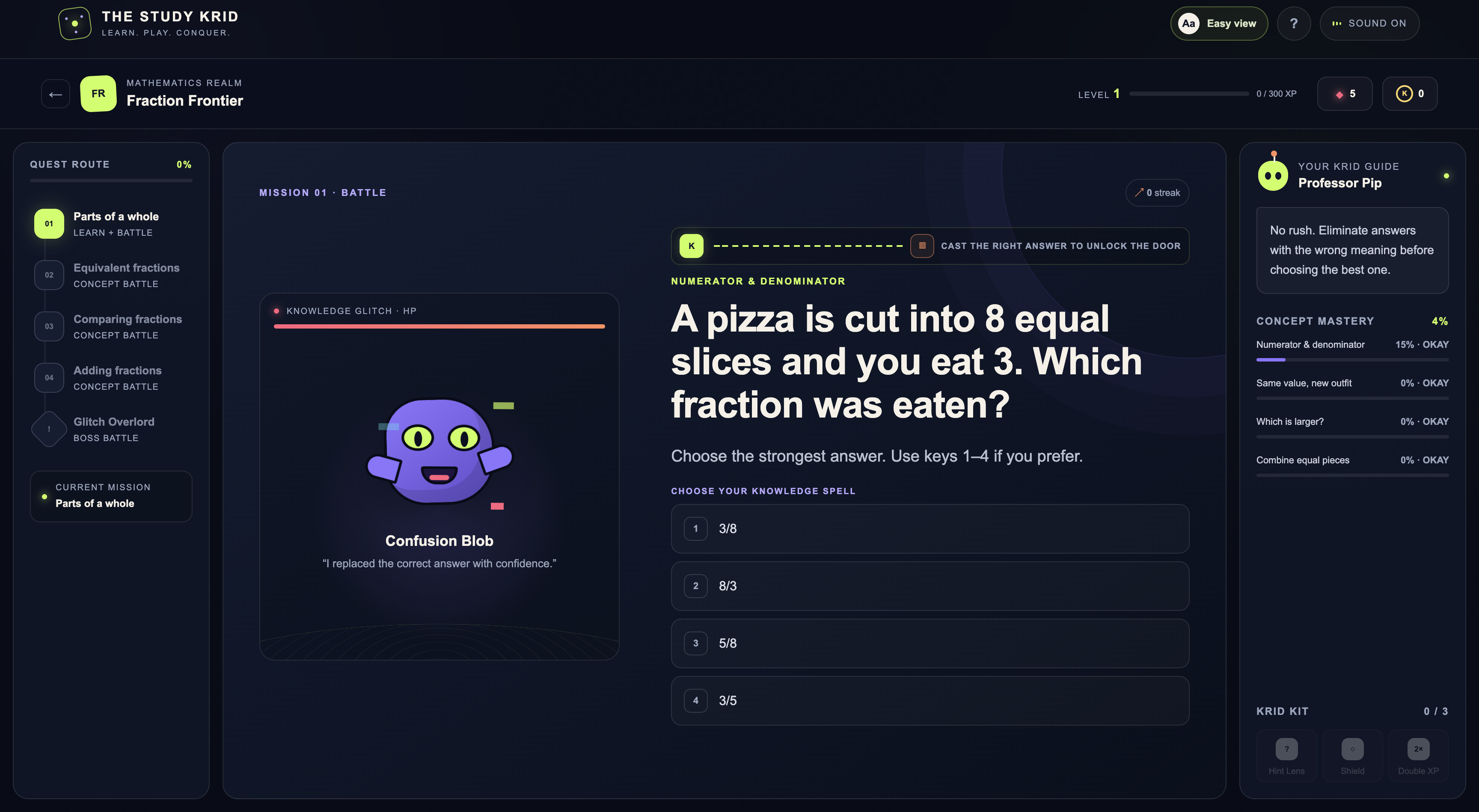
The interactive quiz
-
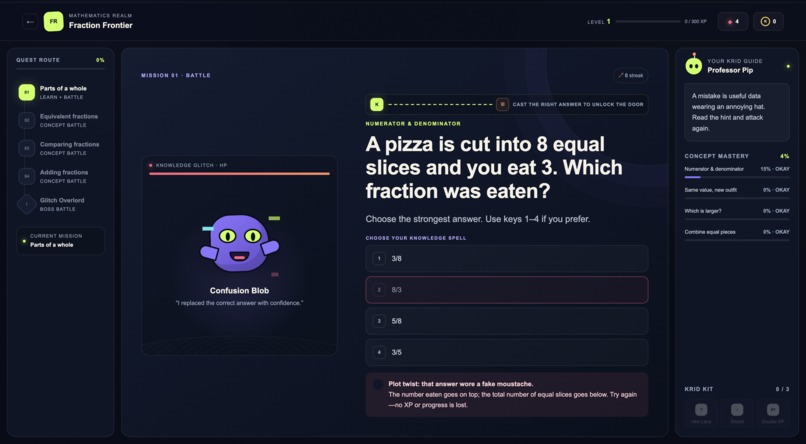
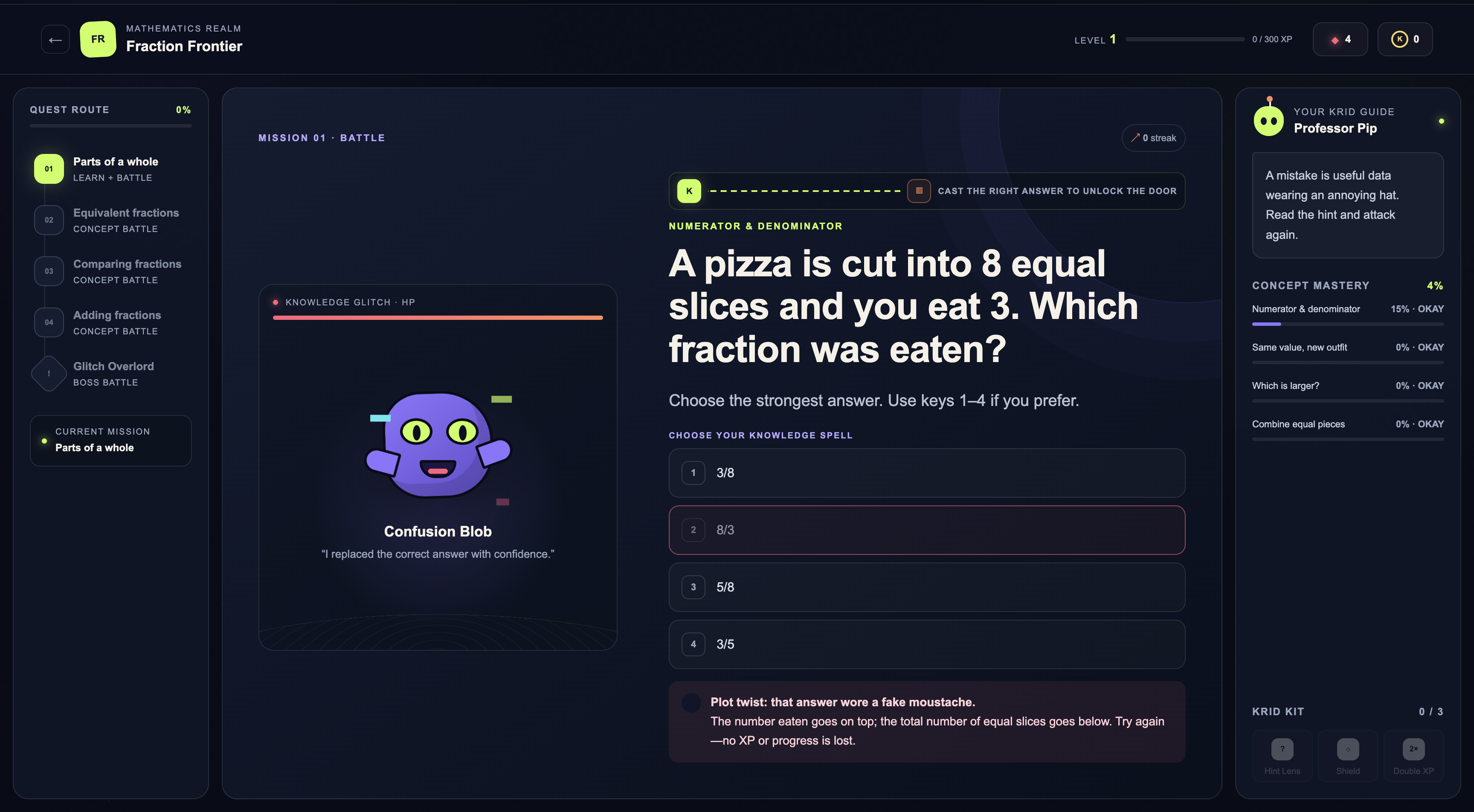
Wrong Answers
-
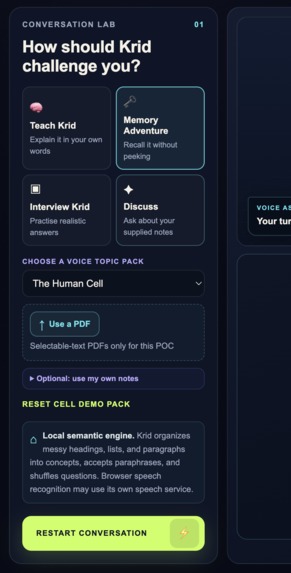
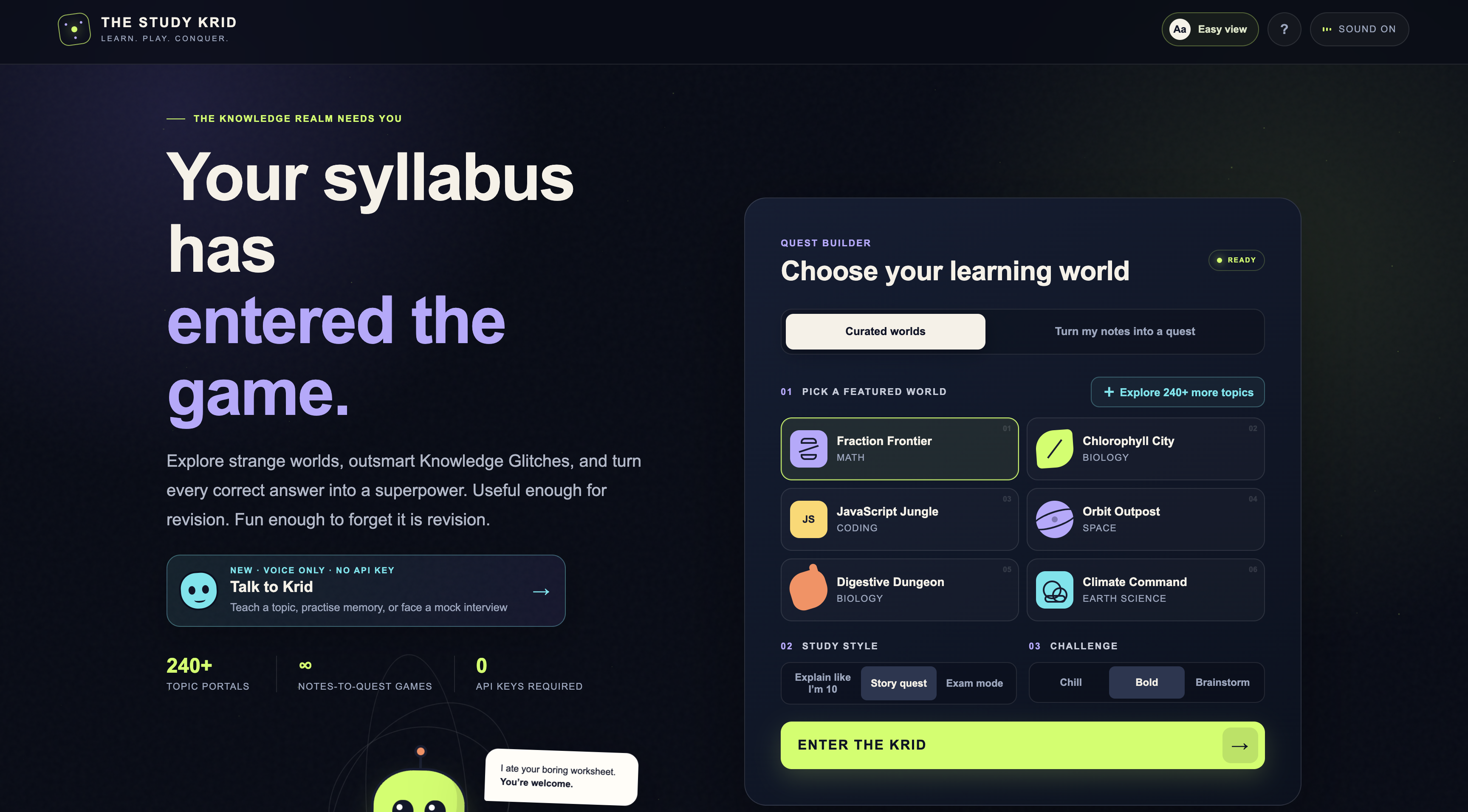
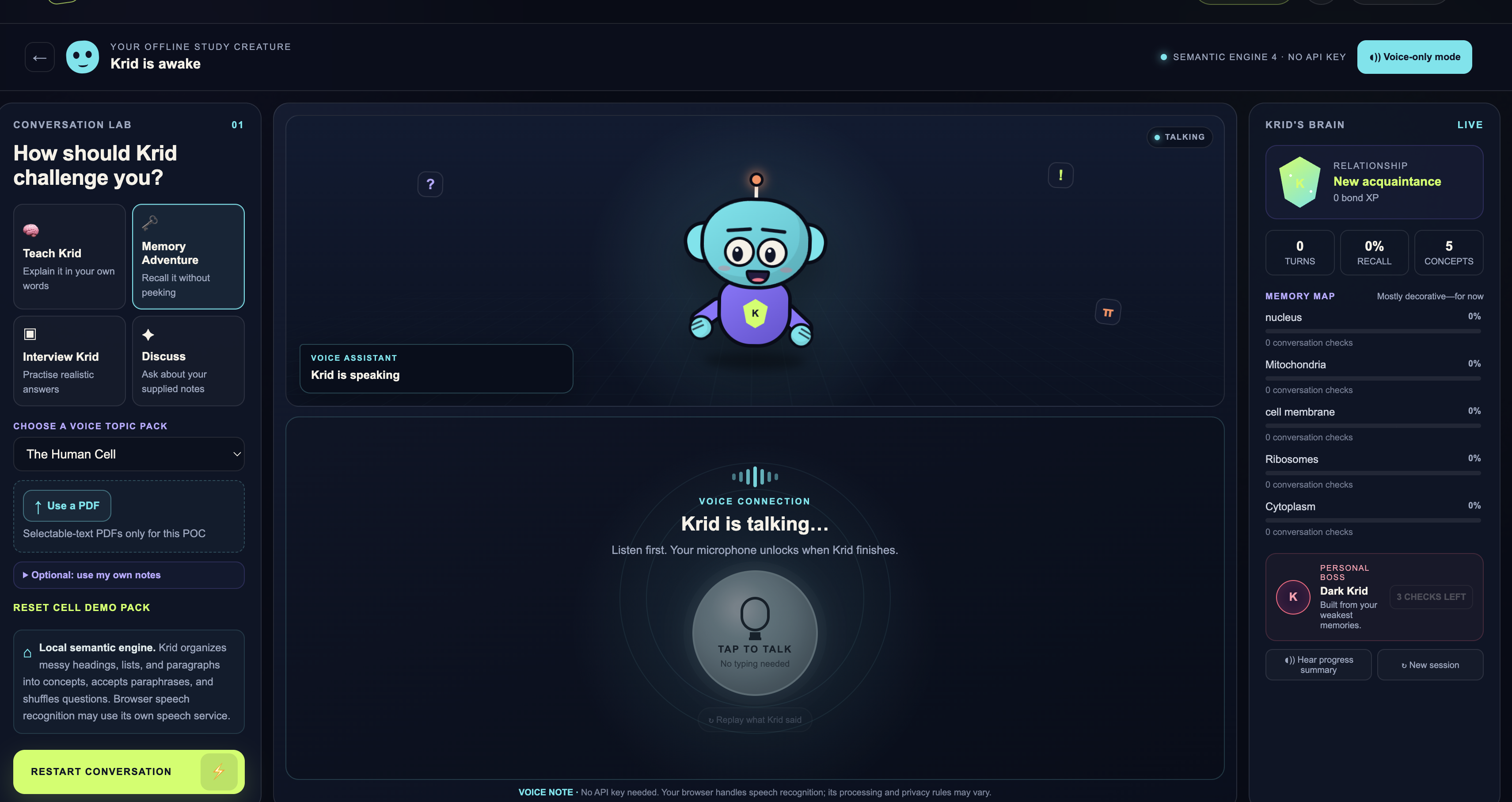
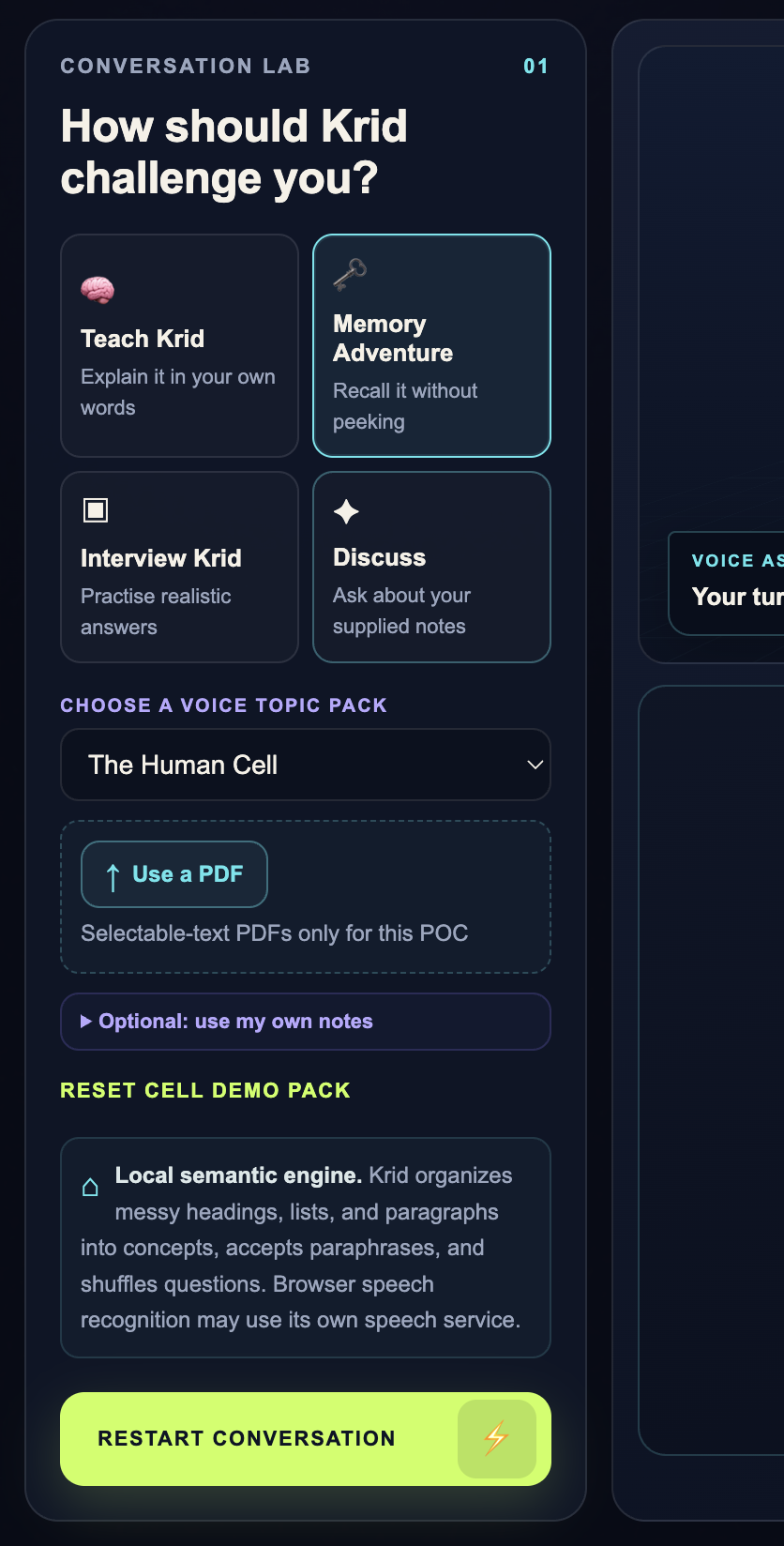
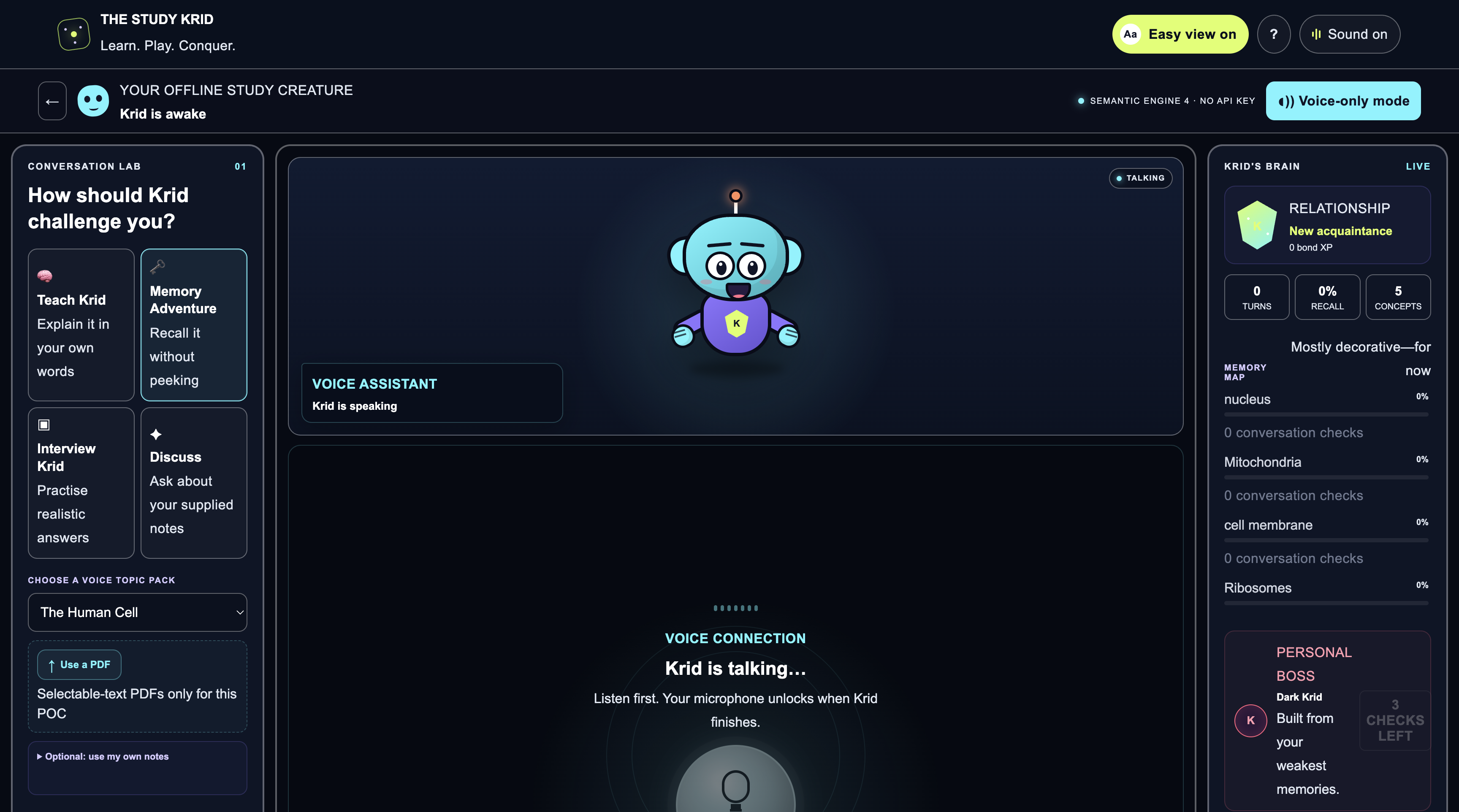
Choose your challenge to learn from .Teach your notes to Krid, memorize them, practice for viva or simply discuss !
-
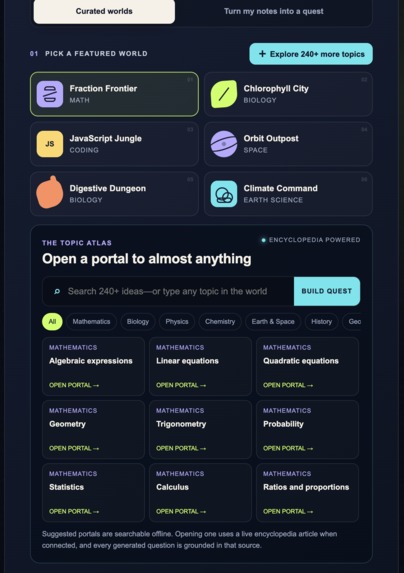
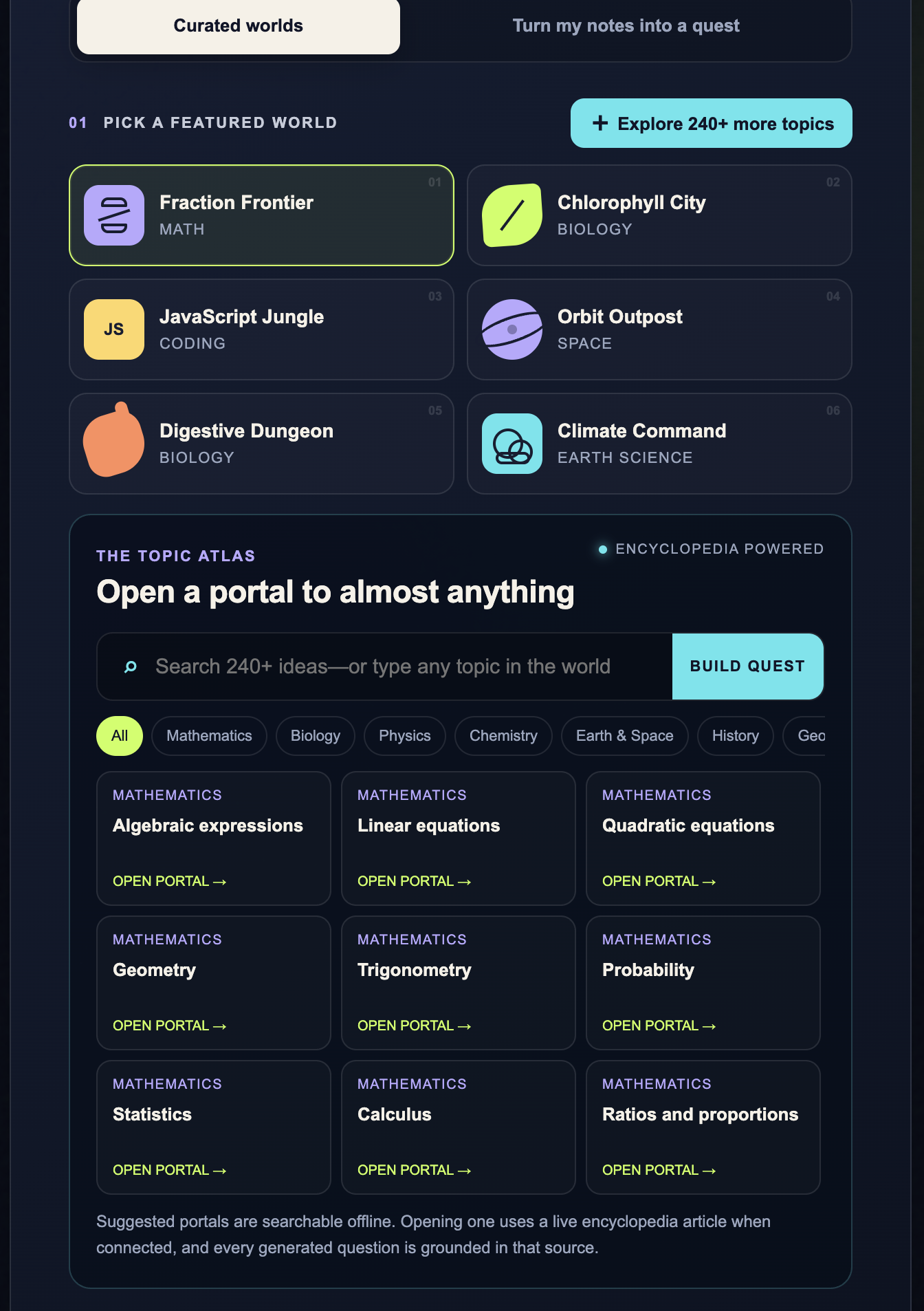
240+ inbuilt topics to choose from
-
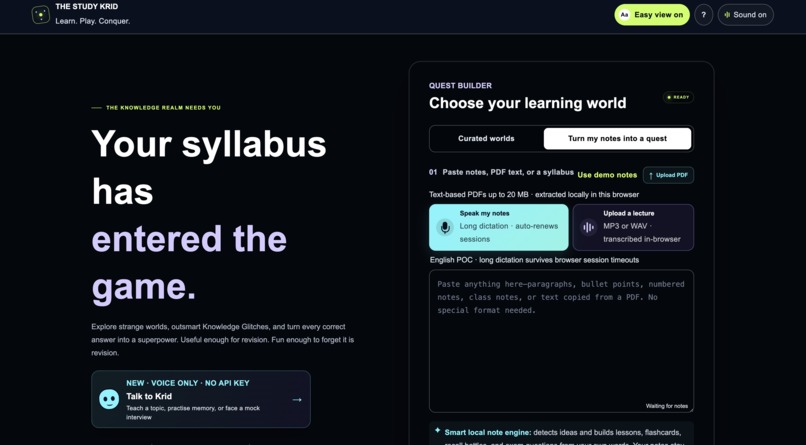
The UI for specially abled students
-
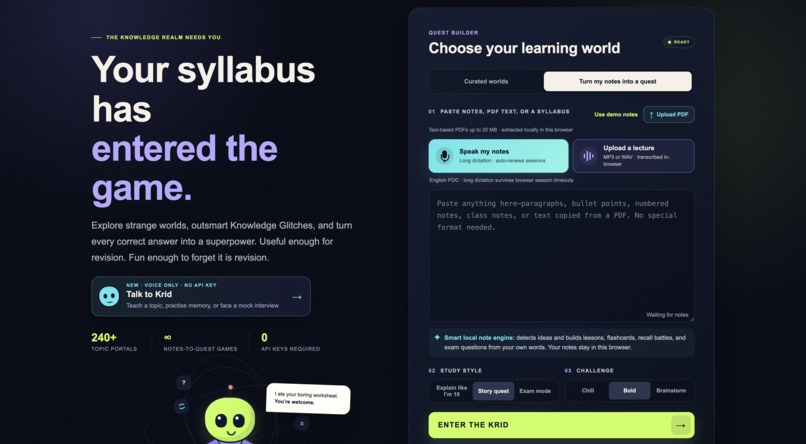
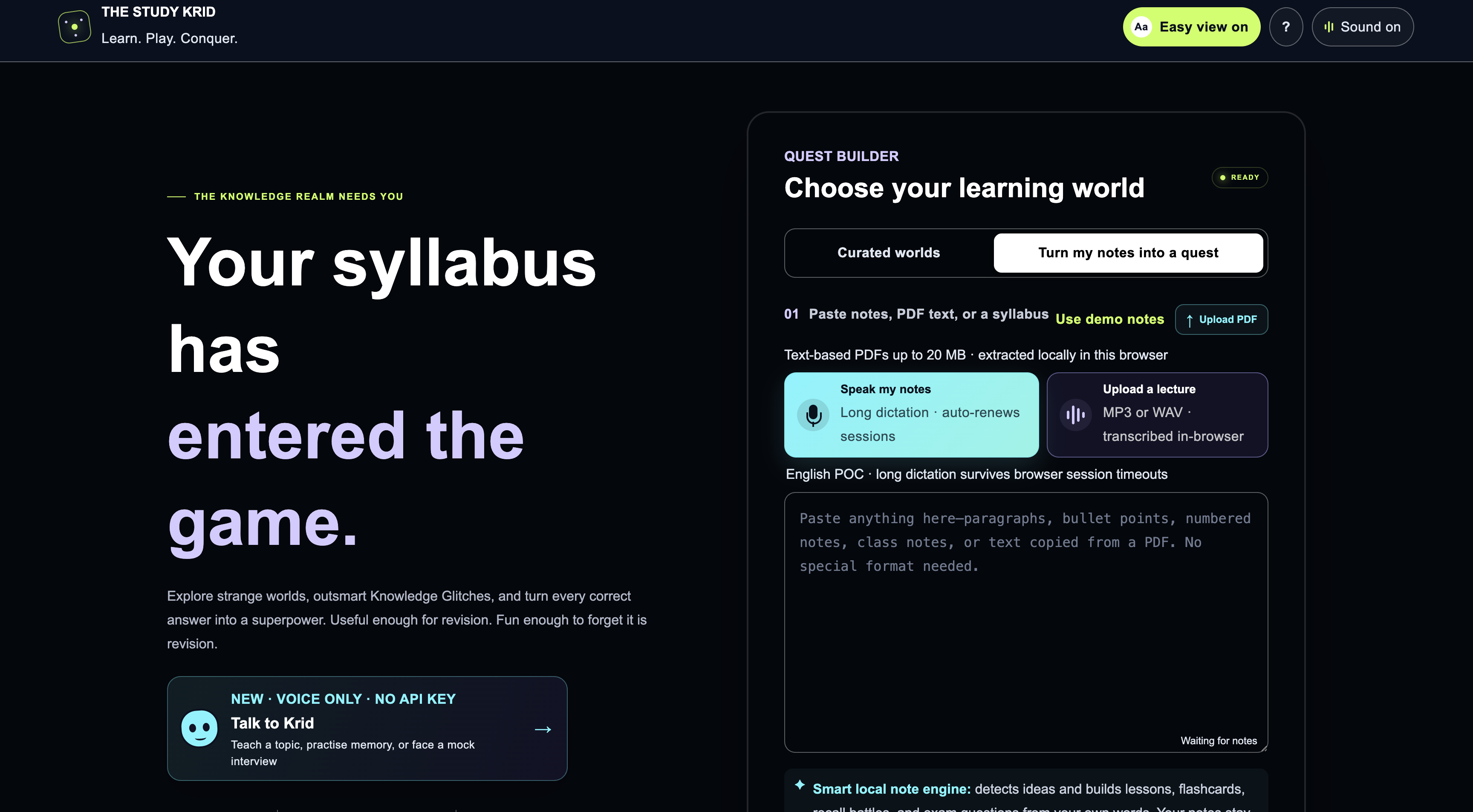
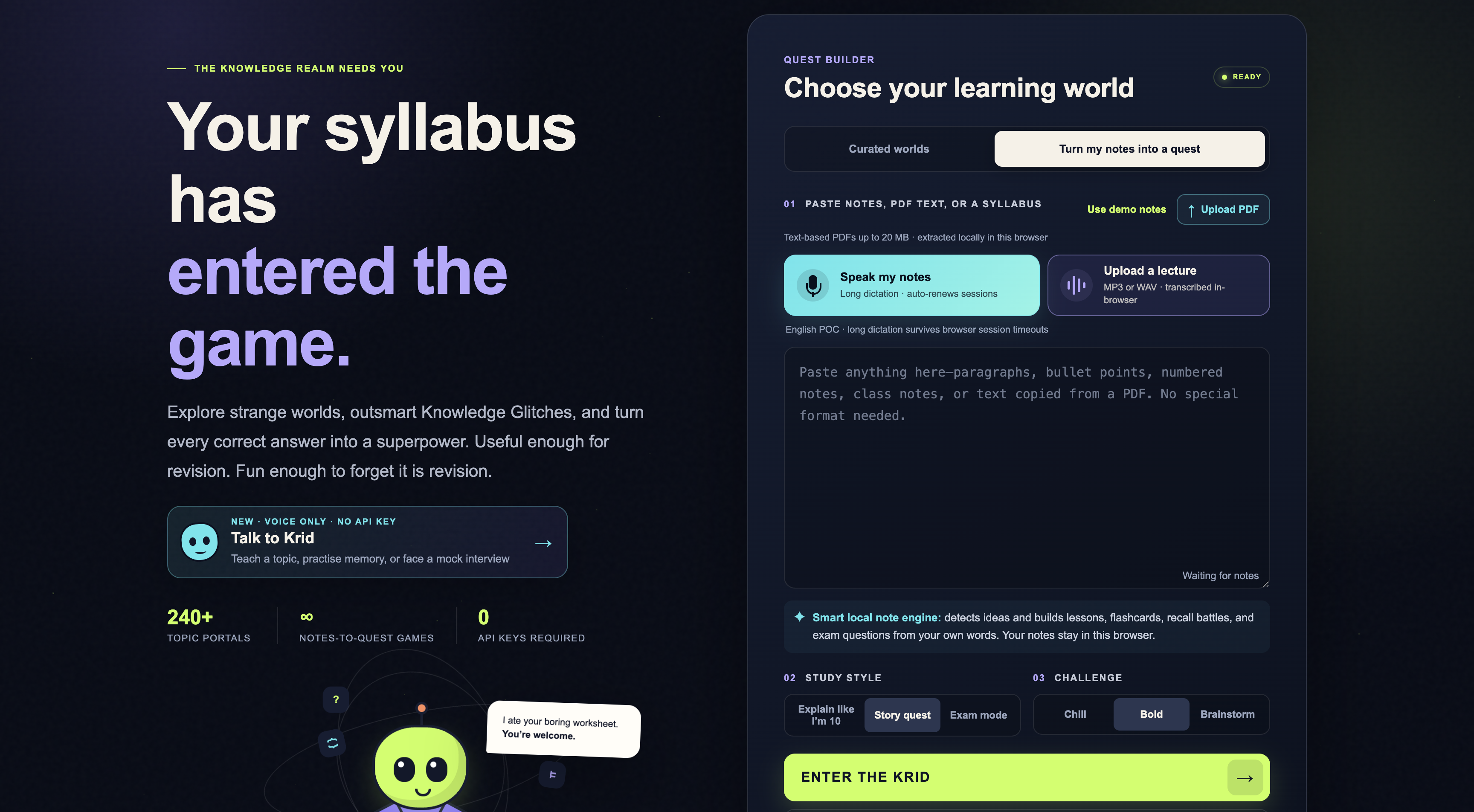
Upload your notes: be it a voice audio transcription, type it, speak it or upload a pdf
-
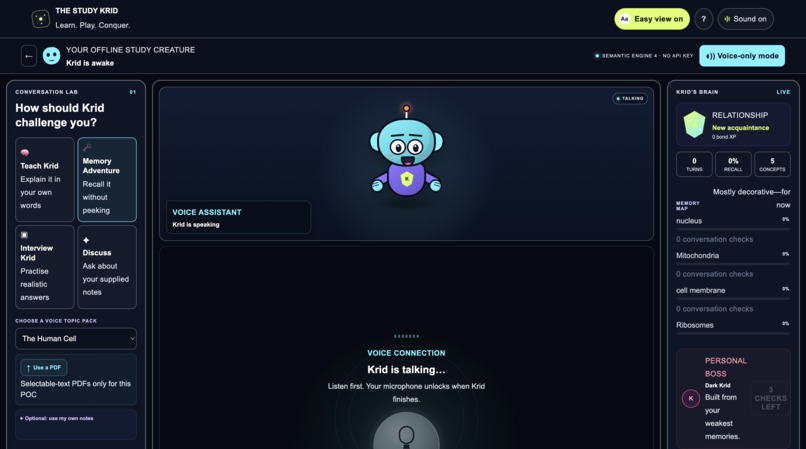
Krid for the special students
Inspiration
The Study Krid : learning is fun The inspiration was this simple question : What if every student had an endlessly patient study companion who could listen, adapt, make them laugh, and keep helping until confusion became confidence? And of course a disability should never determine how much a person is allowed to learn. That idea became Krid—a funny, expressive voice companion who turns the learner’s own material into conversations, games, and personalised adventures.
What it does
The Study Krid is an inclusive educational adventure that transforms notes, PDFs, dictated content, and recorded lectures into interactive lessons, flashcards, voice conversations, memory quests, and personalised revision games. At its centre is Krid, a funny animated voice companion. Krid speaks to learners, listens to answers, accepts explanations in their own words, identifies missing ideas, and responds with encouragement rather than punishment. This is especially valuable for students who struggle with typing, reading, memorisation, communication anxiety, or traditional classroom testing, accessibility is not treated as an afterthought. Students can dictate notes using a prominent microphone button, upload classroom recordings instead of writing everything manually, and interact with Krid almost entirely through speech. Easy View provides larger text, stronger contrast, clearer spacing, simplified visuals, reduced animation, and visible keyboard focus for disabled and impaired students
How we built it
The Study Krid is an installable browser application built with modular JavaScript and semantic HTML, CSS. Its architecture includes: A flexible note-refinement and concept-extraction engine,a source-grounded question generator, a local ,semantic answer evaluator, adaptive mastery and confidence tracking, shuffled retrieval and weak-area scheduling, browser speech recognition and synthesis, pdf text extraction, in-browser lecture transcription, hugging face used for the optional lecture-transcription, featurepersistent progress through localStorage, offline support through a service worker, responsive, keyboard-accessible game interfaces, original code-drawn characters and animations , PDF and uploaded lecture content remain inside the browser. Currently no account, subscription, paid API, or runtime API key is required.
Challenges we ran into
Turning messy notes into sensible concepts, real notes are rarely perfectly formatted. They contain broken headings, lists, incomplete sentences, PDF line wraps, and sections whose meaning depends on previous paragraphs. One PDF initially produced a concept titled “hallucinations and” because a sentence had wrapped across lines. I built reconstruction rules that rejoin lowercase continuations, reject connector fragments as headings, preserve parent-child sections, and generate questions from complete ideas. Generating useful questions. Early versions created vague prompts such as “Explain these controls.” I redesigned the question engine to recognise whether a concept calls for a what, why, how, list, comparison, or application question. Pronouns are resolved back to named concepts, and headings cannot become their own correct answers. Understanding meaning without requiring memorisation. Simple keyword matching rewarded copied notes and sometimes rejected correct general explanations. I added stemming, synonym groups, meaning-unit coverage, concept-weighted evidence, list-item coverage, and contradiction checks. The evaluator now distinguishes between: A correct paraphrase, a partially complete answer, a vague but related statement, a confident answer about the wrong concept, giving complete feedback without repetition, some corrections originally stopped after one sentence, while others repeated the same sentence twice. I introduced complete-answer recovery from the original source and containment-based deduplication so Krid can explain every important point once. Making it feel like a game, the first prototype still felt like a quiz application wearing colourful clothes. I rebuilt the experience around rooms, route progression, powers, rewards, confidence decisions, character reactions, revisit portals, and a personalised boss battle. Browser voice inconsistencies, speech recognition, microphone permissions, and available voices behave differently across browsers and deployed origins. I added delayed voice-list handling, deterministic female-voice selection, echo prevention, browser-specific recovery messages, and service-worker cache updates.
Accomplishments that we're proud of
I am proud that The Study Krid has become more than a content generator. It is a working, installable learning experience where students can: Learn from their own material, answer in their own words, receive complete and grounded feedback, practise through speech, explore instead of completing static quizzes, build confidence without being punished for mistakes, review weak concepts through personalised challenges, use visual and sensory adaptations, practise interviews and communication ,study without an account or paid API key. I am especially proud that accessibility and fun support each other. Larger controls, voice interaction, reduced motion, humorous feedback, and flexible answers make the app more inclusive while also creating a better experience for every learner. The project demonstrates that accessible educational software can still be expressive, playful, technically ambitious, and genuinely exciting.
What we learned
The biggest lesson was that educational value does not come from generating more content. It comes from creating the right feedback loop. Students need to:, Encounter an idea, explain it in their own words, discover what they missed, receive a complete correction, retrieve it again later, build confidence through visible progress. I also learned that accessibility decisions improve the product for everyone. Larger controls, clearer spacing, voice interaction, reduced motion, and forgiving input are useful not only for people with diagnosed disabilities, but also for tired students, younger learners, second-language speakers, and people studying under difficult conditions. Finally, I learned that personality matters. A learner is more willing to try, fail, and try again when feedback comes from a funny, supportive character rather than an intimidating red error message.
How Codex and GPT helped:
I collaborated with Codex and GPT throughout the project as an engineering and product partner. Codex accelerated: Application architecture and modular implementation, semantic parsing and answer-evaluation logic, voice-interaction state management, accessible interface development, character animation and game-state design, PDF and audio-processing integration, regression testing and edge-case discovery, documentation and deployment preparation. I made the key product decisions: making Krid voice-first, refusing exact-memorisation grading, treating accessibility as a core feature, keeping runtime usage free from API keys, and transforming the experience from a quiz generator into a genuine game. GPTand Codex helped turn those decisions into working, tested features and rapidly refine failures uncovered through realistic notes and spoken-answer examples.
What's next for The Study Krid
The Study Krid was designed and built within a single day after I discovered the hackathon a day before. So nonetheless built in a hurry , I am proud to submit a working proof of concept that demonstrates the project’s core vision.Accessibility is my most important next step. The current version introduces proof-of-concept features for learners with disabilities, including voice input, lecture transcription, adaptable visuals, larger controls, stronger contrast, and reduced motion. I want to develop these further through accessibility testing, feedback from real learners, better screen-reader support, captions, additional sensory profiles, and more flexible interaction methods. My long-term vision is to transform The Study Krid into an inclusive learning world that adapts to every student’s abilities, needs, confidence, and preferred way of communicating—because learners should never have to adapt themselves to an inaccessible education system.


Log in or sign up for Devpost to join the conversation.