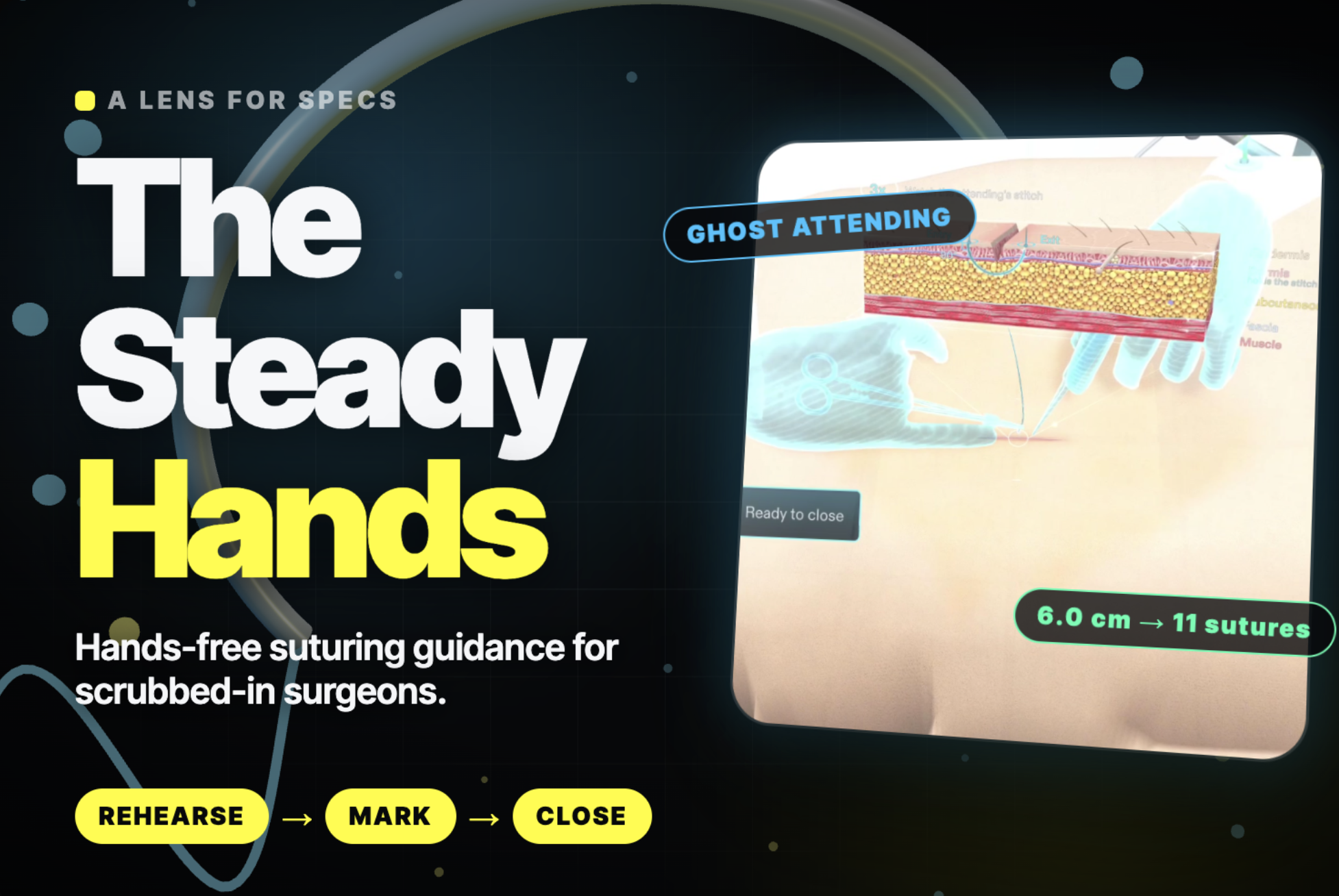
The Steady Hands — a hands-free closing companion for surgeons on Specs. A ghost attending demonstrates the stitch. A 3D cutaway grades yours. The wound itself tells you where every suture goes, and the field won't close until every needle is back.
Inspiration
Once a surgeon scrubs in, two things are spoken for: their hands are sterile and their eyes belong to the wound. No phone, no screen, no paper.
Yet a good closure depends on details that are easy to lose: where each bite lands, how deep the needle travels, and whether every needle that came onto the field has returned to the count.
So we asked a simple question:
What if the guidance lived on the wound itself — and a senior surgeon could stand across the table, even when they aren't in the room?
What it does
The Steady Hands follows the rhythm of a real closure: rehearse → mark → close.
1. Rehearse — learn from the ghost attending Life-size holographic hands reach in from across the table and place one interrupted stitch on the patient: forceps evert the edge, the needle enters at 90°, and the thread is pulled through. Above the wound, a 3× anatomical cutaway (epidermis, dermis, fat, fascia, muscle) shows the same path from inside the tissue.
Then it's your turn. You drag the needle along the arc through a visible tolerance band, and your path is coloured segment by segment as you go. The stitch turns green only within real-scale limits:
$$ d_{\max} \le 1.5\ \text{mm}\ \ (= 4.5\ \text{mm at } 3\times), \qquad \left|\,\theta_{\text{entry}} - 90^\circ\right| \le 15^\circ $$
2. Mark — the wound becomes the guide Pinch both ends of the incision. A millimetre ruler draws itself along the cut and glowing bite marks cascade into place, 5 mm from each edge and evenly spaced:
$$ n = \operatorname{round}!\left(\frac{L}{0.5\ \text{cm}}\right) - 1, \qquad \mathbf{x}_i = \mathbf{A} + \frac{i}{n+1}\,(\mathbf{B}-\mathbf{A}) $$
A 6.0 cm incision reads 6.0 cm → 11 sutures. A slightly imperfect pinch still rounds to 11.
3. Close — nothing gets left behind Pinch + when a needle is opened and − when it returns. Press Close with a needle still out, and the field answers with a red "1 missing", a low chime, and chevrons pointing back to the instrument tray. At zero, the sutures light up green one by one and the field reads Closed.
No dashboards. No menus. One next step at a time, anchored to the wound.
How we built it
- Design first. We began with the plan-lens interview and an approved design brief that pins every element to real-world centimetres.
- Built with CLAD and the Lens Studio MCP in Lens Studio 5.23 for Specs.
- Real interaction. Every target is a Spectacles Interaction Kit Interactable or a UI Kit button, so the same pinches and drags work with the mouse in preview and with hand tracking on device.
- The ghost attending.
- Two of SIK's own skinned hand rigs, posed procedurally into a palm grip on a Mayo-Hegar needle driver and a pencil grip on Adson forceps.
- The instruments are built in code with MeshBuilder.
- The wrist pronation is solved so the needle tip lands exactly on its entry and exit points.
- A hologram shader made for an additive display:
- fresnel rim, scan lines and a soft halo;
- a distance fade for the sleeves;
- a clip plane, so the needle disappears beneath the skin.
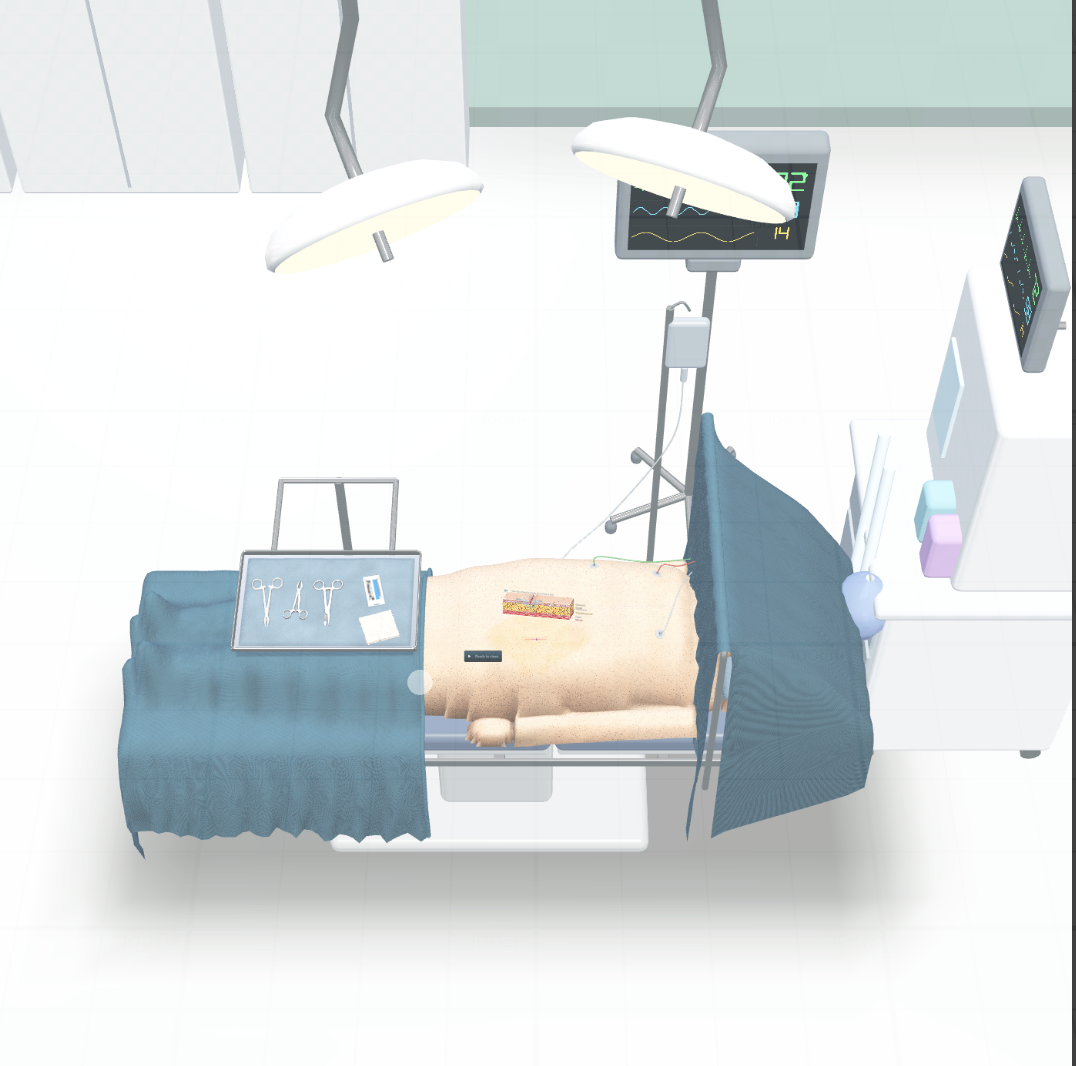
- Procedural everything. The operating room, the patient, the layered wound and the tissue cutaway are generated at runtime, with our own textures.
- Tested end to end. Seventeen LEAF scenarios cover every done criterion through the real input path (pinches, drags and button presses), and all seventeen pass.
Challenges we ran into
Designing for light, not pixels. On Specs, black is transparent. We built a light palette, a saturated cyan ghost that reads against pale skin, and premultiplied glows throughout.
Honest framing. Specs draws holograms inside a window of roughly 46°. Rather than fake a full-screen view, our demo frames exactly what the glasses would show.
From working to beautiful. Our first build passed every test and looked flat. We rebuilt the visuals in four focused passes — stage, ghost attending, overlays and cross-section — all held to the same test contracts, so nothing broke along the way.
Geometry meets anatomy. A rigid 3/8-circle needle cannot follow just any arc, so we solved the hand's motion numerically around the needle's own curve.
Tooling at the edge. Overlapping compiles crashed the editor, so we moved to a write in parallel, integrate one at a time pipeline. The image generator refused skin textures, so we generated our own. And measuring frame rates, not guessing, revealed that the preview throttles hard in the background.
Accomplishments that we're proud of
- A single continuous take: a hologram teaches, you practise, the Lens measures, the field closes.
- Life-size, skinned holographic hands holding real instrument shapes.
- Scoring you can see: a 1.5 mm tolerance band and an entry-angle protractor turn an abstract skill into a visible one.
- Every done criterion verified by an automated test that drives the real input path.
What we learned
- Great spatial UI is mostly restraint: one step, anchored to the real object, with big targets.
- Separate what it does from how it looks. Clean contracts between logic, scoring and visuals let us rebuild the visuals twice without breaking a single test.
- Measure before you guess. In this project, frame rates and logs found the problems faster than intuition did.
What's next for The Steady Hands
- On-device testing with gloved hands, including millimetre-accurate pinch marking.
- Clinical review of entry and exit defaults and tolerances, then more patterns: running, vertical mattress and subcuticular sutures.
- Real-motion feedback, so the practice stitch evolves from a drag into analysis of the user's actual hand path.
- A full sharps count of needles, sponges and instruments, shared with the scrub nurse.
The Steady Hands is a concept demonstrated on a training stand-in. It is not a medical device.
Built With
- clad
- ffmpeg
- glsl
- gltf
- leaf
- lens
- meshbuilder
- node.js
- plan-lens
- specs
- spectacles
- typescript
