Inspiration
What it does
How I built it
Challenges I ran into
Accomplishments that I'm proud of
What I learned
What's next for The Statistical Brain and Bayes' Theorem
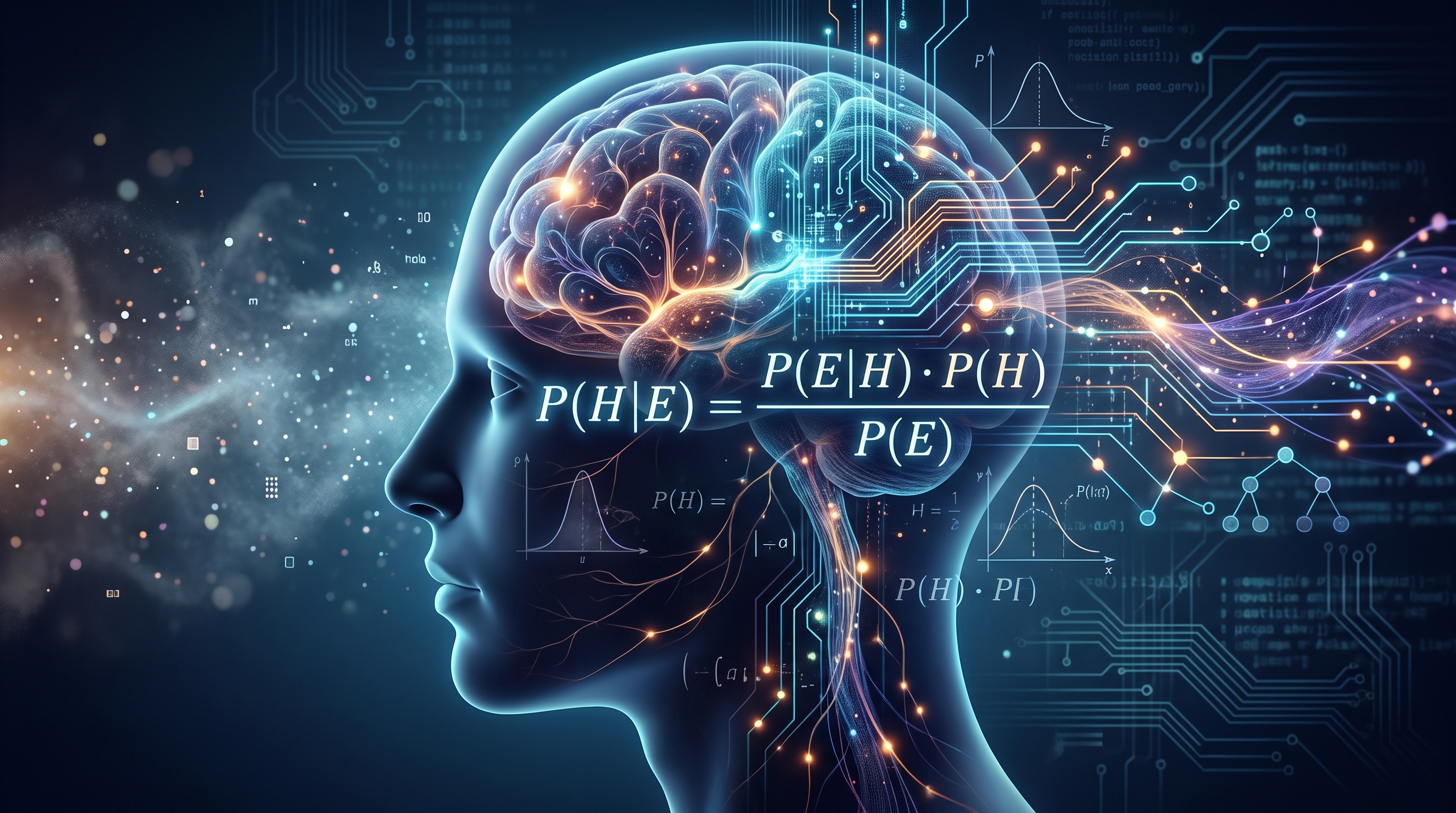
Human cognition operates under a constant veil of uncertainty. From inferring a person's intentions to predicting the weather, our brain continuously evaluates probabilities.The Statistical Brain and Bayes' TheoremBayesian statistics provides the mathematical framework for this process, describing how we should update our beliefs upon encountering new information. The core of this model is Bayes' Theorem:$$P(H\vert{}E) = \frac{P(E\vert{}H) \cdot P(H)}{P(E)}$$$P(H)$ (Prior Knowledge or Prior): The initial probability of a hypothesis before observing the data.$P(E\vert{}H)$ (Likelihood): The probability of observing the evidence $E$ if the hypothesis $H$ is true.$P(H\vert{}E)$ (Updated Belief or Posterior): The new probability of the hypothesis after integrating the evidence.Imagine diagnosing a startup failure in an electronic device. Your experience dictates that a short in the SMD capacitors of the power circuit is the most common cause (prior). Upon applying a thermal camera, you observe abnormal heat dissipation near a microcontroller (evidence). Automatically, your brain calculates the posterior: you drastically reduce the probability of a main power supply failure and focus on that specific component.The Bridge Between Psychology and ComputationDr. Tom Griffiths, in his Princeton laboratory, posits that the mind is not a set of flawed heuristics, but a highly sophisticated inference engine. His research demonstrates that humans solve complex problems by de facto applying Bayesian inference, operating close to mathematical optimality given the finite information available.Pillars of Griffiths' ResearchGriffiths' approach to decoding the brain reveals three fundamental mechanisms:Doing more with less: While traditional neural networks require thousands of examples to classify an object, the Bayesian mind requires only one or two exposures to generalize. This is achieved by drastically limiting the initial space of possible hypotheses.Inductive biases: Our learning is strongly guided by pre-programmed expectations. These structured priors act as mathematical filters, allowing inference to be fast and accurate in the face of completely novel stimuli.Resource-rational analysis: As explored in his book Algorithms to Live By, the brain optimizes the allocation of its limited resources (memory, time, computational energy). Sometimes, settling for an approximate decision is the most rational strategy when the cost of calculating the perfect answer outweighs the benefit.Implications for Artificial IntelligenceUnderstanding these biological limitations and efficiencies is transforming machine learning. Instead of simply scaling computing capacity in hardware architecture, engineers are integrating structured priors directly into AI models and meta-learning techniques. By mimicking resource-rational analysis, artificial systems are learning to allocate their processing power dynamically. This lays the foundation for architectures that do not merely compute by brute force, but reason and manage uncertainty with the same computational elegance as the human brain.
Built With
- text


Log in or sign up for Devpost to join the conversation.