Inspiration
In 2023, I came back to God through The Feast, a Catholic community in Metro Manila, Philippines at the lowest point of my life. At a retreat called Love Life Retreat, I finally saw something that had been true for years: I had been reaching for God as if He were somewhere outside me. The next morning, mid-Praise and Worship, I heard it quietly: “love God from within”, a realization that I can love and value myself the way God sees me. I wept. That was the beginning.
What followed was, in many ways, a gift of community. The people I met through that retreat became a starting point for finding communities of my own – through Light Groups, different ministries, and the people I eventually came to call my own. I found places where I felt that I belonged, where I could ask questions, share what I was going through, and continue growing in faith alongside other people.
But I also wanted to grow personally and independently. I went through my Bible, explored different Bible and prayer apps, and tried different sacramentals and practices on my own. I kept looking for ways to make my faith something I could actively live out beyond the moments when I was with my community. Eventually, I found the SPIRE model, a framework for whole-person wellbeing by positive psychologist Dr. Tal Ben-Shahar. I began using it as a kind of personal weekly checklist: spiritual, physical, intellectual, relational, and emotional well-being. Every Monday, I would tick the boxes and try to assess how I was doing across these different areas of my life.
The framework itself made sense to me. What became difficult was trying to hold myself accountable to all of it on my own. I wanted to pursue this idea of whole-person formation, but I was also expecting myself to keep up with every dimension, every week, with whatever capacity I happened to have at the time. What was meant to help me become more whole could easily become another standard against which I measured myself.
I even started thinking that perhaps I could simply build an app for myself – a tool that would let me keep track of the checklist and make the process easier to monitor.
But the more I thought about it, the more I realized that monitoring wasn’t really the answer. If the problem was simply remembering to check a box, then a checklist would have been enough. But formation is not something you accomplish by completing a list. And if the very tool meant to help you grow eventually makes you feel like you’re falling behind, then something about the way it is designed needs to change.
So I started asking a different question: What would actually make someone want to come back? What would make formation feel less like another obligation and more like something you would genuinely want to continue?
As I was working through that question, the original SPIRE framework began to evolve. Through prayer and what I experienced as the Holy Spirit’s guidance, together with the assistance of AI in helping me articulate and name the dimensions, I eventually developed what became the SPIRIT framework:
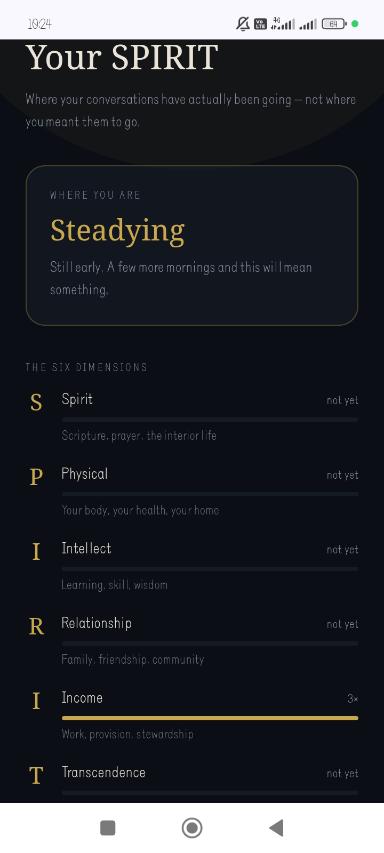
S — Spiritual P — Physical I — Intellectual R — Relational I — Income T — Transcendence
It gave me a way of thinking about formation that extended beyond prayer and personal wellbeing. It included how we care for our bodies and immediate environment, how we think, how we relate to others, how we steward our resources, and ultimately how we discover what we can contribute beyond ourselves.
But another realization followed.
People don’t really want to journey alone.
We may want tools to help us grow, but we also want someone to talk to when we’re struggling. We want people who understand where we’re coming from. We want community. We want friendship. And, for many of us, we eventually hope to find a person with whom we can share our lives.
That became particularly important as I started thinking about the relational and kindred side of Spiritly.
For so long, technology has approached dating primarily through attraction and compatibility: a photograph, a profile, a few interests, and an algorithm trying to determine who might be a good match.
There is nothing inherently wrong with that. Attraction matters, and people should have the freedom to choose whom they want to meet.
But I kept wondering whether there could be something before the match.
What if the person you’re looking for is not simply someone who looks right on your screen, but someone whose life is moving in a direction that resonates with yours?
What if you could encounter people while you’re actually living out the things that matter to you – through community, learning, service, purpose, and shared experiences?
And that brought me back to something I had only recently learned to put into words.
For a long time, I believed that beautiful stories came from beautifully broken people. The idea resonated with me because there is something deeply human about being recognized by someone who sees something in you that other people don’t. We are often drawn to people who understand parts of us because they have encountered something similar in themselves.
We want to be seen.
But perhaps before asking someone else to understand us, we also need to learn to understand ourselves. Before asking someone else to see us, perhaps we need to learn to see ourselves and, ultimately, to see ourselves through God’s eyes.
Not because we need to become perfect before we can be loved. We will always have wounds. We will always have unfinished parts of our story. But as we become more aware of ourselves and more intentional about the life we are building, we can also become more discerning about the people we allow to journey with us.
And perhaps the most meaningful relationships are not necessarily those where two people simply recognize each other’s darkness.
Perhaps they are the ones where two people recognize something of where the other has been, while also seeing where the other is going.
That is the idea that Spiritly is built around.
Formation first, but never formation alone.
Spiritly is meant to be a companion in that formation – not a checklist that tells you whether you’ve succeeded or failed, and not an app that promises to fix you.
It is a space where you can become more intentional about your faith, your physical life, your mind, your relationships, your resources, and your purpose; where that formation can lead you into real community; and where, along the way, you may encounter people who are also trying to live toward something that matters.
Maybe that becomes a friendship. Maybe it becomes a community. Maybe it becomes a vocation or a life of service.
And maybe, for some people, it becomes love.
Not because an algorithm simply decided that you’re compatible, but because you found each other while living toward something that matters.
That is why I built Spiritly.
I don’t believe people need another app telling them everything they need to accomplish.
I believe we need something that can journey with us—something that helps us become more aware of who we are, more grounded in God, more intentional about how we live, and more connected to the people and purpose that make the journey worth taking.
Because perhaps the ultimate goal isn’t simply to find someone who sees you.
It is to learn to see yourself through God’s eyes, become the person you are called to be, and then find people who are willing to walk with you toward the light.
That’s the Spiritly I envision.
And that’s the vision I’m now building.
What it does
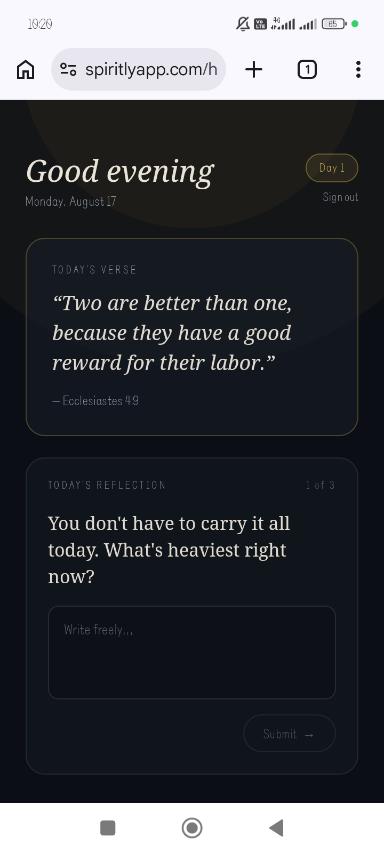
Spiritly asks you three questions each morning and listens to the answers.
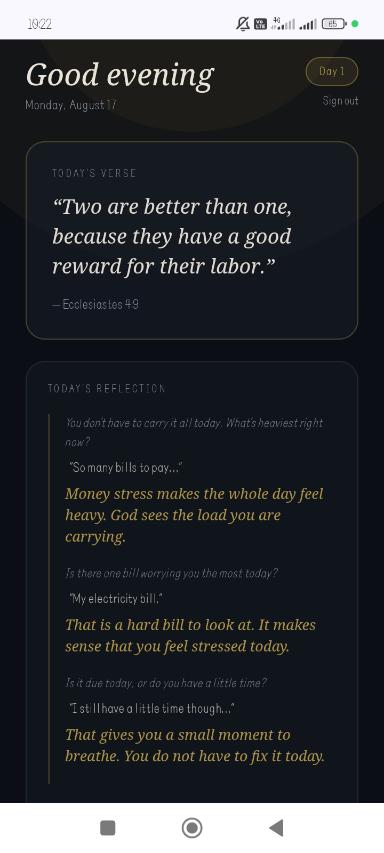
Not a devotional you read — a conversation. You write what is actually true that day. It responds to what you said, then asks something one layer deeper, following your thread rather than changing the subject. Three turns, a few minutes.
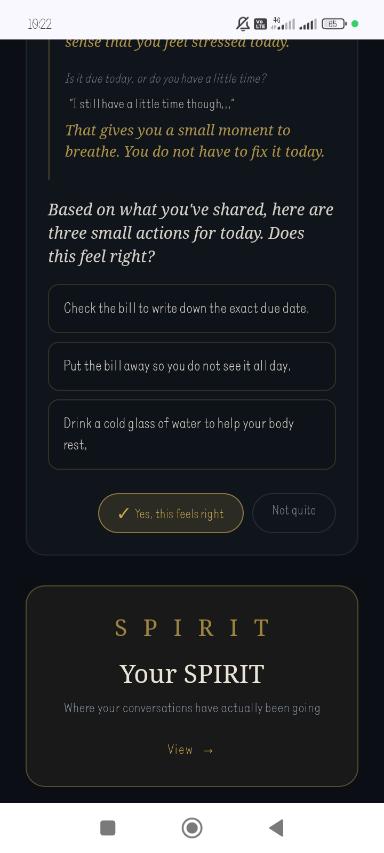
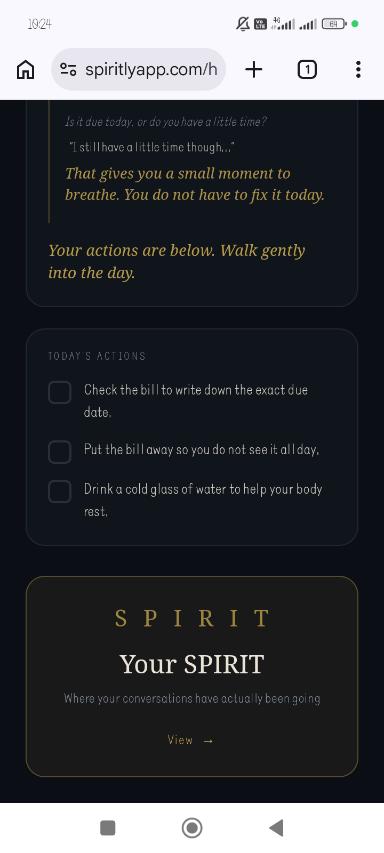
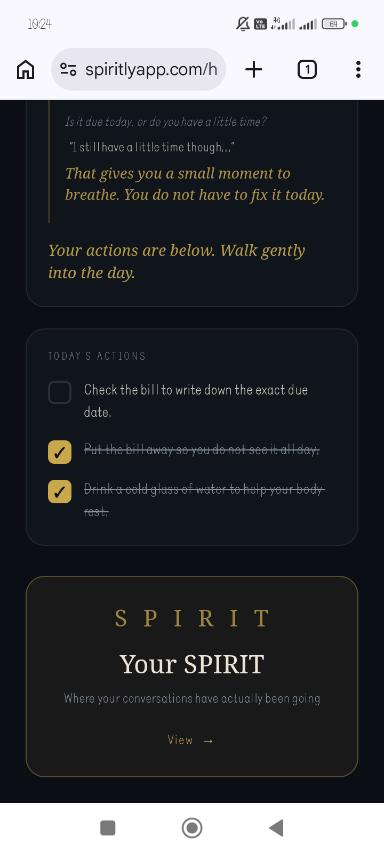
Then it gives you three small things you could do today, shaped by your own words that morning, and a Bible verse chosen for where you actually are — which you carry into tomorrow, so the next morning begins where this one ended.
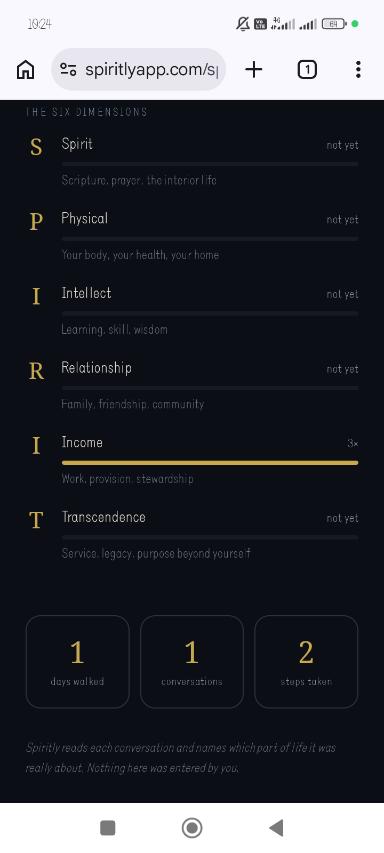
Underneath, it does something you never see. It reads each conversation and names which of six dimensions of life it was really about: Spirit, Physical, Intellect, Relationship, Income, Transcendence. Money worry is Income. Exhaustion is Physical. Loneliness is Relationship. Over weeks this becomes a picture of where a life genuinely needs attention — and Spiritly notices when a dimension has gone quiet.
It also judges how much to ask of you. Someone overwhelmed is met with presence and nothing more. Someone with capacity is asked for real reflection and real action. The app never shows this as a score, and it is never something you can declare about yourself.
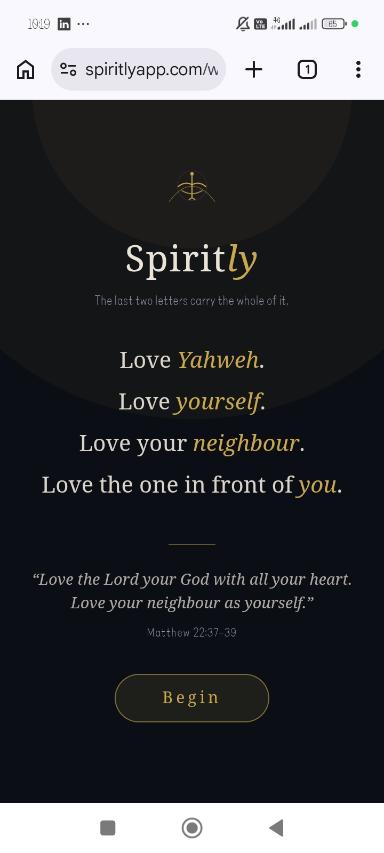
The name carries the shape of it. L is for love. Y is for you — and for Yahweh. Love Yahweh. Love yourself. Love your neighbour. Love the one in front of you.
How I built it
Built solo on a laptop in Manila, relearning software development after nearly twenty years away.
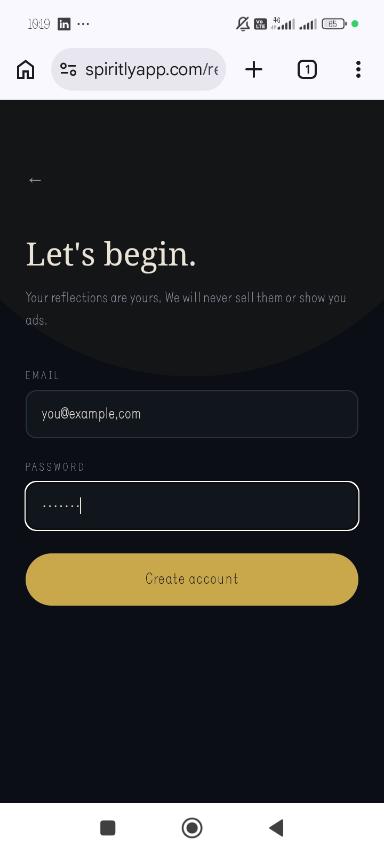
React Native and Expo power the app, exported to web and deployed through Firebase Hosting. Firebase Authentication handles identity, while Firestore stores user data and reflections. Security rules restrict each user to their own reflections.
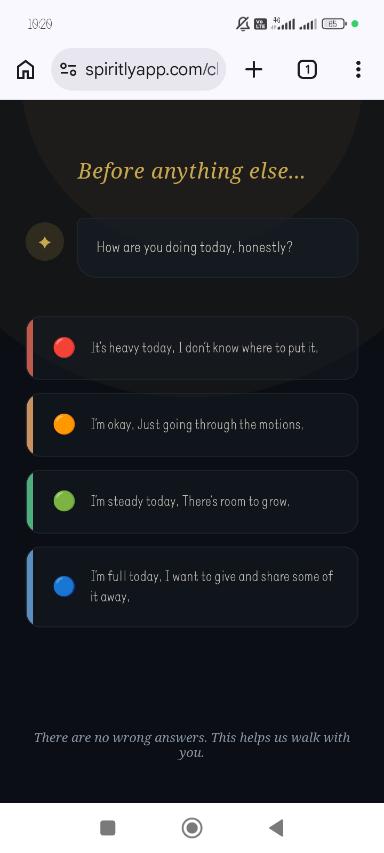
The Gemini API powers the core reflection experience. Each user interaction is processed dynamically by the model, including:
- which question to open with, based on how the user says they are doing
- how to respond to the user's reflection
- what to ask next and how deeply to explore
- which SPIRIT dimension the conversation relates to
- three actions generated from the full exchange
- an assessment of the user's formation stage based on the depth of their reflection
A system prompt defines the AI's voice and interaction rules, optimized for someone reading on a phone at 6 a.m., including users for whom English is a second language. It uses short sentences, everyday language, no unnecessary exclamation marks, and does not give unsolicited advice. When users write in Taglish, it responds in Taglish.
Scripture is deliberately not generated by AI. Verses come from a curated, dimension- and stage-tagged bank. The model selects the appropriate verse rather than writing or paraphrasing Scripture. This keeps the biblical content controlled and verifiable.
Challenges I ran into
Realizing I would have to build it myself. I did not originally intend to write the code. On 11 June, I presented Spiritly to a Makati development firm using mockups I had built in Lovable. They were encouraging and advised me to protect the idea before taking it further, which led directly to my wordmark filing with IPOPHL. We stayed in touch while they assessed what a full MVP build would require. On 3 July, they returned a Development Cost Overview and Partnership Position, estimating ₱9,020,000 (~$147,541) for the MVP and declining the 5% equity partnership I had proposed.
That conversation gave me something I didn't have before: a clear sense of what it would take to build Spiritly professionally, and the realization that I could not wait for the perfect team or budget before starting. So I decided to learn how to build it myself. I started writing code that same week and, three weeks later, had built the working core for under $180, using Claude as a development partner rather than an engineering team.
What began as a search for a development partner became an unexpected opportunity to become the builder myself.
Building traction within a short development window. With limited time, I had to develop the MVP while simultaneously beginning market validation and community building. I have already started posting on social media and introducing Spiritly in relevant community chat groups. The next stage is direct pitching to relevant personalities, organizations and institutions.
Relearning the development stack. Returning to coding meant rebuilding familiarity with the environment from the ground up, including Node.js, npm, APIs, and deployment.
Environment and system configuration issues. An incorrect system clock initially caused certificate validation failures, demonstrating how seemingly unrelated local configurations can break development dependencies.
API and model availability constraints. I encountered Gemini API limitations involving billing/free-tier behavior and a model retirement. This required adapting the implementation to available models and API configurations.
Time-zone handling. Using toISOString() introduced a UTC/local-time mismatch, causing reflections submitted in the morning in Manila to be recorded under the previous date. The system was revised to use the device's local date, so it now works wherever a user is.
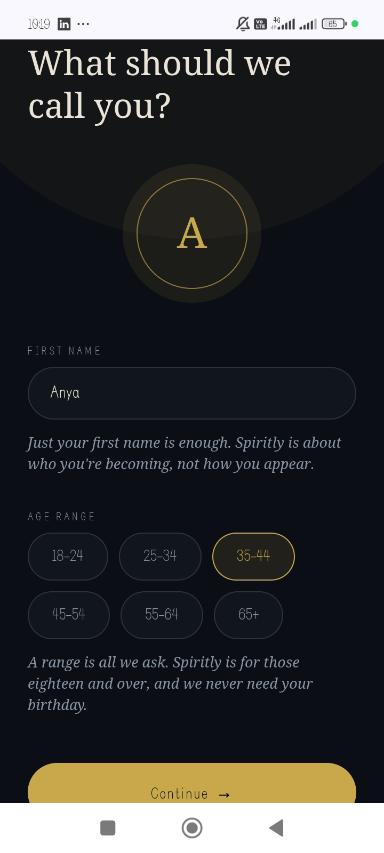
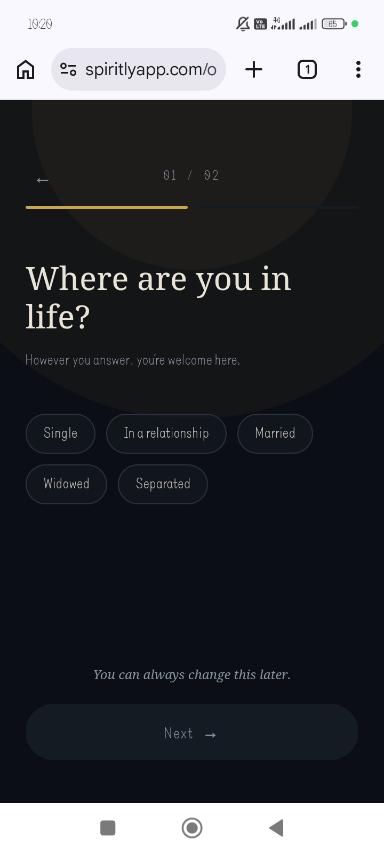
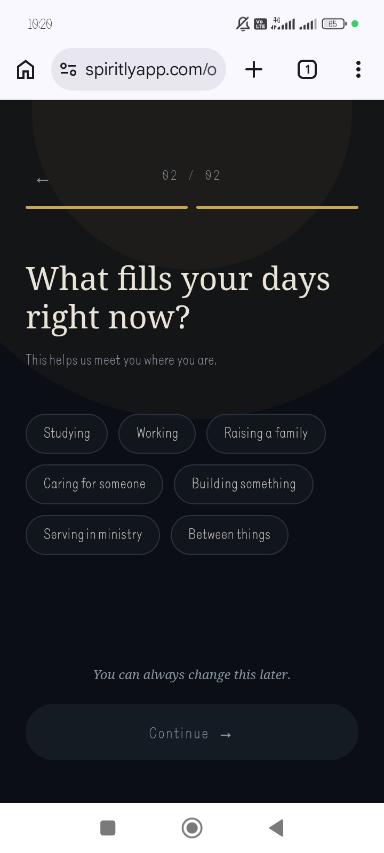
Rethinking personalization and religious assumptions. The initial onboarding flow asked users to identify their Christian denomination for future matching. I removed it because it risked turning formation into categorization and assumed same-tradition matching was inherently preferable. The AI now responds to the user's own language and practices without imposing a denomination.
Designing a meaningful Formation Stage. The initial implementation allowed users to select their own formation level, which could make the assessment arbitrary – and would have turned a spiritual measure into a difficulty setting. I redesigned it so formation is inferred from the depth of actual reflections and evaluated using a rolling median, making the assessment more consistent and resistant to one-off responses.
Accomplishments that I'm proud of
It listens, and the concerns can flow across SPIRIT. A reflection does not have to fit neatly into one category. When a user shares that they are tired or struggling, the AI can respond to the actual concern and recognize how it may relate to different dimensions of SPIRIT, rather than treating each concern in isolation.
A framework, not a chatbot with a nice prompt. SPIRIT is adapted from Dr. Ben-Shahar's SPIRE model and reworked through a Christian lens. Where SPIRE includes Emotional, SPIRIT includes Income and Transcendence - because work and provision are part of everyday formation, and the Christian life extends beyond the self.
Choices that cost something. Days count cumulatively rather than as streaks. Missing a day when life gets difficult does not reset someone's progress or send them back to the beginning.
And it exists. Four weeks ago, there was no development environment on this laptop. Today, there is a working MVP that brings the framework, AI-guided reflection, personalized actions, and formation assessment together in one product.
What I learned
Removing assumptions improved the product. As I developed Spiritly, removing the denomination question, connection limits, and rigid streak-based mechanics made the experience more flexible and better aligned with its purpose.
Plain language takes more work than beautiful language. Early prompts produced polished English that could feel distant to a Filipino reader. Iterating on the prompts helped the AI produce shorter, more natural, and more accessible responses.
AI can identify connections across dimensions. A reflection about financial stress and conflict with one's children, for example, can be recognized as both Income and Relational, rather than being forced into a single category.
Shipping teaches faster than planning. Web deployment exposed a screen where an invisible button prevented users from proceeding, an issue that did not surface during earlier testing.
That writing a rule is not the same as the rule running. I wrote careful constraints for what the AI may ask of someone — never comment on a body, never assume a spouse exists to talk to. Then I put them in the wrong place. They sat inside the refinement path, which fires only when someone taps "Not quite," and nowhere else. Almost every action is generated on the normal path, so in practice none of the safety rules were active at all.
I found it while investigating something unrelated. Nothing had failed, no error appeared, and the app behaved exactly as though the rules were working — which is what makes this class of mistake worth naming. The dangerous bugs in an AI product are not the ones that crash. They are the ones where the model quietly does something you told it not to, because your instruction never reached it.
What's next for Spiritly
Community. Kindling Grounds — spaces for Bible studies, prayer circles, and communities that already gather — alongside church and NGO events near you. Free, because faith was never meant to be practiced alone.
Spiritly Kindred. Faith-aligned connection where your journey speaks for you, rather than a profile you have to create. Formation first, followed by community, service, and real-life connection - with people you've actually had the opportunity to meet. For singles, couples, and married pairs alike, because being in a relationship doesn't always mean having someone to journey with in faith.
And the people Spiritly was built for. The Philippines is overwhelmingly Christian, yet millions of Filipinos live and work far from their communities - including the 11 million Filipinos working overseas. And around the world, billions of Christians are using digital tools that weren't necessarily built with their culture, context, or journey in mind.
Spiritly hopes to build something different: a place where faith, formation, community, purpose, and meaningful relationships can meet.
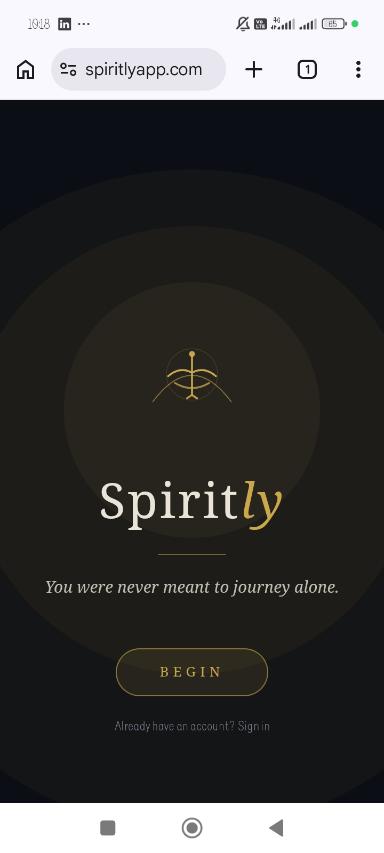
You were never meant to journey alone.
Built With
- cloud-firestore
- css
- expo-router
- expo.io
- firebase
- firebase-authentication
- firebase-hosting
- gcash
- gemini-api
- git
- google-cloud
- html
- javascript
- metro
- node.js
- react-native
- react-native-svg
- typescript


Log in or sign up for Devpost to join the conversation.