-
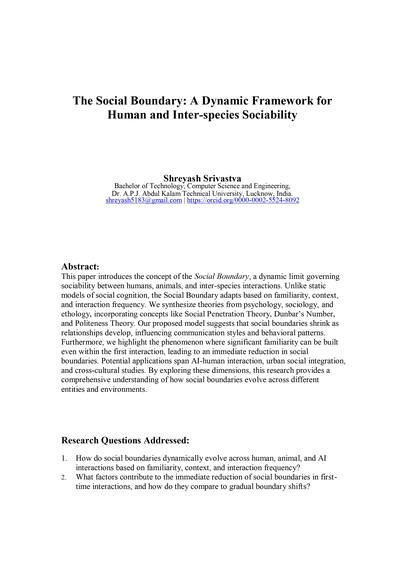
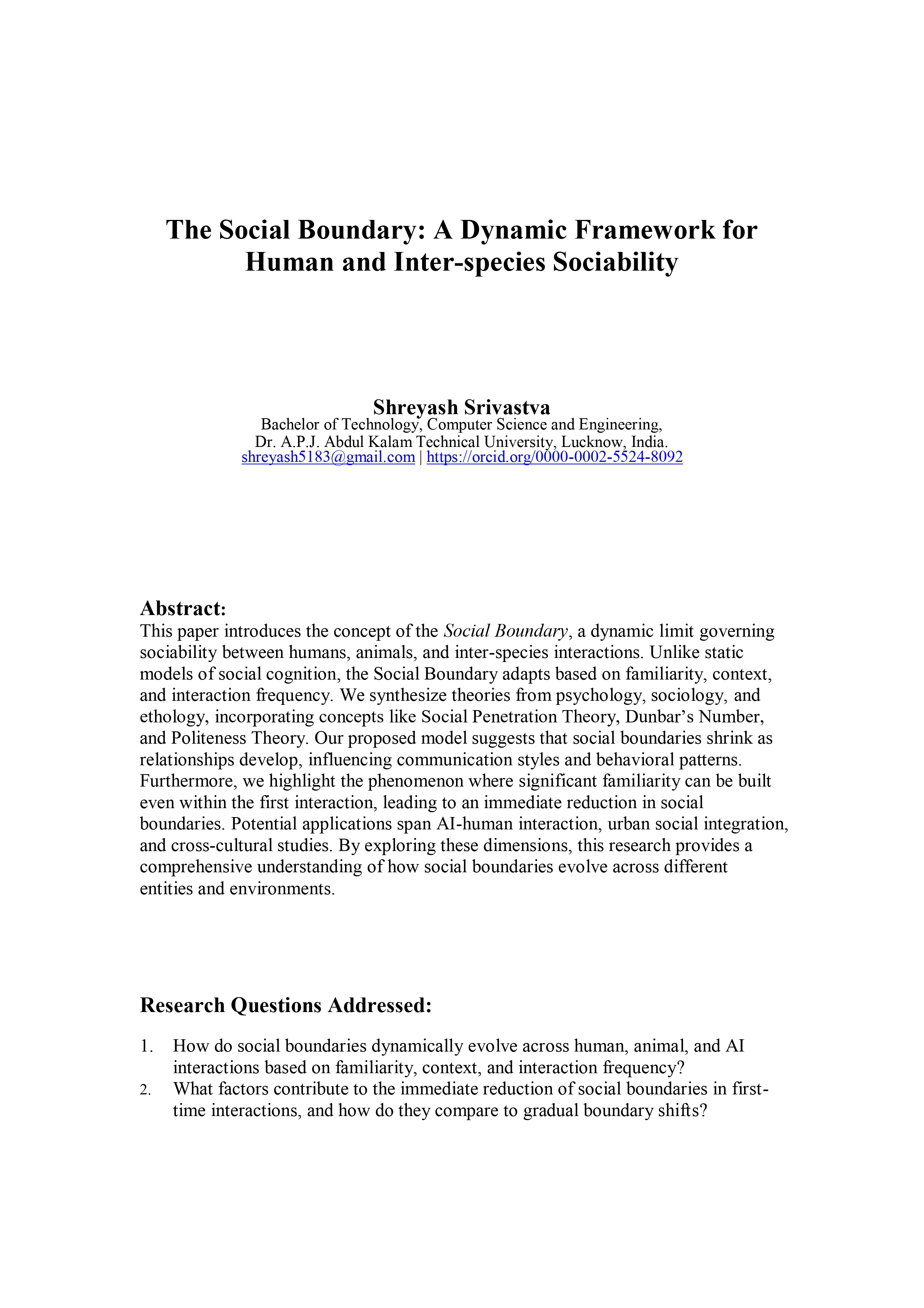
Main Page with Title, Author's Introduction, Abstract and Research Questions
Inspiration
The concept of Social Boundary emerged from a desire to understand the dynamic nature of sociability across humans, animals, and AI. Unlike traditional models of social interaction, we sought to explore how familiarity, context, and interaction frequency contribute to shifts in social boundaries.
What it does
The Social Boundary framework quantifies and models the evolution of social interactions. It explains how relationships transition from formality to informality based on various factors, offering applications in AI-human interactions, urban social integration, and cross-species communication.
How we built it
We synthesized psychological, sociological, and ethological theories, incorporating elements like Social Penetration Theory, Dunbar’s Number, and Politeness Theory. A mathematical model was developed to capture the influence of familiarity, interaction frequency, and context on social boundary dynamics.
Challenges we ran into
- Defining a mathematical model that accurately represents the fluid nature of social boundaries.
- Integrating cross-disciplinary theories into a cohesive framework.
- Addressing cultural variations in social boundary evolution.
- Considering ethical implications in AI-driven applications.
Accomplishments that we're proud of
- Developing a dynamic model that adapts across human, animal, and AI interactions.
- Providing insights that can improve AI adaptability and enhance digital human-computer interactions.
- Laying the groundwork for future research in social robotics and cross-cultural studies.
What we learned
- Social boundaries are highly contextual and influenced by both immediate and long-term factors.
- AI and social robotics can benefit from adaptive models that mimic human-like sociability.
- Understanding interspecies social boundaries can aid in wildlife conservation and human-animal interaction strategies.
What's next for The Social Boundary
- Empirical validation through observational studies and AI-human interaction experiments.
- Refining the mathematical model to improve predictive accuracy.
- Exploring real-world applications in urban planning, social robotics, and cross-cultural communication.
- Investigating the impact of digital interactions on social boundary evolution.


Log in or sign up for Devpost to join the conversation.