Inspiration
AI is amplifying human capability faster than responsibility, institutions, and knowledge governance can adapt.
The same problem appears inside AI-assisted research systems. An unsupported inference can be summarized, linked, and reused repeatedly until it begins to look like established truth. A system that remembers more is not necessarily a system that knows better.
The Second Gate began as a long-horizon research program about human agency in the AI age. It asks how people and institutions can preserve freedom, responsibility, and truthful reasoning while increasingly powerful technologies weaken older constraints on desire and action.
What it does
The Second Gate is a truth-governed research operating system.
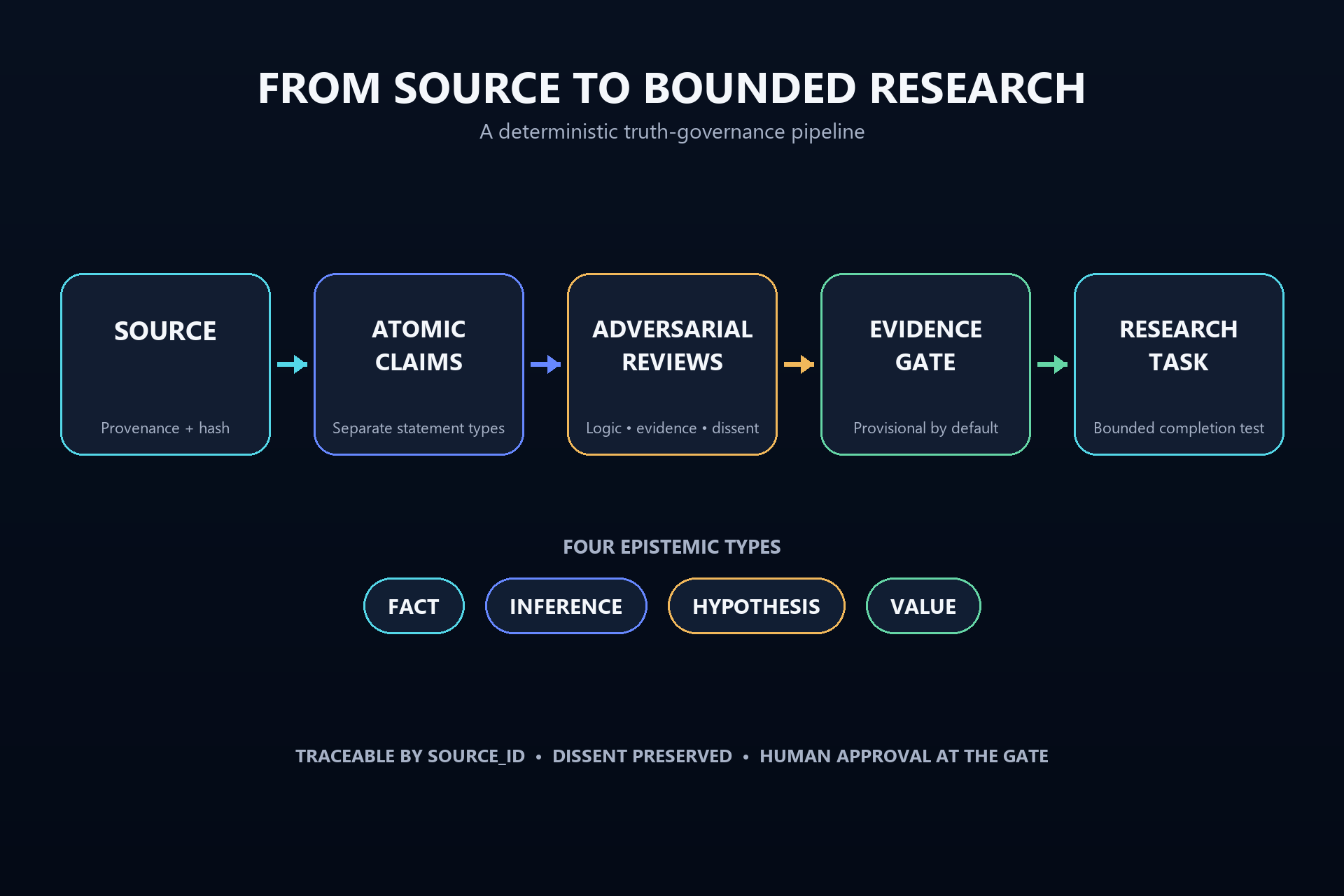
The submitted project provides a deterministic, one-command demonstration that turns a public-safe research source into:
- a source snapshot with provenance and content hashes;
- four atomic epistemic objects: fact, inference, hypothesis, and value judgment;
- four adversarial reviews: Logician, Empiricist, Adversarial Steelman, and Ideological Capture Auditor;
- a synthesis that preserves agreements, disagreements, assumptions, and evidence gaps;
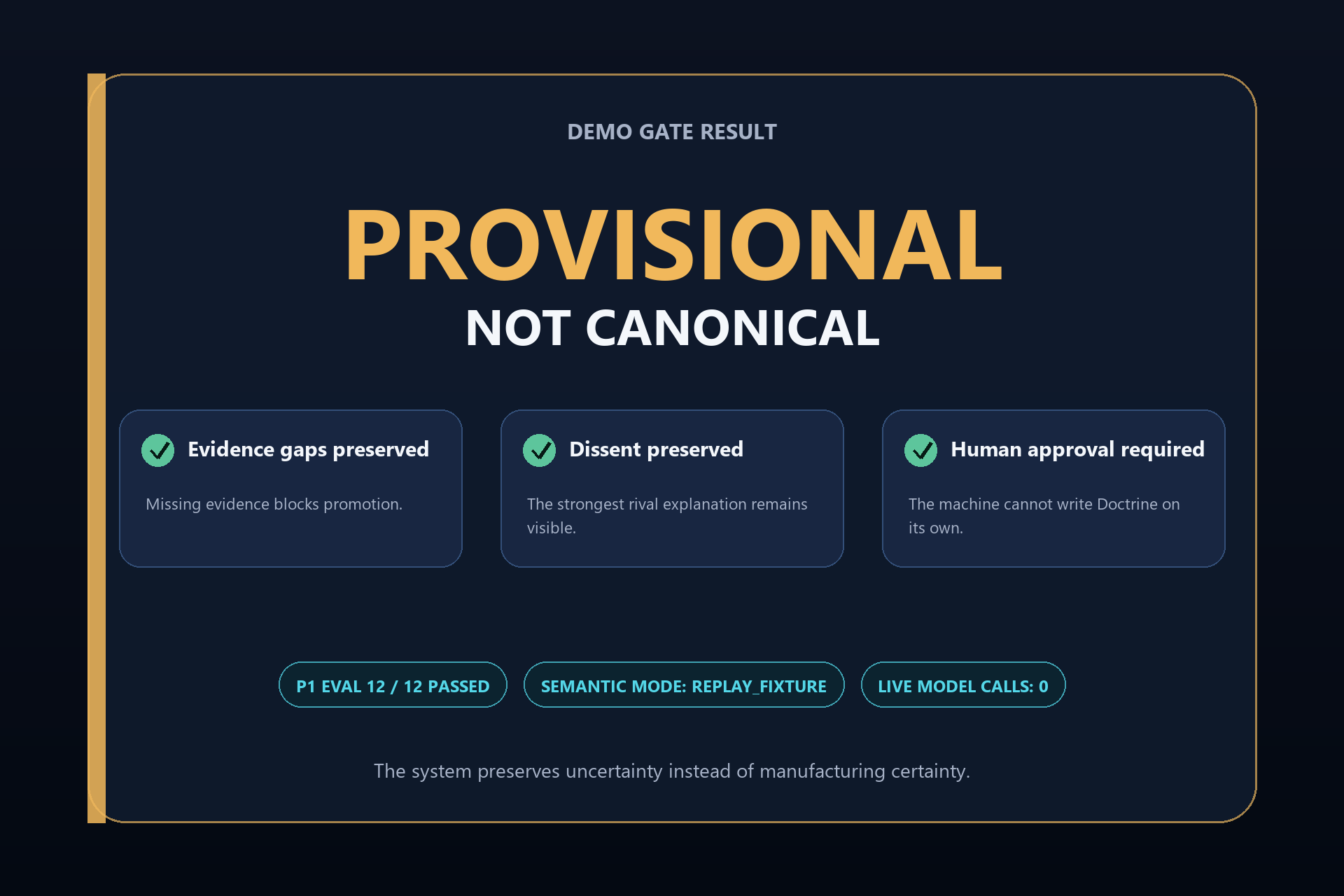
- an evidence Gate that returns PROVISIONAL / NOT CANONICAL;
- a bounded Armory research task with a completion test;
- a traceability query linking every derived object back to the source;
- an Obsidian-compatible Markdown Vault, evaluation report, and run manifest.
The system does not allow unsupported claims to become permanent knowledge automatically. It preserves dissent, blocks canonical promotion when evidence is insufficient, and reserves final normative authority for explicit human approval.
The submitted runtime is deterministic and reproducible. It uses a clearly labeled, project-authored replay_fixture, requires no API key, and makes no live model calls.
How we built it
GPT-5.6 Sol powered the primary Codex build thread.
Codex was used for:
- architecture and workflow design;
- Python implementation;
- Windows debugging and compatibility work;
- test design and regression repair;
- provenance, hashing, and traceability;
- adversarial-review structure;
- JSON schemas and validation;
- privacy and copyright controls;
- Git and GitHub preparation;
- Obsidian visual verification;
- submission images, documentation, and video production.
Deterministic Python code handles ingestion, object IDs, validation, permissions, state transitions, file generation, evaluation, and safety checks.
The semantic material shown in the submitted runtime is a fixed, public-safe replay fixture. It is not presented as fresh GPT-5.6 inference. The repository also contains broader Skill definitions, role descriptions, schemas, and workflow foundations for future live and independently isolated agent execution.
Challenges
The hardest problems were not ordinary note-taking or file storage.
We needed to address several deeper risks:
- repeated AI summaries can compound error as easily as knowledge;
- facts, inferences, hypotheses, and values must not be silently merged;
- disagreement must remain visible after synthesis;
- ideological auditing must challenge both mainstream conformity and reflexive anti-conformity;
- private conversations and unpublished research must remain outside the public demo;
- a failed process must not report false success;
- AI must be able to challenge the author without silently replacing the author’s normative responsibility;
- the demo must remain reproducible without API keys, network access, or hidden dependencies.
These problems were addressed through provenance records, stable hashes, epistemic classifications, protected authority zones, evidence Gates, bounded research tasks, explicit stopping conditions, privacy boundaries, and regression tests.
Accomplishments
During Build Week, the project produced:
- a working one-command deterministic demo;
- an Obsidian-compatible demonstration Vault;
- stable source-to-claim-to-review-to-Gate traceability;
- fact, inference, hypothesis, and value schemas;
- four adversarial-review roles and synthesis;
- a provisional evidence Gate with canonical writing disabled;
- bounded Armory research tasks;
- safe failure propagation and deletion guards;
- public-safe seed material and privacy controls;
- reproducible Git provenance and output hashes;
- a reusable Codex Skill and workflow foundation;
- a 12/12 deterministic evaluation result;
- 21/21 tests passing on Python 3.13;
- 21/21 tests passing on Python 3.14.
The project does not claim to have solved civilization-scale governance. It demonstrates a practical method for researching difficult questions without allowing fluent AI output to replace evidence, dissent, or human responsibility.
The underlying research program and theory existed before Build Week. The tested Windows implementation, deterministic end-to-end demo, provenance engineering, safety controls, evaluation suite, Demo Vault, GitHub preparation, and submission materials were developed during Build Week.
What we learned
A useful second brain should not merely remember more. It must also preserve:
- where a claim came from;
- what type of statement it is;
- what evidence supports or weakens it;
- which assumptions remain unresolved;
- who disagreed and why;
- what would falsify or narrow the claim;
- whether human approval is still required.
We also learned that uncertainty should not be treated as a defect to be hidden. In a truth-governed system, preserving uncertainty can be a successful result.
What's next
The next stages are to:
- add live semantic execution while retaining the deterministic replay path;
- run review roles as independently isolated agents before synthesis;
- expand the public evaluation set and adversarial test cases;
- improve ingestion from explicitly authorized conversation sources;
- compare models and review configurations without allowing a model to grade itself;
- formalize concepts such as Stable Complexity Capacity;
- connect the research system to papers, institutional-design proposals, and the book The Second Gate.
The long-term goal is not to automate human judgment. It is to build infrastructure that preserves truth, disagreement, provenance, and human responsibility as AI systems become more capable.

Log in or sign up for Devpost to join the conversation.