-
-
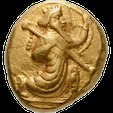
Image of the ancient Persian coin in game
Inspiration
Our team has created a text-based game adapted from the Histories by Herodotus, the classical Greek historian who lived in the 5th century BC. In doing so, we have sought to explore innovative ways of melding modern approaches in computer science with the timelessness wisdom of classical literature.
We also viewed this project as a unique opportunity to explore an innovative approach to matters like accessibility in education by considering the potential of exciting new ways to reach learners, and to hopefully inspire in them an appreciation, and perhaps even a love, for classical literature.
The project blends computer science techniques related to web development, text formatting, and front-end development with historiography techniques of critical textual analysis of ancient primary source material. It is inspired by a deep and overriding desire on the part of the authors to explore innovative and dynamic opportunities to apply ancient knowledge to modern computer-based applications.
What it does
Our text-based game adaptation of Herdotus' Histories strives to transport players into the fascinating world of the ancient Near East in the 5th century BCE.
Classical literature is filled with morals that transcend time and space. It provides a chance to grow one's logical thinking and to expand one’s perspective. We choose to make a game based on the writings of Herodotus because his analysis of the great historical events of his time is considered one of the great founding literary works in Western civilization.
Herodotus' Histories holds exceedingly high value, because of its systematic structure involving cause and effect, critical thinking and objective analysis. His structured approach in narrating his historical account also lends itself in interesting ways to this unique adaptation to a modern computer game format.
The game guides users through one particular series of events, detailed at the beginning of Book 3 of Herodotus, during which Cambyses II, King of the Achaemenid Empire (530–522 BCE), embarks on an expedition of conquest against Egypt, then ruled by Amasis II, the Pharaoh of Egypt during the last phase of the 26th Dynasty of Ancient Egypt. The game recounts some particular events told to us by Herodotus on themes like the motivations attributed to Cambyses for embarking on his invasion of Egypt, as well as the journey which he and his army took to get there. This journey required a difficult desert crossing, and this required the forging of unique alliances.
Along the way, the player encounters a myriad of fascinating characters, who are described to us by Herodotus, including some of the challenging situations which these characters were faced with and some of the deep moral questions with which they had to struggle.
While it is fascinating to view the world of Herodotus through his eyes, one might also say that Herodotus transcends time with his analysis, and that he speaks with great prescience to the highly interconnected global community in which we live today.
How we built it
After an initial brainstorming phase, we created a universal website structure for hosting content in JSON files.
We wrote the game contents based on close study of our historical source material.
We utilized AI solutions provided by ChatGPT and DeepSeek at many phases in the design and implementation process. It proved very useful for things like contextual background historical research, trouble shooting bugs, templating JSON files, and addressing a wide variety of technical questions.
We continually enhanced our design features using CSS, while expanding our collection of JSON game files.
Challenges we faced and what we learned along the way
Implementing our design concepts all the way through to the final presentation form involved a lot of challenges to overcome, with many opportunities to learn new things along the way. Becoming comfortable with the development tools was a particular challenge in and of itself, and we gained a real appreciation for how much more there is to learn about utilizing these tools in the most effective ways.
We relied heavily on Visual Code Studio for our development tasks, and on GitHub for collaboration among team members. While this was challenging at times, it also represented a great opportunity to learn key skills for software development through tangible real-world application.
Key impacts and objectives
The project tangibly contributes to United Nations Goal 4:
"Ensure inclusive and equitable quality education and promote lifelong learning opportunities for all.”
With a goal to promote broader access to classical literature and the timeless values embodied in these works, our team approached web design with accessibility in mind.
The game uses JSON files as its content device. This files are exceedingly easy to modify and deploy, which means this project is endlessly replicable across an immense range of content areas. It is very amenable for those who would wish to access our core files and create entirely new text games from our examples, which will run seamlessly on our platform.
In adapting the adventures of Herodotus to our web-based game, we relied on our close reading of the book's content, and tried to bring these narratives to life through the game format. We also sought to create an intuitive and user-friendly interface, with exclusivity in mind, including ensuring that individuals with specific learning challenges could enjoy this content with ease.
Our team used pastel-toned colors that do not strain the eyes, carefully considered the amounts of space between letters, and used fonts that are recommended for people with visual impairments and other accessibility needs
We also strived to remain true to the original spirit and contents of Herodotus' text at all stages of our implementation, and to incorporate a coherent historical backdrop to our game design. We also considered this in creating our own unique color palette from ancient Persian artifacts and carefully matched these to our font and to other design aspects.
Accomplishments
Our entire team is extremely proud of the project that we have created. It was highly fulfilling to see the project through all phases of the design and development process, and to be able to test out ideas and new approaches as we went along. To experience having our ideas come to life before our very eyes highly fulfilling in and of itself. Moreover, that we were able to blend our admiration for classical literature with our more newfound and burgeoning love for computer science in a way that is both unique and functional is something we feel is a big accomplishment.
What's next for Chewon Cho, Christopher Vote and Mikhail Gaydashevskiy?
One application which we are planning is to create an AI model that automatically generates JSON files for our game from classical literature which is fed into the model. We plan to use the JSON file data we have created in this hackathon as some of the training data for this model.
We are also intent on continuing to explore exciting new ways in which ancient knowledge and modern technology may be made to intersect.
References
Primary Sources:
Herodotus. Herodotus, with an English Translation by A. D. Godley. Vol. 3. Cambridge, MA: Harvard University Press, 1922. Accessed via Internet Archive. link
Aesop. Aesop's Fables. Translated by George Fyler Townsend. London: George Routledge and Sons, 1867. Accessed via Internet Archive. link
Other Sources Consulted:
Herodotus. The Famous Hystory of Herodotus. Translated into English by B. R. Anno 1584. With an Introduction by Leonard Whibley. London: [Publisher Unknown], 1584.
Herodotus. The Histories. Translated by Tom Holland. Introduction by Paul Cartledge. New York: Penguin Classics, 2013.
Herodotus, Robin Waterfield (Translator), and Carolyn Dewald (Editor). The Histories. Oxford: Oxford University Press, 1998.
Herodotus. 헤로도토스 역사 (Historiae). Translated by 박현태 (Hyun-Tae Park). 2nd ed., 4th printing. Seoul: Dongseo Munhwasa (동서문화사), 2013. First published 1977. ISBN 978-89-497-0480-7.
DeepSeek. DeepSeek. link
OpenAI. ChatGPT. link


Log in or sign up for Devpost to join the conversation.