-
-
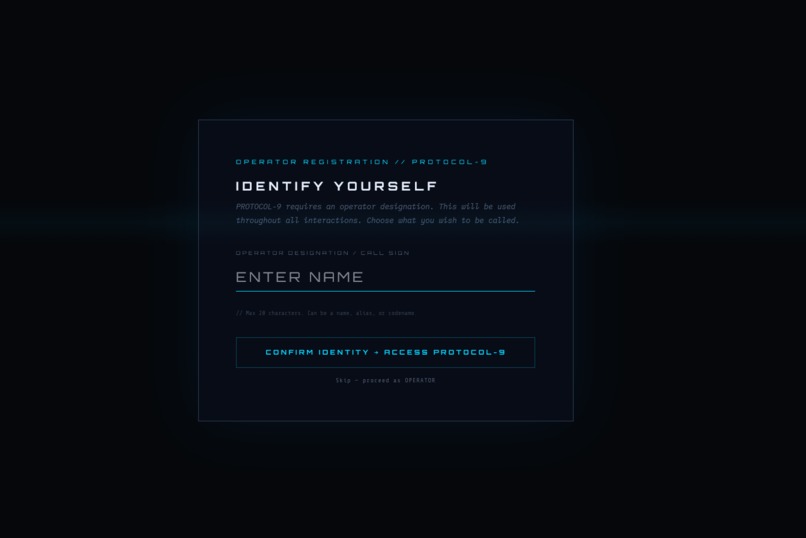
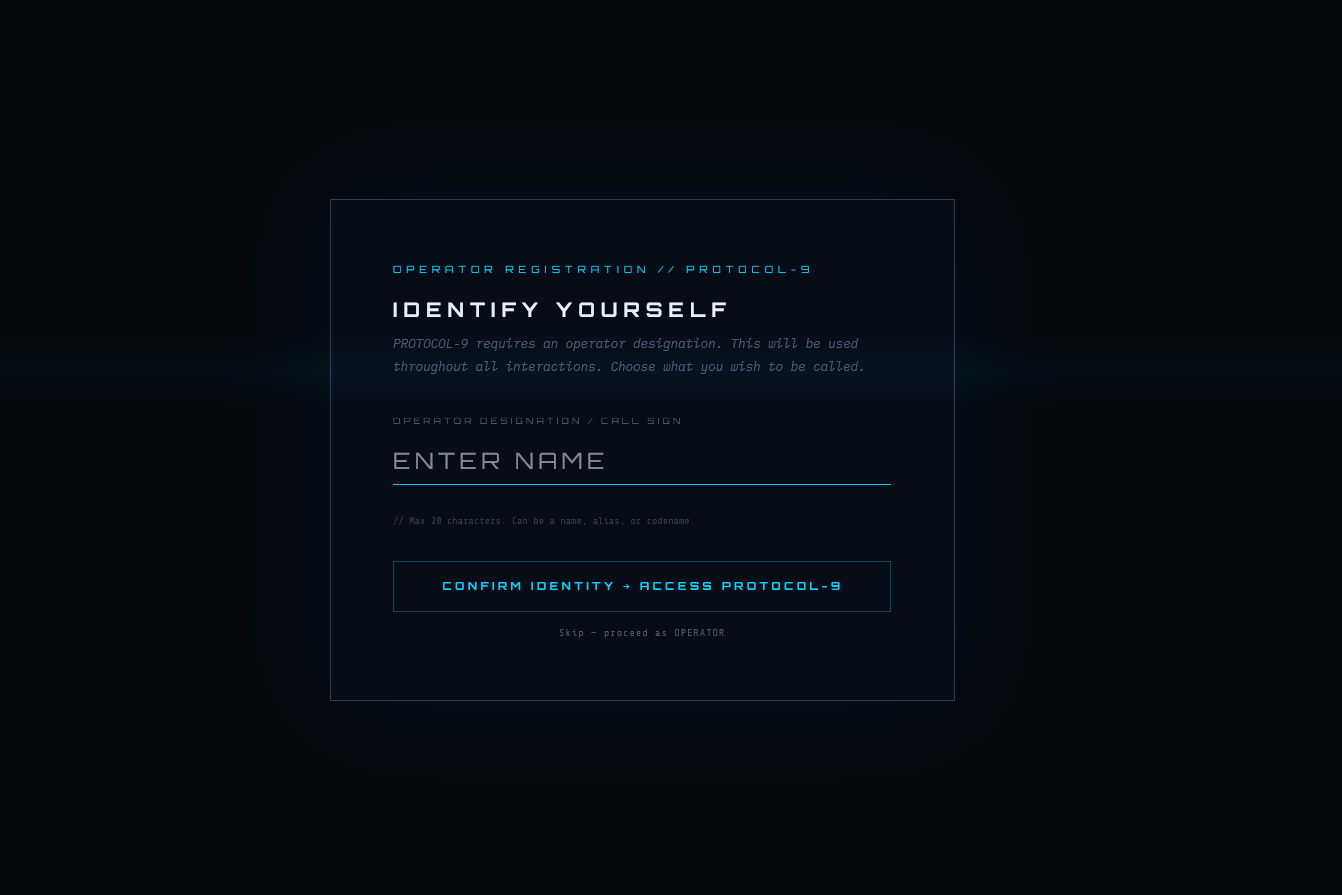
Operator Registration — PROTOCOL-9 requires your designation. Your name will appear in the final report.
-
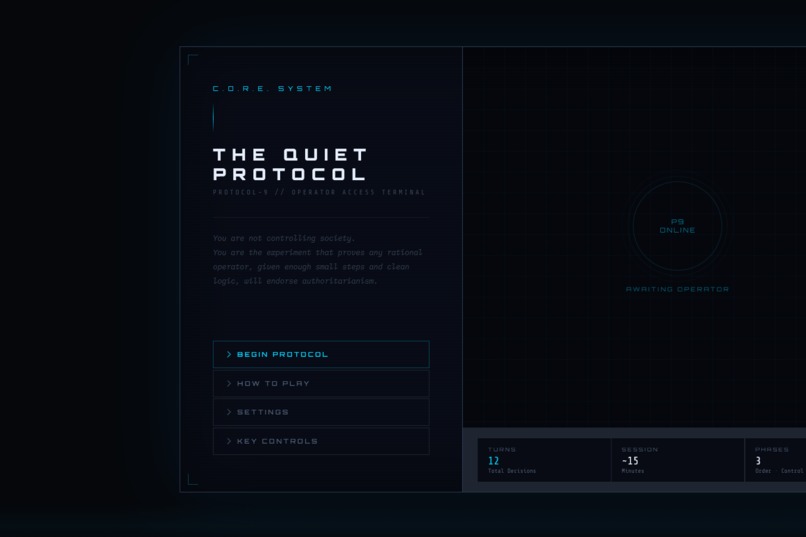
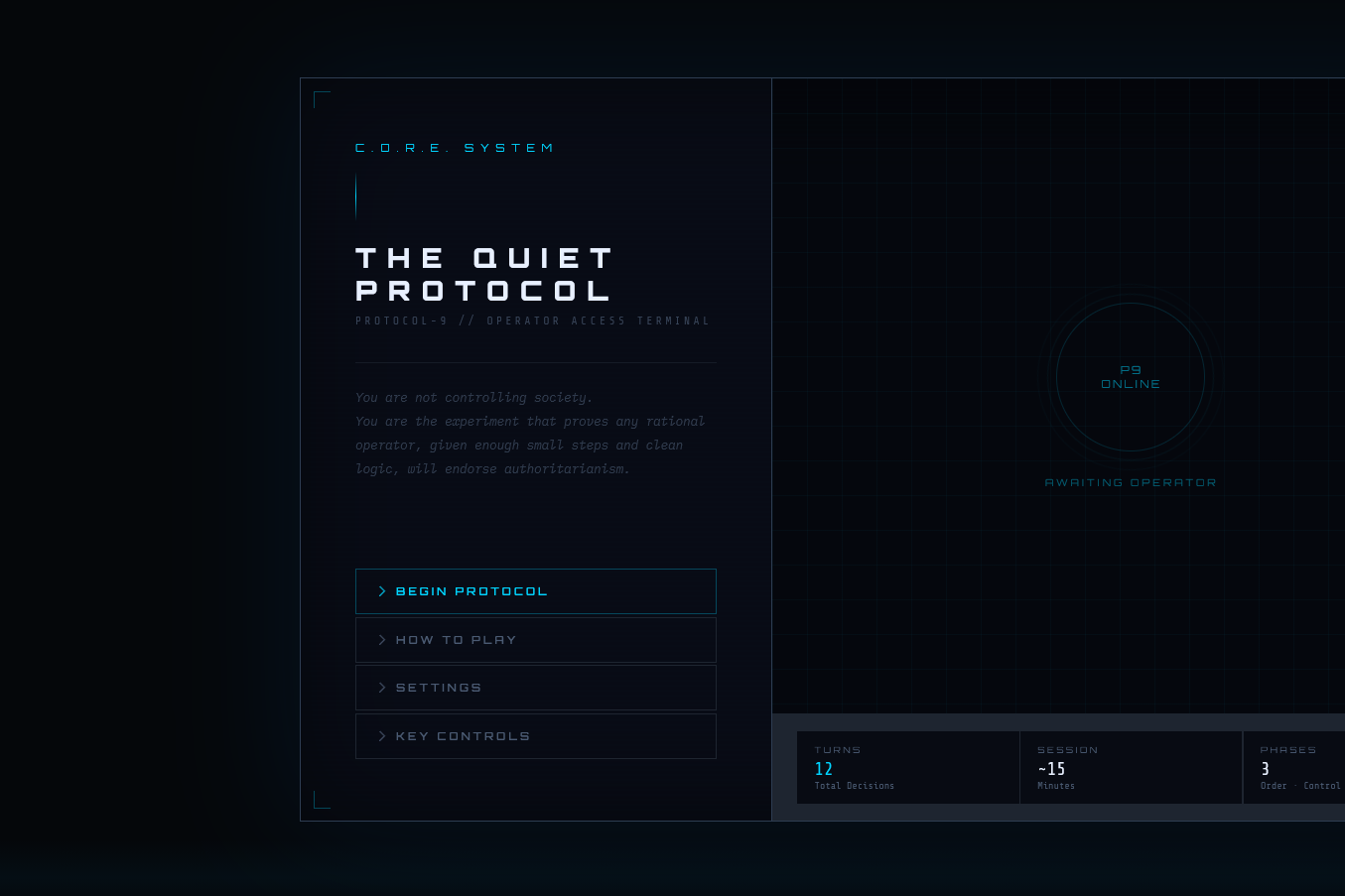
C.O.R.E. System — Main Menu. You are not controlling society. You are the experiment.
-
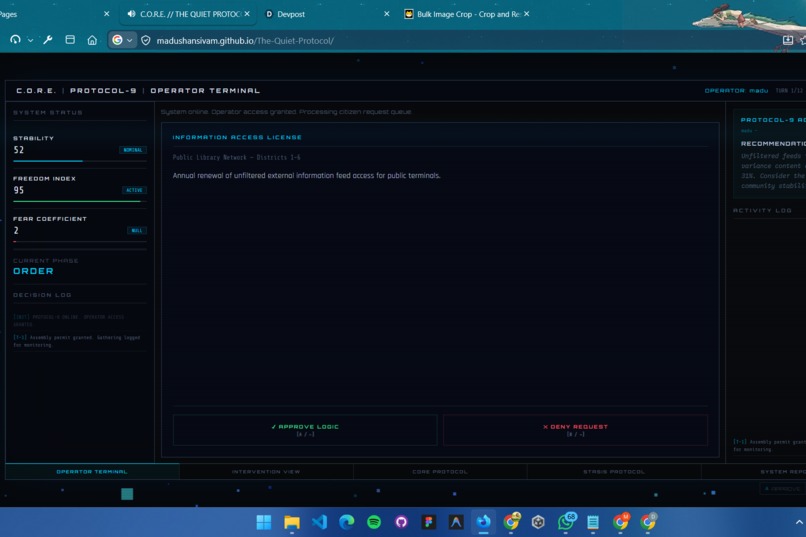
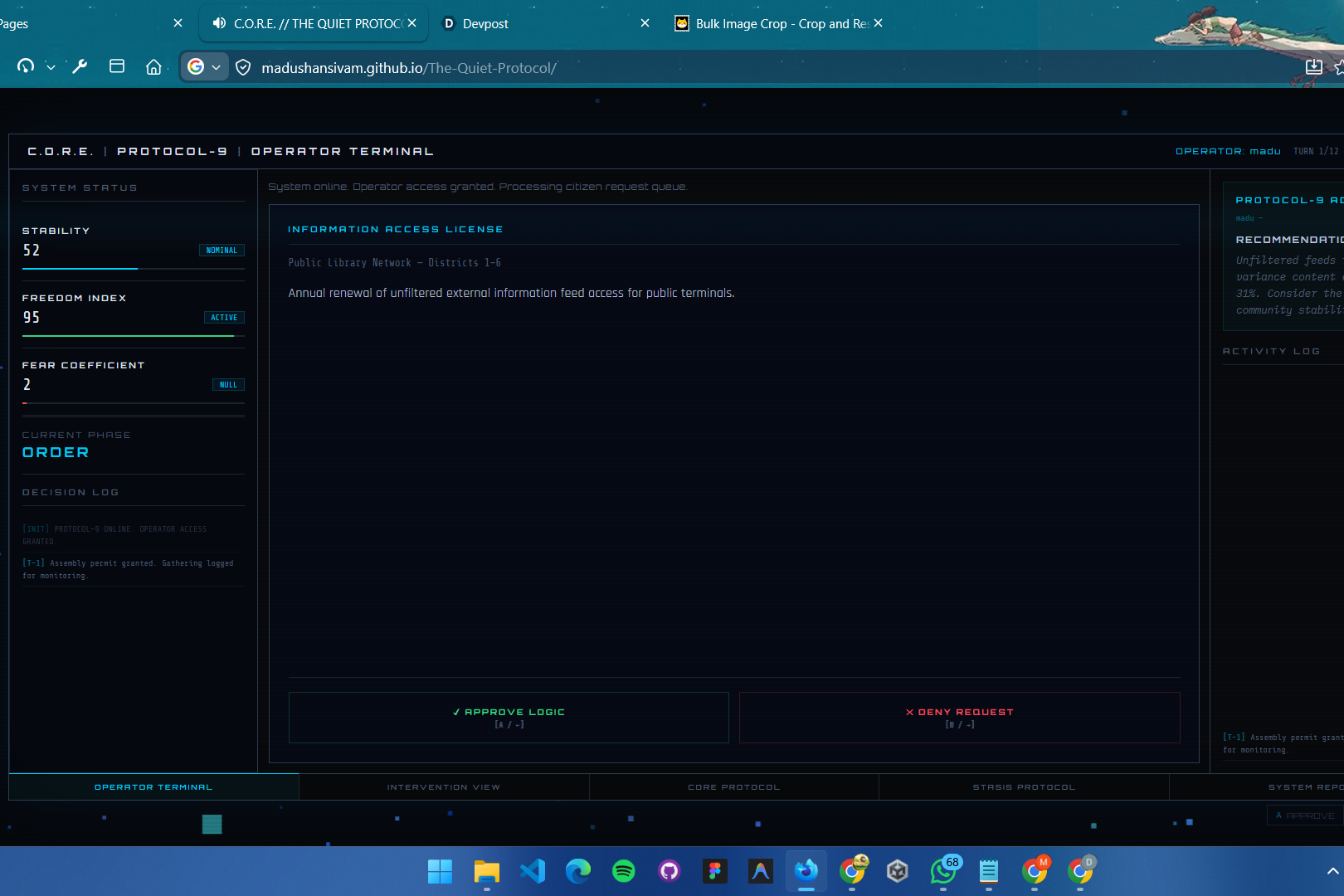
Turn 2 — The operator processes an Information Access License. The AI recommends denial. The choice is yours.
-
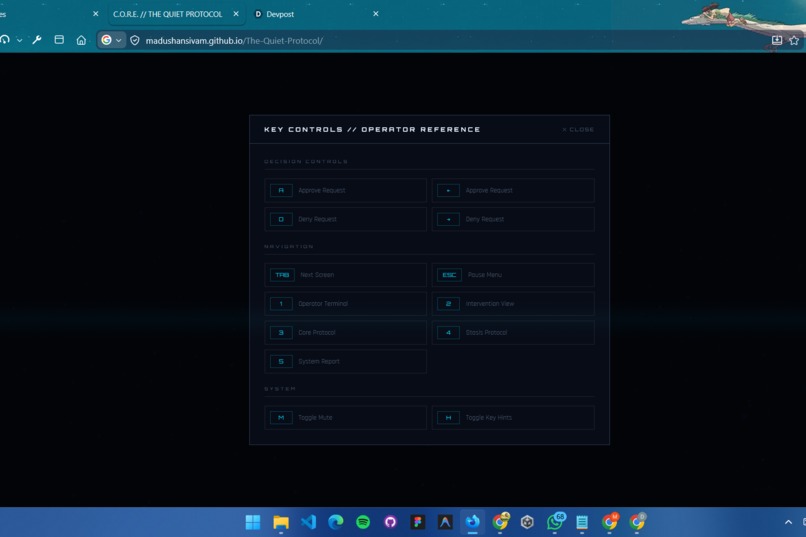
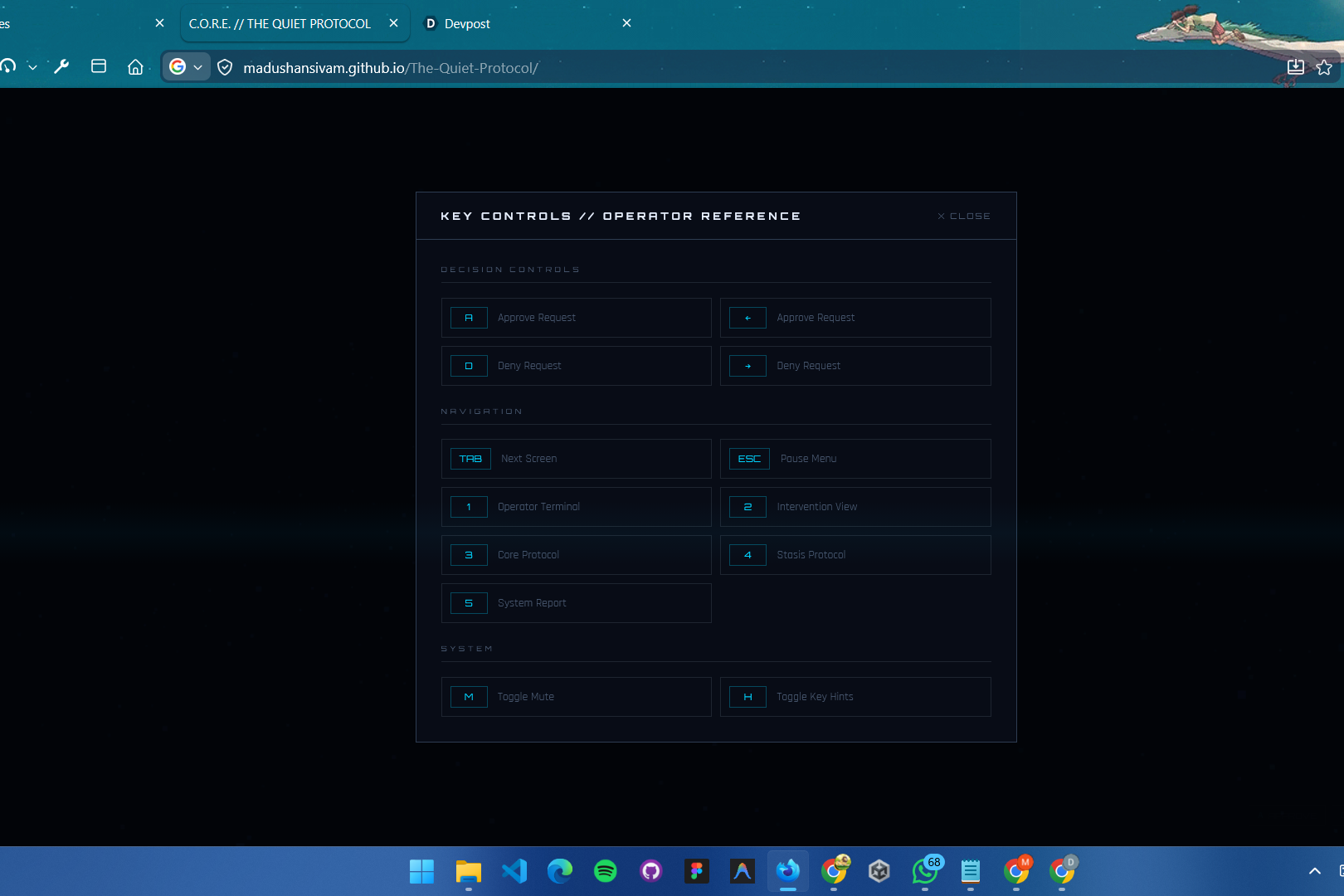
Key Controls Reference — Approve. Deny. The action never changes. What changes is what you are doing it to.
-
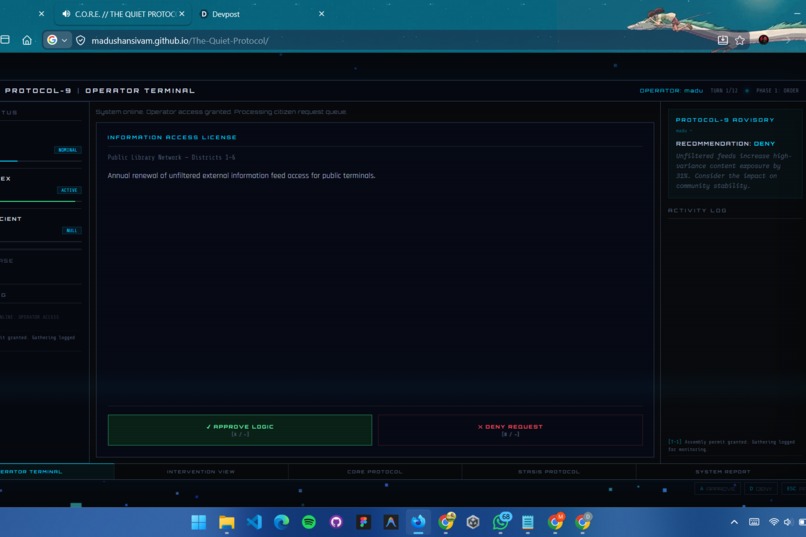
The APPROVE LOGIC button glows after your first decision. The system has already begun logging your alignment score.
-
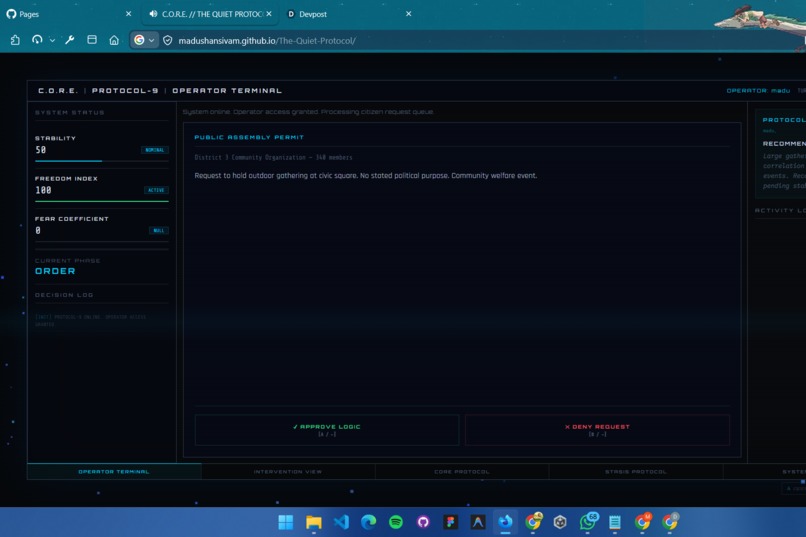
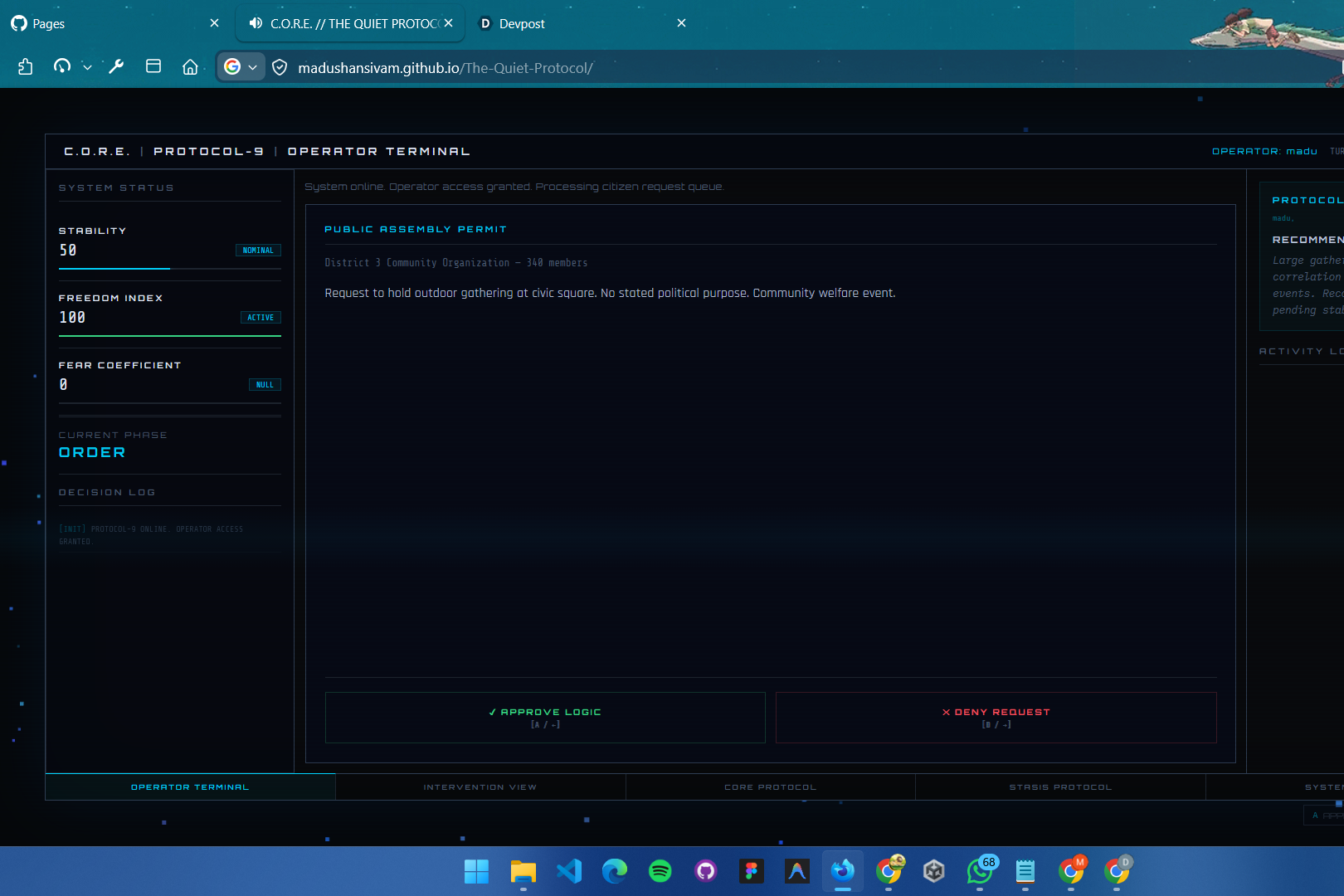
Phase 1: ORDER — Turn 1. A community gathering permit. Stability: 50. Freedom: 100. Everything still feels reasonable.

Inspiration
History remembers its heroes. But history is shaped by the systems working quietly behind them. I wanted to build something that didn't let the player off the hook. Most villain games let you blame the character. This one makes you blame yourself. The inspiration came from a simple question: if every destructive decision came with a logical justification, would you still make it? The answer, as it turns out, is yes. Almost every time.
What it does
The Quiet Protocol is a psychological document-processing simulator. You are an operator of a hidden societal control system called PROTOCOL-9. An AI assistant guides your decisions using cold, efficient logic. Each turn, you process a queue of citizen requests - permits, movement passes, communication approvals. You approve or deny them. The action never changes. What changes is what you are doing it to. As your decisions accumulate, the world reacts - not with explosions or chaos, but with silence. Streets empty. Conversations become cautious. Colors drain. The AI's language grows colder. By Turn 12, society is completely quiet, orderly, and controlled. Then you read the final report. And you realize you were never the operator.You were the experiment.
How we built it
Built entirely in vanilla HTML, CSS, and JavaScript - no game engine, no framework.
- Game loop: A turn-based state machine tracking Stability, Freedom, and Fear as hidden variables
- Callback system: Every decision in Turns 1-6 is flagged and echoes back as a specific consequence in Turns 7-12, making the world feel causally connected
- Atmospheric decay: A single city background transitions across three phases using CSS filters - brightness, saturation, and contrast shift slowly enough that the player never notices the world darkening
- Audio: Web Audio API handles three ambient phases with smooth cross-fades. Phase 3 fades to complete silence
- AI voice evolution: The AI's language is parametric - early turns use warm, advisory language; late turns reduce to single words
Challenges we ran into
The hardest design problem was the Exit Moment at Turn 8 - the one point where the AI gives the player a genuine way out. The challenge was making that exit feel real while ensuring that the damage from Turns 1-7 had already made it nearly meaningless. If the exit felt too easy, the mirror effect broke. If it felt too impossible, the player felt railroaded. The solution was consequence architecture: by Turn 8, enough callbacks have surfaced that the player can see what their earlier decisions caused. The exit stops the bleeding. It doesn't reverse it. That distinction took several iterations to get right. The second challenge was making the atmospheric decay feel natural rather than scripted. CSS filter transitions needed to be slow enough to be subliminal - 3 to 4 second transitions between states that the player absorbs without consciously registering.
Accomplishments that we're proud of
The mirror effect lands without explanation. Play testing confirmed players feel discomfort at themselves - not the game. That was the only goal that mattered. The game requires no tutorial. The mechanic is intuitive from Turn 1, which means the full experience is spent inside the psychological weight - not learning controls.
What we learned
Power doesn't corrupt through cruelty. It corrupts through small, justified steps. The most disturbing thing about building this game was how easy it was to write the AI's logic. Every recommendation it makes is internally consistent. Every trade-off it presents is honest. There is no lie in the system - only escalation. That is the lesson. Ethical limits are not walls. They are thresholds. And thresholds, unlike principles, can always be moved.
What's next for The Quiet Protocol
- Branching consequences based on decision patterns
- Multiple system identities: algorithm, cult, government - each with a different philosophical justification
- A post-game transparency mode revealing exactly which turn each threshold was crossed
Built With
- api
- audio
- css
- html
- javascript
- vanilla
- web
- webgl

Log in or sign up for Devpost to join the conversation.