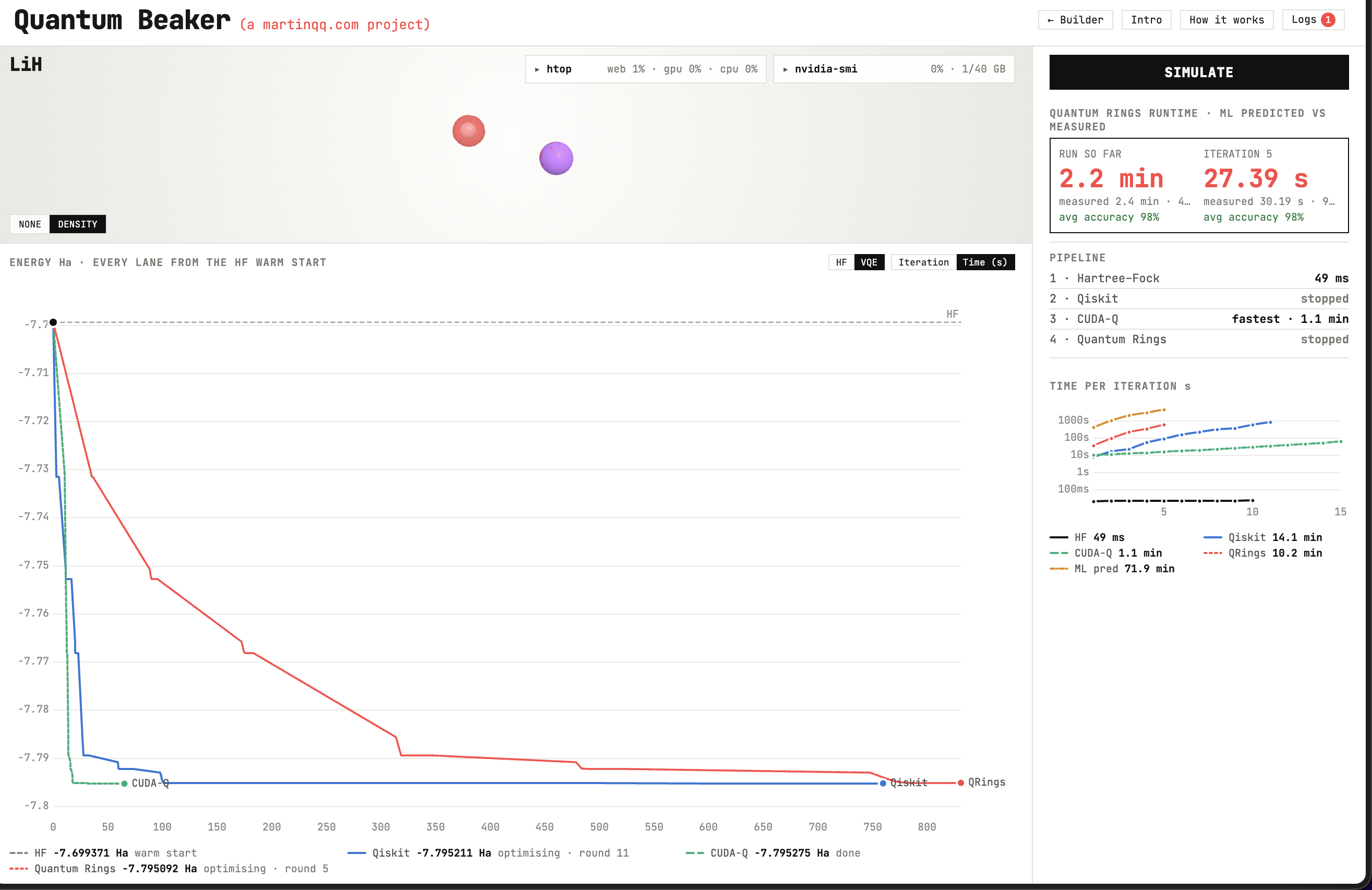
Planck Scale — Quantum Rings Runtime Predictor Planck Scale predicts how long a quantum circuit will take to run on the Quantum Rings SDK—without running the simulation first. Given an OpenQASM 2.0 or 3.0 circuit and a simulator threshold (16, 64, or 512), our system outputs a predicted wall-clock runtime in seconds. It also identifies likely timeouts by predicting the challenge’s 14,400-second cap. Inspiration Quantum simulation cost is difficult to estimate from simple circuit measures such as qubit count or total gate count. A circuit’s gate ordering, entanglement structure, parameter angles, and interactions across qubits can dramatically affect classical tensor-network simulation time. We wanted to make those hidden structural costs visible before committing compute resources. What it does Our predictor reads raw OpenQASM source and builds a compact structural representation of the circuit. It then predicts runtime for the requested Quantum Rings threshold. The model combines:
- A bounded OpenQASM 2/3 parser designed for large circuits
- Temporal cut and tensor-network-inspired χ (bond-dimension) features
- An angle-aware effective-entanglement walk that avoids treating every controlled or rotation gate as equally expensive
- Circuit graph, DAG, gate-mix, parameter-angle, and source-shape features
- A global log-runtime ExtraTrees regressor blended with specialist models for thresholds 16, 64, and 512
- Per-threshold timeout classifiers and targeted lower-bound safeguards How we built it We started with basic circuit statistics, then moved beyond raw gate counts by modeling how a Matrix Product State-style tensor train can grow as gates create entanglement across qubit cuts. The feature pipeline estimates where costly interactions occur, how long they persist, and how simulator thresholds constrain the representation. We trained the runtime model on approximately 532 circuits from MQT Bench, QASMBench, Quantinuum, and Google’s 2019 Sycamore circuit collection, evaluated across up to three thresholds. To avoid relying on filename shortcuts, all predictions are driven by the circuit’s source structure. Our final approach uses 241 selected features across the global model, threshold specialists, and timeout models. On fixed circuit-grouped, distribution-matched out-of-fold validation, it achieved a score of 0.92691. We treat this result cautiously: feature selection used released labels, so hidden-holdout performance may differ.
Challenges we ran into
The hardest part was translating quantum-circuit behavior into features that a classical model can use. Naively assuming every two-qubit gate maximally increases entanglement overestimates runtime, especially for near-basis rotations or controls that remain in classical states. We addressed this with a gated χ walk that accounts for small angles, classical controls, threshold caps, and the geometry of interactions between qubits. We also had to keep feature extraction and inference within the challenge’s 15-second per-circuit limit, including for very large OpenQASM files. Accomplishments we’re proud of
- Built a source-only runtime predictor for OpenQASM 2 and 3 circuits.
- Developed quantum-guided, tensor-network-inspired features rather than relying only on generic circuit counts.
- Combined global and threshold-specific models with explicit timeout handling.
- Kept the system bounded and practical for large circuit files.
- Documented feature selection, validation, failure modes, and model behavior for explainability. What we learned Quantum runtime prediction is not just a machine-learning problem—it is a representation problem. Incorporating simulation-aware signals such as entanglement growth, cut geometry, gate timing, and threshold effects made the model more meaningful than using circuit size alone. What’s next We would like to validate the approach on a fully unseen benchmark suite, improve calibration for rare circuit families, and explore more accurate learned representations that preserve the strict runtime constraints of the challenge.
Built With
- extratrees
- machine-learning
- numpy
- openqasm
- python
- quantum-computing
- scikit-learn
- tensor-networks
- zstandard

Log in or sign up for Devpost to join the conversation.