-
-
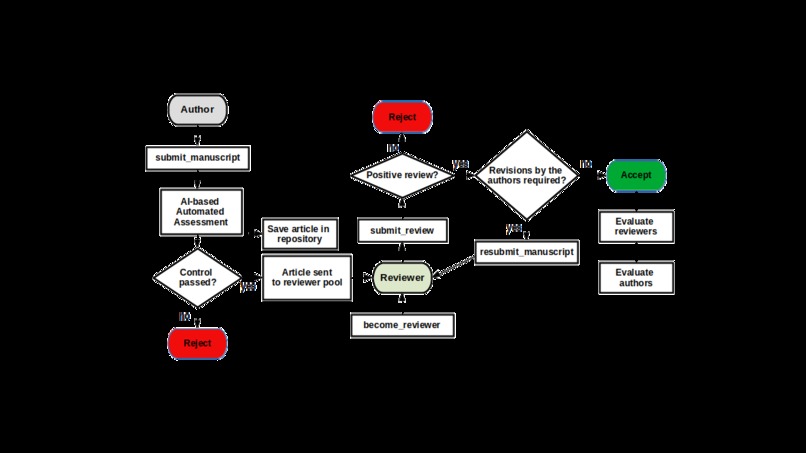
Peer-reviewing flowchart
-
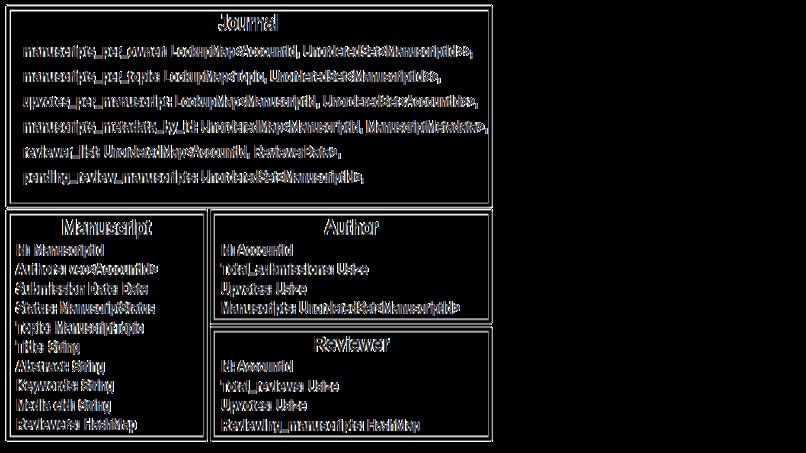
Main contract design


Inspiration
Scientific journals are a periodical publication intended to encourage the progress of science by reporting new research works. However, conventional scientific journals present some serious problems:
1) Journals work in an unfair manner: once an author submits an article, multiple reviewers are asked to review it (for free). Most of them deny the offer, while the ones accepting it, perform a fast and most of the times poor review.
2) Most of the conventional journals do not make use of a version control. Since the article is firstly submitted, until it gets accepted and published in the journal, many versions of the article have been completed considering the recommendations of the reviewers. A version control gives an amplified idea of the trajectory of the article and the quality of the reviews.
3) Many resources are allocated in managing the initial revision process before it is sent to reviewers. Tasks such as plagiarism detection and “out of scope” article detection could be automated by modern Artificial Intelligence (AI) systems.
4) Scientist feel that the reviewing process may be sometimes obscure, the accepting decision is sometimes influenced by internal factors not related to the submitted manuscript’s quality.
In an attempt to solve all these problems, we introduce The Prophet, a decentralized and automated journal that is strongly oriented to an open peer-reviewing process.
What it does
The Prophet is a decentralized and automated digital journal. As opposed to conventional journals, The Prophet uses blockchain technology to manage and store scientific articles, incentivize reviewers and reward top authors. Moreover, it uses artificial intelligent systems to automate and lighten the article revision process.
The Prophet framework encompasses the main processes in peer-reviewing, from manuscript submission to acceptance or rejection, and manages the incentives of reviewers based on public evaluations. On the other hand, articles are stored in a distributed file system that ensures the persistence and accessibility of data. Below we further describe the main processes:
Article Submission. The submission process starts when the author fills the article form with the following items: title, article topic, abstract, key-words and the article file in pdf format. Once the author completes the form, all the manuscript data, with the exception of the pdf file, is stored on the NEAR Protocol blockchain. On the other hand, the article file is uploaded to the IPFS network and an unique identifier of the article will be created.
Peer-Reviewing. Conventionally, an editor invites a reviewer to review a specific article. Instead, the prophet removes the editor role, letting the reviewer take the initiative to start a new review. When a reviewer selects an article to evaluate, a transaction stores the information into the blockchain. To submit a review, another transaction is carried out with the decision of the reviewer.
Reviewer public evaluation. The evaluation of reviewers is conducted by a system that considers both the upvotes that a reviewer receives and the quality of its reviews (short response-time and clear and constructive comments). All users taking part in the review upvoting process need to be previously known as authors or reviewers and they may upvote those reviews that they find helpful and of high quality. The evaluation score of reviewers have a direct impact on the incentives and on the decision power when there are more than one reviews for a certain article.
Author evaluation. Similarly, authors are evaluated by the impact of their articles (upvotes and references). Thus, a reputation system is also constructed around authors.
How we built it
The project can be divided in three main parts: The backend, the storage and the frontend:
The backend consists of a set of NEAR contracts written in rust. The main contract is the Journal, where several LookupMaps are stored, which serve to rapidly access to the journal data, such as the manuscripts of a certain address, or the metadata of a certain manuscript. The metadata of each manuscript stored to the blockchain is shown in the figure below:

Apart from that, the following flowchart describes the primary process of peer-reviewing. Find denoted the functions that are called in each step:

Articles are stored in a decentralized storage service. Particularly, the web3.storage service is used. Content uploaded to web3.storage is stored in an instance of Elastic IPFS, a reliable and performant implementation of IPFS, a decentralized file system that enables the distribution of content in a decentralized network of peers.
The frontend is implemented in React.js, a modern javascript library for building UI based on components.
Challenges we ran into
The main challenges faced during implementation are listed below:
Avoid self-upvoting: In order to avoid users to create several wallets to upvote their own work, we have limited the upvoting action to official authors and reviewers of the journal.
The storage of the article content is another issue. We think that the best option is to store it in a decentralized provider such as web3.storage or Arweave. To create a sustainable framework, the author or reviewer is responsible for paying for the storage costs of their submitted contents.
The third challenge comes when deciding the main structure of the contract. We have been inspired by the NEAR NFT implementation to develop the main fields of the structure, to create an efficient and secure access to the journal metadata.
Accomplishments that we're proud of
We believe that The Porphet constitutes a real breakthrough in the scientific peer-reviewing area. We propose the first completely decentralized solution that will keep growing after the completion of the hackathon.
What we learned
- How to work with the near tools for js and rust to write complex contracts.
- How to store article content in a decentralized storage provider.
- How to connect the contract and storage with the frontend.
- How to create a decentralized journal from scratch.
What's next for The Prophet
- Develop a reference system to automatically detect the reference to another article in The Prophet.
- Improve the UI/UX.
- Add the AI processing system.
- Mainnet.


Log in or sign up for Devpost to join the conversation.