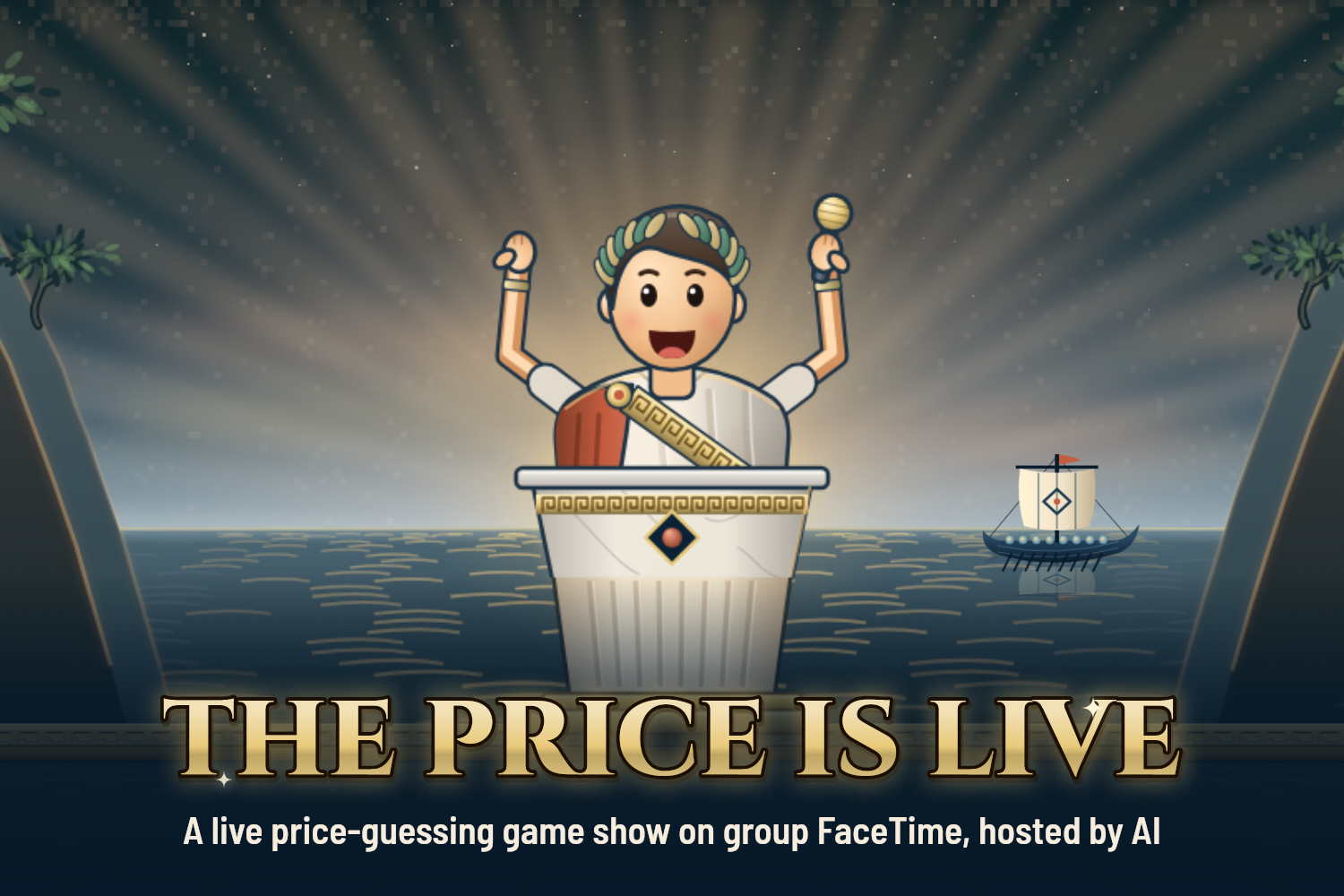
Friends argue about what a banana costs. On a group FaceTime call, that argument becomes a game show.
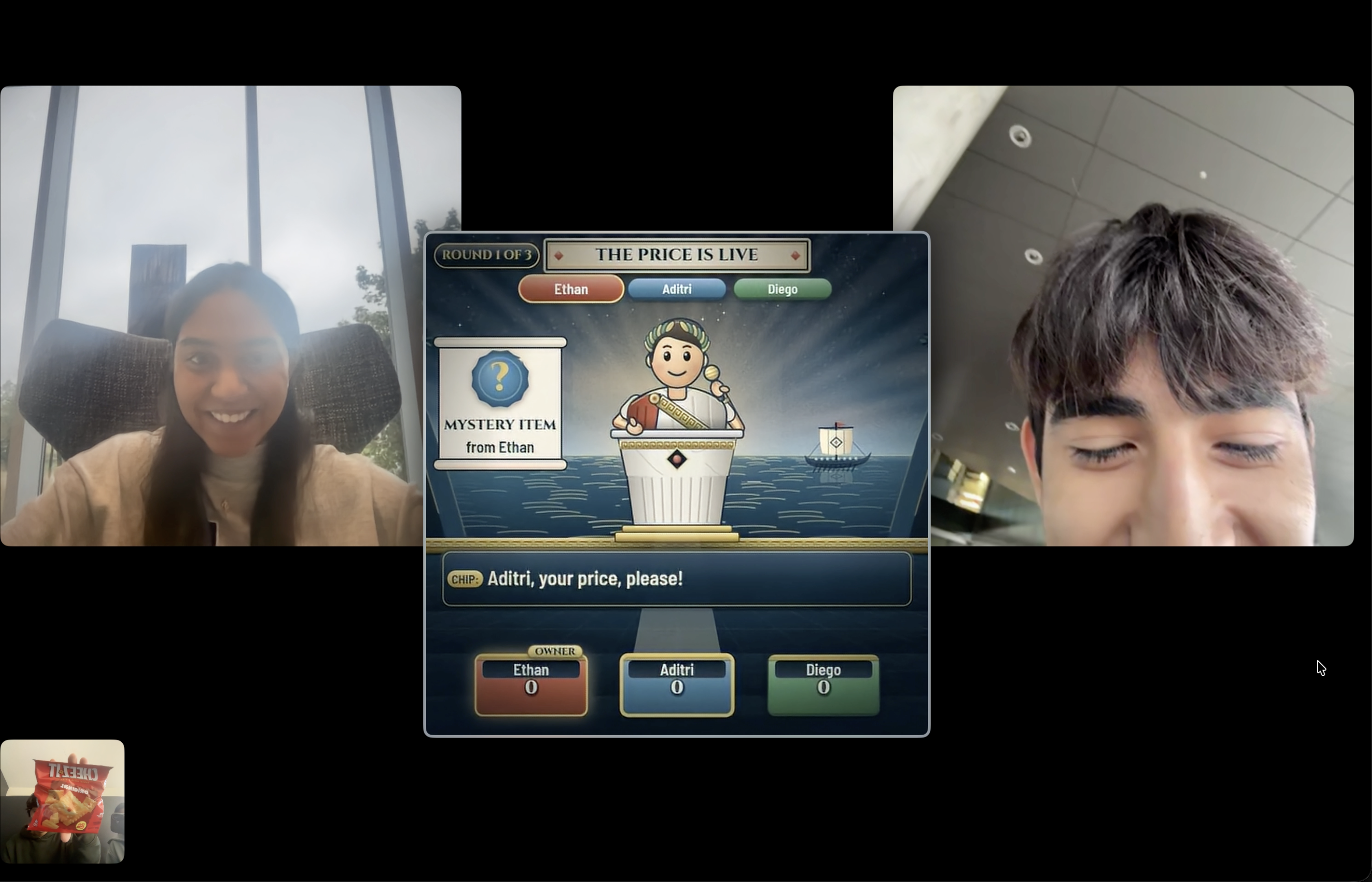
The Price Is Live is a game for two to four friends on one group FaceTime call. Odysseus, an AI host, appears on a drawn stage with a podium for each player. You hold up something from home. Everyone else guesses the price. Closest without going over wins.
The stage is the video. The items are yours.

Everyone has stuff at home and an opinion about what it costs. We wanted that to be a game you can play on a call you already know how to make.
The Price Is Right has a shape people recognize: hold up an item, guess the price, closest without going over wins. We put that game on FaceTime, with a host who can price the item, run the turns, and put the reveal on screen.
The items have to be real. A banana, a Red Bull, a bag of chips: whatever is within reach. The owner holds it up to the camera. The other players guess out loud. Odysseus drops a drumroll, and the price pops up on the stage.
The host prices each item from a reference list of 236 common products first, then a Gemini web lookup if the list has no match. We also built a harness that checks that pricing against 40 held-out items the list has never seen.

- Join by text. Each person texts the line
I'm in, I'm [name]. The first person to join is the main player. - Start the show. The main player texts
start, and the agent places one outbound group FaceTime call to everyone. - Name the item. Before a turn, the owner texts what the item is (for example, "Owala bottle"), or holds it up so Gemini can identify it from the camera.
- Price it in the background. The agent checks a reference list of 236 common items first. If there is no match, Gemini looks up a web price with Google Search grounding.
- Guess out loud. The other players guess one at a time, with a 10-second countdown on the stage. Odysseus repeats the guess, and the player says yes or corrects it. If speech is missed, the guess can be sent as a text.
- Score the round. A guess at or under the price scores up to 100 points by closeness. A guess over scores 0. The closest guess without going over gets 25 extra points. The owner earns up to 100 stump points if the other guesses are far off. When confidence is low, Odysseus calls the price an estimate.
- See the reveal. A drumroll plays, then the price pops up on screen.
- Get the results and play again. At the end, the agent texts everyone a results card with the scoreboard and each item's price, and offers a rematch.
A two-item demo
The judging demo is two items and finishes in under two minutes, inside Chert's five-minute trial cap. All four of us play. Ethan holds up the first item and Diego, Akshi, and Aditri guess. Then Diego is the owner and the others guess. Lightning timing speeds the game up if the clock runs short.
Prices are list prices on a given date. Store prices can differ.
To play, text the line and the agent will FaceTime you at +1 (628) 278-7200.

- Join by text. Each player texts the line
I'm in, I'm [name]. The first person to join is the main player. - Place the call. The main player texts
start. The agent places one outbound group FaceTime call through Chert. Chert bridges everyone into a LiveKit room. The agent joins that room and publishes one audio track (Odysseus's voice and the sound effects) and one video track (the stage). - Name the item. The owner texts what they are holding, or holds it up so Gemini can identify it from in-memory camera frames.
- Price the item. The agent checks the 236-item reference list first. If there is no match, Gemini runs a Google Search grounding lookup and a knowledge estimate. A cached price is reused when the same item comes up again.
- Guess, one player at a time. The other players guess out loud, with a 10-second countdown on the stage. Odysseus repeats each guess for a yes or a correction. Speech is transcribed with ElevenLabs Scribe. If speech is missed for two windows in a row, the game switches to text guesses.
- Reveal and score. A drumroll plays, then the price pops up. Points land on the podiums: closeness up to 100, 25 for the closest guess without going over, and stump points for the owner. Odysseus calls it an estimate when confidence is low.
- Text the results and offer a rematch. The agent sends every player a results card with the scoreboard and each item's price, then offers another game.
The whole product is one TypeScript process on Node 22. There is no website. You play by texting and answering a FaceTime call. The line allows only one audio track, so Odysseus's voice and the sound effects are mixed together before they go out.

Chert and LiveKit: the call itself
Chert gives us a FaceTime line and an iMessage inbox. A group call is bridged into a LiveKit room. Our agent joins that room and publishes Odysseus's voice and the drawn stage (src/comms/chert.ts, src/comms/call.ts, src/comms/livekit.ts).
iMessage through Chert carries the join text, the item name, a backup guess channel, the results card, and the rematch offer (src/comms/imessage.ts).
When Chert refuses a call type, the dial steps down on its own: group video, then group audio, then the main player alone.
ElevenLabs: Odysseus's voice and spoken guesses
Odysseus's lines are ElevenLabs text-to-speech (src/comms/tts.ts), mixed with drumroll and sting sound effects on the single audio track the line allows (src/comms/voice.ts, src/comms/mixer.ts). Spoken guesses are transcribed with ElevenLabs Scribe (src/comms/stt.ts).
Repeated lines are cached on disk, and a character budget keeps the free tier from running out mid-demo (scripts/warm-tts.ts). Speech-to-text is muted while Odysseus talks, plus a short hold-off, so the host does not hear himself as a guess.
Gemini: prices, camera, and host lines
Gemini (src/ai/gemini.ts, running gemini-3.5-flash-lite) prices items that miss the 236-item reference list. The pipeline tries a fuzzy list match first, then a Google Search grounding lookup and a knowledge estimate (src/ai/pricing.ts, src/ai/webSearch.ts, src/ai/estimate.ts).
If an owner forgets to text the item, Gemini vision reads it from camera frames kept in memory (src/ai/identify.ts, src/comms/frames.ts). Gemini can also write short host reactions (src/ai/host/quips.ts). Most of Odysseus's lines still come from a written line bank (src/ai/host/lines.ts).
MongoDB Atlas: the game record
Atlas stores the reference list and every game, player, round, guess, and results card (src/store/index.ts, src/store/mongo.ts). A 30-day price cache means a repeat item is priced from the database instead of a new lookup.
Writes go through an in-memory queue and are retried, so a slow or missing database cannot stall the FaceTime call. If Atlas is unreachable, the game loads the list from data/reference-items.json and continues. scripts/atlas-stats.ts prints aggregations over the game data.
A drawn stage: Odysseus on camera
The video is a stage we draw with @napi-rs/canvas: the set, podiums with names and scores, captions timed to the voice, a countdown, the price reveal, and Odysseus, whose mouth moves while he talks.
There is a classic game-show look and an Odyssey theme with a night sky, a sea, a ship, and Odysseus at a lectern. Frames render in about 9 milliseconds, under the 66-millisecond budget for 15 frames a second.
The rules: a TypeScript state machine
Scoring and game flow live in a pure reducer (src/engine). It takes events and returns effects, so turns, timers, and points can be tested without placing a call (npm test, npm run sim, npm run demo:check).
Building as a team
Ethan Meza led the stage, Odysseus, the demo, and this write-up. Diego Lozano owned the Chert bridge, voice, calls, and iMessage. Akshi Biswal owned pricing, camera identification, and the host script. Aditri Tangeti owned game state, scoring, MongoDB Atlas, deploy, and the accuracy harness.
Technologies
| Category | Technologies |
|---|---|
| Runtime | TypeScript, Node.js |
| Call and messages | Chert (FaceTime and iMessage), LiveKit |
| Voice | ElevenLabs text-to-speech, ElevenLabs Scribe |
| AI | Gemini API, Google Search grounding |
| Data | MongoDB Atlas |
| Stage | @napi-rs/canvas |

- The live API did not match the first fixtures. Shared messages arrive wrapped as
{ data: { items } }, and call events arrive as{ data: { events } }. Until we read those envelopes, the agent never sawbridge_ready, stayed silent, and Chert hung up after about ten seconds. - A group dial can take a while to start. We have seen about 30 seconds before ringing begins, so the agent waits up to two minutes for the call to connect.
- Incoming sender numbers are masked. A text may show up as
•••0101. The game maps those suffixes to a private player list in the local environment so a join text still lands on the right podium. - Chert can refuse a call type. The dial steps down on its own: group video, then group audio, then the main player alone. That covers errors such as
facetime_group_unavailableandoutbound_video_disabled. - Group FaceTime has one mixed audio track and no speaker IDs. A bystander's number can sound like the current player's guess, and the host's own voice can echo back into the microphone. We open the mic only for the player whose turn it is, mute speech-to-text while Odysseus talks, and have Odysseus repeat each guess for a yes or a correction.
- The trial line and the voice budget are tight. A call is capped at five minutes, and ElevenLabs free-tier characters go quickly. The demo is two items in under two minutes, with faster timing if the clock runs short, and predicted host lines are cached ahead of time.

We built a full game that runs on a live group FaceTime call, from the join texts through the price reveals to a results card and a rematch.
The stage is drawn in code at about 9 milliseconds a frame, under the 66-millisecond budget for 15 frames a second.

- Documented shapes are a starting point. We had to watch a live call and code to what Chert actually returned.
- The host has about ten seconds to greet. If Odysseus does not speak soon after the bridge joins, the platform ends the call. That window became a hard requirement.
- Turn-taking has to be a game rule. One mixed audio track will not tell you who just spoke.
- Cache the lines you can predict. That is how we kept voice credits for the demo.
- A pure reducer makes a rushed build safer to change. We could adjust scoring and timing without placing another call.

Support more than four players on a call. Let people join from a link as well as a phone number.
Keep a running score across rematches, so a second game carries the night's totals forward.
Grow the 236-item reference list and attach a checked date to every price, so the number we quote stays honest as retail prices move.
The Price Is Live. Closest without going over.


